The Future No Longer Arrives in Decades: It Arrives Every Quarter
Why Every Executive Needs to Rethink Strategic Planning in the Age of AI
By Carsten Krause, CDO TIMES
For decades, organizations approached strategy with a comforting assumption: the future would unfold gradually enough for annual planning cycles, three-year roadmaps, and five-year digital transformation programs to remain relevant.
That assumption is rapidly becoming obsolete.
Artificial intelligence has fundamentally changed not only how organizations operate but also the speed at which markets, technologies, customer expectations, regulations, and competitive advantages evolve. Today’s strategic decisions are being challenged by innovations that emerge weekly instead of yearly. Product roadmaps become outdated before they are completed. Business models that looked secure six months ago can suddenly face disruption from AI-native competitors operating at a fraction of the cost and development time.
The future has not become more uncertain simply because there are more possibilities.
It has become more uncertain because the velocity of change has accelerated dramatically.
This is precisely why one of the world’s most respected strategic foresight methodologies—the University of Houston’s Framework Foresight—deserves renewed attention.
But it also needs to evolve.
Those approaches worked because the environment changed relatively slowly.
Artificial Intelligence has fundamentally changed not only how organizations operate but also how quickly industries evolve. Foundation models improve monthly. Autonomous AI agents are beginning to execute complex business processes. Regulations shift continuously across global markets. Competitors can launch entirely new AI-native business models in a matter of weeks rather than years.
The challenge facing executives is no longer predicting the future.
The challenge is keeping strategy synchronized with a future that refuses to slow down.
The organizations that thrive over the next decade will not necessarily be those with the most accurate forecasts. They will be those that sense change earliest, evaluate multiple futures continuously, and adapt their strategies faster than their competitors.
That requires moving beyond traditional strategic planning—and even beyond traditional strategic foresight.
Strategy Has Evolved Through Three Distinct Eras
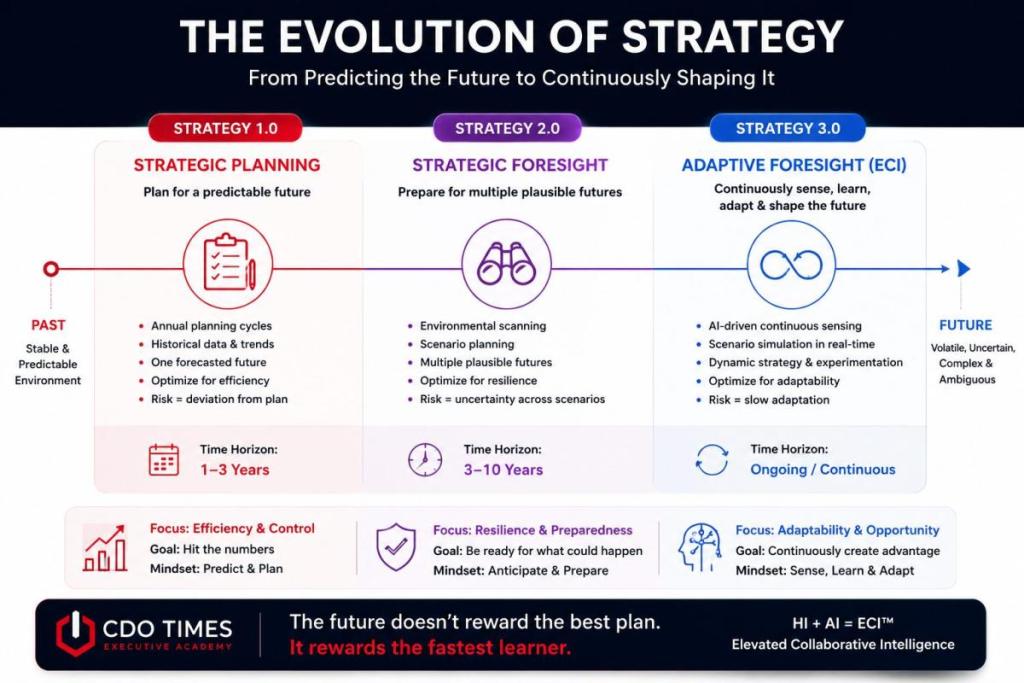
Every generation of business leadership has developed new methods for navigating uncertainty.
Each reflected the pace of change of its time.
Strategy 1.0: Strategic Planning
For decades, organizations relied on annual planning cycles built around historical performance, market forecasts, budgeting exercises, and long-term investment plans.
The underlying assumption was straightforward:
Tomorrow would resemble today closely enough that careful planning could produce reliable outcomes.
This approach worked well in relatively stable markets but struggled whenever disruptive technologies or unexpected geopolitical events emerged.
The future was treated as something to forecast.
Strategy 2.0: Strategic Foresight
Recognizing the limitations of traditional planning, futurists such as Dr. Peter Bishop and Dr. Andy Hines at the University of Houston developed one of the world’s most respected strategic foresight methodologies: Framework Foresight.
Rather than attempting to predict a single future, the Houston model encouraged organizations to prepare for multiple plausible futures through a disciplined process of framing strategic questions, scanning for signals, forecasting trends, building scenarios, creating preferred futures, and identifying leading indicators.
This represented a major shift in executive thinking.
Instead of asking:
“What will happen?”
leaders began asking:
“What could happen, what is most likely to happen, and what future should we actively create?”
The Houston Framework remains one of the most influential strategic foresight models in use today because it acknowledges uncertainty rather than attempting to eliminate it.
Yet even this approach was largely designed for an era in which disruption unfolded over years.
Artificial intelligence has compressed many of those cycles into months—or even weeks.
AI Has Compressed Strategic Time
The speed of innovation has changed dramatically.
Cloud computing matured over more than a decade.
Mobile transformation took years.
Digital commerce evolved over decades.
Generative AI reached hundreds of millions of users in months.
Every week now brings new reasoning models, autonomous AI agents, robotics breakthroughs, multimodal capabilities, open-source releases, scientific discoveries, startup funding announcements, and regulatory developments.
Competitive advantage has become increasingly temporary.
The limiting factor is no longer access to information.
It is an organization’s ability to continuously learn, decide, and adapt faster than the environment changes.
Strategy has become a living system.
The Emergence of Strategy 3.0: The ECI Adaptive Foresight Framework
Artificial Intelligence has fundamentally changed what is possible in strategic management.
Organizations no longer need to perform environmental scanning quarterly.
AI can continuously monitor markets, competitors, patents, research publications, customer behavior, regulatory developments, cybersecurity threats, geopolitical events, supply chain disruptions, and emerging technologies in real time.
But information alone is not intelligence.
Executive judgment remains essential.
From Predicting the Future to Preparing for Multiple Futures
Developed by futurists Dr. Peter Bishop and Dr. Andy Hines at the University of Houston, Framework Foresight was never intended to predict a single future.
Instead, it helps organizations systematically prepare for multiple plausible futures through a structured process of framing, scanning, forecasting, scenario development, visioning, planning, and identifying leading indicators.
This represented a significant departure from traditional strategic planning.
Rather than asking:
“What will happen?”
the Houston model encourages organizations to ask:
“What could happen, what is likely to happen, and what future do we want to create?”
This distinction is becoming increasingly valuable in an AI-driven world where yesterday’s assumptions frequently become today’s obsolete strategies.
AI Has Changed the Rules of Strategic Planning
Historically, technology revolutions unfolded over decades.
Mainframe computing.
Personal computers.
The Internet.
Cloud computing.
Mobile.
Each provided organizations years to observe competitors, build internal capabilities, and gradually adapt.
Artificial intelligence is fundamentally different.
Every month introduces new foundation models, autonomous AI agents, multimodal capabilities, robotics breakthroughs, reasoning models, enterprise platforms, open-source innovations, regulatory developments, and entirely new categories of software.
Organizations are no longer competing against companies.
Increasingly, they are competing against the pace of innovation itself.
This creates three challenges traditional planning struggles to address:
- Long-term forecasts become obsolete more quickly.
- Annual planning cycles cannot keep pace with technological change.
- Competitive advantage increasingly depends on organizational adaptability rather than organizational efficiency.
The question is no longer whether your strategy is correct.
The question is how quickly your organization can recognize when it is no longer correct.
Why Strategic Foresight Is Becoming a Core Executive Capability
The Houston Framework identifies six essential activities:
- Frame the strategic question.
- Scan for signals and emerging trends.
- Forecast plausible developments.
- Build alternative future scenarios.
- Develop strategic plans.
- Monitor leading indicators.
This process remains remarkably relevant.
However, AI has changed the cadence.
Environmental scanning can now occur continuously through AI-powered intelligence systems.
Competitive analysis can update daily.
Weak signals that once required teams of analysts can now be detected automatically across millions of research papers, patents, earnings calls, social media conversations, regulatory announcements, and startup investments.
The bottleneck has shifted.
It is no longer finding information.
It is making better decisions from overwhelming amounts of information.
The ECI Adaptive Foresight Framework
This is where the ECI Adaptive Foresight Framework introduces a new operating model for executive strategy.
Rather than simply extending traditional foresight, the framework is designed specifically for AI-native enterprises. It combines continuous AI-driven horizon scanning, weak-signal detection, scenario generation and simulation, executive decision intelligence, governance, and adaptive execution into a single continuous learning system. Human leaders remain accountable for judgment, ethics, strategic intent, and risk decisions, while AI continuously expands situational awareness, evaluates alternative futures, surfaces emerging opportunities and threats, and accelerates evidence-based decision making. Strategy is no longer treated as a periodic planning exercise; it becomes a continuously evolving capability that learns alongside the business.
Instead of replacing strategic foresight, the ECI Adaptive Foresight Framework modernizes it for an era where AI continuously reshapes the competitive landscape.
The ECI Adaptive Foresight Loop
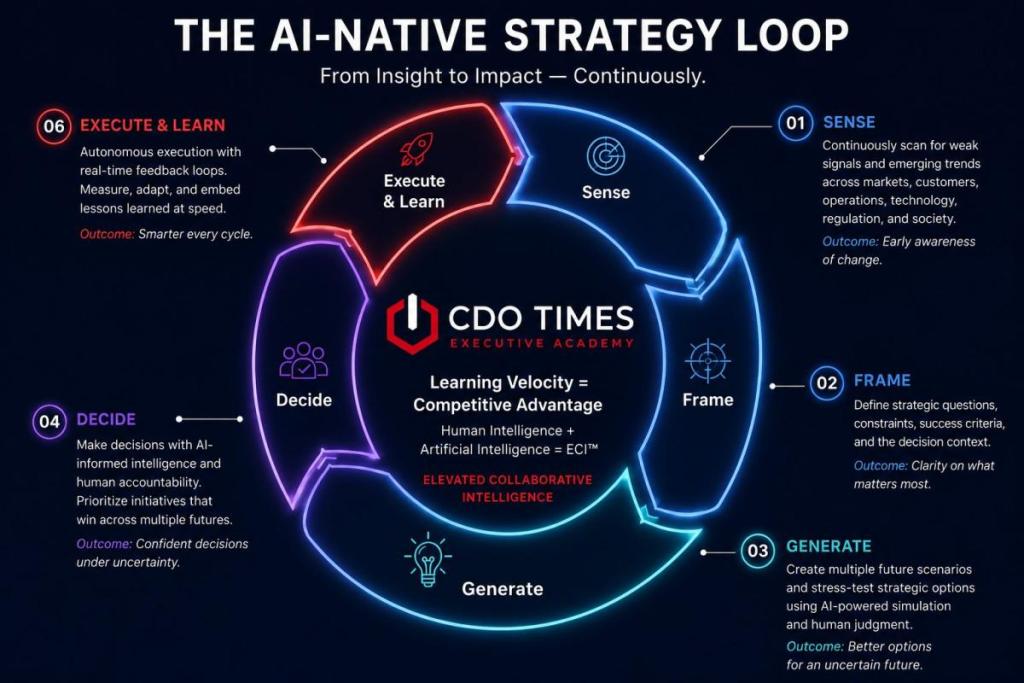
The ECI Adaptive Foresight Framework operates as a continuous strategic intelligence loop.
Sense
AI continuously monitors weak signals across technology, economics, regulation, geopolitics, customer behavior, cybersecurity, labor markets, and competitor activity.
Frame
Leadership defines strategic questions, decision boundaries, organizational priorities, and success criteria.
Generate
AI develops multiple plausible future scenarios and stress-tests strategic options using simulation and predictive modeling.
Decide
Executives apply human judgment, ethical reasoning, governance, and organizational context to determine the best course of action.
Execute & Learn
Initiatives are implemented while AI continuously measures outcomes, captures lessons learned, identifies deviations, and updates strategic assumptions.
The objective is not faster planning.
The objective is faster organizational learning.
As the saying increasingly goes in AI circles:
Learning velocity becomes competitive advantage.
What This Means for Executive Leadership
Every executive function is changing.
Enterprise architects are becoming future architects.
Chief Data Officers are becoming organizational intelligence leaders.
Chief Information Officers are orchestrating AI-enabled business capabilities rather than managing infrastructure.
Chief Information Security Officers are preparing for autonomous cyber threats while deploying AI-powered defense systems.
Boards increasingly expect leadership teams not only to execute strategy but also to demonstrate resilience across multiple possible futures.
Static roadmaps are giving way to adaptive operating models.
Organizations must become continuous learners rather than periodic planners.
Practical Applications Today
The principles behind Adaptive Foresight are already practical for enterprises today.
Organizations can deploy AI to continuously monitor competitive intelligence, patent activity, customer sentiment, market shifts, regulatory developments, cybersecurity threats, and emerging technologies. Generative AI can assist leadership teams in creating and comparing multiple future scenarios, identifying strategic assumptions, stress-testing investment decisions, and evaluating risks before committing significant capital.
Enterprise Architecture teams can use adaptive foresight to guide technology modernization priorities. CIOs can incorporate it into digital transformation governance. CDOs can use it to align AI investments with long-term business outcomes. Boards can use it to improve strategic resilience by evaluating decisions against multiple plausible futures instead of relying on a single forecast.
The technology already exists.
The organizational mindset often does not.
The Next Evolution of Competitive Advantage
Throughout history, competitive advantage has evolved.
It moved from scale.
To operational efficiency.
To digital transformation.
To data-driven decision making.
The next evolution is organizational adaptability.
The organizations that consistently outperform will not simply collect more data or deploy more AI.
They will continuously learn faster than their competitors.
That requires combining Artificial Intelligence with Human Intelligence rather than treating them as competing alternatives.
This is the foundation of Elevated Collaborative Intelligence (ECI).
Human judgment determines direction.
Artificial Intelligence expands awareness.
Together they create organizations capable of navigating uncertainty with greater confidence than either humans or AI could achieve independently.
The CDO TIMES Bottom Line
The University of Houston’s Framework Foresight fundamentally changed how organizations think about uncertainty by shifting strategic planning away from predicting a single future and toward preparing for multiple plausible futures. It remains one of the most influential strategic foresight methodologies available to executive leaders.
However, the pace of change has accelerated dramatically. Artificial intelligence has compressed innovation cycles from years into months, making static planning increasingly ineffective. Organizations now need strategy that evolves continuously rather than periodically.
The ECI Adaptive Foresight Framework represents the next step in that evolution. It combines AI-driven horizon scanning, continuous signal detection, scenario simulation, executive judgment, governance, and adaptive execution into a living strategic operating model. Rather than replacing human leadership, it amplifies it through Elevated Collaborative Intelligence, enabling organizations to sense change earlier, adapt faster, and make better decisions across multiple possible futures.
In the AI era, strategy is no longer a document.
It is a continuously learning system.
And the organizations that master that system will define the next generation of market leaders.
Primary sources
- Hines, A. & Bishop, P. Framework Foresight: Exploring Futures the Houston Way (University of Houston / Futures, 2013), which introduced the Framework Foresight methodology as a modular, end-to-end approach to strategic foresight.
- University of Houston Foresight Program, which continues to teach and evolve the Framework Foresight methodology.
- Krause, C. The AI Ready Leader, CDO TIMES Publishing
Love this article? Embrace the full potential and become an esteemed full access member, experiencing the exhilaration of unlimited access to captivating articles, exclusive non-public content, empowering hands-on guides, and transformative training material. Unleash your true potential today!
Order the AI + HI = ECI book by Carsten Krause today! at cdotimes.com/book

Subscribe on LinkedIn: Digital Insider
Become a paid subscriber for unlimited access, exclusive course content, no ads: CDO TIMES
Do You Need Help?
Consider bringing on a fractional CIO, CISO, CDO or CAIO from CDO TIMES Leadership as a Business Consulting Service. The expertise of CDO TIMES becomes indispensable for organizations striving to stay ahead in the digital transformation journey. Here are some compelling reasons to engage their experts:
- Deep Expertise: CDO TIMES has a team of experts with deep expertise in the field of Cybersecurity, Digital, Data and AI and its integration into business processes. This knowledge ensures that your organization can leverage digital and AI in the most optimal and innovative ways.
- Training, developing, arranging, and conducting educational conferences and programs and providing courses of instruction.
- Strategic Insight: Not only can the CDO TIMES team help develop a Digital & AI strategy, but they can also provide insights into how this strategy fits into your overall business model and objectives. They understand that every business is unique, and so should be its Digital & AI strategy.
- Future-Proofing: With CDO TIMES, organizations can ensure they are future-proofed against rapid technological changes. Our experts stay abreast of the latest AI, Data and digital advancements and can guide your organization to adapt and evolve as the technology does.
- Risk Management: Implementing a Digital & AI strategy is not without its risks. The CDO TIMES can help identify potential pitfalls and develop mitigation strategies, helping you avoid costly mistakes and ensuring a smooth transition with fractional CISO services.
- Competitive Advantage: Finally, by hiring CDO TIMES experts, you are investing in a competitive advantage. Their expertise can help you speed up your innovation processes, bring products to market faster, and stay ahead of your competitors.
By employing the expertise of CDO TIMES, organizations can navigate the complexities of digital innovation with greater confidence and foresight, setting themselves up for success in the rapidly evolving digital economy. The future is digital, and with CDO TIMES, you’ll be well-equipped to lead in this new frontier.
Do you need help with your digital transformation initiatives? We provide fractional CAIO, CDO, CISO and CIO services, do a Preliminary ECI and Tech Navigator Assessment and we will help you drive results and deliver winning digital and AI strategies for you!
Subscribe now for free and never miss out on digital insights delivered right to your inbox!