The Age of Personalized Enterprise AI: Why One-Size-Fits-All AI Is Already Becoming Obsolete
Everyone receives the same AI assistant.
Everyone asks similar questions.
Everyone accesses the same models.
Everyone receives broadly similar capabilities.
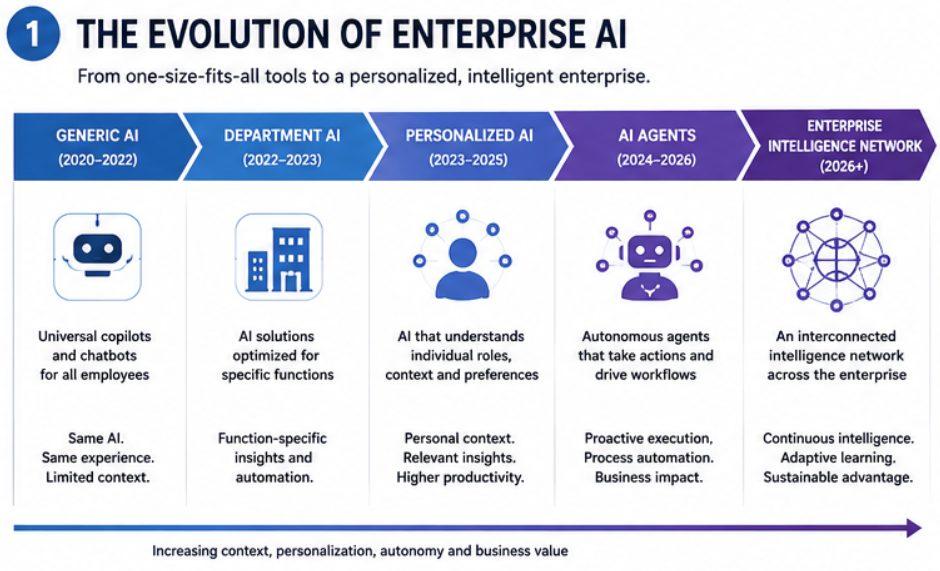
That approach may have been sufficient during the first wave of enterprise AI adoption. It will not define the next generation of competitive advantage.
The future belongs to Personalized Enterprise AI.
Rather than treating AI as a universal assistant, organizations will increasingly create AI systems that understand the specific context of each executive, employee, department, role, customer, project, and business process. AI will become deeply personalized—not simply through preferences, but through enterprise knowledge, business context, decision authority, organizational objectives, and individual work patterns.
This represents one of the largest architectural shifts since cloud computing.
Enterprise AI Is Moving Beyond the General-Purpose Copilot
Today’s enterprise AI solutions are impressive, but they are intentionally broad.
A general-purpose copilot can summarize meetings, generate presentations, draft emails, analyze spreadsheets, write software, answer questions, and assist with research.

That creates productivity.
It does not necessarily create differentiation.
Competitive advantage comes from context.
An AI assistant that understands your enterprise architecture, operating model, governance policies, customer contracts, supplier network, industry regulations, organizational culture, strategic priorities, and executive decision style is fundamentally more valuable than one relying only on public knowledge.
The next generation of enterprise AI will therefore shift from universal intelligence to contextual intelligence.
Every Employee Will Have a Personal Enterprise AI
Imagine two employees asking the same question:
“What should we prioritize this quarter?”
Today’s AI may generate nearly identical answers.
Tomorrow’s Personalized Enterprise AI will produce completely different recommendations.
The CFO’s AI understands:
- Financial performance
- Cash flow
- Capital allocation
- Budget forecasts
- Investor expectations
- Risk exposure
The CISO’s AI understands:
- Threat intelligence
- Security architecture
- Regulatory requirements
- Identity systems
- Vulnerability management
The Chief Data Officer’s AI understands:
- Data quality
- Governance
- Metadata
- Lineage
- Master data
- AI readiness
The Enterprise Architect’s AI understands:
- Technology standards
- Business capabilities
- Technical debt
- Application portfolio
- Integration architecture
Each AI becomes an expert partner for its user rather than a generic assistant for everyone.

Context Is Becoming the New Competitive Advantage
The most valuable enterprise data is rarely public.
It lives inside:
- Business processes
- Internal documentation
- Meeting transcripts
- Strategic plans
- Enterprise architecture repositories
- Knowledge bases
- CRM systems
- ERP platforms
- HR systems
- Operational metrics
- Customer interactions
Personalized Enterprise AI combines these assets with role-specific knowledge to generate far more relevant insights.
This is why Retrieval-Augmented Generation (RAG), enterprise knowledge graphs, semantic search, vector databases, and AI agents are becoming foundational enterprise capabilities.
The value is no longer the model alone.
The value is the context surrounding the model.
Personalization Extends Beyond Individuals
Many organizations think personalization only applies to employees.
In reality, AI personalization will occur at multiple levels.
Individual AI
An assistant that understands one employee’s responsibilities, preferences, work style, calendar, priorities, and knowledge.
Team AI
An assistant optimized for a project team, sharing collective documents, milestones, risks, and objectives.
Department AI
Specialized AI for Finance, HR, Sales, Legal, Operations, Supply Chain, or Enterprise Architecture.
Executive AI
Decision-support systems combining enterprise performance, external intelligence, strategic initiatives, market trends, and board priorities.
Customer AI
AI capable of understanding each customer’s history, products, contracts, support cases, preferences, and future opportunities.
Enterprise AI
An intelligence layer connecting knowledge across the organization while respecting governance and security boundaries.
These layers create a connected ecosystem rather than isolated AI assistants.
The Rise of AI Memory
One of the defining characteristics of Personalized Enterprise AI will be persistent memory.
Instead of beginning every conversation from scratch, AI will remember approved organizational context.
Imagine an executive AI that understands:
- Long-term strategic priorities
- Previous board discussions
- Preferred communication style
- Active transformation initiatives
- Budget constraints
- Historical decisions
- Lessons learned
- Key relationships
- Organizational objectives
Rather than acting as a search engine, AI becomes an institutional knowledge partner.
Memory transforms AI from reactive assistance into continuous collaboration.
Hyper-Personalization Requires Trust
Personalization depends on access to enterprise knowledge.
That creates important governance questions.
Organizations must determine:
- What information should AI remember?
- How long should memory persist?
- Who controls personalization?
- How are permissions enforced?
- How is sensitive information protected?
- How can users inspect or correct AI memory?
- When should AI forget?
Without trust, personalization becomes surveillance.
With proper governance, personalization becomes productivity.
Trust therefore becomes the foundation of Personalized Enterprise AI.
AI Agents Make Personalization Actionable
The next evolution combines personalization with autonomous AI agents.
Rather than simply answering questions, personalized agents begin performing work.
An executive agent may:
- Prepare board briefings
- Monitor competitors
- Summarize earnings calls
- Track KPIs
- Identify strategic risks
- Recommend investments
A sales agent may:
- Prepare customer meetings
- Draft proposals
- Monitor account health
- Recommend cross-selling opportunities
An HR agent may:
- Monitor workforce trends
- Recommend learning plans
- Identify retention risks
- Support recruitment
Personalization turns agents into intelligent digital colleagues.
The Enterprise Architecture Challenge
Delivering Personalized Enterprise AI requires much more than deploying a language model.
Organizations need a scalable architecture including:
- Identity management
- Role-based access control
- Enterprise knowledge graphs
- Metadata management
- Data governance
- AI governance
- Vector databases
- Retrieval-Augmented Generation
- Agent orchestration
- Security monitoring
- Continuous learning
- Human oversight
Enterprise Architecture therefore becomes one of the most important enablers of AI personalization.
The architecture determines whether AI becomes fragmented or enterprise-wide.
Measuring Personalized AI Success
Traditional AI metrics focus on:
- Number of users
- Prompt volume
- Response time
- Cost
- Adoption
Future organizations will measure additional outcomes.
Examples include:
- Decision quality
- Time saved
- Employee productivity
- Knowledge reuse
- Customer satisfaction
- Innovation speed
- AI recommendation acceptance
- Executive decision cycle reduction
- Collaboration effectiveness
The objective shifts from AI usage to business value.
Personalized AI and Elevated Collaborative Intelligence

Personalized Enterprise AI aligns naturally with Elevated Collaborative Intelligence (ECI).
ECI recognizes that AI should strengthen human capabilities rather than replace them.
Personalization makes this possible.
Instead of delivering identical responses to every employee, AI adapts to individual expertise, organizational context, business objectives, and decision authority.
The result is not artificial intelligence replacing human intelligence.
It is artificial intelligence amplifying human intelligence.
That distinction is fundamental.
Executive Questions Every Organization Should Ask
As Personalized Enterprise AI becomes a strategic capability, executive teams should evaluate:
- Which business roles would benefit most from personalized AI?
- What enterprise knowledge should AI access?
- How will AI memory be governed?
- Which decisions require personalized recommendations?
- What governance protects sensitive information?
- How do we measure business value beyond productivity?
- Are we designing one AI platform—or an intelligent enterprise ecosystem?
Organizations answering these questions today will create sustainable competitive advantage tomorrow.
The Future Is an Enterprise Intelligence Network
The long-term vision is not millions of isolated AI assistants.
It is an interconnected intelligence network.
Every employee has a personalized AI.
Every department has specialized AI.
Every executive has strategic AI.
Every business process includes AI.
Every decision benefits from AI.
All operating together through shared governance, trusted data, enterprise architecture, and human oversight.
That represents the true AI-native enterprise.
The CDO TIMES Bottom Line
The first generation of enterprise AI focused on giving everyone access to the same intelligent assistant.
The second generation will focus on giving every individual, every team, every department, and every executive an AI system uniquely optimized for their responsibilities, knowledge, and objectives.
Competitive advantage will no longer come from simply deploying AI faster than competitors.
It will come from deploying AI that understands your enterprise better than competitors understand theirs.
Organizations that master Personalized Enterprise AI will create a workforce where human expertise and artificial intelligence continuously learn from one another.
That is the next evolution of enterprise transformation.
It is also the foundation of Elevated Collaborative Intelligence, where Human Intelligence and Artificial Intelligence work together to produce better decisions, stronger collaboration, and sustainable competitive advantage.
Love this article? Embrace the full potential and become an esteemed full access member, experiencing the exhilaration of unlimited access to captivating articles, exclusive non-public content, empowering hands-on guides, and transformative training material. Unleash your true potential today!
Order the AI + HI = ECI book by Carsten Krause today! at cdotimes.com/book

Subscribe on LinkedIn: Digital Insider
Become a paid subscriber for unlimited access, exclusive course content, no ads: CDO TIMES
Do You Need Help?
Consider bringing on a fractional CIO, CISO, CDO or CAIO from CDO TIMES Leadership as a Business Consulting Service. The expertise of CDO TIMES becomes indispensable for organizations striving to stay ahead in the digital transformation journey. Here are some compelling reasons to engage their experts:
- Deep Expertise: CDO TIMES has a team of experts with deep expertise in the field of Cybersecurity, Digital, Data and AI and its integration into business processes. This knowledge ensures that your organization can leverage digital and AI in the most optimal and innovative ways.
- Training, developing, arranging, and conducting educational conferences and programs and providing courses of instruction.
- Strategic Insight: Not only can the CDO TIMES team help develop a Digital & AI strategy, but they can also provide insights into how this strategy fits into your overall business model and objectives. They understand that every business is unique, and so should be its Digital & AI strategy.
- Future-Proofing: With CDO TIMES, organizations can ensure they are future-proofed against rapid technological changes. Our experts stay abreast of the latest AI, Data and digital advancements and can guide your organization to adapt and evolve as the technology does.
- Risk Management: Implementing a Digital & AI strategy is not without its risks. The CDO TIMES can help identify potential pitfalls and develop mitigation strategies, helping you avoid costly mistakes and ensuring a smooth transition with fractional CISO services.
- Competitive Advantage: Finally, by hiring CDO TIMES experts, you are investing in a competitive advantage. Their expertise can help you speed up your innovation processes, bring products to market faster, and stay ahead of your competitors.
By employing the expertise of CDO TIMES, organizations can navigate the complexities of digital innovation with greater confidence and foresight, setting themselves up for success in the rapidly evolving digital economy. The future is digital, and with CDO TIMES, you’ll be well-equipped to lead in this new frontier.
Do you need help with your digital transformation initiatives? We provide fractional CAIO, CDO, CISO and CIO services, do a Preliminary ECI and Tech Navigator Assessment and we will help you drive results and deliver winning digital and AI strategies for you!
Subscribe now for free and never miss out on digital insights delivered right to your inbox!