The End of Unlimited AI? How CIOs, CDOs and CAIOs Must Prepare for the Shift from Subscription AI to Token Economics
The enterprise AI market may be approaching a major economic reset.
By Carsten Krause
June 2026
For the past two years, many organizations enjoyed what effectively felt like unlimited AI. Employees paid $20-$30 per month for ChatGPT, Claude, Gemini, Copilot, or Perplexity subscriptions. Enterprise agreements often bundled AI capabilities into broader software contracts. AI leaders focused on adoption, use cases, and productivity gains rather than monitoring every prompt and agent interaction.
That era is ending.
Recent reports indicate that major AI providers are actively reevaluating pricing structures as they face enormous infrastructure costs, shrinking margins, and increasing investor pressure ahead of potential IPOs. OpenAI has reportedly explored token price adjustments and broader pricing changes while competition with Anthropic intensifies. Enterprise customers are increasingly pushing back against unpredictable AI spending and questioning ROI.
The next phase of enterprise AI will not be defined by model intelligence alone.
It will be defined by AI economics.
The organizations that succeed will build AI FinOps capabilities now, before token consumption becomes the next cloud cost crisis.
The Reality Nobody Wanted to Talk About
The uncomfortable truth is that most frontier AI providers are still struggling to create highly profitable business models.
Running state-of-the-art foundation models requires enormous investments in GPUs, networking, storage, energy, and model training. Some analysts estimate OpenAI could continue operating at substantial losses for several more years despite rapid revenue growth.
At the same time:
- AI agents generate dramatically higher token consumption than traditional chatbot interactions.
- Coding agents can consume hundreds or thousands of times more tokens than simple chat requests.
- Enterprise customers increasingly deploy AI into production workflows where every transaction has a measurable cost.
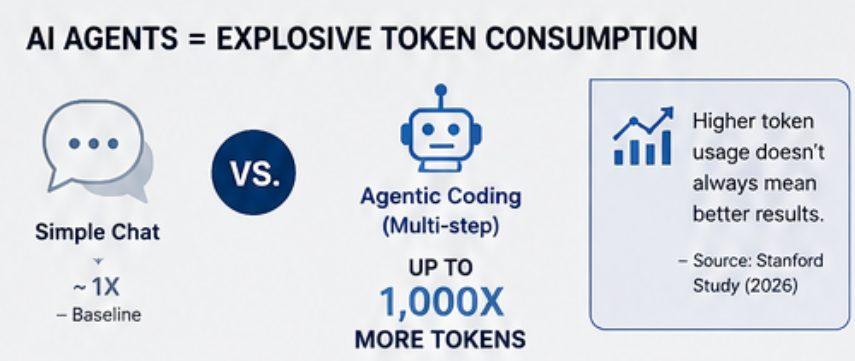
A recent academic study examining agentic coding systems found that AI agents can consume up to 1,000x more tokens than standard conversational use cases, with significant variability even when performing identical tasks. More importantly, higher token consumption did not consistently produce better outcomes. Source: MIT, Stanford Paper 2026
That finding should concern every CIO.
Many organizations are scaling AI without understanding whether increased token consumption actually creates proportional business value.
Carsten Krause

Historically, SaaS vendors charged per seat.
AI vendors increasingly charge per unit of intelligence consumed.
The industry is gradually moving toward:
Model 1: Subscription + Fair Usage
Current approach:
- ChatGPT Team
- Microsoft Copilot
- Claude Enterprise
- Gemini Enterprise
Organizations pay predictable monthly fees while providers absorb usage variability.
The challenge?
Heavy users often consume dramatically more compute than average users, creating profitability problems for vendors.
Model 2: Subscription + Token Allowance
Expected evolution:
- Base subscription
- Included token allocation
- Overage charges
This mirrors cloud consumption models where baseline capacity is included but excess usage incurs additional costs.
Model 3: Fully Consumption-Based AI
Already common in APIs:
- OpenAI API
- Anthropic API
- Azure OpenAI
- Google Vertex AI
Organizations pay based on:
- Input tokens
- Output tokens
- Tool calls
- Search operations
- Agent execution steps
Anthropic and other vendors are increasingly emphasizing token-based enterprise economics.
The AI FinOps Revolution Has Started
Cloud FinOps transformed how enterprises managed AWS, Azure, and GCP spending.
Now AI requires its own discipline.
The FinOps Foundation refers to this emerging field as Token Economics—the management of intelligence consumption as a measurable business resource.
Forward-thinking enterprises are already establishing:
AI Cost Centers
Instead of treating AI as a centralized budget item, organizations are allocating costs to:
- Business units
- Products
- Functions
- Individual applications
- AI agents
This creates accountability.
Marketing sees its AI spend.
HR sees its AI spend.
Software engineering sees its AI spend.
The result is significantly better governance.
Token Chargeback Models
Several enterprises are implementing internal pricing models where business units receive token budgets.
Examples:
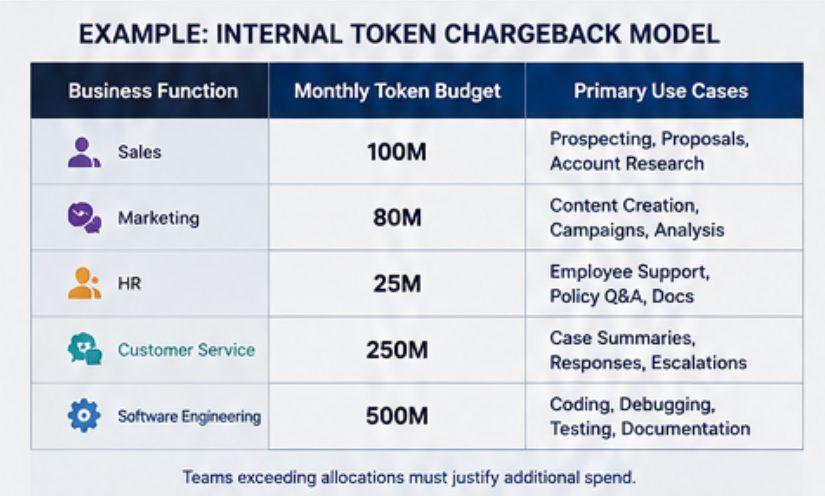
This mirrors successful cloud chargeback approaches.
AI Cost Per Business Outcome
The best organizations are moving beyond cost per token.
Instead they measure:
- Cost per customer case resolved
- Cost per sales proposal generated
- Cost per software feature delivered
- Cost per marketing campaign created
- Cost per support interaction automated
This is where AI ROI becomes real.
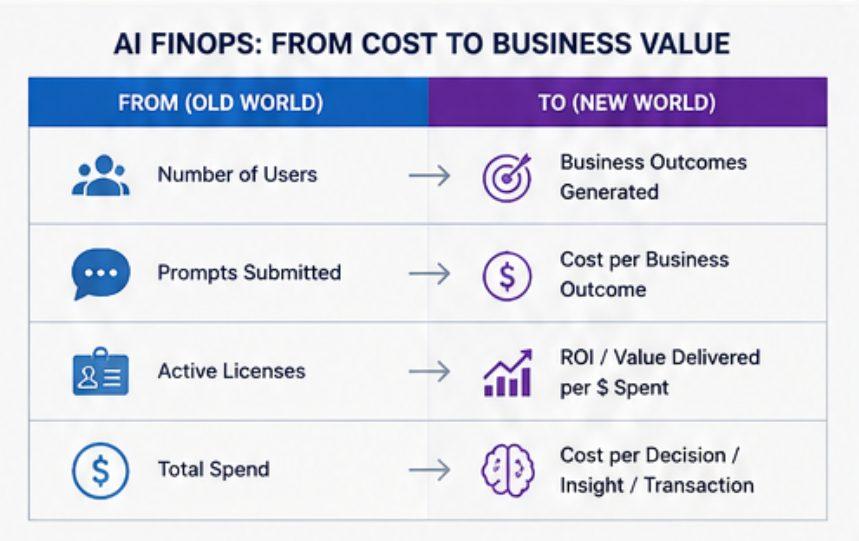
The Death of AI Adoption Metrics
One of the biggest mistakes organizations made during the first AI wave was celebrating adoption.
“We have 10,000 Copilot users.”
“So what?”
Future executive dashboards will increasingly focus on:
Old Metrics
- Number of users
- Prompts submitted
- Active licenses
New Metrics
- Revenue generated
- Labor hours eliminated
- Customer response times reduced
- Engineering throughput improved
- Cost per business outcome
AI adoption is not value.
AI value is value.
How ROI Calculations Must Change
Most AI business cases today look something like this:
Current State
- 1,000 employees
- $30/user/month
- Annual AI spend = $360,000
Easy.
Predictable.
Future AI economics are much more dynamic.
New ROI Formula

Future AI ROI calculations should include:
AI ROI =
(Value Generated)
minus
(Token Costs + Agent Costs + Integration Costs + Governance Costs + Risk Costs)
This requires tracking:
- Input tokens
- Output tokens
- Tool execution
- Search costs
- Vector database costs
- Agent orchestration costs
- Human review costs
Organizations that fail to build these capabilities will struggle to justify AI investments to CFOs.
A Practical AI FinOps Framework
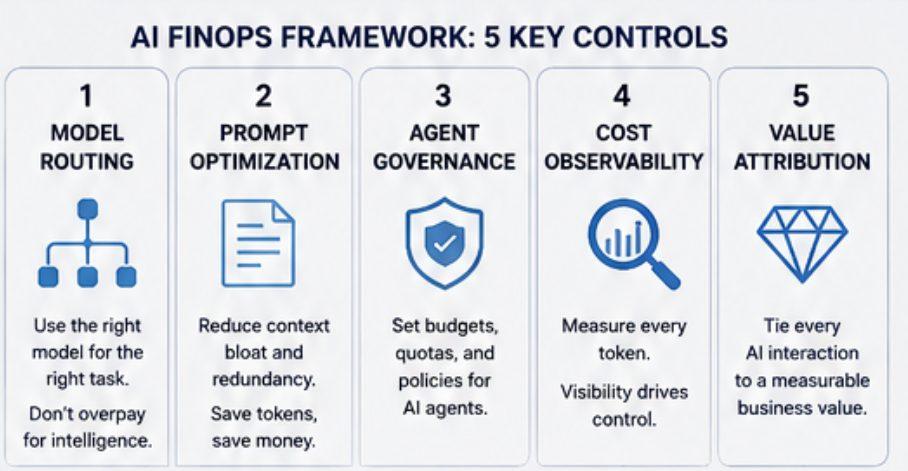
Leading organizations are increasingly adopting five key controls.
1. Model Routing
Not every task requires GPT-5 or Claude Opus.
A practical hierarchy:
| Use Case | Model Class |
|---|---|
| Basic summarization | Small model |
| Internal Q&A | Mid-tier model |
| Coding assistance | Premium model |
| Strategic analysis | Frontier model |
One of the biggest AI savings opportunities comes from selecting the smallest model that delivers acceptable business outcomes.
2. Prompt Optimization
Many organizations waste tokens through:
- Excessive context
- Poor prompt engineering
- Redundant instructions
- Repeated retrieval operations
Even modest reductions in prompt size can generate substantial savings at scale.
3. AI Agent Governance
Agentic systems represent the next cost explosion.
A Gartner analysis notes that custom AI agents often cost significantly more than organizations initially expect because token consumption compounds across multi-step workflows. In another CDO TIMES article we explore establishing and AI control tower.
Every enterprise should establish:
- Agent budgets
- Agent quotas
- Agent monitoring
- Agent cost alerts
4. AI Cost Observability
If you cannot measure token consumption, you cannot manage it.
Microsoft, Anthropic, and FinOps practitioners increasingly recommend token-level tracking and allocation mechanisms.
Leading dashboards now monitor:
- Cost per prompt
- Cost per user
- Cost per application
- Cost per workflow
- Cost per agent
5. Business Value Attribution
Every AI initiative should answer:
“What measurable business outcome did this create?”
No exceptions.
Contract Negotiation Strategies for CIOs
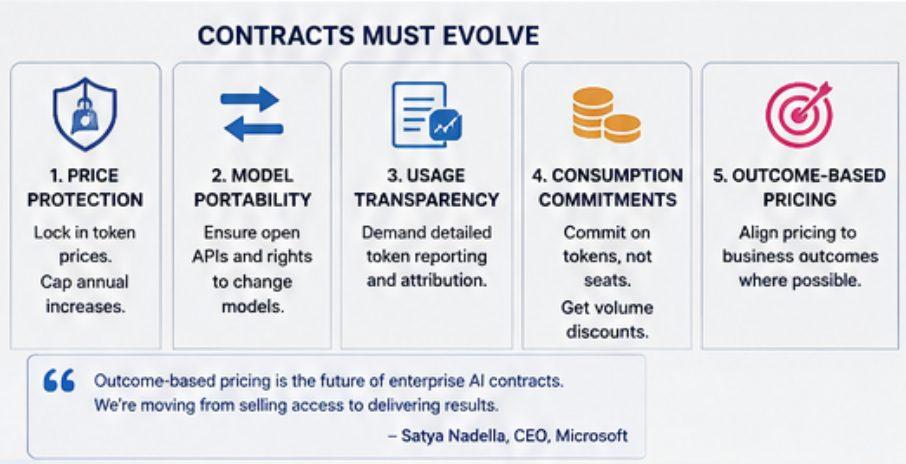
Most enterprise AI contracts remain immature.
That creates opportunity.
Future agreements should include:
Token Price Protection
Negotiate:
- Multi-year pricing guarantees
- Maximum annual increases
- Overage pricing caps
Model Portability Clauses
Avoid vendor lock-in.
Require:
- Open APIs
- Standard interfaces
- Model substitution rights
Large enterprises are increasingly adopting multi-model strategies specifically to reduce dependency on any single AI provider.
Usage Transparency
Demand:
- Detailed token reporting
- Agent-level visibility
- Business unit attribution
If a vendor cannot explain where costs originate, governance becomes impossible.
Consumption Commitments
Instead of seat commitments:
Negotiate:
- Token commitments
- Volume discounts
- Tiered consumption pricing
Similar to cloud enterprise agreements.
Outcome-Based Pricing
This remains early but is emerging.
Examples:
- Cost per resolved customer case
- Cost per completed workflow
- Cost per automated transaction
Many CIOs will push vendors toward business-outcome pricing over the next three years.
The Strategic Opportunity Hidden Inside the Pricing Shift
Most organizations view token billing as a threat.
The best organizations view it as an advantage.
Why?
Because token economics finally creates visibility into AI value creation.
When every AI interaction has a measurable cost:
- Waste becomes visible.
- Optimization becomes possible.
- ROI becomes defensible.
- AI investments become comparable.
This is precisely what happened during the rise of cloud computing.
Organizations that embraced FinOps early gained competitive advantages.
Organizations that ignored it accumulated massive technical debt and cloud waste.
The same pattern is emerging in AI.
The Emerging Enterprise Response
Large enterprises have already begun responding:
- Implementing AI spending dashboards.
- Setting weekly token budgets.
- Restricting premium model access.
- Introducing AI approval workflows for high-cost agents.
- Routing low-value tasks to smaller models.
- Measuring AI cost per business transaction.
The conversation is rapidly shifting from:
“How many people are using AI?”
to
“What business value did we generate per dollar of AI spend?”
That is a far more mature question.
And ultimately the question boards and CFOs care about.
The CDO TIMES Bottom Line
The AI market is entering its next phase of maturity.
- The first phase focused on experimentation.
- The second phase focused on adoption.
- The third phase will focus on economics.
As OpenAI, Anthropic, Google, Microsoft, and other providers face increasing pressure to improve profitability, enterprises should expect continued evolution in pricing models, greater emphasis on token consumption, and more sophisticated usage-based billing structures.
The winners will not necessarily be the companies with the most AI users.
They will be the companies that understand the economics of intelligence.
Just as cloud spending created FinOps, AI spending is creating AI FinOps.
The organizations building token governance, AI chargeback models, cost observability, multi-model strategies, and business-value measurement today will be far better positioned when the industry fully transitions from subscription thinking to intelligence consumption economics.
In the age of AI, the most valuable metric may no longer be cost per user.
It may be cost per decision, cost per insight, or cost per business outcome.
Sources:
- arXiv: How Do AI Agents Spend Your Money?
- Stanford Digital Economy Lab Commentary
- FinOps Foundation – Token Economics
- FinOps Foundation – Optimizing GenAI Usage
- Microsoft FinOps Toolkit for Azure OpenAI
- Reuters – OpenAI Pricing and Economics Discussion
Love this article? Embrace the full potential and become an esteemed full access member, experiencing the exhilaration of unlimited access to captivating articles, exclusive non-public content, empowering hands-on guides, and transformative training material. Unleash your true potential today!
Order the AI + HI = ECI book by Carsten Krause today! at cdotimes.com/book

Subscribe on LinkedIn: Digital Insider
Become a paid subscriber for unlimited access, exclusive course content, no ads: CDO TIMES
Do You Need Help?
Consider bringing on a fractional CIO, CISO, CDO or CAIO from CDO TIMES Leadership as a Business Consulting Service. The expertise of CDO TIMES becomes indispensable for organizations striving to stay ahead in the digital transformation journey. Here are some compelling reasons to engage their experts:
- Deep Expertise: CDO TIMES has a team of experts with deep expertise in the field of Cybersecurity, Digital, Data and AI and its integration into business processes. This knowledge ensures that your organization can leverage digital and AI in the most optimal and innovative ways.
- Training, developing, arranging, and conducting educational conferences and programs and providing courses of instruction.
- Strategic Insight: Not only can the CDO TIMES team help develop a Digital & AI strategy, but they can also provide insights into how this strategy fits into your overall business model and objectives. They understand that every business is unique, and so should be its Digital & AI strategy.
- Future-Proofing: With CDO TIMES, organizations can ensure they are future-proofed against rapid technological changes. Our experts stay abreast of the latest AI, Data and digital advancements and can guide your organization to adapt and evolve as the technology does.
- Risk Management: Implementing a Digital & AI strategy is not without its risks. The CDO TIMES can help identify potential pitfalls and develop mitigation strategies, helping you avoid costly mistakes and ensuring a smooth transition with fractional CISO services.
- Competitive Advantage: Finally, by hiring CDO TIMES experts, you are investing in a competitive advantage. Their expertise can help you speed up your innovation processes, bring products to market faster, and stay ahead of your competitors.
By employing the expertise of CDO TIMES, organizations can navigate the complexities of digital innovation with greater confidence and foresight, setting themselves up for success in the rapidly evolving digital economy. The future is digital, and with CDO TIMES, you’ll be well-equipped to lead in this new frontier.
Do you need help with your digital transformation initiatives? We provide fractional CAIO, CDO, CISO and CIO services, do a Preliminary ECI and Tech Navigator Assessment and we will help you drive results and deliver winning digital and AI strategies for you!
Subscribe now for free and never miss out on digital insights delivered right to your inbox!
Turn insight into action with CDO TIMES.
CDO TIMES helps executives move from AI awareness to AI execution through practical frameworks, tools, executive research, and advisory support.
Explore the Frameworks
Continue with Enterprise AI 2030, HI + AI = ECI, AI Governance, and executive playbooks.
Explore Enterprise AI 2030 →Use the Free Tools
Assess readiness, estimate AI ROI, model AI costs, and prioritize AI initiatives.
Open Executive Tools →Read the Book
Explore the HI + AI = ECI leadership model in The AI-Ready Leader.
Order The AI-Ready Leader →Go deeper with CDO TIMES Pro.
Unlock premium research, executive playbooks, templates, advanced tools, and member-only briefings.
Need executive help?
Explore advisory, workshops, fractional CIO/CDO/CISO/CAIO support, and AI operating model design.
Explore Advisory →Attend executive events
Join leadership forums, executive dinners, webinars, and strategic AI briefings.
View Events →Build AI capability
Use CDO TIMES Academy for executive learning, AI leadership development, and implementation training.
Explore Academy →