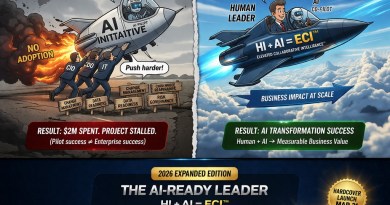
Designing the AI-Ready Enterprise: How to Optimize Business Processes and Organizational Structures for the Age of AI
Most Companies Are Deploying AI. Very Few Are Redesigning for It.
By Carsten Krause | June 17th 2026
Organizations worldwide have spent the last three years deploying copilots, chatbots, automation tools, and generative AI solutions. Yet despite billions of dollars invested, only a small percentage of companies are generating measurable enterprise-wide value from AI. According to research cited by Boston Consulting Group, only about 5% of organizations are realizing significant value from their AI investments. The common factor among successful organizations is not better technology—it is organizational redesign.
Many leaders approach AI as a technology initiative. They add AI tools to existing workflows and expect transformational outcomes. Unfortunately, this often produces incremental productivity gains while preserving inefficient processes, excessive management layers, fragmented data, and siloed decision-making.
The organizations creating the most value are taking a different approach. Rather than fitting AI into existing operating models, they are redesigning their operating models around AI.
The question is no longer:
“How do we implement AI?”
The question has become:
“How do we redesign the business so humans and AI can work together effectively?”

Why Traditional Organizational Structures Are Becoming Obstacles
Most large enterprises were designed for an era characterized by:
- Hierarchical decision making
- Functional silos
- Sequential workflows
- Periodic reporting
- Human-intensive coordination
AI changes the economics of work.
Activities that previously required days of analysis can now be completed in minutes. Information can be synthesized instantly. Agents can monitor workflows continuously. Decision support can occur in real time.

The result is that many traditional organizational layers no longer add the same value they once did.
Recent McKinsey research suggests that AI enables organizations to significantly flatten management structures because leaders can manage broader spans of control with AI-enabled insights and decision support.
In practical terms, AI often reduces the need for:
- Excessive reporting layers
- Manual coordination functions
- Repetitive administrative work
- Information consolidation activities
- Basic analysis roles
At the same time, AI increases demand for:
- Strategic thinking
- Critical judgment
- Innovation
- Governance
- Human relationship management
- Cross-functional collaboration
Organizations that fail to adapt their structures will increasingly find themselves carrying expensive organizational overhead that AI can perform faster and cheaper.
Stop Optimizing Functions. Start Optimizing End-to-End Processes.
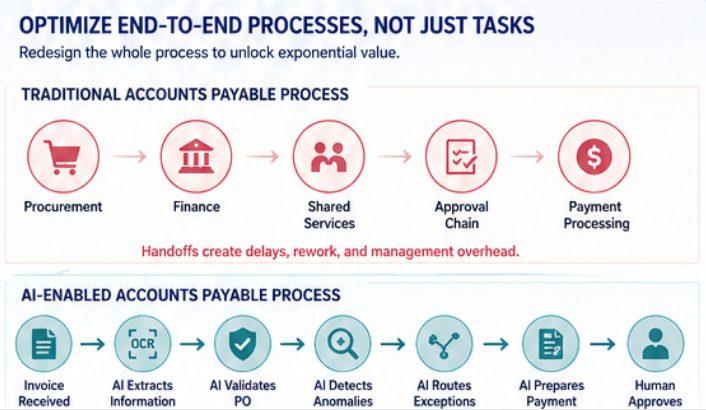
One of the biggest mistakes companies make is applying AI within individual departments instead of redesigning end-to-end value streams.
For example:
Traditional Accounts Payable Process
Procurement → Finance → Shared Services → Approval Chain → Payment Processing
Each handoff creates:
- Delays
- Rework
- Communication gaps
- Management overhead
Most companies use AI to improve one step.
Leading organizations redesign the entire workflow.
AI-Enabled Accounts Payable
- Invoice received
- AI extracts information
- AI validates purchase orders
- AI detects anomalies
- AI routes exceptions
- AI prepares payment recommendation
- Human approves exceptions only
Instead of improving one department, the entire process is redesigned.
The biggest AI value opportunities typically emerge when organizations focus on:
- Customer onboarding
- Order-to-cash
- Procure-to-pay
- Service management
- Product development
- IT operations
- Supply chain planning
- Customer support
BCG reports that the highest-performing organizations derive value by fundamentally reshaping workflows rather than simply automating existing tasks.
The New Organizational Model: Human + AI Teams
The future organization is not humans replacing AI or AI replacing humans.
The future organization is Human + AI Teams.
Leading organizations are increasingly building small, outcome-focused teams where human workers collaborate with AI agents and automation platforms. These teams own business outcomes rather than isolated tasks.
Traditional Team Structure
Manager
- Analyst
- Analyst
- Analyst
- Coordinator
- Specialist
AI-Ready Team Structure
Outcome Owner
- Business Expert
- AI Agent Network
- Data Specialist
- Process Architect
Instead of supervising people performing repetitive tasks, leaders increasingly manage systems that combine:
- Human expertise
- AI agents
- Automation
- Data platforms
This significantly increases organizational capacity without proportional headcount growth.
Create an AI Operating Model
Many organizations have AI strategies.
Far fewer have AI operating models.
An AI operating model defines:
- Who owns AI
- How AI projects are prioritized
- How AI is governed
- How value is measured
- How AI integrates into business operations
Without an operating model, organizations often experience:
- Duplicate AI investments
- Shadow AI
- Governance gaps
- Inconsistent architectures
- Security risks
- Unclear accountability
Successful organizations typically establish three layers.
Layer 1: AI Center of Excellence
Responsibilities include:
- Governance
- Standards
- Platforms
- Risk management
- Vendor strategy
- AI FinOps
Layer 2: Business AI Teams
Responsibilities include:
- Process redesign
- Use case identification
- Value realization
- Adoption
Layer 3: Delivery Teams
Responsibilities include:
- Agent development
- Low-code automation
- Pro-code solutions
- Operations
This creates centralized governance while enabling decentralized innovation.
Redesign Jobs Around Tasks, Not Roles
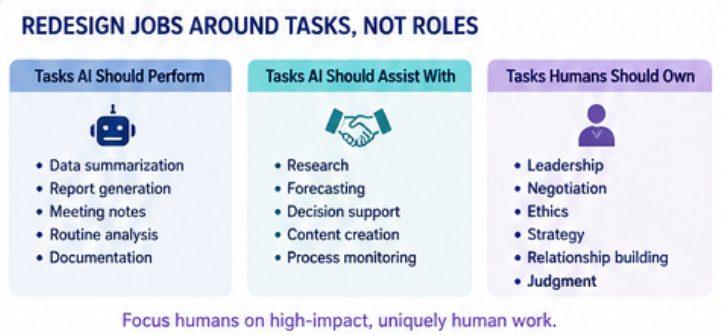
One of the most important organizational shifts involves moving from role-based thinking to task-based thinking.
Traditional job descriptions bundle dozens of activities together.
AI changes this equation.
Every role should be analyzed across three categories:
Tasks AI Should Perform
Examples:
- Data summarization
- Report generation
- Meeting notes
- Routine analysis
- Documentation
Tasks AI Should Assist With
Examples:
- Research
- Forecasting
- Decision support
- Content creation
- Process monitoring
Tasks Humans Should Own
Examples:
- Leadership
- Negotiation
- Ethics
- Strategy
- Relationship building
- Judgment
BCG estimates that 50% to 55% of jobs will be significantly reshaped by AI over the next several years. The implication is not necessarily job elimination, but substantial role redesign.
Organizations that proactively redesign work will significantly outperform those that wait for disruption.
Flatten Decision Making
One overlooked benefit of AI is decision acceleration.
Historically, decisions required:
- Data collection
- Analysis
- Report preparation
- Management reviews
- Executive approvals
AI can compress many of these activities.
Leading organizations are increasingly moving toward:
From
Monthly reviews
Quarterly planning
Annual budgeting
To
Real-time dashboards
Continuous planning
Dynamic forecasting
AI-supported decision making
McKinsey describes emerging “agentic organizations” where AI supports budgeting, forecasting, reporting, and operational decisions through real-time data analysis.
Organizations capable of making faster, data-driven decisions will increasingly outperform competitors relying on traditional management cycles.
Build an AI-Native Workforce
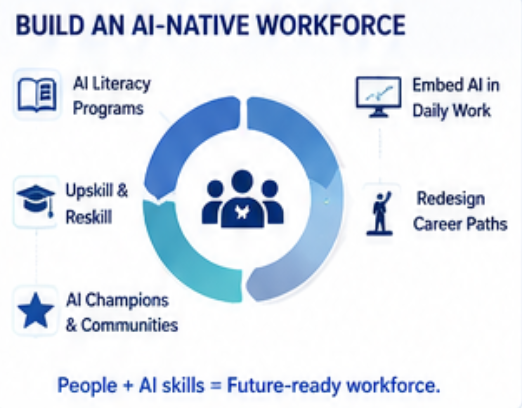
Technology is not the limiting factor.
Skills are.
Many organizations focus heavily on AI deployment while investing insufficiently in workforce transformation.
The highest-performing organizations are:
- Training employees
- Creating AI champions
- Redesigning career paths
- Establishing AI literacy programs
- Embedding AI into daily work
Research shows that organizations successfully scaling AI are significantly more likely to invest in workforce upskilling and involve employees directly in workflow redesign.
The future workforce will not consist of AI experts and non-AI users.
It will consist of professionals who know how to collaborate effectively with AI.
Establish AI Governance Before Scaling
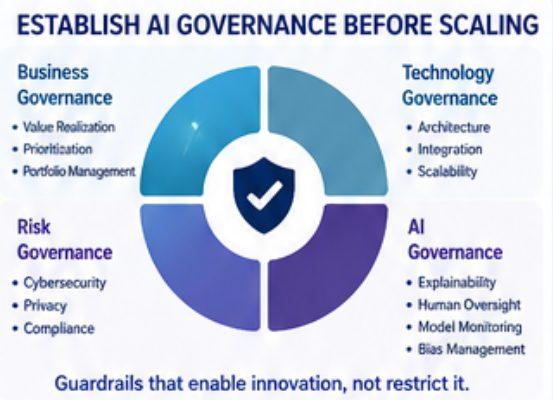
As organizations deploy AI agents into core processes, governance becomes increasingly important.
Key governance areas include:
Business Governance
- Value realization
- Prioritization
- Portfolio management
Technology Governance
- Architecture
- Integration
- Scalability
Risk Governance
- Cybersecurity
- Privacy
- Compliance
AI Governance
- Explainability
- Human oversight
- Model monitoring
- Bias management
Deloitte warns that organizations must establish guardrails now before scaling agentic systems throughout the enterprise.
Governance should accelerate innovation—not slow it down.
The Emerging AI-Ready Organization

The organizational structure of the future will likely look very different from today’s enterprise.
Characteristics include:
Less
- Management layers
- Functional silos
- Manual reporting
- Administrative coordination
- Process handoffs
More
- Cross-functional teams
- AI agents
- End-to-end process ownership
- Real-time decision making
- Human-AI collaboration
Organizations will increasingly resemble networks of outcome-focused teams supported by AI rather than hierarchical structures supported by administration.
The winners of the AI era will not necessarily be the organizations with the best AI models.
They will be the organizations that redesign their processes, operating models, and workforce around the capabilities those models enable.
The CDO TIMES Bottom Line

The biggest mistake executives can make is treating AI as another technology implementation.
AI is not an application upgrade.
It is an organizational redesign opportunity.
The companies creating the greatest value are not simply deploying copilots or building chatbots. They are rethinking how work gets done, redesigning business processes end-to-end, flattening decision-making structures, creating human-AI teams, and building operating models that allow intelligence to flow across the enterprise in real time.
The future belongs to organizations that stop asking how AI can fit into existing processes and start asking how their processes, structures, and workforce must evolve to fully leverage AI. The AI-ready enterprise will not be defined by its technology stack. It will be defined by its ability to combine human intelligence and artificial intelligence into a new operating model capable of delivering faster decisions, higher productivity, and sustainable competitive advantage.
Love this article? Embrace the full potential and become an esteemed full access member, experiencing the exhilaration of unlimited access to captivating articles, exclusive non-public content, empowering hands-on guides, and transformative training material. Unleash your true potential today!
Order the AI + HI = ECI book by Carsten Krause today! at cdotimes.com/book

Subscribe on LinkedIn: Digital Insider
Become a paid subscriber for unlimited access, exclusive course content, no ads: CDO TIMES
Do You Need Help?
Consider bringing on a fractional CIO, CISO, CDO or CAIO from CDO TIMES Leadership as a Business Consulting Service. The expertise of CDO TIMES becomes indispensable for organizations striving to stay ahead in the digital transformation journey. Here are some compelling reasons to engage their experts:
- Deep Expertise: CDO TIMES has a team of experts with deep expertise in the field of Cybersecurity, Digital, Data and AI and its integration into business processes. This knowledge ensures that your organization can leverage digital and AI in the most optimal and innovative ways.
- Training, developing, arranging, and conducting educational conferences and programs and providing courses of instruction.
- Strategic Insight: Not only can the CDO TIMES team help develop a Digital & AI strategy, but they can also provide insights into how this strategy fits into your overall business model and objectives. They understand that every business is unique, and so should be its Digital & AI strategy.
- Future-Proofing: With CDO TIMES, organizations can ensure they are future-proofed against rapid technological changes. Our experts stay abreast of the latest AI, Data and digital advancements and can guide your organization to adapt and evolve as the technology does.
- Risk Management: Implementing a Digital & AI strategy is not without its risks. The CDO TIMES can help identify potential pitfalls and develop mitigation strategies, helping you avoid costly mistakes and ensuring a smooth transition with fractional CISO services.
- Competitive Advantage: Finally, by hiring CDO TIMES experts, you are investing in a competitive advantage. Their expertise can help you speed up your innovation processes, bring products to market faster, and stay ahead of your competitors.
By employing the expertise of CDO TIMES, organizations can navigate the complexities of digital innovation with greater confidence and foresight, setting themselves up for success in the rapidly evolving digital economy. The future is digital, and with CDO TIMES, you’ll be well-equipped to lead in this new frontier.
Do you need help with your digital transformation initiatives? We provide fractional CAIO, CDO, CISO and CIO services, do a Preliminary ECI and Tech Navigator Assessment and we will help you drive results and deliver winning digital and AI strategies for you!
Subscribe now for free and never miss out on digital insights delivered right to your inbox!