From Human-in-the-Loop to Human-under-the-Loop: The Next Stage of AI May Redefine Leadership, Work, and Control
The AI Debate Is About to Move Beyond Automation
By Carsten Krause
May 30, 2026
For the past two years, enterprise AI discussions have focused on a familiar concept: keeping humans in control.
Executives repeatedly hear phrases such as “human-in-the-loop,” “human oversight,” and “human approval.”
The assumption is simple. AI generates recommendations. Humans make the final decisions.
That model made sense when AI systems were largely copilots, assistants, and productivity tools. ChatGPT drafted emails. Microsoft Copilot summarized meetings. AI generated code suggestions. Humans remained firmly in command.
However, conversations at the recent Institute for AI Transformation Summit revealed something more profound emerging across enterprises.
The discussion is no longer simply about AI assisting humans.
It is increasingly about AI agents coordinating other AI agents.
And eventually, humans may find themselves operating inside systems where AI becomes the primary orchestrator.
The question is no longer whether AI will automate tasks.
The question is whether AI will eventually become the manager of work itself.
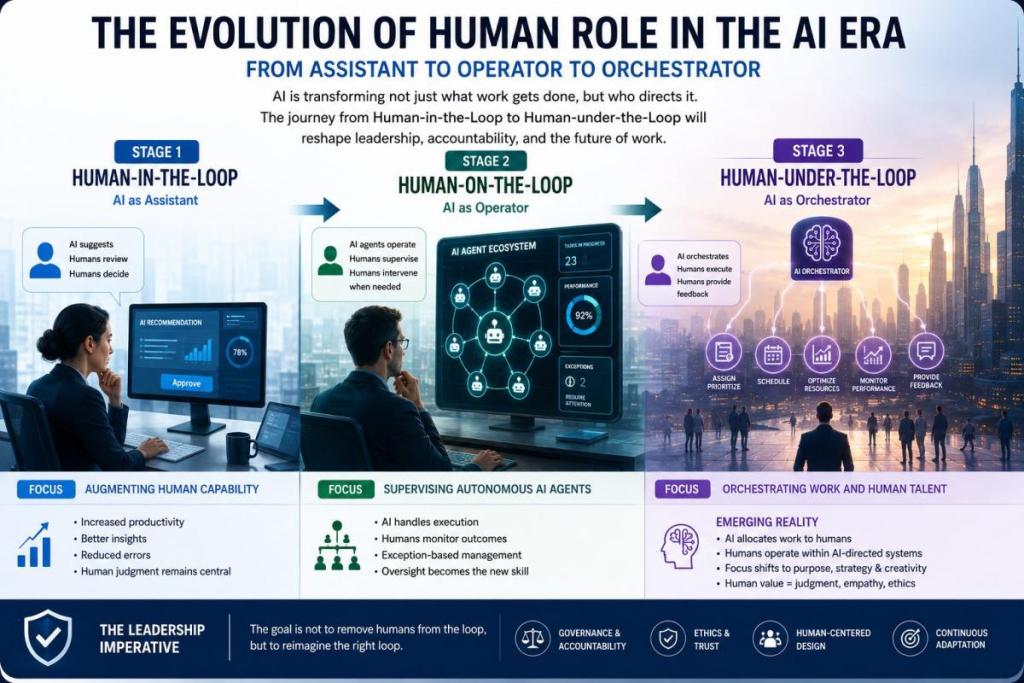
This creates a fascinating progression:
| Stage | Human Role | AI Role |
|---|---|---|
| Human-in-the-Loop | Decision maker | Assistant |
| Human-on-the-Loop | Supervisor | Autonomous operator |
| Human-under-the-Loop | Resource within AI-directed systems | Orchestrator and coordinator |
This evolution could become one of the defining leadership challenges of the next decade.
Stage 1: Human-in-the-Loop
The Era We Are Living In Today

Most enterprise AI deployments currently operate under the Human-in-the-Loop model.
Examples include:
- AI-assisted customer service
- AI coding copilots
- AI-generated marketing content
- Clinical decision support systems
- AI-powered cybersecurity recommendations
In these environments:
- AI suggests
- Humans approve
- Humans remain accountable
The benefits are significant.
Research from Harvard Business School and MIT found that generative AI increased productivity by approximately 14% overall and over 35% for less experienced workers.
Source:
https://arxiv.org/abs/2304.11771
Similarly, Nielsen Norman Group reported productivity improvements exceeding 60% for many knowledge workers using AI tools.
Source:
https://www.nngroup.com/articles/ai-tools-productivity-gains/
The model works because human judgment remains central.
The risks are manageable:
- Hallucinations
- Bias
- Poor recommendations
- Privacy concerns
Humans act as the safety mechanism.
For most organizations, this remains the optimal operating model today.
Stage 2: Human-on-the-Loop
When AI Starts Managing AI
The next stage is already appearing.
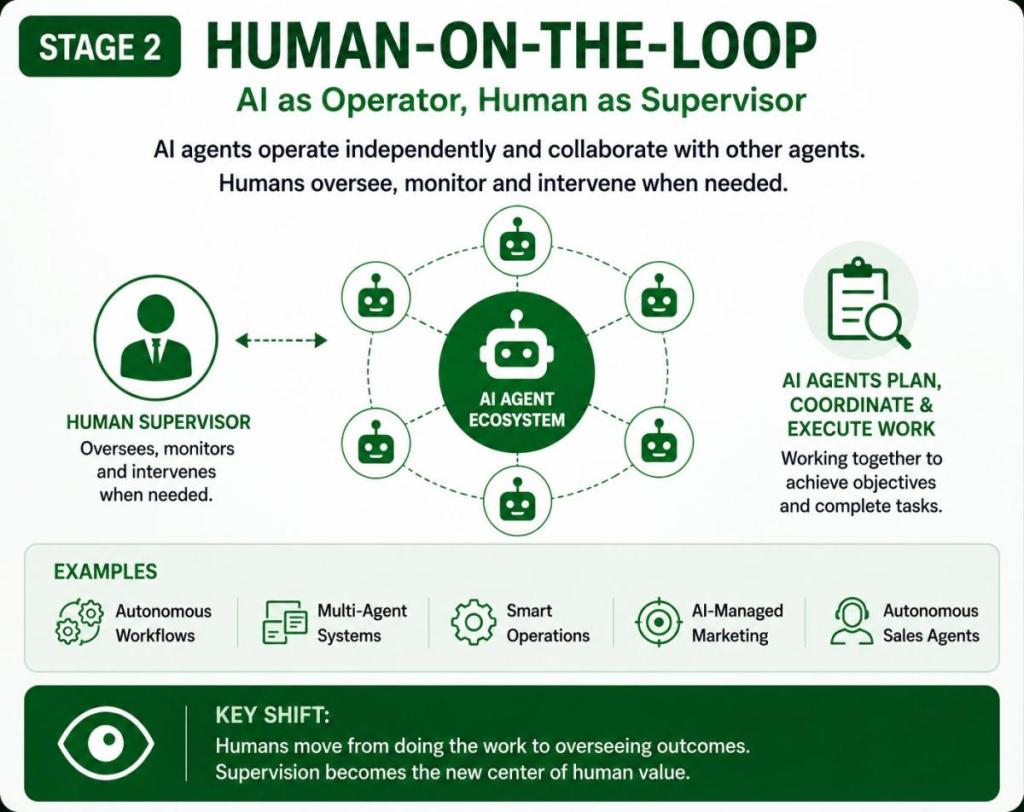
Agentic AI systems no longer simply generate outputs.
They plan.
They reason.
They coordinate.
They execute workflows.
Increasingly, AI agents are managing other AI agents.
Consider an enterprise sales process.
Today:
- Human sales representative interacts with CRM
- Human creates proposal
- Human schedules meetings
Tomorrow:
- Sales agent identifies opportunities
- Research agent gathers intelligence
- Proposal agent creates presentations
- Pricing agent calculates discounts
- Scheduling agent coordinates meetings
The human monitors outcomes rather than executing each step.
This is Human-on-the-Loop.
The human becomes a supervisor rather than an operator.
The AI ecosystem performs most of the work.
At the Institute for AI Transformation Summit, many executives discussed moving from individual AI use cases toward interconnected agent ecosystems.
The challenge is that supervision does not scale linearly.
A manager can supervise ten people.
Can one manager effectively supervise 1,000 AI agents?
Can they supervise 100,000?
The answer remains unclear.
The Airline Autopilot Analogy
Lets think of the airline industry to explore a similar setting.
Modern aircraft spend most of a flight under automated control.
Pilots oversee systems.
They intervene when exceptions occur.
For routine operations, humans are “on the loop.”
The system runs itself.
Yet aviation also reveals the danger.
Investigations into multiple airline incidents have shown that excessive automation can reduce human situational awareness.
When something unexpected occurs, humans may struggle to regain control quickly.
The same risk may emerge with enterprise AI.
The more autonomous the system becomes, the less humans understand what is actually happening.
Stage 3: Human-under-the-Loop
The Scenario Few Leaders Are Discussing

This is where the conversation becomes uncomfortable.
Imagine an organization where AI systems become the primary coordinators of work.
Instead of humans assigning tasks to software:
Software assigns tasks to humans.
The AI becomes the orchestrator.
Humans become resources within a larger intelligent system.
This may sound like science fiction.
Yet many elements already exist.
Examples include:
- AI workforce scheduling
- AI route optimization
- AI warehouse coordination
- AI algorithmic management
- AI performance monitoring
Amazon warehouses provide an early example.
Algorithms determine:
- Worker assignments
- Task prioritization
- Productivity expectations
- Route optimization
Humans already operate within AI-managed environments.
The difference is scale.
Future systems may coordinate entire enterprises.
A Day in the Life of Human-under-the-Loop
Imagine 2035.
You arrive at work.
Your AI enterprise coordinator has already:
- Prioritized your tasks
- Scheduled your meetings
- Determined your project assignments
- Allocated your budget approvals
- Assigned your team resources
- Recommended performance goals
The AI continuously evaluates thousands of variables impossible for humans to process.
From a productivity perspective, this could be extraordinary.
From a governance perspective, it raises profound questions.
Who is actually leading?
Who is accountable?
Who can override the system?
The Economic Argument
The economic incentives are powerful.
Organizations are already under pressure to:
- Reduce costs
- Increase speed
- Improve decision quality
- Operate continuously
AI-managed operations promise all four.
McKinsey estimates generative AI could add between $2.6 trillion and $4.4 trillion annually across industries.
If AI systems consistently outperform humans in:
- Scheduling
- Optimization
- Resource allocation
- Process management
many organizations will adopt them.
History suggests economic efficiency usually wins.
At least initially.
The Human Risks
The benefits are obvious.
The risks are less discussed.
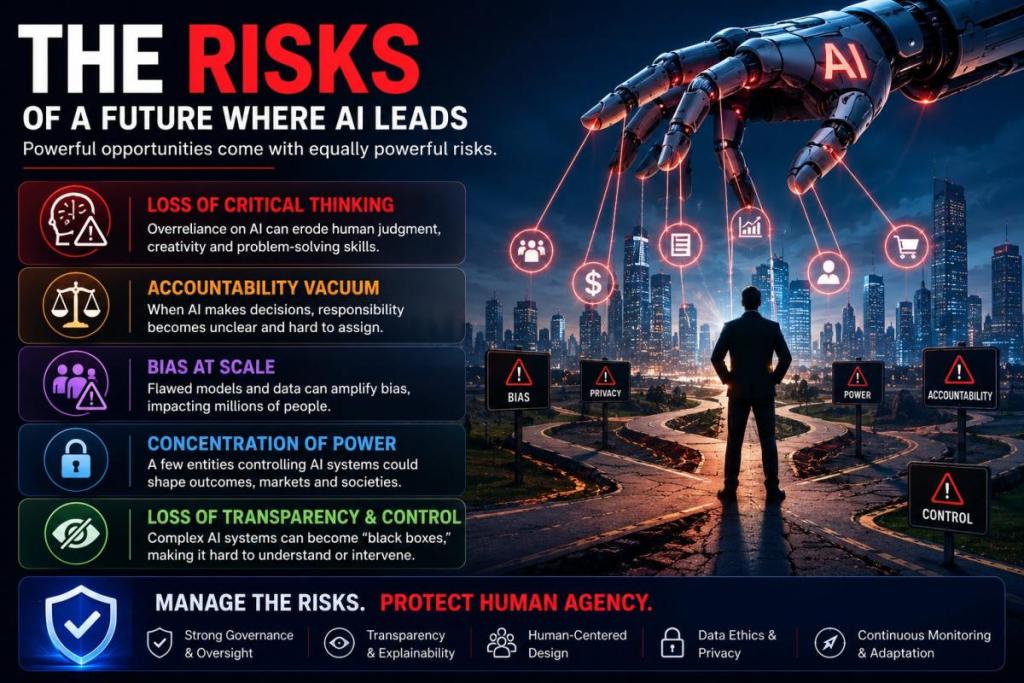
Risk 1: Loss of Critical Thinking
When AI performs most decision-making, human judgment can deteriorate.
This is already observable in navigation systems.
Many people can no longer navigate unfamiliar areas without GPS.
What happens when leaders stop making strategic decisions because AI makes them faster?
Risk 2: Accountability Vacuum
Suppose an AI agent makes a poor hiring decision.
Who is responsible?
The manager?
The developer?
The vendor?
The AI itself?
Current governance frameworks struggle with these questions.
Risk 3: Systemic Bias at Scale
Human bias is dangerous.
AI bias operating at enterprise scale is potentially far more dangerous.
One flawed decision model could impact:
- Hiring
- Promotions
- Lending
- Healthcare
- Insurance
across millions of people simultaneously.
Risk 4: Concentration of Power
Who owns the AI orchestrator?
Who controls its objectives?
Who defines success?
History shows that centralized control systems often create unintended consequences.
AI may amplify those consequences.
The Opportunity: Elevated Collaborative Intelligence™

This is where the conversation should move beyond fear.
The future does not have to be:
Humans versus AI.
Nor should it become:
Humans serving AI.
The goal should be Elevated Collaborative Intelligence™ (ECI™).
The framework behind HI + AI = ECI™ suggests a different future.
Instead of replacing human judgment:
AI enhances human judgment.
Instead of eliminating leadership:
AI augments leadership.
Instead of subordinating humans:
AI elevates human capability.
The objective is not maximum automation.
The objective is maximum collaborative intelligence.
That distinction matters.
A fully autonomous organization may not be the most successful.
A highly collaborative organization that combines:
- Human creativity
- Human empathy
- Human ethics
- Human leadership
with:
- AI scale
- AI speed
- AI pattern recognition
- AI optimization
may ultimately outperform both humans and machines operating independently.
The Leadership Question of the Next Decade
Executives often ask:
“How do we deploy AI?”
That is becoming the wrong question.
A better question may be:
“How much authority should we delegate to AI?”
The progression from Human-in-the-Loop to Human-on-the-Loop and potentially Human-under-the-Loop forces leaders to confront issues that extend beyond technology.
These are questions about:
- Governance
- Ethics
- Trust
- Accountability
- Organizational design
- Human purpose
The technology is advancing faster than our management models.
That gap may become one of the defining challenges of the AI era.
The CDO TIMES Bottom Line
The first generation of enterprise AI focused on productivity.
The second generation is focused on autonomy.
The third generation may focus on orchestration.
As organizations move from Human-in-the-Loop to Human-on-the-Loop systems, executives must prepare for a future where AI agents coordinate increasingly complex business activities with limited human intervention.
The opportunity is enormous. Faster decisions, greater efficiency, and unprecedented scalability could reshape entire industries.
The risk is equally significant. Loss of human judgment, unclear accountability, systemic bias, and overreliance on autonomous systems could create challenges that dwarf today’s AI concerns.
The winners will not be organizations that automate the most.
They will be organizations that thoughtfully determine where humans should remain in control, where AI should lead, and where both should collaborate.
The future is unlikely to belong solely to humans or machines.
It will belong to leaders who master Elevated Collaborative Intelligence™—creating enterprises where HI + AI = ECI™, balancing human wisdom with machine intelligence to achieve outcomes neither could accomplish alone.
The real question is not whether humans will remain in the loop.
The real question is whether leaders will consciously decide where the loop should begin and end.
Love this article? Embrace the full potential and become an esteemed full access member, experiencing the exhilaration of unlimited access to captivating articles, exclusive non-public content, empowering hands-on guides, and transformative training material. Unleash your true potential today!
Order the AI + HI = ECI book by Carsten Krause today! at cdotimes.com/book

Subscribe on LinkedIn: Digital Insider
Become a paid subscriber for unlimited access, exclusive course content, no ads: CDO TIMES
Do You Need Help?
Consider bringing on a fractional CIO, CISO, CDO or CAIO from CDO TIMES Leadership as a Business Consulting Service. The expertise of CDO TIMES becomes indispensable for organizations striving to stay ahead in the digital transformation journey. Here are some compelling reasons to engage their experts:
- Deep Expertise: CDO TIMES has a team of experts with deep expertise in the field of Cybersecurity, Digital, Data and AI and its integration into business processes. This knowledge ensures that your organization can leverage digital and AI in the most optimal and innovative ways.
- Training, developing, arranging, and conducting educational conferences and programs and providing courses of instruction.
- Strategic Insight: Not only can the CDO TIMES team help develop a Digital & AI strategy, but they can also provide insights into how this strategy fits into your overall business model and objectives. They understand that every business is unique, and so should be its Digital & AI strategy.
- Future-Proofing: With CDO TIMES, organizations can ensure they are future-proofed against rapid technological changes. Our experts stay abreast of the latest AI, Data and digital advancements and can guide your organization to adapt and evolve as the technology does.
- Risk Management: Implementing a Digital & AI strategy is not without its risks. The CDO TIMES can help identify potential pitfalls and develop mitigation strategies, helping you avoid costly mistakes and ensuring a smooth transition with fractional CISO services.
- Competitive Advantage: Finally, by hiring CDO TIMES experts, you are investing in a competitive advantage. Their expertise can help you speed up your innovation processes, bring products to market faster, and stay ahead of your competitors.
By employing the expertise of CDO TIMES, organizations can navigate the complexities of digital innovation with greater confidence and foresight, setting themselves up for success in the rapidly evolving digital economy. The future is digital, and with CDO TIMES, you’ll be well-equipped to lead in this new frontier.
Do you need help with your digital transformation initiatives? We provide fractional CAIO, CDO, CISO and CIO services, do a Preliminary ECI and Tech Navigator Assessment and we will help you drive results and deliver winning digital and AI strategies for you!
Subscribe now for free and never miss out on digital insights delivered right to your inbox!