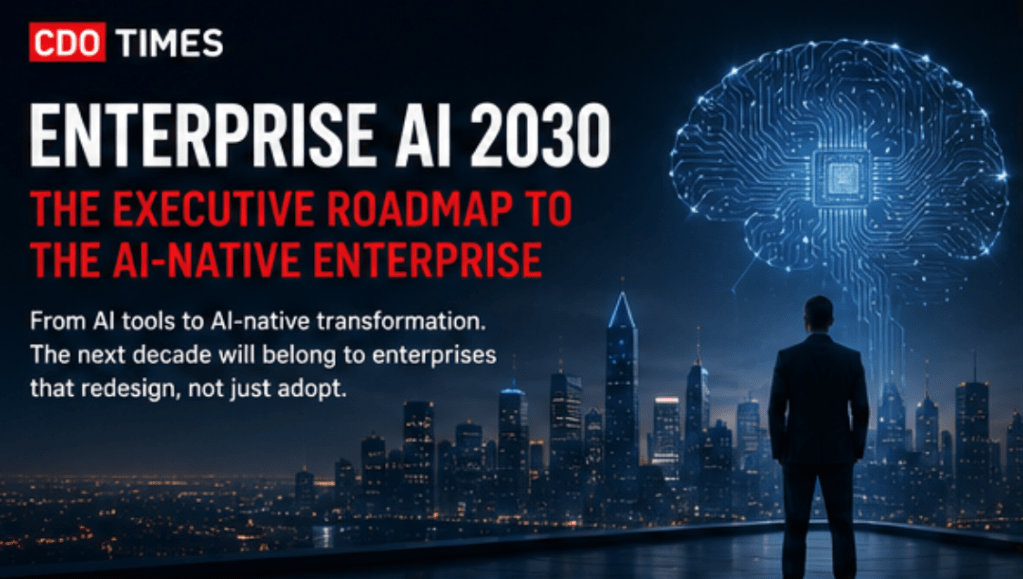
Enterprise AI 2030: The Executive Roadmap to the AI-Native Enterprise
Artificial intelligence is no longer a technology experiment. It is becoming the new operating layer of the enterprise.
By Carsten Krause, CDO TIMES, June 30th, 2026
For the past several years, most organizations have treated AI as a collection of tools: copilots, chatbots, productivity assistants, coding accelerators, analytics helpers, and automation engines. That was a necessary first phase. It helped leaders understand what generative AI could do, where it created value, and where it created risk. But that phase is already giving way to something larger.
Enterprise AI is moving from tool adoption to enterprise redesign.
The next competitive advantage will not come from giving every employee access to the same AI assistant. It will come from building AI-native enterprises where leadership, operating models, enterprise architecture, cybersecurity, governance, data, workforce design, and decision-making are redesigned around intelligent systems.
That is the purpose of the Enterprise AI 2030 framework.
This CDO TIMES executive series explores the major shifts that will define AI-driven enterprises through 2030. It is not a prediction exercise for technology enthusiasts. It is a practical roadmap for CEOs, CIOs, CDOs, CISOs, CAIOs, enterprise architects, digital leaders, and board members who need to understand what must change before AI can scale responsibly and create measurable business value.
The Copilot Era Was Only the Opening Chapter
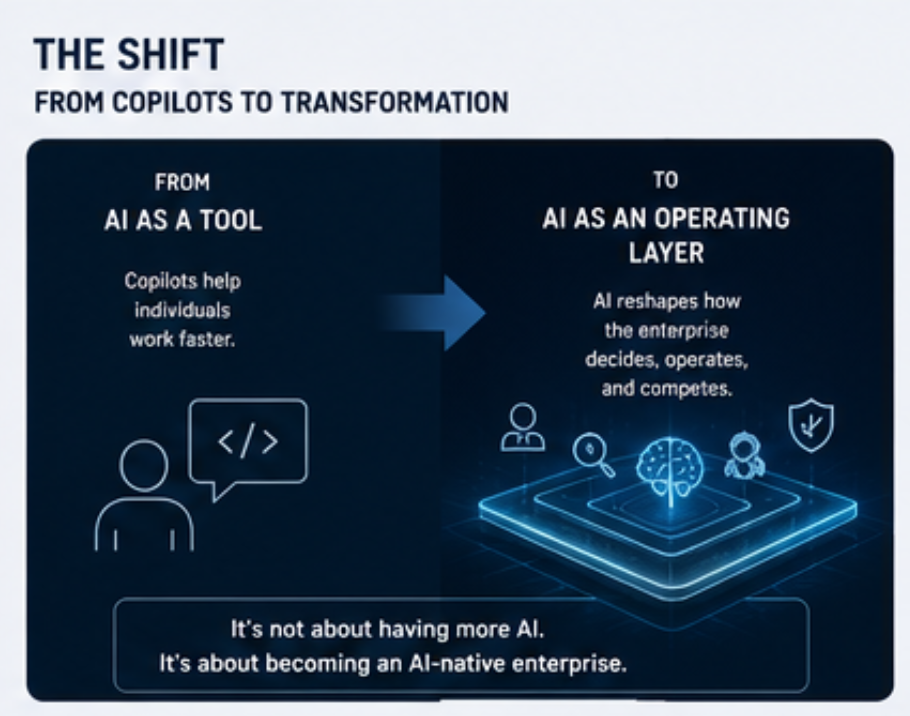
The first major wave of generative AI adoption was dominated by copilots.
This made sense. Copilots were easy to understand. They improved productivity. They summarized documents, drafted emails, generated code, created presentations, answered questions, and assisted knowledge workers. They gave executives a visible way to introduce AI into the organization without immediately redesigning the business.
But copilots alone will not create the AI-native enterprise.
A copilot can help an employee work faster. It does not automatically change how the enterprise makes decisions, governs risk, manages knowledge, designs processes, secures data, or measures value. It does not resolve fragmented data, poor architecture, weak governance, unclear operating models, or outdated leadership behaviors.
This is why many organizations are experiencing an AI value gap.
They are deploying AI tools faster than they are redesigning the enterprise around them.
McKinsey’s 2025 State of AI research found that organizations are increasingly using AI across more business functions, but many remain early in capturing enterprise-level value. Its survey also emphasized that workflow redesign is one of the factors most associated with EBIT impact from generative AI. In other words, the value does not come simply from having AI. It comes from changing how the organization works. Source: https://www.mckinsey.com/capabilities/quantumblack/our-insights/the-state-of-ai-how-organizations-are-rewiring-to-capture-value
That is the core message executives need to internalize.
AI adoption is not the same as AI transformation.
The AI-Native Enterprise Will Be Designed Differently
An AI-native enterprise is not simply a company with many AI tools.
It is an organization where intelligence is embedded into the way work happens.
That means AI is not limited to a chatbot window. It becomes part of strategic planning, product development, customer experience, supply chain decisions, cybersecurity operations, finance analysis, software engineering, HR processes, governance workflows, and executive decision-making.
In an AI-native enterprise, leaders do not ask only:
“How many AI tools have we deployed?”
They ask:
“How has AI changed the way we decide, operate, learn, govern, and compete?”
That is a very different leadership question.
The AI-native enterprise requires a different foundation. It needs trusted data, modern architecture, secure integration, clear governance, responsible AI practices, measurable value management, AI-ready talent, and executive alignment. Without these foundations, AI becomes another layer of complexity on top of already fragile systems.
Many enterprises are discovering this problem now. They are adding AI on top of disconnected applications, inconsistent data definitions, immature governance, unclear accountability, and fragmented operating models. The result is not transformation. It is accelerated confusion.
By 2030, the leading enterprises will look different. They will not bolt AI onto old structures. They will redesign the structures.
Enterprise AI 2030 Is Built Around Five Executive Pillars
The Enterprise AI 2030 framework is organized around five pillars.
These pillars are not abstract categories. They represent the major leadership domains that must evolve if AI is going to move from experimentation to enterprise-scale value.
Pillar 1: AI Leadership
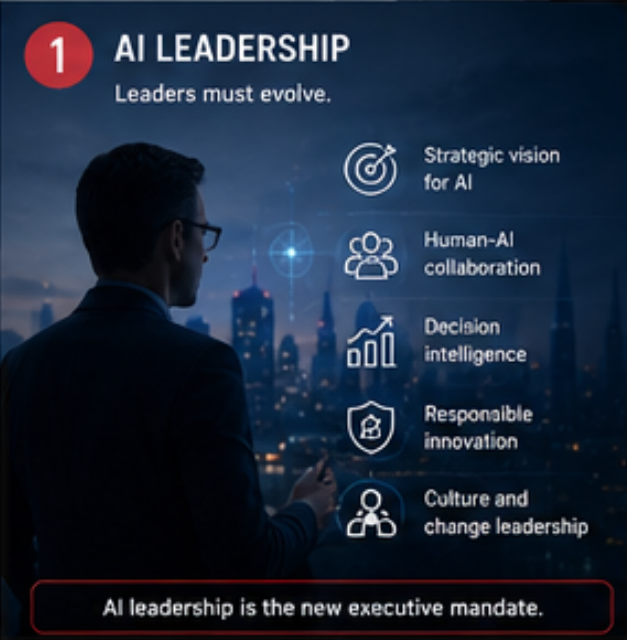
The first pillar is leadership.
AI will force every executive role to evolve. The CEO, CIO, CDO, CFO, CHRO, CISO, COO, CAIO, and enterprise architect will all face new expectations. Leaders will need to understand not only technology, but decision intelligence, AI governance, organizational learning, data trust, workforce redesign, and human-AI collaboration.
The executive skill set is changing.
In the past, digital leadership often meant sponsoring transformation programs, funding platforms, and approving modernization roadmaps. AI leadership requires something deeper. It requires the ability to redesign how humans and intelligent systems work together.
Leaders must know where AI should automate, where it should augment, where it should advise, and where humans must retain authority. They must build organizations that can move faster without becoming reckless. They must balance productivity with trust, innovation with accountability, and automation with human judgment.
This is where the ECI model becomes essential.
Elevated Collaborative Intelligence, or ECI, is based on a simple but powerful premise: the future of enterprise performance will come from combining Human Intelligence and Artificial Intelligence in ways that produce better outcomes than either could achieve alone.
The winning organization will not be human-only.
It will not be AI-only.
It will be human-led, AI-enabled, trust-governed, and execution-focused.
Pillar 2: AI-Native Enterprise Architecture
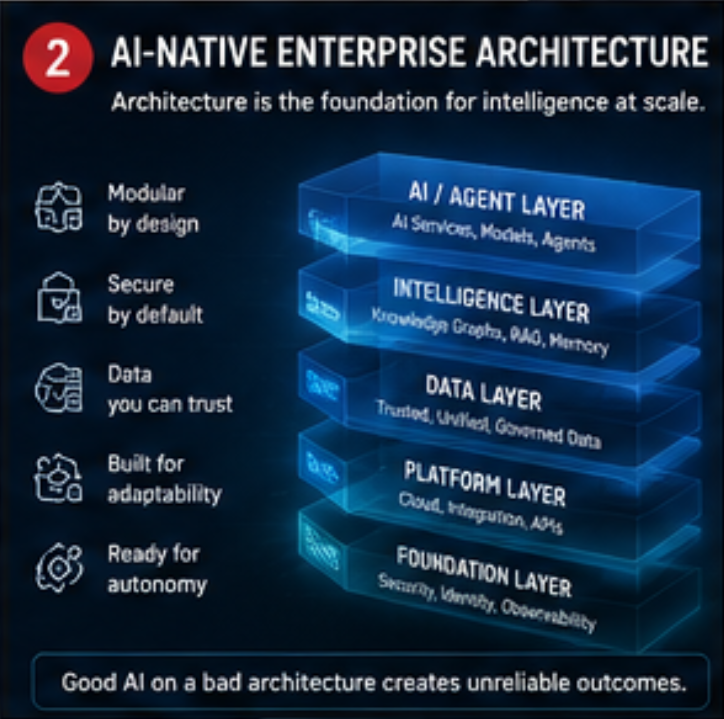
The second pillar is architecture.
Many AI efforts fail because the underlying enterprise architecture is not ready. Data is fragmented. Applications are duplicated. Integrations are brittle. Knowledge is trapped in documents. Business capabilities are poorly mapped. Governance workflows are inconsistent. Security controls were built for traditional systems, not AI agents and autonomous workflows.
AI does not remove the need for enterprise architecture. It makes enterprise architecture more important.
An AI-native architecture must support secure access to enterprise knowledge, controlled integration with systems of record, reusable AI services, model governance, identity management, observability, auditability, and responsible deployment patterns. It must also support new architectural components such as vector databases, retrieval-augmented generation pipelines, semantic layers, enterprise knowledge graphs, AI memory, and agent orchestration.
This is not a technical side issue.
It is a strategic capability.
If the architecture is weak, AI scales poorly. If the data foundation is weak, AI produces unreliable results. If identity and access controls are weak, AI creates new security exposure. If governance is missing, AI adoption becomes fragmented and risky.
By 2030, enterprise architecture will increasingly be judged by one question:
Can it support trusted intelligence at scale?
Pillar 3: AI Operating Models
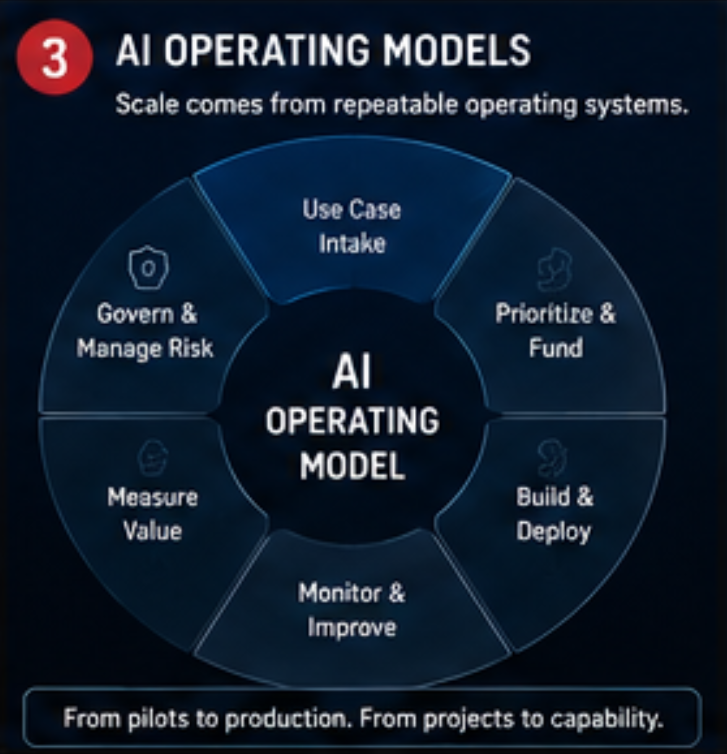
The third pillar is the operating model.
Enterprises cannot scale AI with disconnected pilots and volunteer enthusiasm. They need a clear model for how AI use cases are identified, prioritized, funded, built, governed, deployed, measured, and improved.
That requires an AI operating model.
This operating model must answer practical questions:
Who owns AI strategy?
Who approves high-risk use cases?
Who manages model risk?
Who defines data access?
Who measures business value?
Who maintains AI agents?
Who monitors AI behavior after deployment?
Who decides when a human must stay in the loop?
These are not theoretical questions. They determine whether AI becomes a scalable enterprise capability or a chaotic collection of experiments.
The operating model also determines how organizations balance centralization and decentralization. A fully centralized AI team may become a bottleneck. A fully decentralized model may create duplication, risk, and inconsistent standards. Most enterprises will need a federated model: central governance, shared platforms, reusable architecture, and business-led execution.
The AI Factory concept belongs here.
An AI Factory is not just a team that builds models. It is an operating capability that converts business opportunities into governed, secure, measurable AI solutions. It connects use-case intake, data readiness, model selection, architecture, delivery, governance, adoption, and value realization.
By 2030, companies will not brag about how many pilots they launched. They will compete on how reliably they turn AI ideas into enterprise outcomes.
Pillar 4: Governance, Cybersecurity, and Trust

The fourth pillar is trust.
AI changes the risk profile of the enterprise. It expands the attack surface, increases data exposure, raises ethical questions, creates model risk, and introduces new accountability challenges. It also accelerates the speed at which bad decisions can scale.
This means AI governance, cybersecurity, privacy, compliance, and ethics cannot operate as separate after-the-fact controls.
They must be embedded into the AI operating model.
The NIST AI Risk Management Framework and its Generative AI Profile provide a useful foundation for organizations seeking to manage AI-related risk across trustworthy AI characteristics. NIST frames AI risk management as an ongoing process, not a one-time review. Source: https://www.nist.gov/itl/ai-risk-management-framework and https://www.nist.gov/publications/artificial-intelligence-risk-management-framework-generative-artificial-intelligence
Regulatory pressure is also increasing. The EU AI Act entered into force on August 1, 2024 and introduces a risk-based approach to AI regulation, with full applicability phased in over time and specific obligations for high-risk AI systems and general-purpose AI. Source: https://digital-strategy.ec.europa.eu/en/policies/regulatory-framework-ai
Cybersecurity risk is also changing. IBM’s 2025 Cost of a Data Breach Report highlights the AI oversight gap and warns that ungoverned AI systems are more likely to be breached and more costly when breached. Source: https://www.ibm.com/reports/data-breach
These signals point in the same direction.
AI trust is becoming an enterprise capability.
By 2030, boards will expect management teams to know where AI is being used, what data it touches, which systems it can access, what decisions it influences, which risks it introduces, and how those risks are monitored.
“Responsible AI” will no longer be a slide in a strategy deck.
It will be an operating requirement.
Pillar 5: Enterprise Transformation and Value Realization

The fifth pillar is value.
Executives are becoming more skeptical of vague productivity claims. AI investments are growing. Vendor costs are rising. Token economics, premium copilots, AI agents, infrastructure consumption, and model usage charges are becoming material budget concerns.
The question will shift from:
“Are we using AI?”
to:
“What business value is AI creating?”
That requires better measurement.
AI value cannot be measured only by licenses deployed, prompts submitted, or hours theoretically saved. Those metrics may be useful, but they do not prove transformation. Enterprises need to connect AI to business outcomes such as revenue growth, margin improvement, cycle-time reduction, risk reduction, customer satisfaction, employee productivity, innovation velocity, and decision quality.
This is where AI ROI and AI FinOps become executive disciplines.
AI FinOps will help organizations manage cost, consumption, vendor models, token usage, and infrastructure scaling. AI ROI will help leaders understand where AI creates measurable value and where it simply creates activity.
By 2030, AI investment decisions will be held to the same scrutiny as other major enterprise investments.
That is healthy.
AI should not be treated as magic. It should be treated as a strategic capability with measurable economics.
Personalized Enterprise AI Will Replace Generic AI Experiences
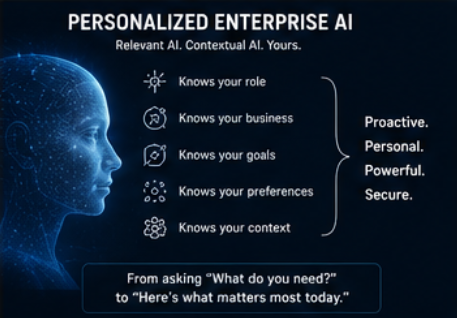
One of the most important shifts in the Enterprise AI 2030 roadmap is personalization.
The first wave of AI assistants was generic. Every user received roughly the same capability. That will not be enough.
The next generation of enterprise AI will become personalized by role, function, workflow, decision authority, business context, and enterprise knowledge. A CFO’s AI should not behave like a CISO’s AI. A supply chain AI should not behave like an HR AI. A CEO’s strategic intelligence system should not behave like a generic search assistant.
Personalized Enterprise AI will understand:
- the user’s role
- the organization’s strategy
- enterprise data context
- business processes
- governance policies
- current priorities
- previous decisions
- relevant risks
- preferred communication patterns
This does not mean AI becomes uncontrolled or invasive. It means personalization must be governed. Memory, permissions, context, data access, and explainability must be designed intentionally.
The organizations that master personalization will create AI systems that are not merely useful, but deeply relevant.
AI Agents Will Force a New Governance Model
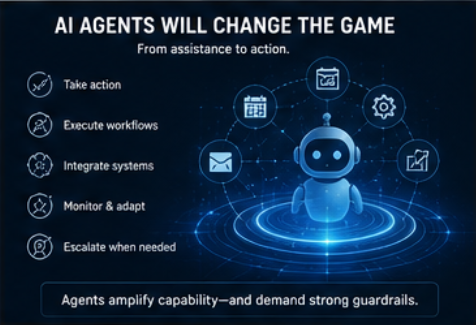
AI agents are another defining shift.
Unlike copilots, agents can take action. They can call APIs, retrieve data, trigger workflows, update systems, generate tickets, draft responses, monitor activity, and coordinate tasks. That creates enormous opportunity and serious risk.
An AI agent with too much authority becomes a security issue. An AI agent with unclear accountability becomes a governance issue. An AI agent connected to poor data becomes an operational issue. An AI agent operating without monitoring becomes an enterprise risk.
By 2030, many organizations will operate fleets of AI agents across functions. Some will be personal productivity agents. Others will be departmental agents. Some will support IT, cybersecurity, finance, HR, sales, legal, supply chain, product development, and customer service.
The enterprise will need agent registries, permission boundaries, human approval rules, logging, monitoring, escalation procedures, and lifecycle management.
This is why AI agents are not just a productivity topic.
They are an enterprise architecture, cybersecurity, governance, and operating model topic.
The Workforce Will Not Just Use AI—It Will Be Redesigned Around AI
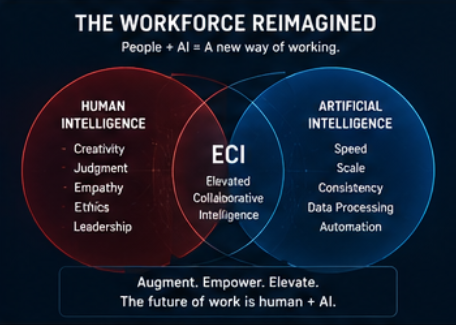
AI will change jobs, but the bigger question is how it changes work.
Too many conversations focus on whether AI will replace workers. That is too narrow. The more important executive question is how organizations redesign roles, teams, workflows, skills, and leadership around AI-enabled work.
Some tasks will be automated. Some roles will be augmented. Some jobs will disappear. New roles will emerge. But the largest transformation will be in how human expertise is combined with machine intelligence.
This will require new workforce capabilities:
- AI literacy
- prompt and instruction design
- AI-assisted decision-making
- workflow redesign
- model risk awareness
- data interpretation
- human oversight
- ethical judgment
- change leadership
The CHRO and CIO will need to work much more closely. So will the CDO, CISO, CAIO, legal, finance, and business leaders.
AI workforce transformation is not an HR program.
It is an enterprise operating model redesign.
The Board Agenda Is Changing

Boards increasingly need to understand AI beyond headlines and vendor promises.
A mature board-level AI agenda should include:
- AI strategy
- AI governance
- AI risk management
- cybersecurity exposure
- regulatory readiness
- AI investment discipline
- workforce impact
- vendor concentration
- data readiness
- measurable value
- executive accountability
The board does not need to approve every model. But it should understand whether the organization has the leadership, governance, architecture, and controls required to scale AI responsibly.
By 2030, AI oversight will likely become a standard part of enterprise governance.
The question for directors will not be:
“Are we experimenting with AI?”
It will be:
“Do we have the enterprise capability to use AI safely, responsibly, and competitively?”
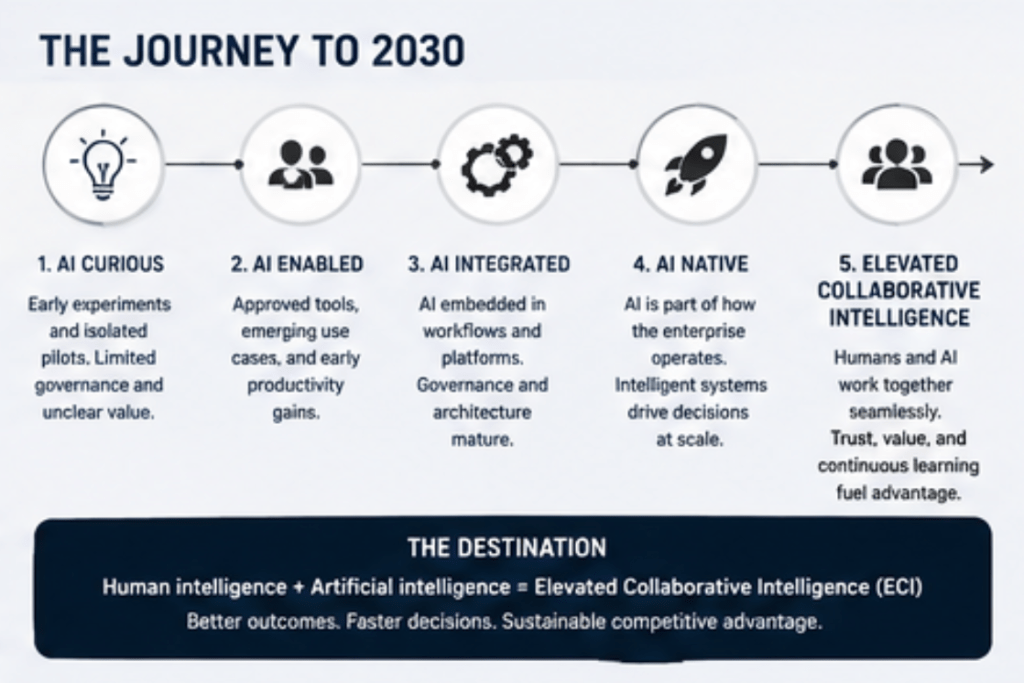
The Enterprise AI 2030 Maturity Model

Organizations will progress through five broad levels of AI maturity.
Level 1: AI Curious
AI is mostly experimental. Employees use public tools, pilots are scattered, governance is limited, and business value is unclear.
Level 2: AI Enabled
Approved tools are available, common use cases emerge, policies are developed, and early productivity gains appear.
Level 3: AI Integrated
AI becomes embedded in workflows, enterprise data sources, platforms, and business processes. Governance, architecture, and operating models begin to mature.
Level 4: AI Native
AI is part of how the enterprise operates. Agents, knowledge systems, decision intelligence, and AI-enabled workflows are integrated across business functions.
Level 5: Elevated Collaborative Intelligence
Human intelligence and artificial intelligence operate together through trusted systems, adaptive governance, measurable value, and continuous organizational learning. AI does not simply automate work. It elevates the enterprise.
This final level is the strategic destination of Enterprise AI 2030.
Why Enterprise AI 2030 Matters Now
Some leaders may ask why the roadmap matters today if the target is 2030.
The answer is simple.
The foundations take years to build.
Trusted data does not appear overnight. Enterprise architecture does not modernize itself. Governance does not mature after a crisis. Workforce capabilities do not evolve without investment. Operating models do not redesign themselves. Cybersecurity controls do not automatically adapt to AI agents. Executive teams do not become AI-ready by reading headlines.
The organizations that will lead in 2030 are making structural decisions now.
They are not simply buying tools.
They are building capabilities.
They are redesigning how work gets done.
They are preparing leaders.
They are creating governance models.
They are modernizing architecture.
They are measuring value.
They are building trust.
How to Use the Enterprise AI 2030 Series
This series is designed as an executive roadmap.
CIOs can use it to shape technology strategy, platforms, architecture, and AI operating models.
CDOs can use it to strengthen data foundations, decision intelligence, governance, and AI value realization.
CISOs can use it to understand AI-driven security exposure and the controls needed for AI-native environments.
CAIOs can use it to define enterprise AI strategy, use-case portfolios, governance models, and adoption roadmaps.
Enterprise architects can use it to connect business capabilities, data, platforms, applications, and AI services into a coherent architecture.
CEOs and boards can use it to ask better questions about competitiveness, risk, investment, workforce transformation, and accountability.
This is not just a content series.
It is a structured executive framework.
The CDO TIMES Bottom Line
Enterprise AI is entering a new phase.
The first phase was experimentation.
The second phase was tool adoption.
The third phase will be enterprise redesign.
By 2030, leading organizations will not be defined by how many AI tools they deployed. They will be defined by how effectively they redesigned leadership, architecture, operating models, governance, cybersecurity, workforce capabilities, and value management around AI.
The AI-native enterprise will not happen by accident.
It must be designed.
That is the purpose of Enterprise AI 2030.
It is a roadmap for leaders who understand that AI is not simply another technology wave. It is a new enterprise operating layer.
The winners will not be the organizations that chase every AI trend.
They will be the organizations that build the leadership discipline, architecture, governance, trust, and human-AI collaboration required to turn artificial intelligence into enterprise intelligence.
That is the path to Elevated Collaborative Intelligence.