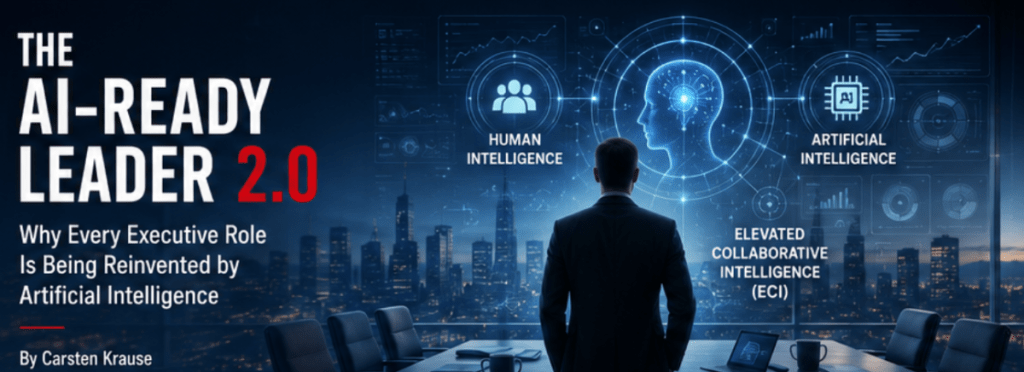
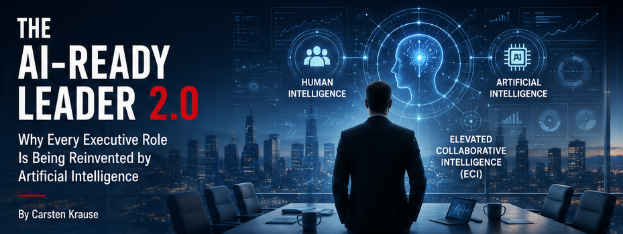
The AI-Ready Leader 2.0: Why Every Executive Role Is Being Reinvented by Artificial Intelligence
By Carsten Krause
AI Isn’t Just Transforming Business. It’s Transforming Leadership Itself
For decades, organizations adapted leadership roles to match technological change. The PC era created IT leaders. The Internet created digital executives. Cloud computing elevated cybersecurity, enterprise architecture, and data leadership into boardroom priorities.
Artificial intelligence is fundamentally different.
Unlike previous technology waves, AI is not simply another capability that organizations adopt. It is becoming an active participant in decision-making, knowledge work, software development, customer engagement, operations, and increasingly strategy itself.
That changes the role of every executive.
The question is no longer whether organizations need AI. The real question is whether leadership models built for the industrial and digital eras are capable of leading AI-native enterprises.
The answer is increasingly no.
The organizations creating competitive advantage over the next decade will not necessarily have the best AI models. They will have leaders who understand how to combine Human Intelligence (HI) with Artificial Intelligence (AI) to create Elevated Collaborative Intelligence (ECI).
That represents the next evolution of executive leadership.
Leadership Has Evolved Before—AI Is Accelerating the Next Transformation

Leadership has continuously adapted to technological disruption.
The CFO evolved from accounting to strategic capital allocation.
The CIO evolved from infrastructure management to digital transformation.
The CMO shifted from advertising to customer analytics.
The COO became increasingly data-driven.
Today’s AI revolution compresses decades of organizational evolution into only a few years.
Every executive now manages both human capabilities and machine intelligence simultaneously.
Leadership therefore shifts from directing people toward orchestrating an intelligent ecosystem.
The Biggest Leadership Shift: From Decision Maker to Decision Architect
Traditional executives were expected to possess the answers.
Tomorrow’s executives will be responsible for designing systems that continuously produce better answers.
That requires entirely new capabilities:
- Designing AI-assisted decision processes
- Knowing when AI should lead analysis
- Knowing when humans must override AI
- Building governance into every AI workflow
- Managing uncertainty instead of certainty
- Continuously learning alongside AI
The executive becomes less of an expert and more of an intelligence orchestrator.
Every C-Suite Role Is Being Reinvented

CEO → Chief Transformation Architect
The CEO increasingly becomes responsible for creating an organization capable of continuous adaptation.
Future CEOs spend less time reviewing reports and more time asking better strategic questions.
They orchestrate AI, human expertise, customers, partners, and ecosystems into one adaptive enterprise.
CIO → Chief Intelligence Officer
Technology infrastructure becomes table stakes.
Future CIOs manage enterprise intelligence.
Their responsibilities expand to include:
- AI platforms
- Intelligent automation
- Agent ecosystems
- Knowledge management
- Enterprise decision intelligence
- Digital workforce enablement
Technology becomes an intelligence platform.
CDO → Chief Decision Officer
Data alone no longer creates value.
Insight does.
The future Chief Data Officer increasingly owns:
- Enterprise AI governance
- Data quality
- AI trust
- Decision intelligence
- Semantic knowledge models
- Business intelligence powered by AI
Their mission becomes improving organizational decisions rather than simply managing information.
CHRO → Workforce Transformation Leader
HR experiences perhaps the largest shift.
Instead of managing jobs, HR manages capability evolution.
Key priorities include:
- AI literacy
- Human-AI collaboration
- Continuous reskilling
- Workforce redesign
- AI ethics
- Leadership development
Organizations that fail here risk creating an AI divide inside their workforce.
CFO → AI Investment Strategist
Financial leadership increasingly evaluates AI similarly to capital investments.
Questions evolve from:
“How much does AI cost?”
to
“What measurable business capability does AI create?”
Future finance leaders evaluate:
- AI ROI
- Token economics
- AI operating costs
- Productivity measurement
- AI portfolio optimization
CISO → Digital Trust Executive
Security expands beyond cyber.
Future CISOs increasingly manage:
- AI model security
- Prompt injection risks
- Synthetic identity
- Deepfake protection
- AI governance
- Digital trust
Trust becomes a competitive advantage.
The Rise of New Leadership Competencies

Technical expertise alone is no longer enough to lead an AI-native enterprise.
For decades, executives built careers by becoming specialists in finance, technology, operations, marketing, or cybersecurity. Deep functional knowledge remains valuable, but AI is changing the nature of executive work itself.
Future leaders will spend less time gathering information and more time validating, orchestrating, and challenging intelligence generated by humans and AI working together.
That requires an entirely new leadership toolkit.
AI Literacy
Every executive will need a practical understanding of artificial intelligence—not to build models, but to make informed business decisions.
Just as financial literacy became essential for modern executives regardless of department, AI literacy is becoming a foundational leadership capability.
Leaders must understand:
- What modern AI models can and cannot do
- The differences between generative AI, reasoning models, AI agents, and traditional machine learning
- Hallucinations, bias, uncertainty, and confidence levels
- Prompt engineering and effective human-AI collaboration
- AI governance, privacy, security, and regulatory considerations
Executives who lack AI literacy risk either overestimating AI’s capabilities or underutilizing one of the most powerful productivity technologies ever introduced.
The objective is not technical mastery. It is informed leadership.
Systems Thinking
Artificial intelligence does not operate in isolation.
Every AI implementation affects business processes, employee roles, customer experiences, data quality, governance models, cybersecurity, and organizational culture simultaneously.
Future executives must think in systems rather than silos.
They need to understand how decisions in one part of the enterprise create second- and third-order effects across the organization.
For example, deploying an AI customer service agent is not simply an IT initiative.
It influences:
- Customer experience
- Workforce planning
- Data governance
- Security
- Brand reputation
- Compliance
- Finance
- Change management
Systems thinking enables leaders to optimize the enterprise rather than individual functions.
Adaptive Leadership
Traditional organizations transformed every five to ten years.
AI-native organizations evolve continuously.
Technology capabilities improve every month. New foundation models emerge quarterly. Competitive advantages can disappear within weeks.
Leadership therefore shifts from managing stability to managing perpetual change.
Adaptive leaders:
- Experiment rapidly
- Learn continuously
- Adjust strategies based on evidence
- Build organizations capable of evolving without disruption
- Encourage responsible innovation while maintaining operational excellence
Instead of asking, “What is our five-year AI strategy?”
Future leaders increasingly ask:
“What did we learn this quarter, and how should our strategy evolve?”
Continuous adaptation becomes a core organizational capability.
Decision Intelligence
Perhaps the most important executive competency is knowing how to make better decisions alongside AI.
AI excels at analyzing enormous volumes of information, identifying patterns, generating scenarios, and surfacing recommendations.
Humans contribute context, ethics, intuition, creativity, organizational awareness, and strategic judgment.
Decision Intelligence combines both.
Executives must learn:
- Which decisions AI should automate
- Which decisions AI should inform
- Which decisions must remain exclusively human
- How to validate AI-generated recommendations
- How to recognize situations where human judgment should override algorithmic output
The goal is not replacing executive judgment.
The goal is dramatically improving it.
Organizations that master Decision Intelligence consistently make faster, better-informed, and more consistent decisions than competitors relying on either humans or AI alone.
Ethical Governance
As AI becomes embedded in every business function, governance moves from a compliance exercise to a strategic leadership responsibility.
Executives are increasingly accountable not only for what AI can do, but also for what it should do.
Ethical governance requires leaders to balance innovation with responsibility by ensuring AI systems are:
- Transparent where appropriate
- Fair and free from unacceptable bias
- Secure against misuse and manipulation
- Compliant with evolving regulations
- Aligned with organizational values
- Subject to meaningful human oversight
Organizations that ignore governance may achieve short-term productivity gains but expose themselves to legal, financial, reputational, and operational risks.
Organizations that build trust into every AI initiative will earn a sustainable competitive advantage.
Trust is becoming as important as intelligence.
Human-AI Orchestration
The defining leadership capability of the AI era may be the ability to orchestrate collaboration between people and intelligent systems.
Future executives will lead teams composed of:
- Human employees
- AI copilots
- Autonomous agents
- Specialized reasoning models
- External AI services
- Digital knowledge platforms
Managing these hybrid workforces requires new approaches to delegation, accountability, performance measurement, and organizational design.
Rather than asking, “Who should perform this task?”
Leaders increasingly ask:
“Which combination of humans and AI will produce the best outcome?”
This shift from managing people to orchestrating intelligence represents one of the most profound changes in executive leadership since the Industrial Revolution.
The New Executive Skill Set
Collectively, these competencies define a new model of leadership. Future executives will no longer be evaluated solely on their functional expertise or years of experience. They will be measured by their ability to combine human judgment, organizational insight, and artificial intelligence into better decisions and superior business outcomes. The leaders who thrive will not necessarily be those who know the most about AI—they will be those who know how to lead effectively with AI.
Why Human Intelligence Becomes More Valuable—Not Less
One of the biggest misconceptions surrounding AI is that human expertise becomes less important.
The opposite is happening.
As AI commoditizes technical execution, uniquely human capabilities increase in value.
These include:
- Curiosity
- Creativity
- Emotional intelligence
- Strategic judgment
- Ethical reasoning
- Relationship building
- Storytelling
- Negotiation
- Vision
These become executive differentiators.
The future belongs neither to humans nor AI alone.
It belongs to organizations mastering collaboration between both.
From Human in the Loop to Elevated Collaborative Intelligence

Many organizations still operate with “Human in the Loop” governance.
That is only the beginning.
Leading organizations will evolve through three stages:
Human in the Loop – AI assists humans.
Human on the Loop – AI executes while humans supervise.
Elevated Collaborative Intelligence (ECI) – Humans and AI continuously amplify each other’s strengths, improving outcomes neither could achieve independently.
This represents a new operating model rather than another AI framework.
Five Questions Every Executive Team Should Ask Today
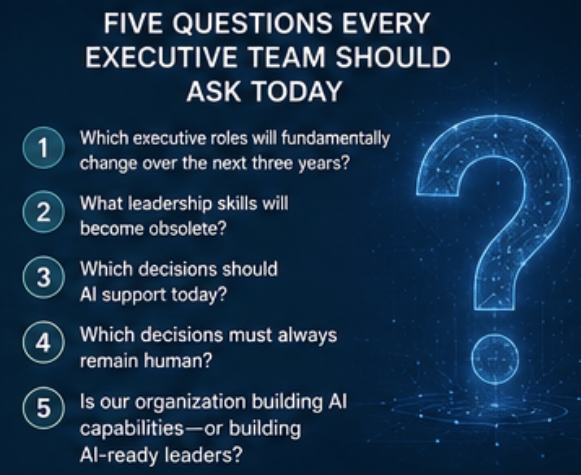
- Which executive roles will fundamentally change over the next three years?
- What leadership skills will become obsolete?
- Which decisions should AI support today?
- Which decisions must always remain human?
- Is our organization building AI capabilities—or building AI-ready leaders?
The organizations asking these questions now will likely shape their industries over the coming decade.
The CDO TIMES Bottom Line
Artificial intelligence is not replacing executives. It is redefining what effective executive leadership looks like.
Tomorrow’s leaders will spend less time managing information and more time orchestrating intelligence across humans, AI systems, and digital ecosystems.
Technology leadership, data leadership, HR, finance, operations, and cybersecurity are converging into one common mission: enabling organizations to make faster, smarter, and more trustworthy decisions.
The winners of the AI era will not simply deploy better models. They will build leadership systems that combine Human Intelligence and Artificial Intelligence into Elevated Collaborative Intelligence (ECI).
The future competitive advantage will not be AI alone.
It will be leaders who know how to lead with AI.