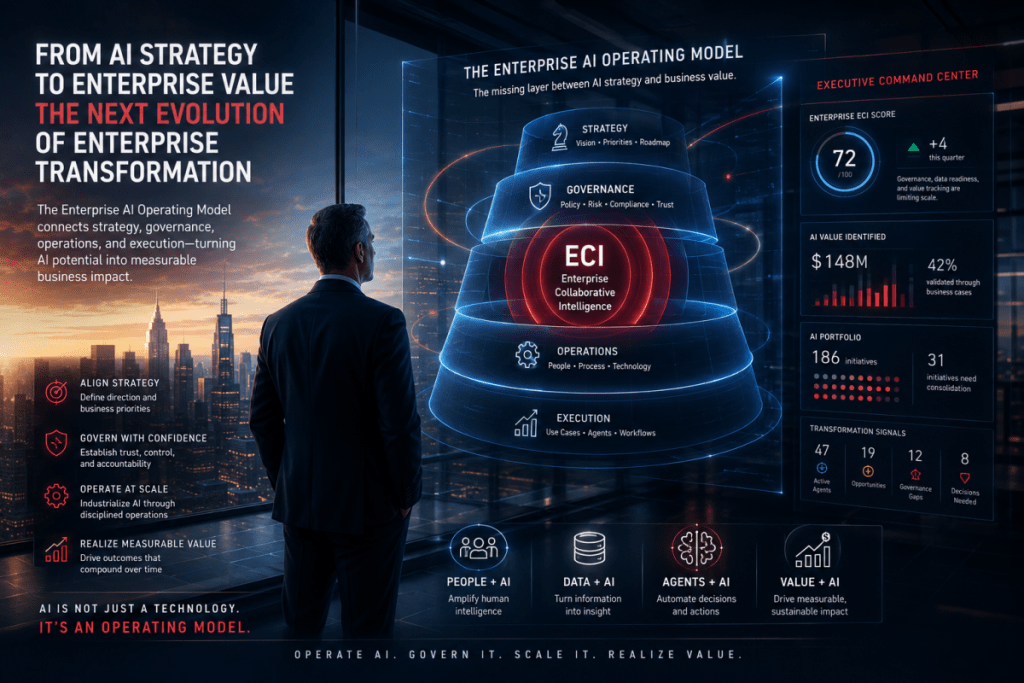
The Enterprise AI Operating Model: The Missing Layer Between AI Strategy and Business Value
By Carsten Krause
AI Strategy Is No Longer Enough
Enterprise leaders have spent the last two years asking the wrong question.
The dominant executive question has been: What is our AI strategy?
That question still matters, but it is no longer sufficient. Most large organizations already have AI strategies, AI pilots, AI governance discussions, Microsoft Copilot deployments, internal chatbots, data science programs, and emerging agent experiments. The issue is no longer whether the enterprise has AI activity. The issue is whether the enterprise has an operating model capable of turning that activity into measurable business value.
This is where many AI programs begin to stall.
They do not fail because the technology is weak. They fail because the enterprise operating model was not designed for AI-enabled work, human-AI collaboration, agentic workflows, cross-functional governance, value tracking, or continuous decision-making. AI moves faster than traditional committees, annual planning cycles, project funding models, and fragmented ownership structures can absorb. The result is predictable: AI pilots multiply, business cases remain inconsistent, shadow AI expands, governance becomes reactive, and executives lose visibility into what is actually happening across the organization.
Deloitte’s recent research makes this point clearly. In its 2026 analysis on rewiring the enterprise operating model for AI scale, Deloitte reports that 75% of surveyed leaders say their operating model must change within the next 12 to 18 months to drive greater value, but only about a quarter say they are already changing it continuously or dynamically. Source: https://www.deloitte.com/us/en/insights/topics/technology-management/rewiring-ai-operating-model.html
That gap should concern every CIO, CDO, CAIO, CTO, COO, and board member.
It means the enterprise conversation has moved beyond AI adoption. The real issue is AI operations.
The Enterprise AI Execution Gap
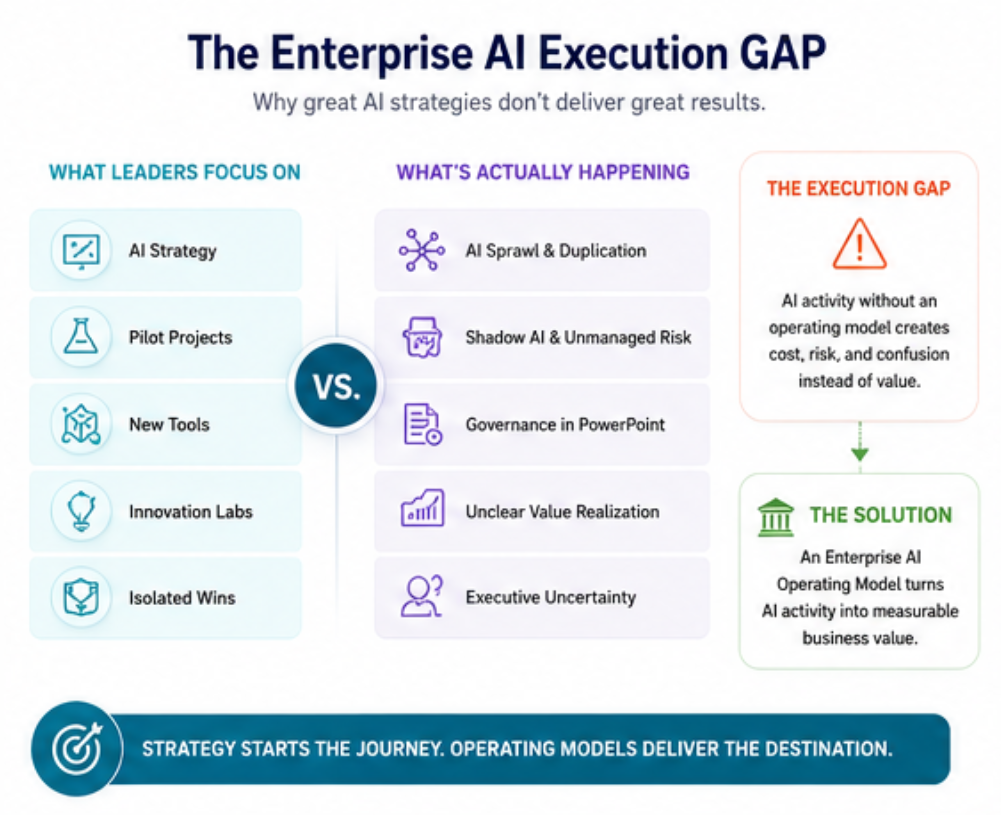
The first wave of generative AI adoption was driven by experimentation. That was reasonable. Enterprises needed to understand what large language models, copilots, generative interfaces, retrieval-augmented systems, and early agents could do. Teams explored use cases in customer service, software development, finance, procurement, HR, legal, cybersecurity, marketing, and supply chain. Innovation teams launched pilots. Business units built prototypes. Employees tested public AI tools. Technology teams created governance documents. Vendors added AI features to almost every platform.
But experimentation is not transformation.
A pilot proves that something can work. An operating model determines whether it can scale, be governed, be funded, be measured, be improved, and be trusted. Without that layer, the enterprise ends up with AI activity without enterprise intelligence.
This is the execution gap.
It shows up in six common ways:
- AI sprawl: Multiple departments buy tools, launch pilots, and create agents without a shared view of the enterprise portfolio. One business unit may build a procurement assistant while another buys a similar capability from a vendor. One region may adopt an AI-enabled workflow platform while another implements a different product for the same use case. The enterprise pays for overlapping capability without realizing it.
- Shadow AI: Employees and teams use unapproved tools because they are fast, accessible, and useful. This is not always malicious. In many cases, it is the predictable result of slow governance and unmet demand. But unmanaged AI usage creates risks around data exposure, intellectual property, compliance, cybersecurity, auditability, and decision quality.
- Governance theater: The organization may have AI principles, policy documents, risk frameworks, and review boards, but governance is not operationalized into workflows, ownership, intake, approvals, monitoring, exceptions, escalation paths, and executive routines. Governance exists as documentation, not as a working operating system.
- Unclear value realization: AI initiatives often claim productivity improvement, cost reduction, growth enablement, cycle-time reduction, risk reduction, or customer experience improvement. But many organizations lack a consistent way to estimate, validate, track, and realize value after deployment. The business case is approved, but the value is never governed as an enterprise asset.
- Architecture misalignment: AI initiatives often bypass enterprise architecture, data architecture, integration strategy, identity controls, records retention, privacy review, and lifecycle management. This creates the next generation of technical debt.
- Executive uncertainty: Leaders receive fragmented updates from technology, data, cyber, legal, finance, HR, operations, and business teams. They see activity, but not an integrated view. They cannot answer five basic questions quickly: Where are we? What needs attention? Where are we wasting money? Where are we taking unacceptable risk? What should we do next?
That is not a dashboard problem.
That is an operating model problem.
The Missing Layer: Enterprise AI Operations
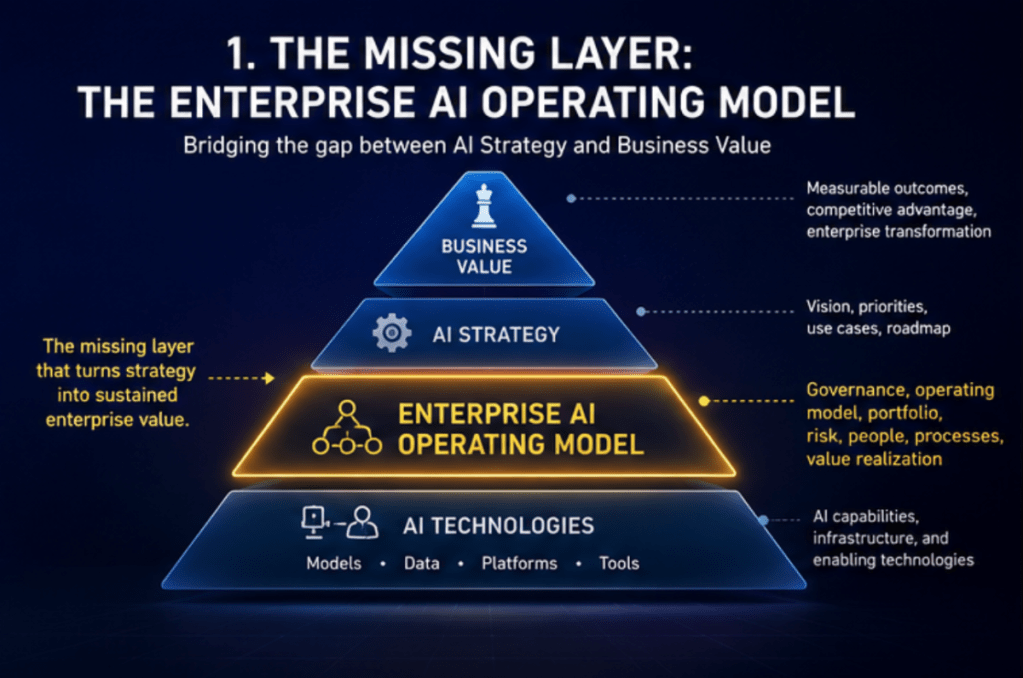
Enterprises need a new management discipline:
Enterprise AI Operations.
This should not be confused with the traditional IT term AIOps, which usually refers to applying AI to IT operations, observability, incident management, and infrastructure monitoring. Enterprise AI Operations is broader. It is the operating discipline required to govern, scale, measure, and continuously improve AI across the enterprise.
Enterprise AI Operations connects:
- Strategy
- Governance
- Portfolio management
- Risk management
- Enterprise architecture
- Data readiness
- Business capability planning
- Workforce transformation
- Financial transparency
- Executive decision-making
- Operating cadence
- Continuous improvement
This is the missing layer between AI strategy and business value.
AI strategy defines ambition. Enterprise AI Operations defines how the ambition becomes repeatable execution.
AI governance defines rules. Enterprise AI Operations turns those rules into workflows, decision rights, controls, and accountability.
AI portfolio management tracks initiatives. Enterprise AI Operations determines which initiatives deserve funding, which should be consolidated, which create risk, and which produce measurable value.
Enterprise architecture defines fit. Enterprise AI Operations ensures AI capabilities align with processes, data, systems, integration, security, and business capabilities.
The board and executive team do not need another disconnected AI dashboard. They need a way to operate AI as an enterprise capability.
The Five Executive Questions Every AI Operating Model Must Answer

A useful Enterprise AI Operating Model should help executives answer five questions in under 60 seconds.
1. Where are we?
This is the enterprise health question.
Executives need to understand the current state of AI maturity, governance readiness, portfolio scale, value realization, risk exposure, and department performance. This should not be a vanity score. It should be a structured view of enterprise readiness and execution health.
In the ECI framework, this is where the Enterprise ECI Score becomes important. It gives leaders a way to assess how well the organization is combining human intelligence, artificial intelligence, trust, and resistance management into a scalable operating model.
2. What needs my attention?
This is the executive attention question.
Executives do not need every data point. They need the few items that require decision, escalation, funding, intervention, or governance action. This is where the concept of an Executive Attention Feed becomes powerful.
Instead of forcing leaders to search dashboards, the system should surface what matters:
- A high-risk AI tool was detected.
- Two departments are funding duplicate AI initiatives.
- A major AI business case has not produced validated value.
- A policy exception is overdue.
- A new agent workflow requires executive approval.
- A department is scaling AI without adequate governance.
The attention feed should not be a notification stream. It should be an executive decision queue.
3. Where are we wasting money?
This is the financial transparency question.
AI waste is becoming a serious enterprise issue. It appears as duplicate tools, unused licenses, overlapping pilots, redundant vendors, poorly coordinated platforms, underutilized copilots, low-adoption automation, and projects that never move from prototype to production.
The enterprise needs to know not only where AI is creating value, but where AI activity is consuming budget without strategic return.
This is where the operating model must connect technology portfolio management, software asset management, financial management, procurement, enterprise architecture, and business ownership.
4. Where are we taking unacceptable risk?
This is the governance and trust question.
AI risk is not limited to model risk. It includes data leakage, intellectual property exposure, regulatory risk, cyber risk, bias, explainability gaps, vendor dependency, model drift, workflow automation errors, auditability failures, and unapproved agent behavior.
As AI becomes embedded into workflows and decisions, enterprises need a more integrated view of risk. AI governance cannot sit separately from cybersecurity, privacy, legal, compliance, enterprise architecture, data governance, and business operations.
5. What should we do next?
This is the action question.
Many dashboards stop at visibility. That is not enough. Executives need recommendations, sequencing, ownership, expected impact, and operating cadence.
A mature Enterprise AI Operating Model should translate signals into action:
- Launch an AI governance sprint.
- Consolidate duplicate initiatives.
- Prioritize finance automation.
- Review shadow AI usage in customer-facing functions.
- Create an agent inventory.
- Assign business ownership.
- Update the operating cadence.
- Redirect funding toward higher-value use cases.
This is where AI strategy becomes operational leadership.
Introducing the Enterprise AI Operating Model

The Enterprise AI Operating Model is the management system that defines how an organization governs, funds, scales, measures, and improves AI.
It includes eight core dimensions.
1. Executive Ownership
AI must have clear executive ownership. This does not mean one leader owns every AI initiative. It means the enterprise defines who is accountable for strategy, governance, risk, architecture, funding, value realization, and operating cadence.
Without executive ownership, AI becomes everyone’s priority and no one’s responsibility.
2. Decision Rights
The organization must define which AI decisions are made by business units, technology, data, cyber, legal, finance, architecture, and executive governance forums.
Decision rights should be explicit for:
- New AI tools
- AI-enabled applications
- Agent deployments
- Data usage
- High-risk use cases
- Vendor selection
- Model approval
- Business case approval
- Exceptions
- Retirement decisions
3. Governance Workflow
AI governance must move from policy to process.
That means intake, review, approval, monitoring, exception management, escalation, and periodic reassessment. The process should be risk-based. A low-risk internal productivity use case should not require the same governance path as an AI agent making customer-impacting decisions or processing sensitive data.
4. Portfolio Transparency
The enterprise needs one view of AI initiatives, tools, agents, pilots, vendors, costs, business cases, risks, and ownership. This is not only a technology inventory. It is a business portfolio.
The portfolio should answer:
- What exists?
- Who owns it?
- What does it cost?
- What value does it create?
- What risk does it carry?
- What overlaps?
- What should be stopped, scaled, consolidated, or governed differently?
5. Value Realization
AI value must be defined, tracked, and governed. This requires a consistent value model across cost reduction, productivity, revenue enablement, risk reduction, cycle-time improvement, customer experience, employee experience, and strategic capability building.
Without value realization discipline, AI programs become activity engines instead of business engines.
6. Architecture Alignment
AI should not be allowed to create uncontrolled technical debt. Enterprise architecture must help determine whether initiatives align with business capabilities, data architecture, integration strategy, application portfolio direction, security standards, and platform strategy.
AI initiatives should be reviewed not only for innovation potential, but for enterprise fit.
7. Human-AI Work Design
The operating model must define how humans and AI systems work together. This includes role redesign, workflow redesign, supervision, exception handling, accountability, training, and resistance management.
Deloitte’s separate research on human-agent operating models reported that 84% of companies had not redesigned jobs to fit AI, despite high automation expectations. Source: https://www.deloitte.com/us/en/insights/topics/talent/operating-models-for-humans-ai-agents.html
That matters because AI transformation is not only a technology implementation. It changes work.
8. Operating Cadence
Finally, AI needs a cadence.
Weekly: attention feed, urgent risks, intake decisions.
Monthly: portfolio review, value tracking, governance exceptions.
Quarterly: ECI score review, operating model updates, funding shifts, roadmap decisions.
Annually: strategy refresh, benchmark review, capability planning, workforce implications.
Without cadence, AI governance becomes episodic. With cadence, it becomes an operating system.
How ECI OS Operationalizes the Enterprise AI Operating Model
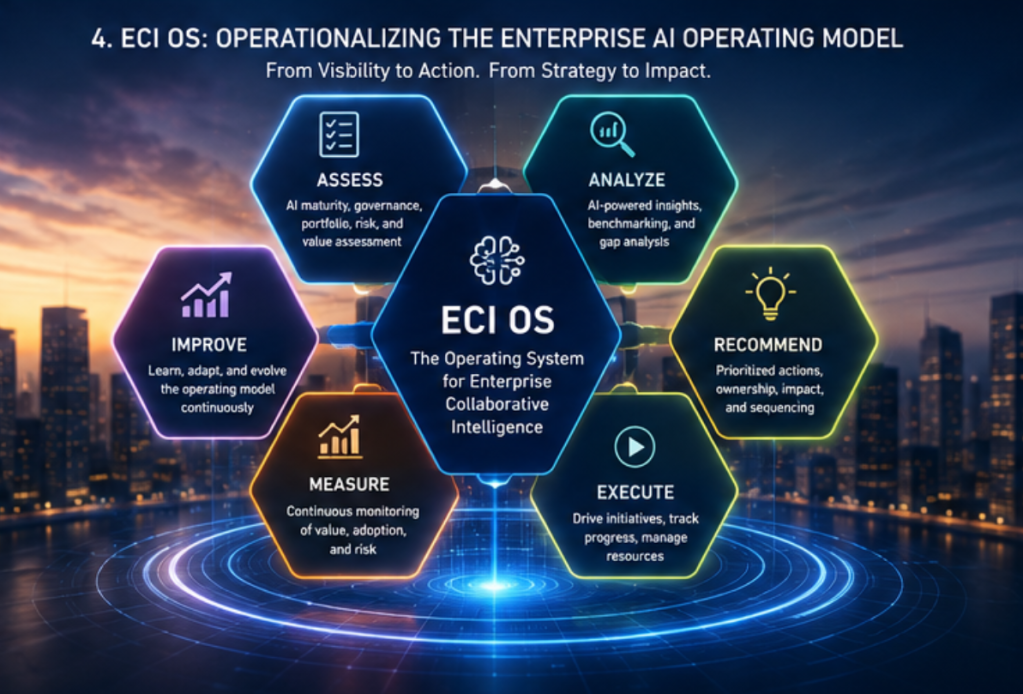
An operating model, by itself, is still only a blueprint.
Organizations have produced operating models for decades covering finance, supply chain, cybersecurity, digital transformation, enterprise architecture, and data governance. Many of them were well designed, clearly documented, and broadly communicated. Yet despite that effort, countless initiatives failed to achieve their intended outcomes because the operating model remained a document rather than becoming an operational management system.
Artificial intelligence presents an even greater challenge.
Unlike previous technology waves, AI evolves continuously. New foundation models emerge every few months. Existing software platforms rapidly introduce AI capabilities. Employees adopt new AI tools independently. AI agents begin executing increasingly complex workflows. Regulatory requirements evolve. Business priorities shift. Executive expectations continue to rise.
Static governance documentation cannot keep pace with that level of change.
This is where the next evolution begins.
An Enterprise AI Operating Model requires a digital operational layer that continuously measures, monitors, recommends, and guides executive decision-making. Rather than relying on quarterly presentations or annual governance reviews, leaders require an environment that reflects the current state of AI adoption across the enterprise and highlights where executive attention is needed.
This is precisely the role that ECI OS is designed to fulfill.

ECI OS | Enterprise Collaborative Intelligence Platform | CDO TIMES
ECI OS is designed as the operational platform that brings the Enterprise AI Operating Model to life. Instead of replacing executive judgment, it augments leadership by providing continuous visibility into enterprise AI activity, governance, portfolio performance, risk exposure, and business value realization.
In practical terms, the operating model defines how the enterprise should function. ECI OS enables leaders to execute that operating model every day.
From Reporting to Decision Intelligence
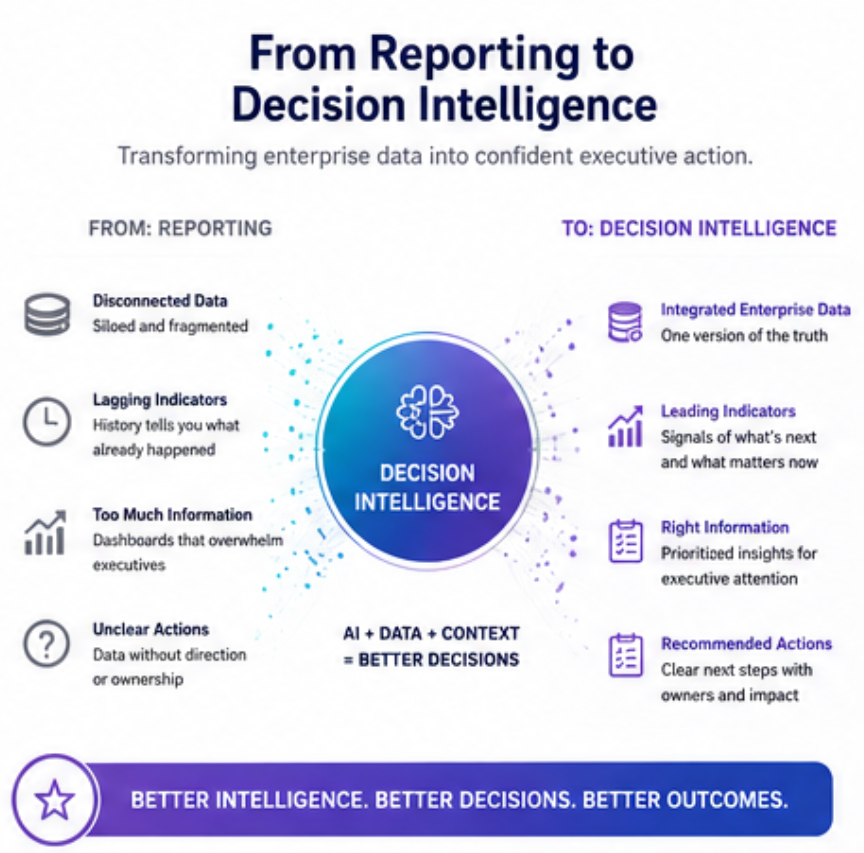
Traditional executive dashboards are primarily retrospective.
They summarize metrics. They display KPIs. They visualize trends. While these capabilities remain valuable, they rarely answer the question executives ultimately care about:
What should we do next?
Modern enterprise leadership increasingly requires decision intelligence rather than reporting.
Decision intelligence combines enterprise data, governance policies, business priorities, AI-generated insights, and executive context to recommend the next best action. Instead of asking leaders to interpret dozens of reports, the platform surfaces the few issues requiring executive attention.
Within an Enterprise AI Operating Model, decision intelligence becomes the mechanism that transforms information into action.
Rather than presenting hundreds of disconnected data points, executives receive prioritized recommendations such as:
- Consolidate overlapping AI initiatives within two business units.
- Review newly discovered Shadow AI applications before regulatory exposure increases.
- Accelerate deployment of a high-performing AI capability that is demonstrating measurable value.
- Pause funding for initiatives that have failed to achieve expected adoption.
- Launch governance reviews for high-risk AI agents operating without documented ownership.
The objective is not to automate executive leadership. It is to improve executive decision quality.
This reflects one of the core principles behind Enterprise Collaborative Intelligence: artificial intelligence should elevate human judgment rather than replace it.
A Practical Enterprise Scenario
Consider a global manufacturing organization with operations across North America, Europe, and Asia-Pacific.
During the first two years of AI adoption, multiple business units independently launched initiatives to improve engineering productivity, procurement automation, customer support, predictive maintenance, marketing content generation, software development, and financial forecasting.
Each initiative appeared successful in isolation.
However, after two years, executive leadership faced a very different picture.
Technology teams reported more than 250 AI-enabled initiatives across the organization.
Procurement had contracted with over forty AI-related vendors.
Several departments purchased overlapping copilots that addressed nearly identical business problems.
Cybersecurity identified increasing usage of public generative AI services without enterprise approval.
Enterprise architecture struggled to maintain visibility into rapidly evolving AI-enabled applications.
Finance could not determine which initiatives had produced measurable business value.
The executive committee possessed significant AI activity but limited enterprise intelligence.
The organization did not need another strategy workshop.
It needed an operating model.
Using an Enterprise AI Operating Model supported by an operational platform such as ECI OS, leadership could begin addressing these challenges systematically.
The first step would be establishing portfolio transparency by creating a unified inventory of AI initiatives, business owners, technologies, expected benefits, costs, governance status, and organizational dependencies.
Next, governance workflows would identify initiatives requiring executive review while allowing lower-risk use cases to proceed with appropriate oversight.
Portfolio analytics would identify duplicate investments, overlapping capabilities, redundant vendor contracts, and opportunities for consolidation.
Executive scorecards would provide continuous visibility into value realization, adoption rates, governance maturity, and organizational readiness.
Most importantly, executive leadership would begin operating AI as an enterprise capability rather than managing isolated projects.
Why This Approach Is Difficult to Copy
Technology platforms are increasingly becoming commodities.
Most organizations can purchase AI models, copilots, development platforms, orchestration tools, and analytics software from multiple vendors.
Competitive advantage no longer comes from acquiring AI technology alone.
It comes from operating AI more effectively than competitors.
This is where the Enterprise AI Operating Model creates long-term differentiation.
Unlike individual AI tools, an operating model combines governance, organizational design, executive accountability, enterprise architecture, portfolio management, financial transparency, workforce transformation, and continuous improvement into a single management system.
Competitors can purchase similar software.
They cannot easily replicate years of organizational capability development.
That is why successful enterprises increasingly focus less on individual AI technologies and more on creating sustainable operating capabilities that evolve as technology changes.
Enterprise Collaborative Intelligence: Connecting Strategy, Operations, and Execution
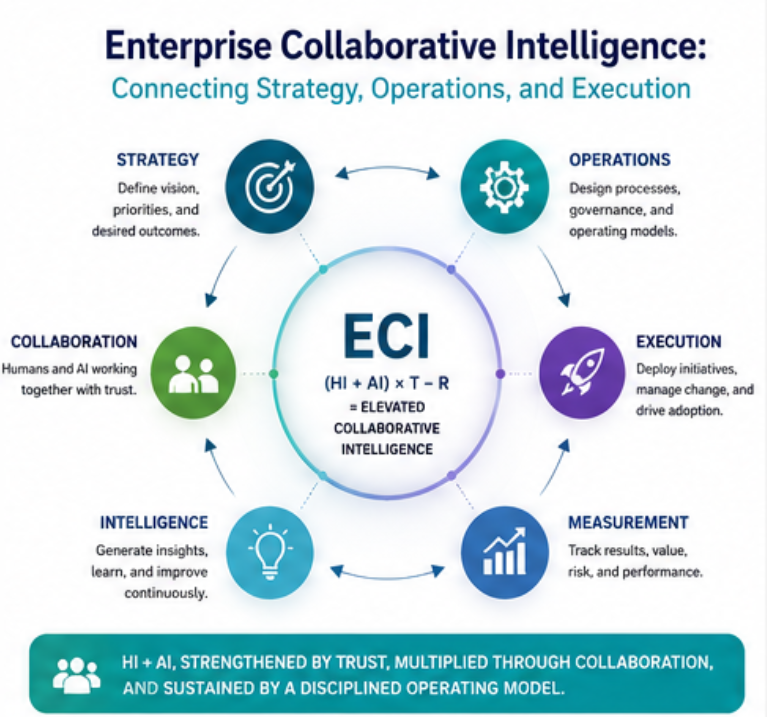
This perspective also represents the next evolution of the Enterprise Collaborative Intelligence (ECI) framework.
The original ECI equation:
(HI + AI) × T − R = ECI
emphasizes that enterprise value emerges from combining Human Intelligence and Artificial Intelligence while strengthening trust and reducing organizational resistance.
As organizations mature, however, another realization becomes clear.
Even organizations with highly capable people, advanced AI technologies, and strong executive sponsorship may still struggle if they lack a repeatable operating model.
Enterprise Collaborative Intelligence therefore extends beyond collaboration between humans and AI.
It becomes the operating philosophy that connects strategy, governance, architecture, technology, organizational change, executive leadership, and continuous value realization.
Within this context:
- Enterprise Collaborative Intelligence provides the philosophy.
- The Enterprise AI Operating Model provides the management methodology.
- Enterprise AI Operations provides the operational discipline.
- ECI OS provides the digital platform that operationalizes the methodology.
Together, these elements establish a comprehensive enterprise system rather than a collection of disconnected frameworks.
Looking Beyond Today’s AI Landscape

Artificial intelligence continues to evolve rapidly.
The next generation of enterprise AI will likely include autonomous agents, multi-agent collaboration, continuous reasoning, adaptive workflows, digital workforce management, and increasingly autonomous business processes.
As these capabilities mature, governance complexity will increase rather than decrease.
Organizations will require greater transparency into autonomous decisions, agent accountability, operational risk, regulatory compliance, financial optimization, and executive oversight.
The organizations that succeed will not necessarily possess the most advanced models.
They will possess the most mature operating systems for managing those models.
History provides many examples of technological breakthroughs that ultimately became widely available.
Competitive advantage rarely remained with the organization that adopted technology first.
Instead, advantage shifted toward organizations that learned how to operationalize technology more effectively than everyone else.
Artificial intelligence is unlikely to be different.
The CDO TIMES Bottom Line
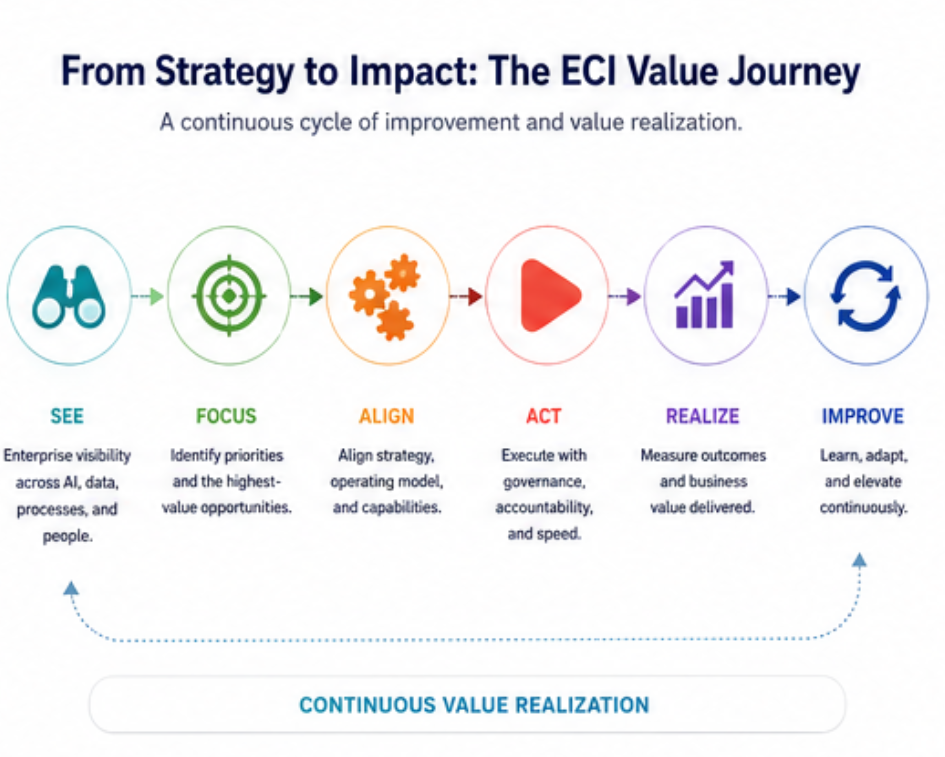
The conversation surrounding enterprise AI is entering a new phase.
The first phase focused on experimentation.
The second focused on deployment.
The next phase will focus on operational excellence.
Organizations that continue viewing AI primarily as a collection of pilots, tools, or isolated business initiatives risk creating fragmented portfolios, inconsistent governance, duplicate investments, and unclear business value.
The organizations that lead over the next decade will think differently.
They will establish Enterprise AI Operating Models that define ownership, governance, decision rights, portfolio management, value realization, and executive accountability.
They will implement operational platforms that continuously monitor enterprise health, surface executive priorities, and transform data into informed decisions.
Most importantly, they will recognize that sustainable competitive advantage will come not from having more AI—but from operating AI better.
That is the next frontier of enterprise transformation.
It is not simply about becoming AI-enabled.
It is about becoming AI-operated.
Want to see what an Enterprise AI Operating Model looks like in practice?
Explore ECI OS — the executive operating system designed to help leaders answer five critical questions:
- Where are we?
- What needs my attention?
- Where are we wasting money?
- Where are we taking unacceptable risk?
- What should we do next?
Turn insight into action with CDO TIMES.
CDO TIMES helps executives move from AI awareness to AI execution through practical frameworks, tools, executive research, and advisory support.
Explore the Frameworks
Continue with Enterprise AI 2030, HI + AI = ECI, AI Governance, and executive playbooks.
Explore Enterprise AI 2030 →Use the Free Tools
Assess readiness, estimate AI ROI, model AI costs, and prioritize AI initiatives.
Open Executive Tools →Read the Book
Explore the HI + AI = ECI leadership model in The AI-Ready Leader.
Order The AI-Ready Leader →Go deeper with CDO TIMES Pro.
Unlock premium research, executive playbooks, templates, advanced tools, and member-only briefings.
Need executive help?
Explore advisory, workshops, fractional CIO/CDO/CISO/CAIO support, and AI operating model design.
Explore Advisory →Attend executive events
Join leadership forums, executive dinners, webinars, and strategic AI briefings.
View Events →Build AI capability
Use CDO TIMES Academy for executive learning, AI leadership development, and implementation training.
Explore Academy →