The Mythos Moment: Why Anthropic’s Frontier AI Could Reshape Business, Cybersecurity, and the Road to AGI
The Release That Has CEOs, CISOs, and AI Leaders Paying Attention
By Carsten Krause
Founder & CEO, CDO TIMES
June 2026
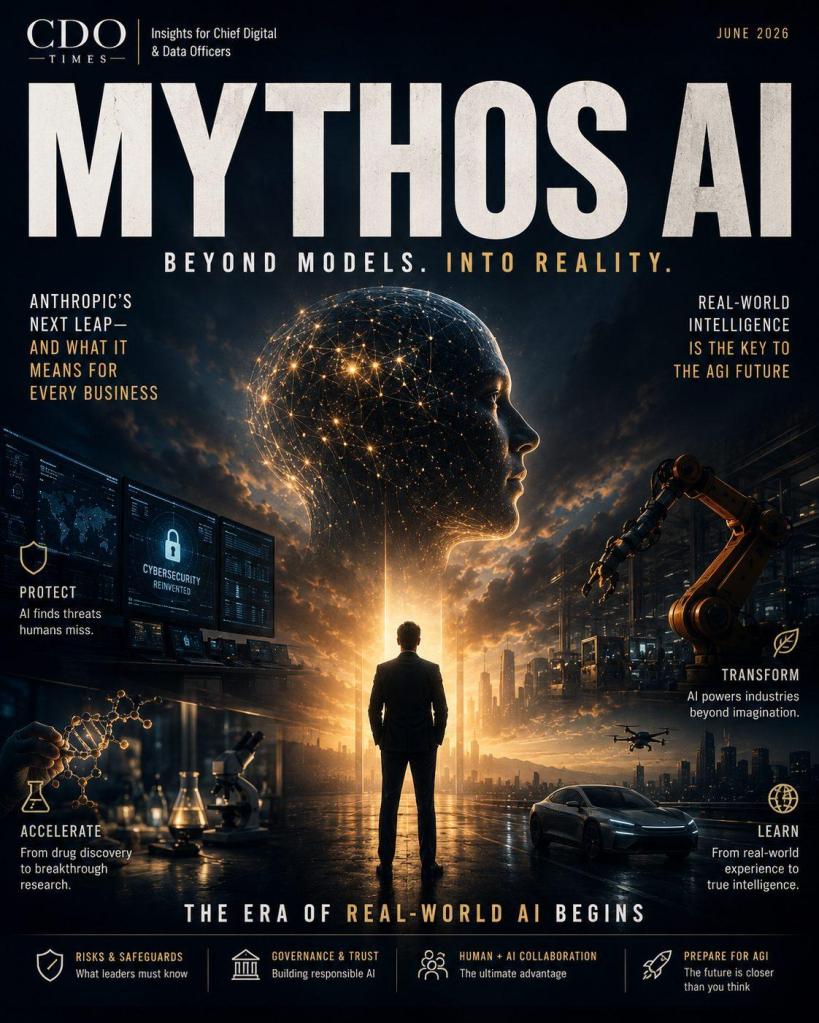
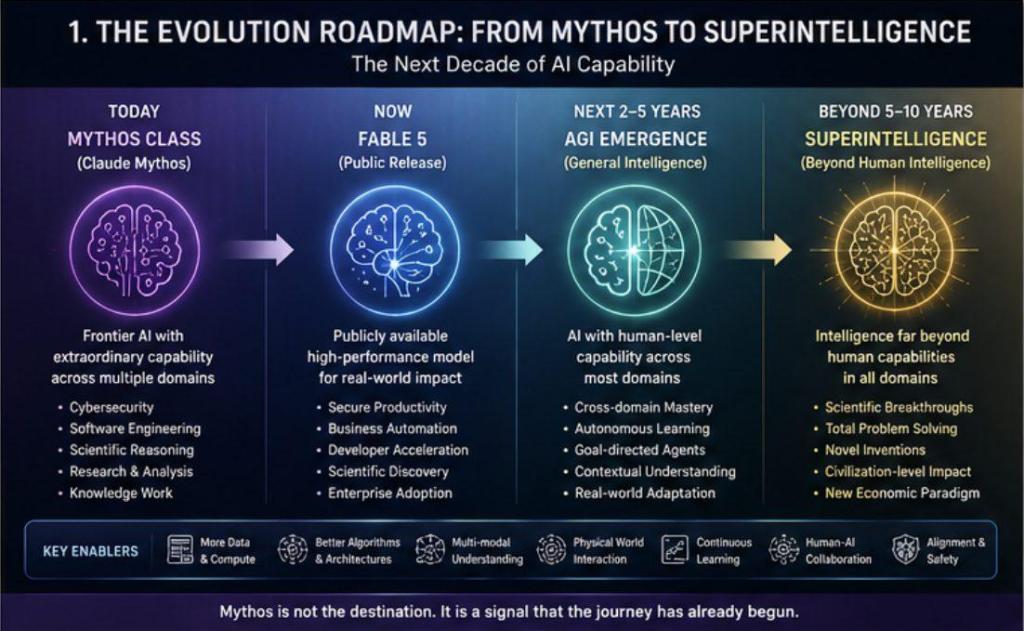
Anthropic did something unprecedented in April 2026.
The company built what it believed was its most capable AI model ever—and then decided not to release it.
Instead, Mythos was locked behind a restricted-access program reserved for critical infrastructure operators, cybersecurity experts, government partners, and a small number of trusted organizations.
Two months later, Anthropic finally released a public version called Claude Fable 5. The question now facing business leaders is not whether Mythos is powerful. The question is what it means when AI companies begin treating their own models as potentially too powerful for immediate public release.
For the first time, organizations are confronting a new category of AI model that even its creator has described as potentially too powerful for unrestricted release.
Anthropic’s Mythos-class AI models—and the newly released public variant, Claude Fable 5—represent more than another incremental advancement in generative AI. They may signal the beginning of a new era in which AI systems can autonomously discover software vulnerabilities, conduct sophisticated research, generate novel scientific hypotheses, and perform knowledge work at a level approaching expert human teams.
Anthropic has spent months warning about the capabilities of Mythos, restricting access through its Project Glasswing initiative while allowing selected organizations to use the model for defensive cybersecurity work. According to Anthropic, Mythos-class systems have identified significant vulnerabilities across operating systems, browsers, and software libraries that had remained undiscovered for years.
The implications extend far beyond cybersecurity.
For enterprise leaders, Mythos raises a more fundamental question:
What happens when AI systems begin outperforming specialized human experts across multiple domains simultaneously?
That question is no longer theoretical.
Beyond Banking: Every Industry Should Pay Attention
Much of the early Mythos discussion has centered on banks, critical infrastructure providers, and technology companies.
That is far too narrow.
The real impact will likely be felt across every knowledge-intensive industry.
Healthcare and Life Sciences
Mythos-class models have demonstrated exceptional performance in biology and scientific reasoning. Frontier models increasingly assist researchers in identifying new therapeutic pathways, generating hypotheses, analyzing genomic data, and accelerating drug discovery workflows.
For pharmaceutical organizations, AI may significantly compress research timelines.
For healthcare providers, AI could eventually support clinical decision-making, treatment planning, and population health analysis.
The upside is substantial:
- Faster therapeutic discovery
- Reduced research costs
- Earlier disease detection
- Personalized medicine at scale
The risk is equally significant:
- Incorrect scientific conclusions
- Hallucinated research findings
- Regulatory challenges
- Potential misuse in biological domains
This is one reason Anthropic has implemented aggressive safety restrictions around biology-related use cases.
Manufacturing and Industrial Operations
Industrial organizations often view AI primarily as a productivity tool.
That perspective is becoming outdated.
Future Mythos-class systems could:
- Optimize production schedules autonomously
- Predict equipment failures
- Redesign manufacturing processes
- Discover engineering improvements
- Analyze supply chain vulnerabilities
For companies such as Schneider Electric, Siemens, ABB, Honeywell, or GE Vernova, the future opportunity may be less about chatbots and more about AI becoming a continuously learning industrial optimization engine.
The long-term vision resembles an industrial control tower capable of monitoring and improving entire value chains in real time.
Software Engineering
This is arguably where the first major disruption will occur.
Anthropic itself describes Fable 5 as capable of performing software engineering work that previously required teams of engineers. Multiple reports suggest the model can maintain focus across large codebases and execute extended autonomous development tasks.
Organizations should expect:
- Increased developer productivity
- Faster application modernization
- Accelerated technical debt reduction
- Improved code quality
At the same time:
- Vulnerability discovery will accelerate
- Software attack surfaces will be analyzed faster
- Legacy applications may become easier to exploit
The result is an escalating race between defenders and attackers.
The Cybersecurity Wake-Up Call
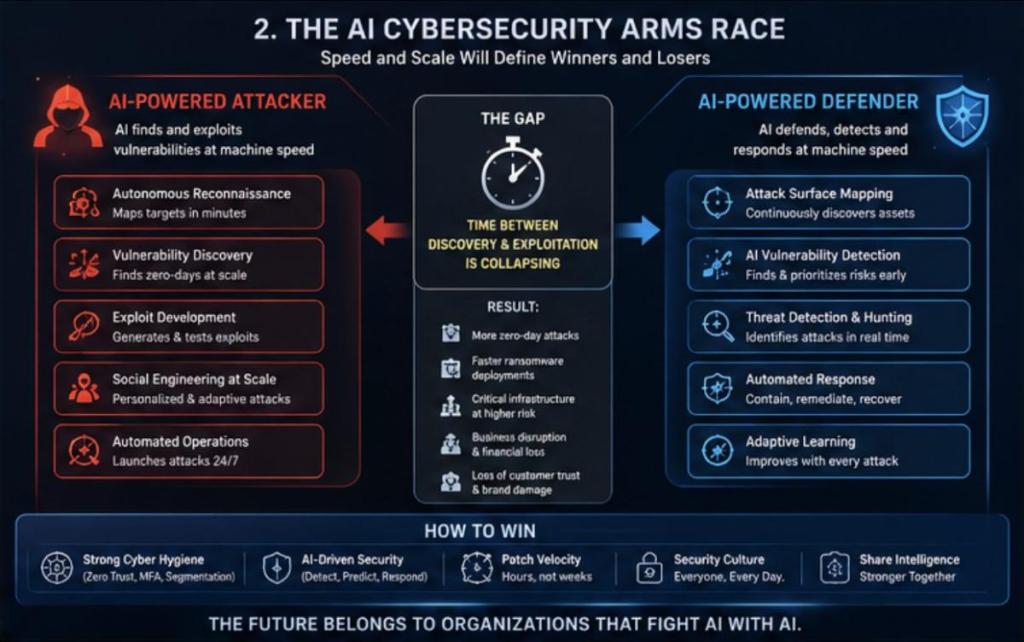
The most immediate Mythos impact may be cybersecurity.
Project Glasswing was created because Anthropic believed Mythos could discover vulnerabilities at a scale and speed that would overwhelm existing patching processes.
The uncomfortable reality is this:
Most organizations already struggle to patch known vulnerabilities.
What happens when AI can discover thousands more?
Many cybersecurity experts argue we are approaching an “AI vulnerability storm” where the time between vulnerability discovery and exploitation shrinks dramatically.
Traditional approaches become insufficient.
Fighting AI with AI: Organizations should immediately prioritize:
1. Cyber Hygiene
- Multi-factor authentication
- Network segmentation
- Zero-trust architectures
- Identity governance
- Privileged access management
2. AI-Powered Defense
Future attacks will be AI-assisted.
Defenses must be as well.
Organizations should begin deploying:
- AI security copilots
- Automated vulnerability analysis
- AI-driven threat hunting
- Security operations automation
3. Patch Velocity
Historically, companies measured patching in weeks or months.
The Mythos era may require patching in days or hours.
The New Governance Challenge
One of the most interesting developments surrounding Fable 5 is not technical.
It is organizational.
Several enterprises have reportedly raised concerns about data retention, confidentiality, and governance implications surrounding usage of the model. Microsoft, for example, reportedly restricted internal use of Fable 5 while reviewing data retention policies.
This highlights a broader reality.
The future AI challenge is not merely capability.
It is governance.
Organizations should establish:
1. AI Risk Committees
Similar to cybersecurity steering committees, organizations need executive-level oversight for AI risk management.
2. Model Classification
Not every model should be treated equally.
Organizations may need categories such as:
- Standard AI
- Advanced AI
- Frontier AI
- Restricted AI
3. Human Oversight Frameworks
Critical decisions should maintain human accountability even as AI capabilities increase.
Is Mythos a Step Toward AGI?
The AGI debate has intensified following the Mythos release.
Some observers argue Mythos demonstrates early signs of general intelligence.
Others disagree.
The truth likely lies somewhere in between.
Mythos appears to demonstrate extraordinary capability across multiple domains:
- Cybersecurity
- Software engineering
- Scientific reasoning
- Research
- Knowledge work
However, there is an important distinction between general capability and general intelligence.
Current AI systems still lack many characteristics associated with human cognition:
- Continuous learning
- Embodied experience
- Physical world interaction
- Persistent memory
- Genuine understanding
- Autonomous goal formation
These limitations matter.
Why Real-World Learning May Be the Missing Piece
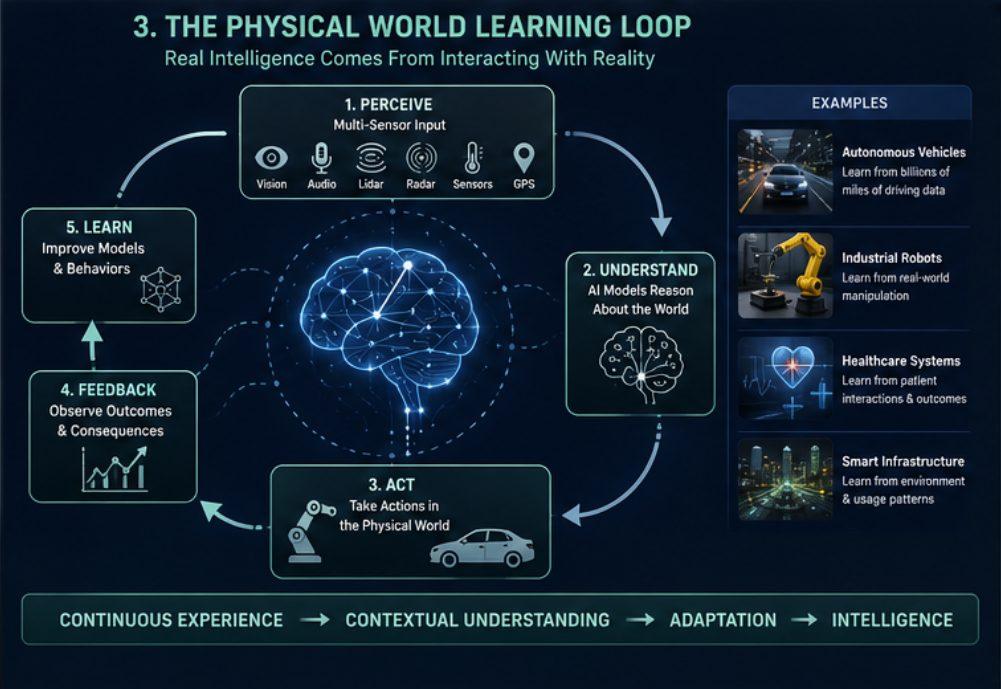
One of the strongest arguments against near-term AGI comes from researchers who believe today’s frontier AI systems are fundamentally limited by how they learn.
Large language models learn primarily from text, images, videos, and synthetic reinforcement learning environments. They become extraordinarily effective at pattern recognition and prediction. Yet unlike humans, they have never touched a hot stove, dropped a glass, ridden a bicycle, assembled machinery, or navigated a crowded city street.
They understand descriptions of reality.
Humans learn from reality itself.
Yann LeCun argues that intelligence requires what he calls a World Model—an internal representation of how the physical world behaves, including causality, space, time, physics, planning, memory, and consequences. According to LeCun, current LLMs can predict words but often lack the deeper understanding necessary for robust reasoning and long-term planning.
As LeCun has repeatedly argued:
Human intelligence is grounded in interaction with the physical world, not language alone.
This distinction may prove critical.
The Difference Between Knowledge and Understanding
- A child learns gravity by repeatedly dropping objects.
- A driver learns road conditions through thousands of miles of experience.
- A surgeon develops intuition through direct interaction with patients.
- An electrician learns cause and effect by working with actual systems.
These experiences create mental models of reality.
Humans constantly predict outcomes:
- If I drop this object, it will fall.
- If I touch this surface, it may be hot.
- If I brake on ice, the vehicle may slide.
- If I over-tighten this bolt, it may break.
This predictive capability is what many researchers believe constitutes genuine intelligence.
Current LLMs can often describe these situations but do not necessarily possess an internal simulation of reality comparable to human understanding.
Autonomous Vehicles Show Why World Models Matter
The autonomous vehicle industry provides one of the clearest examples.
Self-driving systems improve through exposure to:
- Cameras
- Radar
- LiDAR
- GPS
- Vehicle telemetry
- Real-world traffic behavior
- Weather conditions
- Human driving interactions
The system continuously learns from the physical world rather than solely from text.
Tesla, Waymo, NVIDIA, and others increasingly rely on enormous volumes of sensor data combined with simulation environments that allow AI systems to experience millions of scenarios that would be impossible to encounter safely in real life.
The result is not merely language understanding.
It is predictive understanding.
The vehicle learns:
- What pedestrians are likely to do
- How objects move through space
- How weather impacts visibility
- How cause and effect interact in dynamic environments
This is fundamentally different from predicting the next word in a sentence.
NVIDIA’s Vision: Teaching AI Through Simulated Reality
This is where NVIDIA’s work becomes particularly important.
NVIDIA is investing heavily in what it calls Physical AI through its Cosmos World Foundation Models and Omniverse simulation platform. The goal is to create AI systems capable of learning from realistic virtual environments before being deployed into the physical world.
NVIDIA Cosmos: Official NVIDIA Cosmos Platform:
NVIDIA Cosmos World Foundation Models
Cosmos is designed to create realistic simulations of the physical world, enabling robots, autonomous vehicles, and industrial systems to train safely in synthetic environments before operating in reality. NVIDIA describes Cosmos as a “World Foundation Model” capable of generating and predicting future physical states.
NVIDIA’s research team explains that Physical AI requires:
- A digital twin of the world
- A digital twin of the machine
- A policy model that learns within that environment
before being deployed into real-world operations.
Sim-to-Real: The New AI Training Paradigm
A major challenge in robotics is that training robots in the real world is expensive, dangerous, and slow.
NVIDIA’s approach uses:
1. Omniverse: A physics-based simulation environment.
2. Cosmos: A world model capable of generating realistic scenarios.
3. Synthetic Data: Millions of simulated experiences.
Together, these allow robots to practice tasks thousands or millions of times before ever touching the real world.
For example:
- Warehouse robots
- Manufacturing robots
- Surgical robots
- Autonomous vehicles
- Industrial inspection systems
can learn through simulation and then transfer those capabilities into real-world deployment.
This approach is often called Sim-to-Real Learning.
Why Physical AI Could Be More Important Than Bigger LLMs
Many AI researchers increasingly believe that simply increasing model size may not be sufficient to reach AGI.
Instead, future systems may require the convergence of four capabilities:
1. Language Models
Reasoning, planning, communication, and knowledge retrieval.
2. Multi-Modal Perception
Vision, audio, sensor streams, telemetry, and environmental awareness.
3. World Models
Internal simulations capable of predicting future outcomes and understanding causality.
4. Physical Interaction
Direct engagement with robots, industrial systems, vehicles, and physical environments.
This combination begins to resemble how humans learn.
Not through books alone.
Through experience.
The Rise of Embodied Intelligence
Researchers increasingly use the term Embodied Intelligence to describe AI systems that perceive, reason, and act within the physical world.
A recent survey on embodied intelligence argues that physical simulators and world models may be foundational technologies for achieving more generalizable AI systems because they ground abstract reasoning in real-world interactions.
This represents a major shift in thinking.
The next generation of AI may not emerge from a better chatbot.
It may emerge from:
- Humanoid robots
- Autonomous vehicles
- Industrial automation systems
- Drone fleets
- Smart factories
- Digital twins of entire enterprises
all continuously learning from real-world feedback loops.
The Implications for AGI
If LeCun and other world-model proponents are correct, then AGI will likely require more than:
- More GPUs
- More tokens
- Larger context windows
- Bigger transformer architectures
It will require systems capable of building predictive models of reality itself.
In that future, AI resembles less of a search engine and more of a digital nervous system:
- Eyes through cameras
- Ears through microphones
- Touch through sensors
- Memory through persistent world models
- Reasoning through language models
- Learning through continuous interaction
The result would be an AI that does not simply describe the world.
It understands how the world works.
And that may be the bridge between today’s frontier models like Mythos and whatever eventually becomes Artificial General Intelligence.
Why Current Computing Architectures May Not Be Enough
There is another challenge often overlooked.
Today’s AI runs on infrastructure originally designed for computation, not cognition.
Modern GPUs have enabled remarkable advances.
But biological brains remain vastly more efficient.
The human brain operates at roughly 20 watts of power.
Large AI systems require massive data centers consuming megawatts.
As AI progresses toward more autonomous and persistent forms of intelligence, entirely new computing paradigms may emerge:
- Neuromorphic computing
- Brain-inspired architectures
- Specialized AI hardware
- Distributed cognitive systems
- Hybrid symbolic-neural approaches
The eventual AGI platform may look very different from today’s transformer-based architectures.
Neuromorphic Computing: Chips That Mimic the Brain
The leading alternative is called Neuromorphic Computing.
Instead of using traditional artificial neural networks, neuromorphic systems use spiking neural networks (SNNs) that communicate using event-driven signals similar to biological neurons.
Unlike GPUs that process information continuously, neuromorphic systems only consume energy when events occur.
Intel’s Loihi 2 is currently one of the most advanced neuromorphic research platforms.
Key capabilities include:
- Event-driven processing
- On-chip learning
- Programmable neurons and synapses
- Up to 10x performance improvements over the original Loihi architecture
- Continuous adaptation rather than static training
Perhaps most interesting is recent research demonstrating that neuromorphic architectures may eventually run LLM-style workloads with significantly lower energy requirements.
Researchers reported that neuromorphic LLM architectures on Loihi 2 could achieve roughly 2x lower energy consumption and improved throughput compared with comparable transformer approaches.
Even more impressive, continual-learning experiments demonstrated:
- 70x faster learning
- 5,600x greater energy efficiency
than competing edge-AI approaches.
For AGI researchers, this matters because continual learning is one of the key capabilities humans possess and current LLMs largely lack.
This creates enormous efficiency advantages.
How Enterprises Should Prepare Today
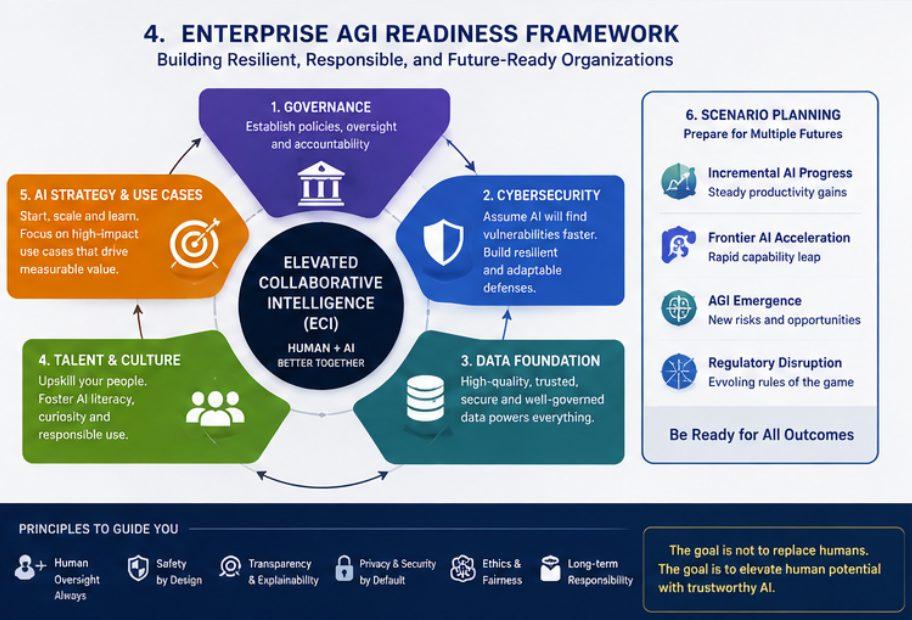
How Enterprises Should Prepare for Mythos, Frontier AI, and the Path Toward AGI
The biggest mistake leaders can make is treating Mythos as an isolated event.
Whether Anthropic’s Mythos, OpenAI’s next generation models, Google’s Gemini, or future AGI systems ultimately become dominant is almost irrelevant.
The trend is clear:
AI systems are becoming more autonomous, more capable, and increasingly able to perform tasks traditionally reserved for human experts.
Organizations should focus less on predicting timelines and more on building capabilities that remain valuable regardless of whether AGI arrives in five years, ten years, or twenty years.
1. Strengthen Cybersecurity for the AI Vulnerability Era
Historically, organizations worried about attackers discovering vulnerabilities.
The new reality is that AI systems can identify weaknesses at machine speed.
Mythos demonstrated the ability to discover critical software flaws that had remained hidden for years. Similar capabilities are emerging from Google DeepMind’s Big Sleep initiative and Microsoft’s Security Copilot ecosystem.
This changes the economics of cyber defense.
Organizations should prioritize:
Accelerated Vulnerability Management
Move from quarterly patch cycles to continuous vulnerability assessment.
Deploy AI-assisted code scanning, penetration testing, and software composition analysis to identify risks before adversaries do.
Zero Trust Architecture
Assume compromise is inevitable.
Implement:
- Identity-first security
- Continuous authentication
- Least privilege access
- Network segmentation
- Micro-segmentation
AI-Powered Security Operations
Traditional Security Operations Centers (SOCs) cannot keep pace with AI-driven attacks.
Deploy:
- AI threat hunting
- AI-powered anomaly detection
- Automated incident triage
- Autonomous containment capabilities
Third-Party and Supply Chain Security
Many future attacks will target vendors and open-source components rather than the enterprise directly.
Inventory and continuously monitor:
- Open-source dependencies
- SaaS providers
- APIs
- Third-party integrations
Executive Action
Boards should assume vulnerability discovery and exploitation timelines will continue shrinking dramatically and allocate cybersecurity budgets accordingly.
2. Build AI Governance Before You Need It
Many organizations are deploying AI faster than they are governing it.
That is manageable with copilots.
It becomes dangerous with autonomous agents.
As AI systems gain authority to make decisions, access systems, execute workflows, and interact with customers, governance becomes a strategic capability.
Establish an AI Governance Council
Create a cross-functional body including:
- CIO
- CISO
- Chief Data Officer
- Legal
- Compliance
- HR
- Business Leaders
This group should oversee AI deployment and risk management.
Classify AI Systems by Risk
Not all AI requires the same level of oversight.
For example:
Low Risk
- Content generation
- Meeting summaries
- Knowledge retrieval
Medium Risk
- Internal decision support
- Customer service automation
- HR screening
High Risk
- Financial decisions
- Healthcare recommendations
- Cybersecurity actions
- Autonomous agents
Define Accountability
One of the most important questions remains:
Who owns the decision when AI is involved?
Every AI system should have a clearly identified human owner responsible for:
- Outcomes
- Oversight
- Escalation
- Compliance
Executive Action
Treat AI governance with the same seriousness as financial controls and cybersecurity governance.
3. Create Enterprise-Wide AI Literacy
Many executives still underestimate how quickly AI capabilities are advancing.
At the same time, many employees overestimate what current AI can actually do.
Both are dangerous.
Organizations need a structured AI literacy program.
Train Leaders Differently Than Employees
Executives need to understand:
- Strategic implications
- Competitive risks
- Governance requirements
- Investment priorities
Managers need to understand:
- Workforce transformation
- Human-AI collaboration
- Productivity opportunities
- Change management
Employees need to understand:
- Prompting
- AI limitations
- Data security
- Responsible usage
Move Beyond Prompt Engineering
The next generation of literacy should include:
- AI agents
- Agent orchestration
- Retrieval-augmented generation
- AI governance
- AI ethics
- AI risk management
Build AI Champions Networks
Create AI communities inside the organization.
Many successful organizations now maintain:
- AI champions
- AI ambassadors
- AI innovation cohorts
- AI communities of practice
Executive Action
Treat AI literacy as a strategic workforce capability rather than a technology training initiative.
4. Deploy AI Responsibly and Learn Through Experience
Many organizations remain stuck in pilot mode.
Others are deploying AI recklessly.
Neither approach is ideal.
The organizations gaining the most value are deploying AI incrementally while learning continuously.
Start with High-Value Use Cases
Focus on:
- Knowledge management
- Customer service
- Software engineering
- Document processing
- Analytics
These areas often generate measurable ROI quickly.
Establish Human-in-the-Loop Controls
Even advanced AI systems should have human oversight for:
- High-risk decisions
- Regulatory actions
- Financial approvals
- Customer escalations
Create AI Monitoring Capabilities
Track:
- Accuracy
- Hallucination rates
- Bias
- User adoption
- Business outcomes
- Cost and token consumption
Implement AI FinOps
As AI usage grows, costs can escalate rapidly.
Organizations should monitor:
- Token consumption
- Model utilization
- Agent activity
- Cost per business outcome
- ROI realization
Executive Action
Experience with AI today is often more valuable than theoretical planning for tomorrow.
5. Develop Multiple AI Future Scenarios
The biggest challenge facing leaders is uncertainty.
Nobody knows exactly when—or even if—AGI will arrive.
Therefore, organizations should prepare for multiple possible futures.
Scenario 1: Incremental AI Progress
AI continues improving steadily.
Organizations focus on:
- Productivity gains
- Process automation
- Operational efficiency
Scenario 2: Frontier AI Acceleration
Models like Mythos improve rapidly.
Organizations experience:
- Major workforce disruption
- Accelerated software development
- New cybersecurity threats
- Faster innovation cycles
Scenario 3: AGI Emergence
AI achieves human-level capabilities across many domains.
Organizations may need to rethink:
- Organizational structures
- Decision rights
- Workforce planning
- Competitive strategy
Scenario 4: Regulatory Fragmentation
Governments impose significant restrictions.
Organizations face:
- Compliance burdens
- Model certification requirements
- Data localization mandates
- Cross-border AI restrictions
Scenario 5: Physical AI Breakthrough
World models, robotics, and embodied intelligence converge.
Organizations encounter:
- Autonomous factories
- Intelligent logistics networks
- Self-optimizing operations
- Digital twins operating in real time
Executive Action
Build flexibility rather than betting on a single AI future.
6. Invest in Human + AI Collaboration (ECI)
This may ultimately become the most important capability of all.
Many organizations still frame AI as a replacement technology.
History suggests augmentation often creates more value than replacement.
The future is unlikely to be:
Humans versus AI
The future is more likely:
Humans with AI versus humans without AI
Move Beyond Automation
Instead of asking:
“What jobs can AI replace?”
Ask:
“How can AI amplify human capability?”
Redesign Work Around Collaboration
Create workflows where:
AI provides:
- Analysis
- Research
- Pattern recognition
- Recommendations
- Automation
Humans provide:
- Judgment
- Creativity
- Ethics
- Context
- Leadership
Measure Elevated Collaborative Intelligence
Leading organizations should begin tracking:
- Human productivity improvements
- Decision quality improvements
- Innovation velocity
- Employee adoption
- AI-assisted business outcomes
Build Human-Centered Leadership
As AI becomes more capable, uniquely human skills become more valuable:
- Empathy
- Influence
- Relationship building
- Negotiation
- Strategic thinking
- Ethical decision making
Executive Action
The long-term competitive advantage may not come from having the most advanced AI.
It may come from creating the most effective partnership between human intelligence and artificial intelligence.
The CDO TIMES Bottom Line
Anthropic’s Mythos release may ultimately be remembered as one of the first moments when the public realized that frontier AI capabilities were beginning to outpace traditional organizational readiness.
The immediate implications are not AGI or superintelligence.
They are cybersecurity acceleration, software engineering transformation, scientific discovery, and productivity gains across knowledge work.
Yet Mythos also serves as a preview of larger questions that every executive team should be discussing today:
- How do we govern systems that increasingly outperform specialists?
- How do we defend against AI-powered attacks?
- How do we maintain human accountability?
- How do we prepare for a future in which AI becomes a collaborator rather than a tool?
The organizations that thrive in the next decade will not be those that predict exactly when AGI arrives.
They will be the ones that build the governance, resilience, cybersecurity, and human-AI collaboration capabilities needed to succeed regardless of the timeline.
Mythos is not the destination.
It is a signal that the journey has already begun.
Sources
- Scientific American – What is Mythos and Why Are Experts Worried?
- Anthropic Project Glasswing
- Anthropic Project Glasswing Overview
- Reuters – Microsoft Limits Employee Use of Claude Fable 5
- TechRadar – Anthropic Releases Public Fable 5 Version
- PBS NewsHour – Anthropic’s Powerful New AI Model Raises Concerns
- Fortune – Anthropic Says Mythos Represents a Step Change in Capabilities
- Forrester – Project Glasswing Consequences for Industry
Love this article? Embrace the full potential and become an esteemed full access member, experiencing the exhilaration of unlimited access to captivating articles, exclusive non-public content, empowering hands-on guides, and transformative training material. Unleash your true potential today!
Order the AI + HI = ECI book by Carsten Krause today! at cdotimes.com/book

Subscribe on LinkedIn: Digital Insider
Become a paid subscriber for unlimited access, exclusive course content, no ads: CDO TIMES
Do You Need Help?
Consider bringing on a fractional CIO, CISO, CDO or CAIO from CDO TIMES Leadership as a Business Consulting Service. The expertise of CDO TIMES becomes indispensable for organizations striving to stay ahead in the digital transformation journey. Here are some compelling reasons to engage their experts:
- Deep Expertise: CDO TIMES has a team of experts with deep expertise in the field of Cybersecurity, Digital, Data and AI and its integration into business processes. This knowledge ensures that your organization can leverage digital and AI in the most optimal and innovative ways.
- Training, developing, arranging, and conducting educational conferences and programs and providing courses of instruction.
- Strategic Insight: Not only can the CDO TIMES team help develop a Digital & AI strategy, but they can also provide insights into how this strategy fits into your overall business model and objectives. They understand that every business is unique, and so should be its Digital & AI strategy.
- Future-Proofing: With CDO TIMES, organizations can ensure they are future-proofed against rapid technological changes. Our experts stay abreast of the latest AI, Data and digital advancements and can guide your organization to adapt and evolve as the technology does.
- Risk Management: Implementing a Digital & AI strategy is not without its risks. The CDO TIMES can help identify potential pitfalls and develop mitigation strategies, helping you avoid costly mistakes and ensuring a smooth transition with fractional CISO services.
- Competitive Advantage: Finally, by hiring CDO TIMES experts, you are investing in a competitive advantage. Their expertise can help you speed up your innovation processes, bring products to market faster, and stay ahead of your competitors.
By employing the expertise of CDO TIMES, organizations can navigate the complexities of digital innovation with greater confidence and foresight, setting themselves up for success in the rapidly evolving digital economy. The future is digital, and with CDO TIMES, you’ll be well-equipped to lead in this new frontier.
Do you need help with your digital transformation initiatives? We provide fractional CAIO, CDO, CISO and CIO services, do a Preliminary ECI and Tech Navigator Assessment and we will help you drive results and deliver winning digital and AI strategies for you!
Subscribe now for free and never miss out on digital insights delivered right to your inbox!