Helping Organizations Transform Data into Decisions with AI – Digital First Magazine

Connect.Explore.Inspire.Excel
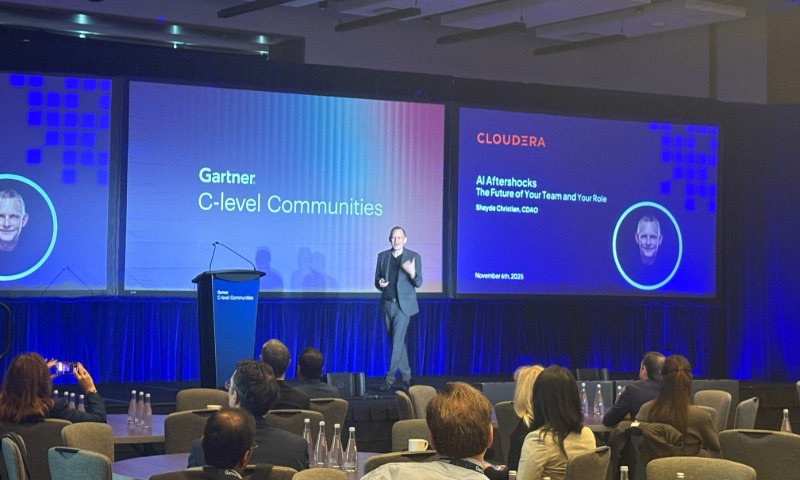
Shayde Christian is the Chief Data and Analytics Officer at Cloudera where he leads data-driven cultural transformation to help organizations realize maximum value from data and AI. Shayde works with customers to optimize their Cloudera investments and build high-value use cases that deliver measurable business impact. Before joining Cloudera, Shayde served as a principal consultant advising Fortune 500 companies on data strategy and enterprise information management.
Recently, in an exclusive interview with Digital First Magazine, Shayde shared insights into how his path from Fortune 500 data consultant to Fortune 200 healthcare leader shaped his mission to turn data into business outcomes. He sees AI moving from experimentation to execution, with trust in data and measurable ROI now the real barriers to scale. His advice to new tech talent: use AI immediately, learn to direct it with natural language, and build something practical. The following excerpts are taken from the interview.
I started my career as a consultant helping Fortune 500 companies develop data strategies and, in some cases, helping data organizations recover when programs were not delivering the expected outcomes. From there, I moved into enterprise leadership roles, eventually leading data and analytics for a Fortune 200 healthcare company. Today, I serve as Chief Data & Analytics Officer at Cloudera.
The common thread throughout that journey has been helping organizations turn data into business outcomes. The technology has changed dramatically over the years, but the challenge has remained largely the same: helping leaders make better decisions, move faster, and create measurable value from their investments.
The biggest trend I see is the shift from AI experimentation to AI execution.
For the last several quarters, nearly every executive conversation has centered on AI agents, AI at scale, and AI ROI. Most organizations have already proven that AI can work. The question now is whether it can deliver meaningful business value beyond a handful of pilots and proofs of concept.
Customers are increasingly focused on operationalizing AI, embedding it into workflows, and measuring outcomes such as revenue growth, cost optimization, customer experience improvements, and risk reduction. The conversation is becoming much less about the technology itself and much more about measurable business results.
Trust remains one of the biggest barriers. Organizations need confidence in both the data being supplied to AI systems and the reliability of the outputs those systems generate. If users do not trust the answers, they will not use the solution. If leaders do not trust the outcomes, they will not scale the investment.
Another challenge is data readiness. AI performs best when business context is clear, data is well organized, definitions are consistent, and governance practices are in place.
Many organizations also struggle with selecting the right use cases. Not every AI project deserves enterprise-scale investment. Success usually starts by identifying opportunities that solve real business problems and produce measurable outcomes.

Trust, scale, and returns are tightly connected. Organizations typically begin by establishing trust through strong data foundations, governance, and human oversight. As trust increases, they become comfortable applying AI to more important business processes.
That creates opportunities to scale successful use cases across additional teams and workflows. As adoption grows, organizations begin generating measurable business outcomes and can demonstrate return on investment.
When value is proven credibly, leaders are more willing to continue investing. That investment improves capabilities, expands adoption, and creates additional value. In my experience, organizations rarely achieve AI at scale without first establishing trust in the underlying data and outcomes. Without scale, returns tend to hit a ceiling.
One solution I am particularly excited about is our Natural Language Querying, or NLQ, platform. NLQ allows employees to ask business questions using everyday language and receive insights, visualizations, and dashboards without requiring deep technical expertise. Historically, many employees depended on data analysts and reporting teams, which often created lengthy queues and delays.
By enabling self-service access to insights, we are dramatically reducing the time required to answer business questions while expanding access to data-driven decision making across the organization. Time to insight has dropped over 90% for natural language speakers.
The results have been significant internally, and we believe the same approach can help our customers accelerate insight generation and improve decision velocity within their own organizations.
Use AI immediately and use it often. One of the best learning exercises is to identify tasks from a role you have already performed and use AI to automate portions of that work. Build something practical. Experiment. Improve it. Break it and fix it.
The future will not belong only to people who can code. It will also belong to people who can effectively direct AI, evaluate its outputs, govern its use, and apply it responsibly to real business problems. Learning how to collaborate with AI through natural language is becoming an essential professional skill. The sooner you start developing that skill, the better positioned you will be.
Content Disclaimer
Home
About Us
Privacy Policy
Terms & Conditions
Content Disclaimer
Partner With Us
Content Contribution
Subscribe
Contact Us
Bulletin Board
source
This article was autogenerated from a news feed from CDO TIMES selected high quality news and research sources. There was no editorial review conducted beyond that by CDO TIMES staff. Need help with any of the topics in our articles? Schedule your free CDO TIMES Tech Navigator call today to stay ahead of the curve and gain insider advantages to propel your business!