Industrial AI After the Pilot: Where Energy, Operations and Human Judgment Meet
THE CDO TIMES / EXECUTIVE RESEARCH / INDUSTRIAL AI
Factory floors, power systems and transport networks need more than promising AI demonstrations. The path to scale runs through measurable plant economics, operational technology safeguards and clear authority for the people responsible for physical outcomes.
BY CARSTEN KRAUSE | CDO TIMES | UPDATED NOVEMBER 4, 2026 | 3,824 WORDS OF ANALYSIS
In industrial AI, the difference between a persuasive demo and a trusted operating capability is measured in energy, uptime, safety and operator confidence.
The Industrial AI Conversation Has Changed
The executives gathering to discuss industrial AI no longer need a presentation proving that a model can classify an anomaly or summarize a maintenance record. They need to know whether an intervention produces a repeatable improvement in uptime, energy intensity, safety, quality or customer service without introducing an unacceptable new failure mode. That distinction surfaced at Microsoft Frontier Tour Paris in October 2026, when Fabrice Kermorgant moderated an “Industrial Intelligence Unlocked” discussion involving Schneider Electric Group CIO Audrey Hazak and leaders from other infrastructure-intensive sectors [1]. His published recap identified measurable and scalable value, trust by design, and the human dimension of transformation as three takeaways. Those are the moderator’s reported themes, not verbatim statements attributed to each panelist, and they provide a useful frame for the industrial AI investment agenda.
The stakes are different when software influences a physical asset. A misleading answer in an internal knowledge base can waste time; a poor recommendation involving a cooling plant, industrial drive or rail network can create equipment, reliability or safety consequences. Industrial systems also operate under constraints that do not disappear because a machine-learning model is accurate in a test environment. Operators must manage maintenance windows, production commitments, equipment aging, environmental variability and cybersecurity obligations simultaneously. As a result, the best industrial AI architecture is not automatically the most autonomous one; it is the design that improves decisions within verifiable operating boundaries.
Energy Is Both the Constraint and the Opportunity
AI has a dual relationship with energy. Its computing infrastructure creates demand for electricity, while its analytical and control capabilities may help energy-intensive operations improve efficiency. The International Energy Agency’s 2025 Energy and AI report examined both sides of that equation and projected significant growth in data-center power requirements as AI adoption expands [12]. A subsequent IEA outlook described data-center electricity consumption rising from about 485 terawatt-hours in 2025 to around 950 terawatt-hours in 2030 in its central projection [13]. That is a scenario, not a guaranteed outcome, and the report emphasizes constraints and uncertainty across the energy system.
Industrial buyers should therefore evaluate AI energy economics on two sides of the ledger. The potential gains include lower electricity use per unit of output, fewer unplanned shutdowns, reduced scrap and better scheduling of energy-intensive activity. The costs include compute, sensing, networking, integration, controls, model operations and workforce change, as well as the electricity consumed by AI infrastructure itself. A project that saves local operator time but materially raises energy use or maintenance burden may still be worth doing, but the trade-off must be explicit. Energy, production and IT teams should approve a joint benefit statement rather than maintain separate scorecards that can each show success while the enterprise total remains uncertain.

FIGURE 1 | The physical test of industrial AI: real plant operations, OT/IT integration, human governance and the ECI operating lens. Conceptual executive visualization.
Case Study: Schneider Electric Hyderabad Makes the Business Case Tangible
Schneider Electric’s Hyderabad manufacturing site offers a documented example of a data-and-operations program rather than a standalone AI pilot. In its December 2023 account of the plant’s World Economic Forum Sustainability Lighthouse recognition, Schneider described an advanced cloud-based manufacturing system, IoT-connected devices and predictive analytics used for operating decisions [2]. Over four years, the company reported a 59 percent reduction in energy consumption, a 61 percent reduction in carbon dioxide emissions and a 57 percent reduction in water consumption. The World Economic Forum also reported a 64 percent reduction in normalized waste generation in its site description [3]. Those are plant-level transformation results attributed to a combination of technology and operating changes, not isolated causal effects of a single AI model.
The mechanism is more instructive than the trophy. Schneider reports targeting major energy users such as compressors and chillers, using an IoT-based regulator for the former and a data-driven closed-loop control system for the latter [2]. This focuses investment where a measurable physical variable, an operational decision and an actuator can be connected. It also means the improvement must be maintained under changing production conditions, not just measured during a favorable demonstration week. For a CIO and COO, the decision lesson is to start with an economically material operating constraint, then design the data, controls and skills required to improve it safely.

FIGURE 2 | Schneider Electric Hyderabad: four-year reported plant-level improvements from a wider Industry 4.0 program. These are not isolated AI effects. Sources: [2] and [3].
Case Study: Le Vaudreuil Shows the Value of Operational Visibility
Schneider Electric’s Le Vaudreuil facility provides another long-running industrial reference point. In a 2022 Sustainability Lighthouse announcement, the company said that IIoT sensors, data visibility and digital platforms helped reduce power consumption by 25 percent, material waste by 17 percent and carbon dioxide emissions by 25 percent [4]. It also reported that cloud-connected analytics and AI-supported monitoring at a water-recycling station contributed to a 64 percent reduction in water use. These figures belong to a broader factory transformation and should not be merged into a single AI return-on-investment percentage. What matters is the traceable chain from measured condition to operating response to physical outcome.
That chain explains why industrial AI must be implemented with production engineers and plant teams rather than handed off as an abstract analytics service. Sensors need calibration, asset context needs maintenance, interventions require operating authority and performance must be normalized for changing production loads. A model might find a pattern that a technician did not have time to calculate, but the technician knows when a machine has recently been overhauled or a measurement is unreliable. Those human observations are not noise to be removed indiscriminately. They are part of the evidence required to keep the analytical system useful as the physical environment changes.
Case Study: Google DeepMind Demonstrates Bounded Autonomy
Google reported in 2016 that DeepMind technology reduced the energy used for data-center cooling by 40 percent during a live deployment, equivalent to a 15 percent reduction in overall power-usage-effectiveness overhead as the company described it [5]. In 2018, DeepMind reported a next-stage autonomous cooling system delivering approximately 30 percent energy savings on average within a more tightly bounded operating regime [6]. The percentages are from different stages and operating designs and should not be interpreted as a decline in performance or added together. The 2018 account is more revealing than the headline number because it explains the operating safeguards. Recommended actions were checked against constraints, verified again by a local control system and subject to human override.
That design offers an important corrective to the assumption that industrial AI reaches maturity only when humans disappear from the control loop. Operators specified acceptable boundaries and retained the authority to leave AI-control mode, while the optimization system acted within a defined envelope. Redundant verification and fallback controls reduced the dependence on any one model prediction. The organization could learn from control recommendations without surrendering its operational responsibility. In factories, data centers, buildings and power networks, a bounded agent that improves a verified physical outcome is often more valuable than an unrestricted agent that offers greater theoretical flexibility.
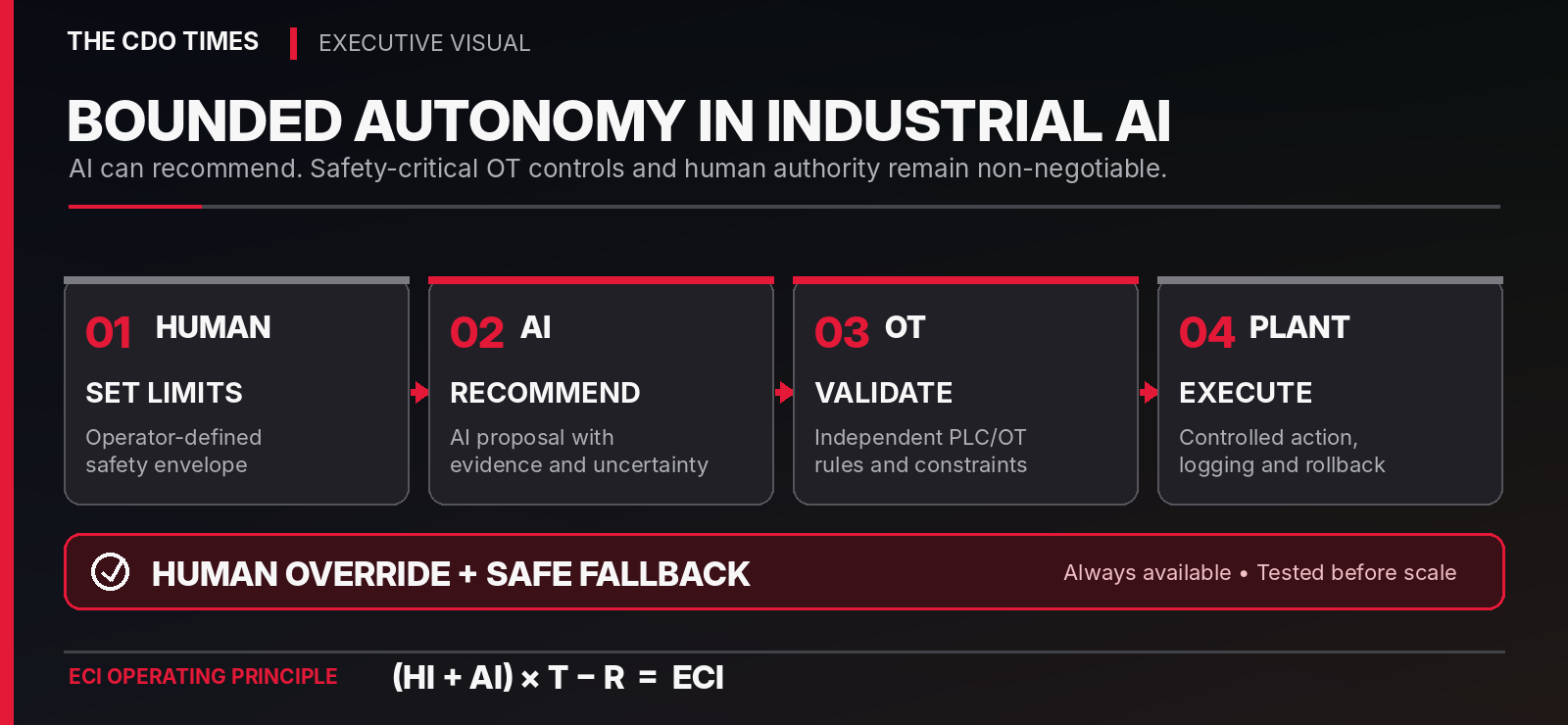
FIGURE 3 | Bounded autonomy: operator-defined limits, AI recommendations, independent OT validation, controlled execution and tested human override. Conceptual framework informed by [6] and [10].
The Human Judgment Dividend Is Measurable Too
Industrial AI changes work as well as equipment performance. The World Economic Forum describes a Schneider Electric Wuhan operation using AI-supported workforce planning and engineering assistance in a broader transformation [9]. According to that account, employee engagement increased from 62 percent to 96 percent, and a deployment of 21 agents helped reduce the time engineers spent on new-product-introduction tasks by 75 percent. Those site-reported improvements do not establish that agents alone caused the engagement change or every productivity gain. They do demonstrate why the value case must include training, worker experience and the ability to apply engineering judgment—not just hours displaced by software.
The most valuable industrial workforce design may keep people responsible for diagnosis, escalation and exception resolution while transferring repetitive sensing and documentation tasks to machines. That requires rethinking how junior engineers build competence if AI absorbs the routine work from which they traditionally learned. Plants also need operators who understand not only which model output to accept but when the sensor, context or recommended action is suspect. Performance incentives should reward accurate escalation and safe overrides, not blind agreement with automated guidance. When a digital system produces a confident but implausible recommendation, organizational permission to challenge it may be a more important safety feature than the user interface.
From Equipment Signals to Better Service Decisions
The physical-AI opportunity does not end at the factory gate. Industrial assets generate alarms, condition readings, inspection histories and failure patterns, yet field-service organizations can still make dispatch decisions with incomplete context. An effective service architecture would assemble trustworthy asset identity, time-stamped telemetry, maintenance history and operating criticality before asking whether a technician should travel. It could distinguish a condition suitable for remote troubleshooting from one requiring inspection, isolation or urgent onsite intervention. The business test would be fewer avoidable visits and less unplanned disruption without increasing missed faults, repeat repairs or exposure to hazardous conditions. Those outcomes must be measured against an actual dispatch baseline, not asserted from a model demonstration.
The next step is to turn that evidence into a practical service work order. Siemens publicly documents a Maintenance Copilot that uses asset-linked manuals and maintenance history to provide troubleshooting guidance, recommended parts and contextual information within a work-order workflow [16]. That is a useful illustration of the pattern, not evidence that every manufacturer has already realized a quantified field-service saving. An executive should evaluate whether a technician receives the correct asset configuration, relevant fault history, approved procedures, warranty status and safety instructions before reaching the site. The work order should also record what the technician verified, changed and learned so the next intervention starts with better information. This is where agentic AI can help orchestrate a closed loop between condition monitoring, service planning, technician judgment and asset records.
Schneider Electric also describes a public, operationally relevant example of condition-based maintenance. Its EcoCare services combine connected-asset monitoring, predictive analytics and expert support; the company’s June 2026 announcement extended AI-powered maintenance and 24/7 remote monitoring to three-phase UPS equipment [25]. The disclosed operating pattern includes detecting emerging faults, assessing whether remote troubleshooting is appropriate, and dispatching a qualified technician when physical intervention is necessary. This is a manufacturer-published service offering, not independent evidence of a universal reduction in dispatch costs or proof that autonomous agents approve safety-critical work. It shows why the industrial-AI story should include the information flow from equipment signals to service decisions, rather than limiting the discussion to robots on an assembly line.
Hands-Free Intelligence: Better Information at the Point of Work
A service technician working around energized equipment, rotating machinery or other physical hazards often cannot stop repeatedly to search through long manuals on a phone or laptop. Voice-enabled or wearable interfaces can offer a more natural way to retrieve a procedure, confirm a part number or record an observation while the worker keeps both hands available for the task. HCLTech has publicly described a voice-enabled assistant for a freight-rail maintenance customer that integrates with operational systems and offers hands-free access to checklists, documentation and issue capture [17]. The case is vendor-reported and should not be treated as an independent cross-industry performance benchmark. The significant architectural question is not the voice interface by itself, but whether the answer is traceable to an approved document for the specific equipment and remains usable in noisy, disconnected or restricted environments. Human approval and established safe-work procedures must remain authoritative when the response might influence a physical intervention.
Consider the design choices before celebrating a conversational technician assistant. A system that retrieves the wrong manual revision or confuses similarly named components can create more risk than the paperwork it replaces. Maintenance instructions therefore need version control, asset-specific grounding, visible citations, permission checks and a clear method for escalating uncertainty to a qualified person. In some situations the safest response is to stop, obtain a supervisor or de-energize the equipment rather than continue the conversation. Captured observations should flow back into the maintenance record without silently altering approved operating procedures. These are practical enterprise-architecture requirements for human–AI collaboration, not claims about a particular company deployment.
Physical AI: Robotics Must Pass the Factory Safety Test
Physical AI also extends from software recommendations to machines that inspect, move and manipulate objects. The shift is tangible in BMW Group’s publicly reported 2025 Spartanburg pilot using a Figure 02 humanoid robot to position sheet-metal parts for welding. BMW stated in February 2026 that the pilot robot handled more than 90,000 components across roughly 1,250 operating hours and supported production involving more than 30,000 BMW X3 vehicles [18]. Those figures describe the scope of a manufacturer-reported pilot, not a plant-wide productivity uplift caused by the robot. BMW also emphasized the need for production IT, occupational safety, shop-floor logistics and process teams to participate early. The lesson is that robotic intelligence succeeds only when the physical environment, equipment integration, workflow design and safety case mature together.
The more consequential opportunity may be to reduce human exposure to repetitive lifting, awkward movement or hazardous equipment conditions. OSHA recommends mechanical assistance for heavy equipment and warns that electrical arc flash can cause severe injury even in systems that may appear low voltage [21][22]. Remote racking of electrical breakers is one established example of separating people from a potential hazard, and it does not require generative AI to be useful [24]. Future AI-enabled inspection and handling systems may add capability, but their introduction also creates new collision, sensing, emergency-stop and failure-recovery risks. An autonomous robot should not be permitted to improvise around lockout/tagout, electrical protection or plant safety interlocks. The engineering sequence is to remove the hazard where possible, define a safe physical envelope, then assess whether automation adds value inside that envelope.
Digital Twins: Rehearse, Validate and Learn Before Physical Execution
Digital twins and simulation offer a bridge between model insight and safe operational change. NIST’s research on robot-system digital twins describes their potential for designing, testing, commissioning and reconfiguring manufacturing systems [19]. Its 2025 trust analysis also identifies cyber and operational assurance issues that arise when a digital representation influences real assets [20]. A simulation can explore how a robot path, conveyor sequence, maintenance intervention or energy-control setpoint behaves under different assumptions before the change reaches production. But simulated safety is not proof of physical safety: asset fidelity, sensor drift, incomplete operating states and unusual failures can invalidate the result. Deployment therefore requires documented acceptance tests and local engineering verification, not merely a successful run in a virtual model.
This creates a stronger mandate for enterprise architecture. A reliable digital thread needs governed identifiers linking asset registers, bills of materials, engineering drawings, telemetry, service records, manufacturing systems and approved model versions. OT/IT interfaces must preserve security segmentation and the authority of real-time control systems, while AI governance must account for uncertainty, drift and changed equipment configurations. NIST’s 2026 smart-manufacturing roadmap highlights the continuing challenge of integrating heterogeneous sensing and control systems while delivering reliable, explainable operation [15]. The World Economic Forum’s 2026 industrial-operations outlook similarly emphasizes the organizational transition from isolated pilots toward coordinated human–machine operating models [23]. What leaders should fund is not an impressive digital replica in isolation, but a maintained information and decision architecture that remains accurate across repairs, upgrades and shifts. Only then can simulation become a repeatable step toward safer industrial AI at scale.
Schneider Electric: Digital-Twins – from Machines to Critical Infrastructure
The digital-twin argument is not theoretical. Schneider Electric publicly launched EcoStruxure Machine Expert Twin in 2022 to let machine builders model equipment and virtually commission mechanical, electrical and control behavior before a physical machine is completed [26]. The company described potential commissioning-time reductions of 60% and time-to-market improvements of up to 50%; these are vendor-stated product expectations, not independently audited results that should be assigned to every installation. The more durable lesson is the sequencing: virtual tests, controller integration and operator training can expose design defects earlier, when changing a virtual sequence is cheaper and safer than modifying a running production line. A robust digital twin therefore needs to represent equipment constraints and approved control logic, not just produce a convincing three-dimensional image.
In February 2026, Schneider Electric and ETAP announced a physics-based digital twin intended to connect utility planning with operational conditions [27]. Public documentation describes a model combining electrical network data, location information and engineering-grade simulation so operators can evaluate contingency scenarios, protection coordination, arc-flash studies and switching consequences before a physical action occurs. This is a particularly strong example of bounded autonomy: simulation informs a qualified decision, while actual switching, protection systems, site procedures and authorized personnel remain authoritative. It is a product announcement and architectural direction; the release itself does not establish a quantified reduction in safety incidents. For CIOs and enterprise architects, the value proposition is traceable engineering evidence at the point where digital recommendations intersect with physical consequences.
A more recent real-world pilot was announced on October 22, 2026. Schneider Electric, AVEVA, Nscale and Start Campus reported an end-to-end Immersive Twin pilot at the SIN01 data-center facility in Portugal, developed with the NVIDIA Omniverse DSX Blueprint [28]. According to the participating companies, the pilot brings engineering and operating data together with power, cooling, electrical and workload models so teams can explore changes before making them onsite. The partners anticipate improved operational efficiency and faster infrastructure planning, but the public announcement should be read as a pilot milestone, not a measured plant-wide productivity outcome. The significance lies in combining multiple operational domains within one decision context: energy, asset capacity, cooling and AI workload demand affect one another, so optimizing a single model in isolation is insufficient.
Here is the essential problem: separate digital twins can recreate the very fragmentation that industrial AI is supposed to remove. If control engineers, facility operators, cybersecurity teams and service organizations cannot reconcile equipment identities, versions and engineering assumptions, an attractive simulation becomes another disconnected application. This is where enterprise architecture could take ownership of common asset semantics, authoritative source relationships, model lifecycles, secure OT/IT interfaces and human decision rights. Schneider Electric’s published offerings illustrate different stages of the same journey, but they should not be conflated into a single, company-wide deployment.
Rail Provides a Useful Counterpoint to Factory Automation
Alstom’s HealthHub offers an industrial operations comparison beyond factory energy management. Alstom states that its predictive maintenance systems monitor more than 18,000 train cars and can reduce service downtime by up to 30 percent, based on its published account of the solution [7]. The claimed reduction is a vendor-reported upper-bound outcome rather than a universal guarantee across fleets. The underlying business benefit is intelligible: potential faults can be identified early and maintenance scheduled when it is least disruptive to service. The system’s value depends on maintainers and operators acting on the information, not merely on the quality of the anomaly score.
In September 2026 Alstom introduced “Talk to My Train,” an intelligence interface that draws together operational data, maintenance history, engineering documents and specialist experience [8]. The company explicitly notes that inconsistent terminology and incomplete records undermine trustworthy answers. That is the industrial version of the integration tax: the maintenance expert becomes responsible for reconciling poorly connected evidence in a time-sensitive environment. An AI interface can shorten the search, but only if data provenance, permissions and human validation are engineered into the investigation workflow. The best design makes the expert faster and better informed while leaving operational accountability in the right place.
From Proof of Concept to Portfolio: Five Gates for Scale
Industrial AI should advance through five distinct management gates before being treated as a repeatable operational capability. The value gate asks whether the plant can quantify the problem against a reliable baseline and normalize for throughput or load. The data gate tests sensor quality, provenance, asset semantics, cybersecurity and the ability to reproduce model inputs. The safety gate defines approved operating envelopes, manual override, fallback modes and hard constraints that cannot be learned away. The operations gate assigns ownership for model drift, calibration, maintenance, incident response and retraining, while the scale gate checks whether the use case can be repeated at other sites without hiding local differences.
These gates are not substitutes for engineering standards or sector-specific regulation. NIST SP 800-82 Revision 3 describes the unique reliability, performance and safety requirements of operational technology and the need to tailor security accordingly [10]. NIST’s AI Risk Management Framework adds a lifecycle discipline for assigning responsibilities and measuring changing AI risks [11]. The practical architectural implication is that the model should not connect casually from a corporate assistant into a production actuator. Industrial AI must respect OT segmentation, tested interfaces, approval boundaries and the authority of the people running the physical process.
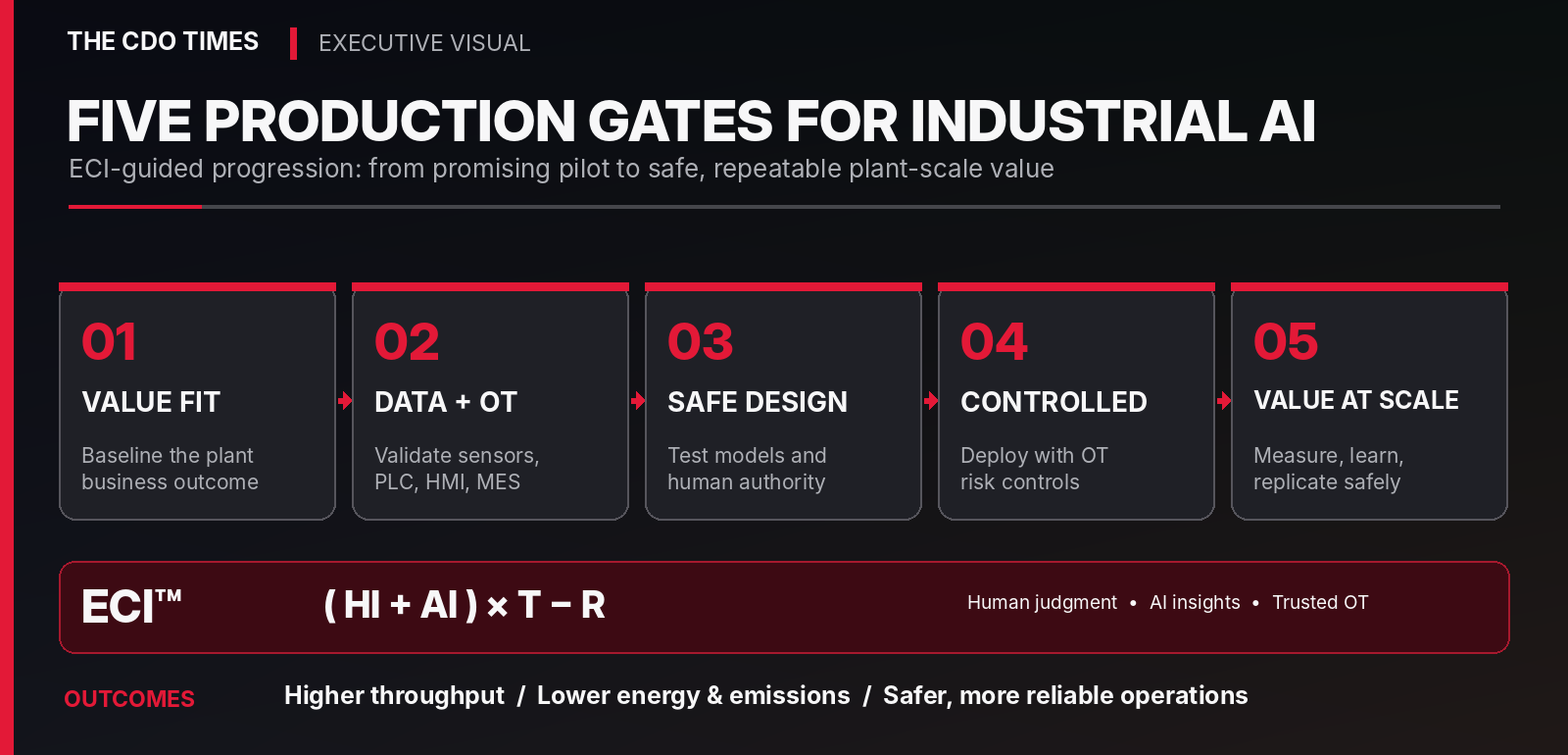
FIGURE 4 | Five ECI-guided production gates: value fit, data/OT readiness, safe design, controlled deployment and evidence-backed scaling. CDO TIMES original framework, informed by [10] and [11].
The Leadership Question: Can the Improvement Survive the Next Shift?
The most persuasive demonstration takes place when enthusiastic specialists stand nearby, the sample data are clean and everyone knows what the system is supposed to do. The real test is the night shift after equipment maintenance, a change in product mix, an unexpected sensor value or a network interruption. Does the recommendation remain useful, does the operator know what evidence it used and can the process fall back safely? Can a plant manager explain the economic benefit without borrowing a projection from the vendor’s sales deck? An industrial deployment is scalable only when its controls and skills are repeatable under ordinary operating conditions.
For leaders, the next step is to finance a small portfolio of measurable use cases rather than dozens of unrelated demonstrations. Begin where the operating cost, environmental impact or risk is substantial and where the physical baseline is trustworthy. Pair every AI use case with its owner in operations, its technical owner in IT/OT and its decision authority in the plant. Audit performance after deployment and remove systems that have not justified their ongoing cost or cannot meet safety expectations. The successful enterprise will learn not only how to build industrial AI, but also when not to deploy it.
ECI: Where Industrial Intelligence Meets Human Authority
Elevated Collaborative Intelligence (ECI™) frames industrial AI as a leadership and operating-design challenge, not simply the deployment of another model or robot. The ECI = (HI + AI) × T − R framework puts human intelligence at the center of operating judgment, engineering authority and accountability. AI supplies pattern detection, predictive analysis and decision support, while the technology accelerator connects trustworthy data, maintenance workflows, simulations and industrial control systems. Risk and regulatory constraints encompass worker safety, cybersecurity, operational reliability, privacy and the enforceable limits of autonomy. The formula is a conceptual management framework rather than a numerical performance law. Its practical test is whether people and machines jointly deliver outcomes that can be measured, reproduced and safely overridden.
In a factory, an AI recommendation should be validated by local OT controls before authorized personnel permit an equipment change. In field service, better monitoring can support a more informed triage decision, an evidence-rich work order and a technician receiving a validated instruction. In robotics, machines can take on appropriately bounded physical tasks while qualified people retain responsibility for exceptions, safety and escalation. The public Schneider Electric examples of virtual machine commissioning, engineering-grade electrical twins, connected-asset services and an AI-factory pilot show what is becoming technically possible; they do not remove the need to prove performance at each site. The highest-value architecture is a repeatable human–AI operating pattern with known owners, auditable evidence and less friction at the next facility.
The CDO TIMES Bottom Line
Industrial AI has reached the point where another successful demonstration is no longer enough. Factory optimization, predictive maintenance, voice-supported field service, digital twins and robotics all require the same foundations: trusted asset data, connected workflows, a measurable business case and controls designed for physical reality. Publicly documented company examples show possibilities, but vendor-reported pilot results must not be confused with independent proof of plant-wide outcomes. The CIO and enterprise architect should resist building another disconnected technology layer; operating leaders must own the decisions and benefits after deployment. Under the ECI framework, HI supplies judgment, AI expands the available intelligence, T accelerates the integration of work and R keeps the system within legitimate risk boundaries. The CDO TIMES Bottom Line: scale the capability only when it improves energy, uptime, service and worker safety with clear human accountability—not simply because the model, agent or robot can perform the task.
Sources
[1] Fabrice Kermorgant, LinkedIn recap of Microsoft Frontier Tour Paris “Industrial Intelligence Unlocked,” October 2026 https://fr.linkedin.com/in/fabrice-kermorgant
[2] Schneider Electric, “World Economic Forum recognizes Hyderabad factory as a Sustainability Lighthouse,” December 18, 2023 https://www.se.com/ww/en/about-us/newsroom/news/press-releases/world-economic-forum-recognizes-schneider-electric%E2%80%99s-hyderabad-factory-as-a-sustainability-lighthouse-657bc5e81e57755d7e06770b/
[3] World Economic Forum, “Factories of the Future Show How to Apply AI to Benefit People, Planet and Performance,” 2023 https://www.weforum.org/media/factories-of-the-future-show-how-to-apply-ai-to-benefit-people-planet-and-performance
[4] Schneider Electric, Le Vaudreuil Sustainability Lighthouse announcement, March 30, 2022 https://www.se.com/ww/en/about-us/newsroom/news/press-releases/new-recognition-for-schneider-electric-from-world-economic-forum-62441e75d32cd17e7b1f0ab4/
[5] Google, “DeepMind AI reduces energy used for cooling Google data centers by 40%,” 2016 https://blog.google/company-news/outreach-and-initiatives/environment/deepmind-ai-reduces-energy-used-for/
[6] Google DeepMind, “Safety-first AI for autonomous data centre cooling and industrial control,” August 17, 2018 https://deepmind.google/blog/safety-first-ai-for-autonomous-data-centre-cooling-and-industrial-control/
[7] Alstom, “The future (of rail) is digital,” HealthHub case and fleet monitoring https://www.alstom.com/stories/future-rail-digital
[8] Alstom, “Talk to My Train: How Alstom is turning railway knowledge into operational action,” September 2026 https://www.alstom.com/press-releases-news/2026/9/talk-my-train-how-alstom-turning-railway-knowledge-operational-action
[9] World Economic Forum, “3 ways leading manufacturers are preparing their workforce for AI,” 2026 https://www.weforum.org/stories/manufacturing-and-value-chains/ai-manufacturing-workplace-transformation
[10] NIST, “Guide to Operational Technology (OT) Security,” SP 800-82 Rev. 3, 2023 https://csrc.nist.gov/pubs/sp/800/82/r3/final
[11] NIST, AI Risk Management Framework Core, Govern/Map/Measure/Manage https://airc.nist.gov/airmf-resources/airmf/5-sec-core/
[12] International Energy Agency, “Energy and AI,” April 10, 2025 https://www.iea.org/reports/energy-and-ai
[13] International Energy Agency, “Key Questions on Energy and AI,” 2026 executive summary https://www.iea.org/reports/key-questions-on-energy-and-ai/executive-summary
[14] World Economic Forum, 2026 Global Lighthouse recognition, Schneider Electric El Paso https://www.weforum.org/media/new-global-lighthouse-sites-demonstrate-how-ai-is-rewiring-manufacturing-and-supply-chains
[15] NIST, “2026 Roadmap on Artificial Intelligence and Machine Learning for Smart Manufacturing,” July 3, 2026 https://www.nist.gov/publications/2026-roadmap-artificial-intelligence-and-machine-learning-smart-manufacturing
[16] Siemens, “Maintenance Copilot,” Asset Essentials Enterprise product documentation https://help.assetmanagement.siemens.com/help/Content/Documentation/Maintenance/Asset%20Essentials/EnterpriseFeatures/AI-Driven%20Capabilities/Maintenance%20Copilot.htm
[17] HCLTech, “Revolutionizing rail maintenance with HCLTech’s voice AI,” published October 16, 2025 https://www.hcltech.com/case-study/revolutionizing-rail-maintenance-with-hcltech-voice-assistant
[18] BMW Group, “BMW Group to deploy humanoid robots in production in Germany for the first time,” February 2026 https://newsroom.bmwgroup.com/global/bmw-group-to-deploy-humanoid-robots-in-production-in-germany-for-the-first-time
[19] NIST, “Digital Twins for Robot Systems in Manufacturing,” October 26, 2024 https://www.nist.gov/publications/digital-twins-robot-systems-manufacturing
[20] NIST, “Security and Trust Considerations for Digital Twin Technology,” NIST IR 8356, February 2025 https://csrc.nist.gov/pubs/ir/8356/final
[21] OSHA, “Electric-Arc Flash Hazards,” occupational safety guidance https://www.osha.gov/electrical/flash-hazards
[22] OSHA, “Solutions for Electrical Contractors: Materials Handling — Heavy Lifting,” ergonomic safety guidance https://www.osha.gov/etools/electrical-contractors/materials-handling/heavy
[23] World Economic Forum, “Intelligent Industrial Operations Outlook 2026,” April 16, 2026 https://www.weforum.org/publications/intelligent-industrial-operations-outlook-2026
[24] ABB, “The Ultimate Guide to Arc Flash,” public electrical safety resource, remote-racking mitigation https://electrification.us.abb.com/techtuesday/august/ABB-ultimatearcflashguide.pdf
[25] Schneider Electric, “EcoCare Expands to 3-Phase UPS,” June 30, 2026 (remote monitoring and condition-based maintenance). https://www.se.com/us/en/about-us/newsroom/news/press-releases/Schneider-Electric-expands-EcoCare-services-to-3Phase-UPS-delivering-AIpowered-conditionbased-maintenance-to-help-organizations-maximize-uptime-and-reduce-risk-6a42dd7b95f70f78d50fbc5a/
[26] Schneider Electric, “Schneider Electric launches digital twin software solution,” May 31, 2022 (EcoStruxure Machine Expert Twin). https://www.se.com/ww/en/about-us/newsroom/news/press-releases/schneider-electric-launches-digital-twin-software-solution-629597b711e12072551ef656/
[27] Schneider Electric and ETAP, “Physics-Based Digital Twin to Bridge Design and Operations,” February 3, 2026. https://www.se.com/us/en/about-us/newsroom/news/press-releases/schneider-electric-and-etap-launch-physicsbased-digital-twin-to-bridge-design-and-operations-for-utilities-and-critical-infrastructure-69655b6d86c928ffc30e9cab/
[28] Schneider Electric, AVEVA, Nscale and Start Campus, “NVIDIA Omniverse DSX Blueprint … Live AI Factory Environment,” October 22, 2026 (pilot). https://www.se.com/ww/en/about-us/newsroom/news/press-releases/Schneider-Electric-Nscale-and-Start-Campus-Bring-the-NVIDIA-Omniverse-DSX-Blueprint-into-a-Live-AI-Factory-Environment-6ad9e16e42ef4591f00c873d/
[29] Schneider Electric, AVEVA and ETAP, “Join Alliance for OpenUSD to Advance Digital Twins and 3D Modeling for Industries,” November 18, 2025. https://www.se.com/us/en/about-us/newsroom/news/press-releases/Schneider-Electric-AVEVA-and-ETAP-Join-Alliance-for-OpenUSD-to-Advance-Digital-Twins-and-3D-Modeling-for-Industries-691cfdda176764554a046227/