The AI Value Realization Gap: Why Enterprise AI Adoption Is Surging — But Business Impact Isn’t
From Pilots to Profit: What Separates AI Activity from Real Enterprise Value
By Carsten Krause
April 9, 2026
If you walk into any boardroom today, AI is front and center. Budgets are increasing, teams are experimenting, and executives are under pressure to demonstrate tangible progress. Copilots are deployed, generative AI is explored, and agents are being tested across functions. On the surface, it looks like a success story.
But when you look closer, the results tell a very different story. AI initiatives are proliferating, yet business impact remains inconsistent. Productivity gains exist, but they are often localized and difficult to translate into enterprise-wide financial outcomes. Many organizations still struggle to answer a simple executive question: what value has AI actually delivered?
This is the emerging AI value realization gap, and it is quickly becoming the defining challenge of enterprise AI. Adoption has accelerated. Spending has accelerated. Expectations have accelerated.
Value realization, in many organizations, has not.
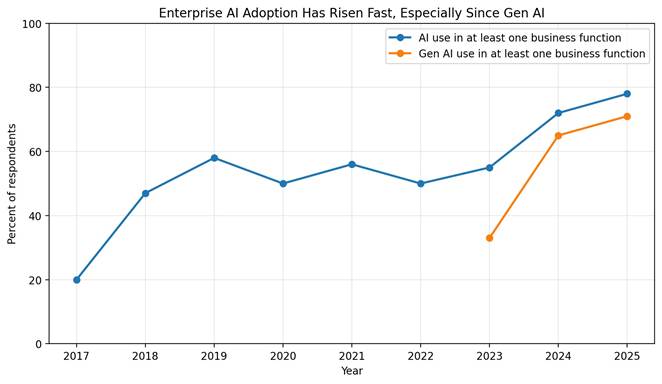
Chart 1. Enterprise AI adoption has accelerated sharply, with generative AI driving a new surge in enterprise use.
Source: Carsten Krause, CDO TIMES Research. Data adapted from McKinsey, “The state of AI: How organizations are rewiring to capture value,” March 12, 2025 and PDF dated March 26, 2025:
https://www.mckinsey.com/capabilities/quantumblack/our-insights/the-state-of-ai-how-organizations-are-rewiring-to-capture-value and https://www.mckinsey.com/~/media/mckinsey/business%20functions/quantumblack/our%20insights/the%20state%20of%20ai/20 25/the-state-of-ai-how-organizations-are-rewiring-to-capture-value_final.pdf
McKinsey’s 2025 research shows just how fast this has moved. Seventy-eight percent of respondents said their organizations use AI in at least one business function, up from 72 percent in early 2024 and 55 percent a year earlier. Generative AI use moved even faster, climbing from 33 percent in 2023 to 65 percent in early 2024 and 71 percent in 2025. The front end of adoption is no longer the problem. The back end of value realization is.
Why AI Gets Stuck After Early Success
Across industries, a consistent pattern has emerged. In the first phase, organizations move quickly. Teams launch pilots, deploy generative AI tools, and experiment with new capabilities. Early results are promising, productivity improves, and enthusiasm builds across the enterprise.
In the second phase, AI use cases expand rapidly. Business units adopt different tools, new initiatives are funded, and AI becomes part of the corporate narrative. Activity increases, but coordination does not. This is usually where the dashboard looks healthiest and the operating model looks weakest.
Then comes the third phase, where most organizations begin to struggle. Initiatives remain siloed, integration becomes complex, and the ability to measure ROI becomes increasingly difficult. What initially looked like momentum turns into fragmentation. The enterprise ends up with more pilots, more vendors, more excitement, and more confusion.
The problem is not that AI fails. The problem is that the surrounding enterprise system is not designed to convert AI into value. Most organizations are still good at launching experiments and surprisingly bad at industrializing outcomes.
The Real Issue: AI Is Not Embedded Into How Work Gets Done
Many organizations still treat AI as an overlay, a tool layered on top of existing processes rather than something that fundamentally reshapes how work happens. AI generates insights, recommendations, or content, but those outputs often stop short of influencing execution. A recommendation without an operational trigger is still just a recommendation.
This creates a disconnect between intelligence and action. True enterprise value is not created when AI produces an answer. It is created when that answer is operationalized, when it triggers decisions, actions, and measurable outcomes across the organization. Without that connection, AI remains interesting but not transformative.
That is why the value gap feels so frustrating to executives. The technology appears to work. The demos are compelling. Employees like the tools. Yet the P&L; often refuses to get equally excited.
Real-World Case Studies: Where AI Actually Delivers Value
Walmart: AI in Supply Chain Optimization. Walmart has embedded AI deeply into its supply chain operations. Rather than treating AI as a reporting layer, the company uses it to drive core processes such as demand forecasting, inventory optimization, and logistics planning. By integrating AI into fulfillment centers and distribution networks, Walmart improves stock availability, reduces operational costs, and increases responsiveness to demand fluctuations. The key point is not that Walmart uses AI; it is that Walmart ties AI directly to execution.
JPMorgan Chase: AI for Contract Intelligence. JPMorgan Chase’s COIN platform remains one of the clearest examples of measurable operational value. The system automates the review of commercial loan agreements by extracting and analyzing key legal clauses. JPMorgan said this work had previously required roughly 360,000 hours of annual manual effort. By embedding AI into a critical process, the company reduced time, improved consistency, and increased accuracy.
Schneider Electric: Digital Twins and the Infrastructure Behind AI Data Centers. Schneider Electric represents a different but equally important dimension of AI value creation, enabling the infrastructure that powers AI at scale. The company has advanced digital twin capabilities for data centers and AI factories, allowing organizations to simulate electrical, thermal, and operational behavior before deployment. In 2025, Schneider Electric and ETAP introduced a digital twin designed to simulate AI factory power requirements from grid to chip level using NVIDIA Omniverse. As AI workloads drive significantly higher power densities and cooling demands, Schneider Electric’s approach integrates resilient power systems, advanced cooling technologies, and lifecycle management capabilities. The point here is simple: AI value is not only created at the model layer. It also depends on the infrastructure and operational systems that keep AI running in production.
Netflix: AI-Driven Revenue Growth. Netflix provides one of the clearest examples of AI tied directly to commercial outcomes. Its recommendation engine personalizes content for each user, driving engagement and influencing viewing behavior. Estimates widely cited by Netflix and industry analysts indicate that recommendations drive the vast majority of content watched on the platform, often referenced as more than 80 percent. This directly affects customer retention and subscription revenue, which is why Netflix is still one of the cleanest examples of AI as a growth engine rather than a side experiment.
Across these examples, a clear pattern emerges. These companies embed AI into workflows, connect it directly to execution, and align it with measurable business outcomes. They do not treat AI as isolated use cases. They wire it into end-to-end processes where value is created.

Chart 2. The maturity gap remains brutal: broad investment has not translated into broad enterprise readiness.
Source: Carsten Krause, CDO TIMES Research. Data adapted from McKinsey, “Superagency in the workplace: Empowering people to unlock AI’s full potential at work,” January 28, 2025: https://www.mckinsey.com/capabilities/tech-and-ai/our-insights/superagency-i n-the-workplace-empowering-people-to-unlock-ais-full-potential-at-work and PDF: https://www.mckinsey.com/~/media/mckinsey/busi ness%20functions/quantumblack/our%20insights/superagency%20in%20the%20workplace%20empowering%20people%20to%20un lock%20ais%20full%20potential%20at%20work/superagency-in-the-workplace-empowering-people-to-unlock-ais-full-potential-v4.pdf
This maturity gap matters more than most leaders admit. McKinsey’s 2025 workplace AI report says almost all companies invest in AI, but only 1 percent believe they are at maturity. That should make every boardroom slightly uncomfortable. The issue is no longer whether organizations are spending money on AI. The issue is whether they know how to turn that spending into scaled operating advantage.
Why Most Enterprises Don’t Achieve This
Despite strong examples, most organizations struggle to replicate this level of impact. AI initiatives are often fragmented across business units, leading to duplication and inconsistent approaches.
Integration into core workflows is limited, leaving AI outputs disconnected from execution. Ownership of outcomes remains unclear, with AI treated as an IT initiative rather than a business responsibility.
Measurement frameworks are weak, making it difficult to quantify value.
Individually, these challenges are manageable. Combined, they create a system that prevents AI from scaling effectively. Enterprises end up mistaking experimentation for transformation and tool deployment for operating model change.

Chart 3. AI spending continues to surge, raising the pressure on leaders to convert investment into measurable value.
Source: Carsten Krause, CDO TIMES Research. Data adapted from IDC, “Time for the AI pivot: From experimentation to industry transformation,” 2025, citing IDC Worldwide AI and Generative AI Spending Guide forecast: https://www.idc.com/wp-content/uploads/2025/09/DIR2025_GS_AIPivot_MW.pdf
The Hidden Barrier: Leadership Alignment
One of the most underestimated challenges in enterprise AI is leadership alignment. AI initiatives require coordination across business, technology, and data functions. Without alignment, priorities diverge, investments become fragmented, and execution slows. Even well-funded AI programs can stall if leadership teams are not operating with a shared view of where value is created and how it will be captured.
This is not a technology problem. It is an operating model problem. And that is precisely why some organizations manage to turn AI into outcomes while others remain stuck in the pilot purgatory they politely call innovation.
The Shift Happening Now: From Use Cases to Value Chains
Leading organizations are changing how they approach AI. Instead of asking, “Where can we use AI?” they are asking, “Where is value created, and how can we improve it end to end?” That shift changes both investment logic and execution discipline.
It leads to fewer initiatives but significantly higher impact. Organizations focus on critical value chains, integrate AI into workflows, and align ownership with business outcomes. The result is not more activity. It is more value. That is a big difference, and a useful one.

Chart 4. Reported revenue benefits are strongest in functions where AI is embedded into decisions, workflows, and execution.
Source: Carsten Krause, CDO TIMES Research. Data adapted from McKinsey, “Gen AI’s ROI,” April 30, 2025, based on second-half 2024 survey responses: https://www.mckinsey.com/featured-insights/week-in-charts/gen-ais-roi
What Executives Should Do Next
Focus on a small number of high-impact domains tied to revenue, cost, or risk. Map end-to-end processes to understand where value is created. Embed AI into decision points so that outputs drive execution. Assign ownership for outcomes to business leaders, not just technology teams. Measure success based on business impact, not activity.
These steps are not theoretical. They reflect what leading organizations are already doing. The organizations that win with AI over the next several years will not necessarily be the ones with the most pilots or the loudest announcements. They will be the ones that connect intelligence to execution more effectively than their competitors do.
Why This Moment Matters
Enterprise AI is entering a new phase. The first wave was about experimentation and adoption. The next wave will be about value realization and scale. As AI capabilities become more accessible, competitive advantage will shift away from access to technology and toward the ability to execute effectively.
AI is becoming a commodity. Execution is not. That is why this moment matters so much for CIOs, CDOs, CAIOs, and business leaders who are serious about turning AI from a promising toy into a durable enterprise capability.
The CDO TIMES Bottom Line
Enterprise AI has reached a tipping point. Adoption is no longer the challenge; value realization is. While most organizations have deployed AI tools and launched numerous initiatives, only a small fraction have translated those efforts into measurable business outcomes. The difference lies in how AI is embedded into workflows, connected to decision-making, and aligned with business ownership. Real-world leaders such as Walmart, JPMorgan Chase, Schneider Electric, and Netflix show that AI delivers value when it is integrated into end-to-end processes rather than treated as an isolated capability. For CIOs, CDOs, and CAIOs, the priority now is to move from fragmented experimentation to focused execution. That means rethinking operating models, aligning leadership, and building systems where human expertise and AI capabilities work together seamlessly. This is also where the principles behind HI + AI = ECI™ become relevant: not as hype, but as a practical way to think about how organizations create value from intelligent systems.
Selected source links used in this article:
McKinsey, The state of AI: How organizations are rewiring to capture value: https://www.mckinsey.com/capabilities/quantumblack/our-insights/the-state-of-ai-how-organizations-are-rewiring-to-capture-value
McKinsey PDF version of The state of AI: https://www.mckinsey.com/~/media/mckinsey/business%20functions/quantumblack/our%2
0insights/the%20state%20of%20ai/2025/the-state-of-ai-how-organizations-are-rewiring-to-capture-value_final.pdf
McKinsey, Superagency in the workplace: https://www.mckinsey.com/capabilities/tech-and-ai/our-insights/superagency-in-the-workpl ace-empowering-people-to-unlock-ais-full-potential-at-work
IDC, Time for the AI pivot: From experimentation to industry transformation: https://www.idc.com/wp-content/uploads/2025/09/DIR2025_GS_AIPivot_MW.pdf
McKinsey, Gen AI’s ROI: https://www.mckinsey.com/featured-insights/week-in-charts/gen-ais-roi
Schneider Electric and ETAP digital twin announcement: https://www.se.com/us/en/about-us/newsroom/news/press-releases/etap-a nd-schneider-electric-unveil-world%E2%80%99s-first-digital-twin-to-simulate-ai-factory-power-requirements-from-grid-to-chip-level-u sing-nvidia-omniverse-67d8f1bae06184512a0b9f48
Schneider Electric AI data centers: https://www.se.com/us/en/work/solutions/data-centers-and-networks/ai-data-centers/
Love this article? Embrace the full potential and become an esteemed full access member, experiencing the exhilaration of unlimited access to captivating articles, exclusive non-public content, empowering hands-on guides, and transformative training material. Unleash your true potential today!
Order the AI + HI = ECI book by Carsten Krause today! at cdotimes.com/book

Subscribe on LinkedIn: Digital Insider
Become a paid subscriber for unlimited access, exclusive course content, no ads: CDO TIMES
Do You Need Help?
Consider bringing on a fractional CIO, CISO, CDO or CAIO from CDO TIMES Leadership as a Business Consulting Service. The expertise of CDO TIMES becomes indispensable for organizations striving to stay ahead in the digital transformation journey. Here are some compelling reasons to engage their experts:
- Deep Expertise: CDO TIMES has a team of experts with deep expertise in the field of Cybersecurity, Digital, Data and AI and its integration into business processes. This knowledge ensures that your organization can leverage digital and AI in the most optimal and innovative ways.
- Training, developing, arranging, and conducting educational conferences and programs and providing courses of instruction.
- Strategic Insight: Not only can the CDO TIMES team help develop a Digital & AI strategy, but they can also provide insights into how this strategy fits into your overall business model and objectives. They understand that every business is unique, and so should be its Digital & AI strategy.
- Future-Proofing: With CDO TIMES, organizations can ensure they are future-proofed against rapid technological changes. Our experts stay abreast of the latest AI, Data and digital advancements and can guide your organization to adapt and evolve as the technology does.
- Risk Management: Implementing a Digital & AI strategy is not without its risks. The CDO TIMES can help identify potential pitfalls and develop mitigation strategies, helping you avoid costly mistakes and ensuring a smooth transition with fractional CISO services.
- Competitive Advantage: Finally, by hiring CDO TIMES experts, you are investing in a competitive advantage. Their expertise can help you speed up your innovation processes, bring products to market faster, and stay ahead of your competitors.
By employing the expertise of CDO TIMES, organizations can navigate the complexities of digital innovation with greater confidence and foresight, setting themselves up for success in the rapidly evolving digital economy. The future is digital, and with CDO TIMES, you’ll be well-equipped to lead in this new frontier.
Do you need help with your digital transformation initiatives? We provide fractional CAIO, CDO, CISO and CIO services, do a Preliminary ECI and Tech Navigator Assessment and we will help you drive results and deliver winning digital and AI strategies for you!
Subscribe now for free and never miss out on digital insights delivered right to your inbox!