HI + AI = ECI

Why Every Enterprise Will Need an AI Operating System Within Three Years

Artificial intelligence is no longer a collection of isolated pilots—it is becoming the operating fabric of the modern enterprise. As organizations deploy AI agents, copilots, foundation models, and autonomous workflows across every business function, executive leaders face a new challenge: how to govern, measure, orchestrate, and optimize AI at enterprise scale. Existing AI platforms and control towers provide valuable visibility within their own ecosystems, but executives increasingly need a technology-agnostic operating layer that connects business strategy, enterprise architecture, governance, AI economics, cybersecurity, and portfolio management into a single executive decision framework. This article explores why Enterprise AI Operating Systems are emerging as the next evolution of enterprise technology management, how they complement platforms such as SAP, Microsoft, Google Cloud, ServiceNow, Salesforce, Oracle, and Workday, and why organizations that master enterprise AI orchestration will gain a sustainable competitive advantage in the age of AI.

Read More

The Enterprise AI Operating Model: The Missing Layer Between AI Strategy and Business Value

Enterprise leaders must shift focus from merely developing AI strategies to establishing effective operating models for AI operations. Many organizations possess AI tools but lack structures for governance, value realization, and management. The future of AI in enterprises relies on creating integrated systems that ensure measurable business value and operational excellence.

Read More

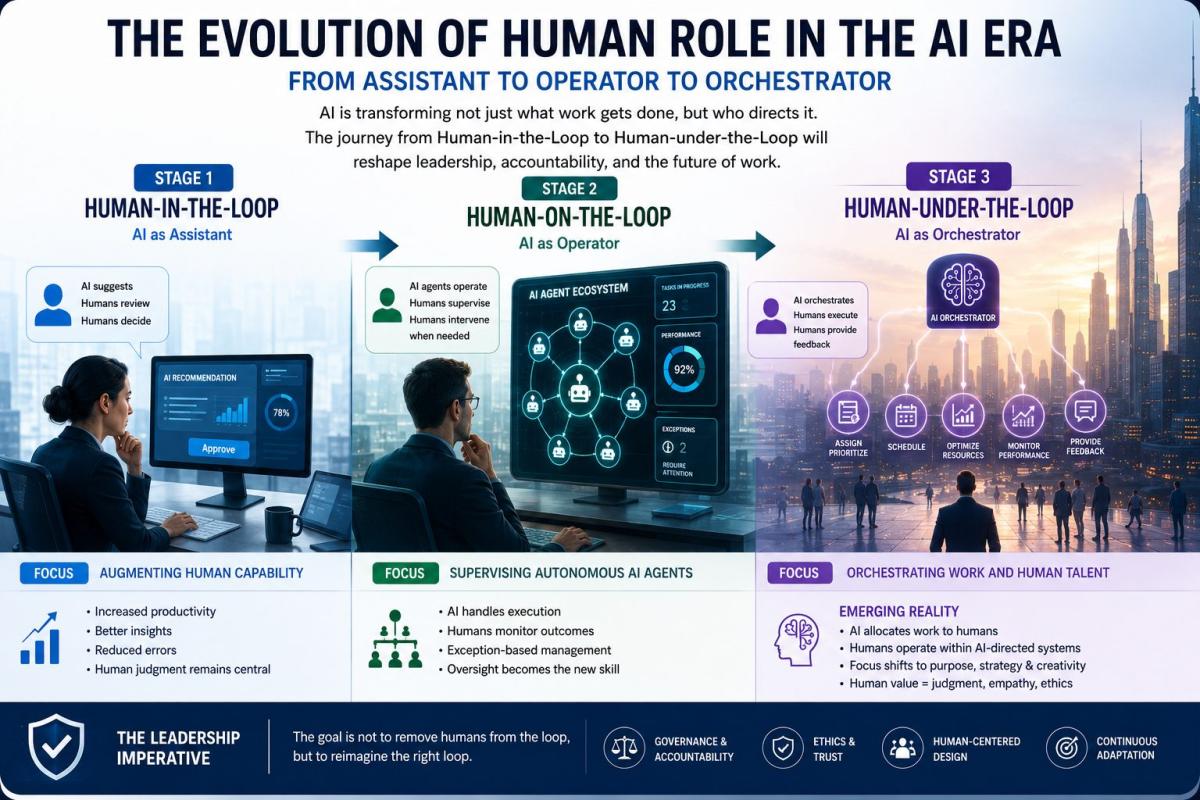
From Human-in-the-Loop to Human-under-the-Loop: The Next Stage of AI May Redefine Leadership, Work, and Control

The AI debate is evolving beyond merely keeping humans in control to considering scenarios where AI agents coordinate their peers, potentially becoming the primary managers of work. This transition raises critical questions about human roles, accountability, and the risks of over-reliance on AI, emphasizing the need for Elevated Collaborative Intelligence™ to balance human judgment with AI efficiency.

Read More

The AI Remix: How Artificial Intelligence Is Rewriting the Future of Music, Media, and Creative Production

From Grammy Studios to Generative Soundscapes, the Creative Economy Is Entering Its Most Disruptive Era Since the Internet By Carsten KrauseMay 11, 2026 The music industry has survived vinyl disruption, cassette piracy, Napster, MP3 compression, YouTube, Spotify, TikTok, and the collapse of physical media economics. Yet artificial intelligence may become – See more –

Read More

The AI Factory Era Is Here — But Most Enterprises Are Producing Noise, Not Intelligence

Data centers are evolving into AI factories, generating intelligence and insights that drive business outcomes. This transformation poses challenges, including energy constraints and the need for leadership alignment. Successful organizations are focusing on the application of AI to enhance decision-making and operational efficiency rather than merely scaling technology.

Read More

The MIT AI Reality Check: Why 93% of Executives Are Scaling the Wrong AI Strategy

At the 2026 MIT AI conference, Bruce Lawler revealed that while 68% of companies are increasing AI investment, only 7% have a well-defined strategy, leading to failed initiatives. His research shows a significant gap between AI leaders and laggards, emphasizing that organizational readiness and effective change management are critical for realizing AI’s potential.

Read More

The 10 AI Trends of 2026: Why the Most Important Shift Is Humans Moving Above the Loop

In 2026, organizations that excel will prioritize “above-the-loop” leadership, where human intelligence governs AI autonomy rather than micromanaging decisions. By redefining roles and adopting frameworks like the ECI framework, leaders can optimize the collaboration between AI and human insight, driving productivity, innovation, and controlled risk in a rapidly evolving technological landscape.

Read More

PART 1 – 2025 Technology Review: The Year Enterprise AI Stopped Being Software and Started Acting Like Employees

In 2025, technology transcended mere digital transformation, as AI began executing workflows autonomously, demanding a shift to Elevated Collaborative Intelligence™. Organizations learned that scaling AI without addressing enterprise readiness amplified risk. Sustainable architecture and robust governance emerged as essentials, emphasizing accountability, foresight, and the need for strategic alignment in a rapidly evolving digital landscape.

Read More

Connected Intelligence, Agentic Reality

The CDAO Summit in Boston highlighted the importance of connected intelligence in retail, exemplified by the collaboration of human and artificial intelligence (HI + AI = ECI). Panelists from major companies discussed AI’s practical applications, emphasizing reliable metadata, real-time responsiveness, and seamless integration into workflows, underscoring the critical role of governance and cultural acceptance.

Read More

Haunted by Disruption: Microsoft’s AI Bet and the Ghost of DEC

In this article I review the motivation and reasonable fear of Microsofts CEO Satya Nadella to be out innovated into irrelevance by the fourth platform – Artificial Intelligence – and the billions of dollars Microsoft is investing to stay at the helm of this movement. The article includes business lessons that other leaders can learn from to stay ahead in this AI platform revolution.

Read More