Case Study: Instacart Physical AI in Retail
Instacart Is Turning the Shopping Cart Into a Physical AI Platform
The Caper Cart case reveals what retailers really need to connect edge AI, shelf intelligence, store operations, and personalized commerce in the physical world.
By Carsten Krause | The CDO TIMES | August 2026

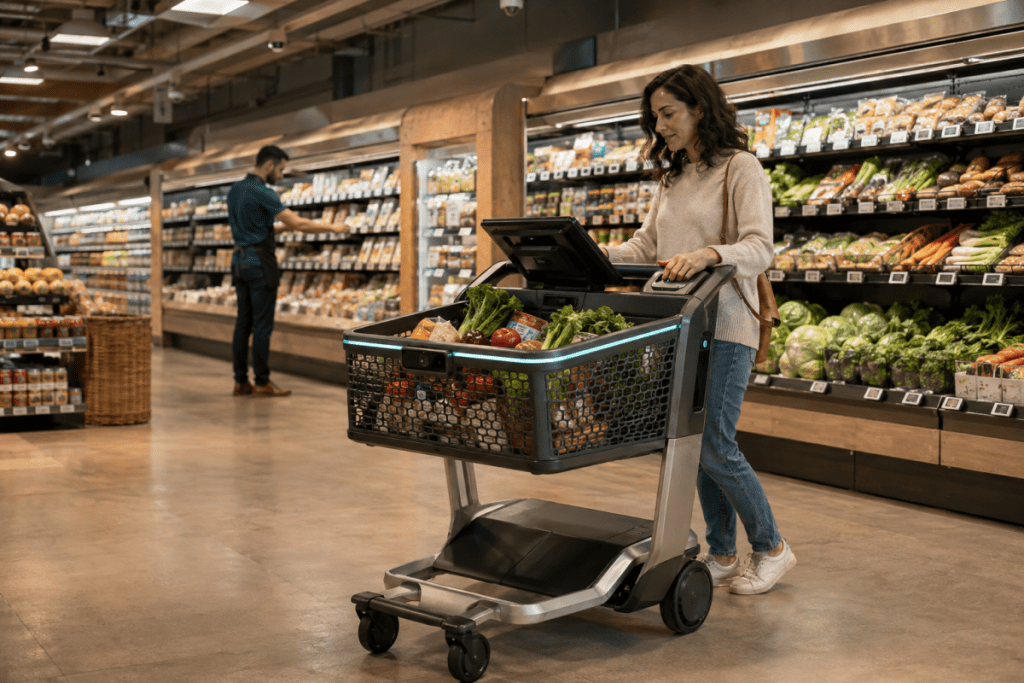
Visual 1. Physical AI moves intelligence into the aisle. Original editorial illustration created for The CDO TIMES.
The Store Floor Is Becoming a Computer
A Bernard Marr live conversation with David McIntosh, Instacart’s Chief Connected Stores Officer I recently listened into, provides a useful way to understand why physical AI is different from adding another chatbot to retail.
The challenge is not merely to generate an answer; it is to perceive a constantly changing store, interpret millions of sensor inputs, respond within hundreds of milliseconds, and keep operating when the Wi-Fi becomes unreliable. The same system must recognize what entered a cart, what was removed, what remains on a shelf, where the shopper is standing, and whether a checkout event is trustworthy. It also has to work in stores whose lighting, aisle layouts, product mixes, promotional displays, and local operating practices differ every day. That combination of real-world variability and commercial consequence turns the grocery aisle into one of the most demanding proving grounds for enterprise AI. I have seen many of these technologies at this years National Retail Federation (NRF) event in New York and it is exciting to see how these technologies including sensors, video to vision model feeds and seamless checkout are integrated in the Instacart solution.
Specificallu, Instacart’s answer is the Caper Cart, but the more important strategic move is the intelligence layer developing around it. NVIDIA describes the cart as a mobile AI platform with five cameras, a Weights and Measures-certified scale, location sensors, a touchscreen, and an NVIDIA Jetson Orin NX module. Three basket-facing camera views are fused with weight and location data on the cart, while two outward-facing cameras observe shelves; cloud models add deeper product, merchandising, and recommendation context asynchronously. Instacart says Caper Carts now operate in more than 100 cities and that deployments have tripled year over year, while the company is also using cart and shopper imagery to create near-real-time shelf intelligence. The case is therefore no longer about a clever cart: it is about building a continuously learning representation of the physical store.[1][2][3][7]
Case Snapshot: From Delivery Platform to In-Store Intelligence
Dimension | Publicly documented evidence | Executive implication |
|---|---|---|
Physical AI edge | Five cameras, certified scale, location sensing, and Jetson Orin NX process basket events locally. | Latency and resilience are product requirements, not infrastructure afterthoughts. |
Data flywheel | More than 1.6 billion lifetime online orders are combined with live in-store signals. | Proprietary physical data becomes a strategic moat when it is governed and reusable. |
Scale | Caper deployments span 100+ cities and grew threefold year over year, according to Instacart/NVIDIA. | Fleet operations and repeatable integration matter as much as model accuracy. |
Shelf intelligence | Arpalus turns video scans into shelf views with more than 95% average item-identification accuracy, according to Instacart. | The cart becomes one sensor among many in a broader store operating system. |
Value | Instacart reports basket lift from location-aware prompts, personalization, loyalty, coupons, checkout, and retail media. | Measure revenue, availability, shrink, adoption, and service outcomes together. |
Sources: Instacart and NVIDIA public disclosures. Vendor-reported performance should be validated in each retailer’s own environment.
Why a Jetson Board Belongs in the Cart
A cloud-only architecture is too brittle for a cart that has to react as a customer drops in a product, removes another, stacks two items together, or blocks a camera with a bag. The edge processor provides the first level of interpretation close to the sensors, reducing the network dependency and the round-trip delay that would otherwise make the interface feel uncertain. Instacart’s public architecture places real-time sensor fusion on Jetson and lets cloud encoders run asynchronously for deeper context, which is a pragmatic division of labor rather than an ideological choice between edge and cloud. The edge handles immediacy, continuity, and a degree of privacy; the cloud handles fleet learning, large-model context, ranking, analytics, and distribution of improved models. Retailers should copy that decision pattern even if they choose different hardware: allocate every function according to its latency budget, bandwidth burden, privacy sensitivity, safety consequence, and tolerance for disconnection.[1]
McIntosh’s discussion of weak store Wi-Fi and harsh Ohio weather exposes the difference between a laboratory demo and an operating retail system. A cart can leave the access point’s ideal coverage as it moves through freezers, dense shelving, seasonal displays, vestibules, parking areas, and loading zones; its cameras also experience glare, shadows, changing color temperature, condensation, vibration, impacts, and dirt. Amazon reached the same durability conclusion with Dash Cart, describing heat, cold, impact, battery-life, and weather-resistance testing because shoppers wanted to take carts all the way to their cars. The infrastructure response is not simply to purchase faster Wi-Fi. Retailers need RF surveys in real store conditions, roaming validation, segmented device networks, local store-and-forward queues, reliable time synchronization, defined degraded modes, and an assisted checkout path when confidence or connectivity falls below threshold.[16][18]
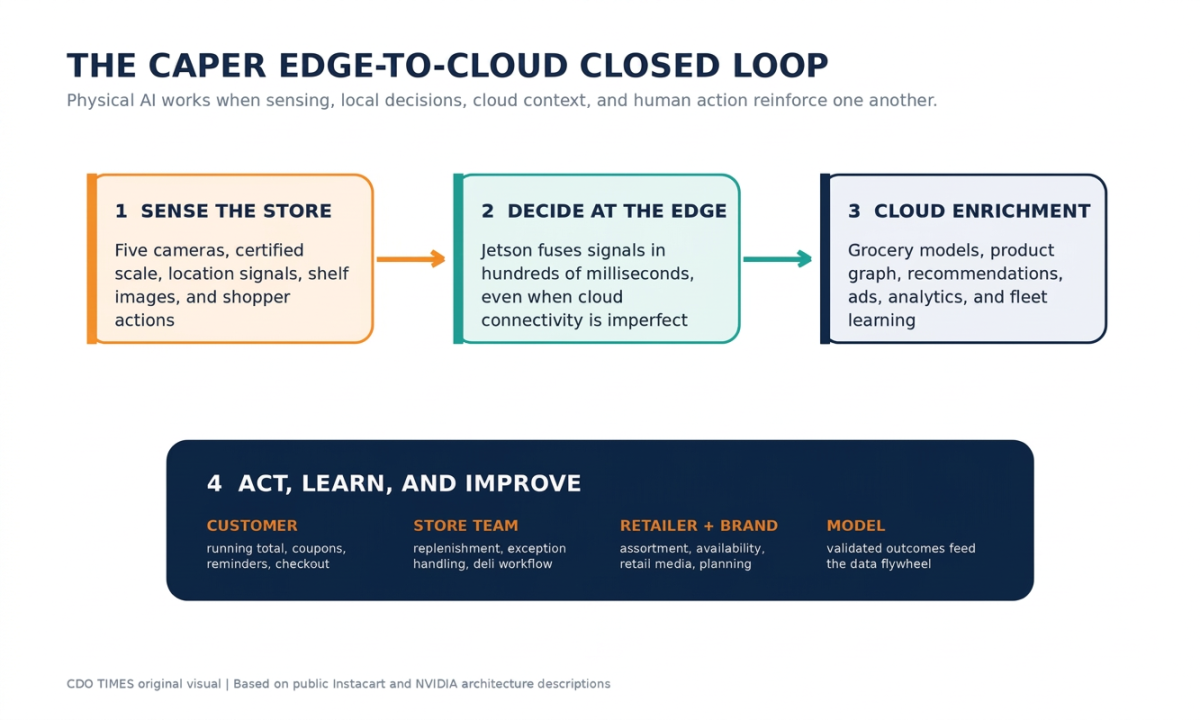
Visual 2. The Caper edge-to-cloud closed loop. CDO TIMES original visual based on public Instacart and NVIDIA descriptions.
The Data Flywheel Frontier Models Cannot Buy Off the Shelf
General-purpose frontier models learn mainly from digital artifacts: documents, images, websites, code, video, and synthetic examples. They do not automatically know how a crumpled produce bag looks under fluorescent light, how two visually similar private-label packages differ after a redesign, or how a family rearranges items while a cart bumps across a floor transition. Instacart’s advantage is the combination of a commerce graph built from more than 1.6 billion lifetime orders and a growing stream of physical observations from carts and shoppers. NVIDIA says Instacart is developing a grocery world model that connects orders, product instances, shelf state, location, weight, and real-time behavior; Instacart’s 2026 acquisition of Arpalus gives that ambition a more explicit shelf-intelligence engine. The strategic point for CDOs is that physical AI requires rights to the right data, feedback loops that connect predictions to outcomes, and an operating model that converts ambiguous cases into supervised learning rather than silent failure.[1][3]
Sensor fusion is central because no single modality is dependable enough. Cameras can be occluded or confused by reflections and packaging similarity, but the scale can detect a weight change; the scale can be noisy when the cart is moving, but location and image sequences can constrain the possibilities. A barcode can identify a package but says little about quantity, removal, placement, or the state of the shelf. The most sophisticated physical AI systems therefore reason over events and relationships rather than isolated frames: who or what moved, where it moved, how weight changed, what products are expected nearby, and whether the emerging basket state remains coherent. That is also why an apparently simple question such as “Is the cart empty?” becomes a loss-prevention problem with many edge cases rather than a binary image-classification task.[1][9]
The Business Model Changed When the Cart Became a Revenue Surface
The business case for connected carts is broadening from labor efficiency and faster checkout to measurable revenue. NVIDIA reports that Instacart’s location-aware recommendations produced more than 1% incremental sales lift in A/B testing and that a pre-checkout “got everything you need?” reminder delivered nearly another percentage point of lift. Instacart’s Weis Markets announcement repeats the nearly one-point basket effect for the reminder, while its Caper product materials position loyalty enrollment, coupons, retail media, omnichannel conversion, and reduced shrink as parts of the same value proposition. Those figures are company and partner claims, not neutral industry benchmarks, and retailers should resist inserting them directly into business cases without local validation. The right test design compares matched stores or randomized shopping trips and measures incremental gross margin, adoption, repeat use, false exception rates, checkout time, availability, shrink, labor effort, customer satisfaction, and media performance together.[1][2][7]
The customer value proposition is also more nuanced than removing the checkout line. In earlier interviews, McIntosh noted that shoppers often valued the running total and coupons more than the line-skip itself, an insight reflected in Caper’s later features for loyalty sign-up, personalized offers, digital lists, and EBT SNAP-eligible running totals. This matters because a physical AI program will struggle if it is framed only as surveillance or automation for the retailer. The customer needs a visible exchange of value: easier budgeting, reliable savings, less searching, fewer forgotten items, more accessible benefits, convenient deli ordering, and the choice to use a conventional path. Family shopping can become collaborative when lists, preferences, meal plans, offers, and cart progress travel across online and in-store channels without making the experience feel like a sequence of ads.[4][5]
Modularity Is the Hidden Scaling Advantage
Instacart has deliberately described Connected Stores as modular because few retailers can rebuild every location around one monolithic technology bet. Caper Carts can integrate with existing POS, payment, and loyalty environments; Carrot Tags add software to compatible electronic shelf labels; FoodStorm digitizes deli, bakery, catering, and prepared-food workflows; Storefront and in-store mode connect the digital journey; and Store View converts shelf imagery into operational intelligence. That creates multiple entry points, allowing a retailer to begin with the problem that has the clearest economics and then connect the components through shared identity, catalog, inventory, and event services. It also reduces the risk that one underperforming feature sinks the entire connected-store strategy. The architectural caution is that modular products only create an ecosystem when the data semantics, APIs, observability, security controls, and operating ownership are genuinely shared.[2][5][6]
The deli illustrates why physical AI should not be confined to vision. Many service counters still depend on paper tickets, verbal coordination, or disconnected queue systems, which makes production status invisible to the shopper and difficult to synchronize across departments. FoodStorm Department Orders allows customers to place prepared-food requests and keep shopping while the store coordinates fulfillment and notifies them when the order is ready, including through the cart experience. In a mature connected store, the model can understand that a family still needs to collect a sandwich, that a promised pickup time is approaching, and that the relevant counter is behind them, without forcing the shopper to stand in a line. The value comes from joining process digitization, staff workflow, location awareness, and customer communication—not from adding a camera to the deli.[2][5]
What Other Retailers Are Building
Instacart is not alone, and the competitive landscape shows that there is no single physical AI pattern. Amazon’s redesigned Dash Cart combines computer vision, weight sensing, an integrated produce scale, an interactive map, lists, running totals, and more payment options; Amazon says the newest version will reach dozens of additional Whole Foods Market locations by the end of 2026. Amazon’s Just Walk Out architecture instruments the store instead of the cart, using cameras, weight sensors, a 3D store map, and a multimodal foundation model to determine who took what under occlusion, variable lighting, and complex shopper behavior. REWE’s Pick&Go stores use Trigo’s 3D digital model while preserving a hybrid choice between checkout-free and conventional payment, demonstrating that operating-model flexibility can matter as much as technical ambition. Sam’s Club targets a narrower friction point by using AI and computer vision to validate Scan & Go purchases at the exit, while Focal and Vusion focus on shelf visibility, electronic labels, task execution, and retail IoT. At Wendy’s I helped implement the voice AI drive thru digitizing the process of ordering, upselling and purchasing product leveraging agentic AI.[8][9][10][11][12][13]
These approaches should be viewed as composable patterns rather than mutually exclusive winners. A large weekly-basket grocer may combine connected carts, shelf cameras, electronic shelf labels, and conventional staffed checkout, while a stadium concession or convenience store may favor ceiling-based checkout-free technology. A warehouse club with strong Scan & Go adoption may generate faster value by fixing exit verification, and a retailer with chronic fulfillment substitutions may prioritize shelf intelligence before personalization. The store format, basket profile, customer trust threshold, remodel cycle, associate model, and loss characteristics should decide the sequence. The common denominator is a real-time store data layer that can reconcile what the enterprise systems believe with what is physically happening now.
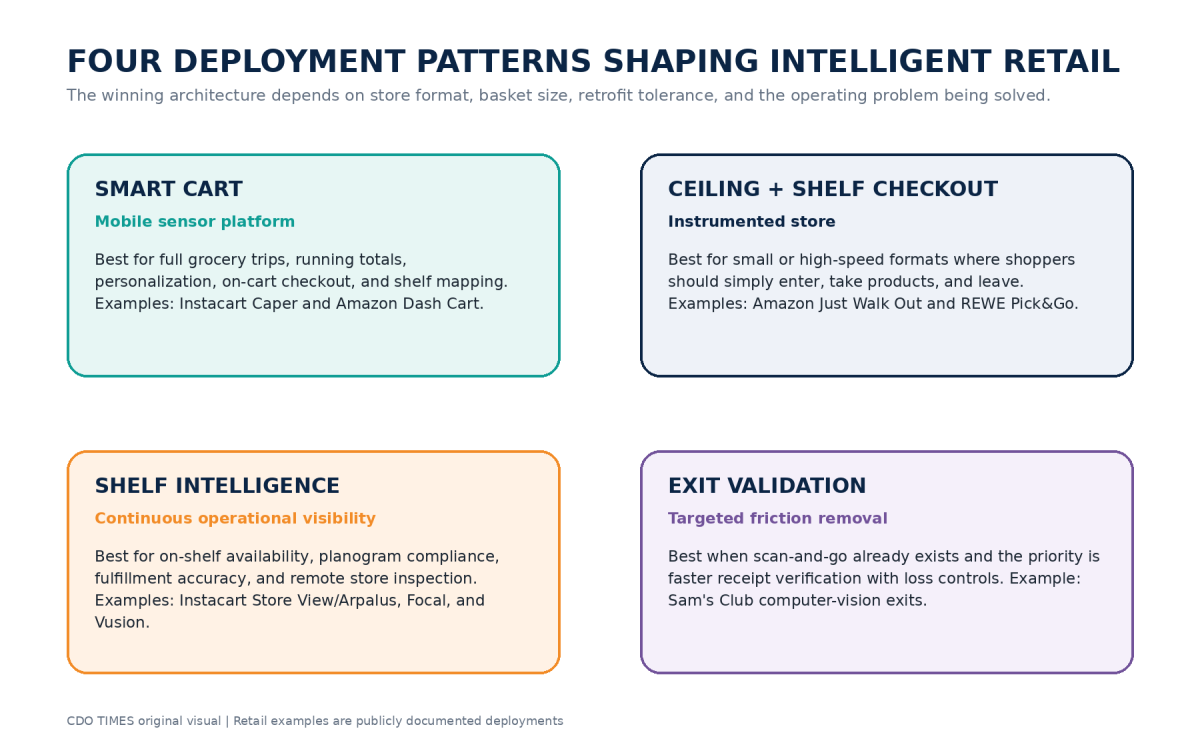
Visual 3. Four deployment patterns shaping intelligent retail. CDO TIMES original visual.
The Retail Physical AI Readiness Stack
Retailers frequently pilot the visible device before they modernize the foundations that determine whether it will scale. The better sequence begins with the physical store and network, then establishes data and integration, then builds device and model operations, and only then treats customer and workforce workflows as a repeatable product. The stack also needs cross-cutting controls for security, privacy, safety, accessibility, and regulatory obligations, especially where payment, identity, cameras, weight certification, or automated loss decisions are involved. NIST’s AI Risk Management Framework provides a useful governance pattern around Govern, Map, Measure, and Manage, while the NIST zero-trust practice guide reinforces the principle that thousands of in-store devices should not receive implicit network trust. A retailer that cannot monitor device health, model drift, calibration, data lineage, or exception outcomes does not yet have a physical AI platform; it has a collection of fragile endpoints.[14][15]

Visual 4. The Retail Physical AI Readiness Stack. CDO TIMES original visual.
What Retailers Must Engineer Before the Pilot Scales
- Map the physical environment: record aisle widths, shelf heights, endcaps, freezer doors, reflective surfaces, lighting zones, cart routes, vestibules, parking exposure, charging locations, and seasonal reconfiguration patterns.
- Design for disconnection: specify which functions remain available locally, how long events can queue, how transactions reconcile, when the user is redirected, and how store staff resolve low-confidence cases.
- Create a store connectivity SLO: measure coverage, roaming, packet loss, latency distribution, device density, interference, authentication time, and backhaul health during real trading hours—not in an empty-store survey.
- Build a governed product and location graph: unify SKU identity, packaging changes, weighted items, price, promotion, tax, shelf position, planogram, inventory, substitution, loyalty, and payment references.
- Operate the fleet as critical infrastructure: support secure provisioning, signed software, certificate rotation, OTA updates, staged rollout, rollback, remote diagnostics, calibration, cleaning, spares, battery monitoring, and end-of-life handling.
- Make confidence visible in the workflow: define thresholds, reasons, evidence, human overrides, escalation paths, customer recovery, and feedback labels so errors improve the system instead of disappearing into store workarounds.
- Test the ugly edge cases: stacked products, children moving items, loose produce, bags blocking cameras, packaging changes, abandoned carts, low batteries, lighting shifts, condensation, network loss, wheel impacts, unusual body positions, returns, and attempted item swapping.
- Measure ecosystem value: track benefits and burdens for customers, associates, retailers, CPG suppliers, e-commerce pickers, loss-prevention teams, advertisers, and accessibility stakeholders before declaring success.
A Credible Roadmap for Instacart and for Retail
The first horizon is already visible: scale Caper as a reliable edge platform, deepen loyalty and savings, support multiple checkout modes, and use outward-facing cameras to improve shelf state. The second horizon connects that physical signal to Store View, Arpalus, Carrot Tags, FoodStorm, catalog intelligence, and agentic analytics so store managers can move from dashboards to prioritized actions. The third horizon is a living store twin that understands product identity, location, availability, customer intent, operational constraints, and economic context in near real time. That twin could simulate the effect of a display or promotion in one part of the store on decisions made somewhere else, guide employees and e-commerce pickers, and provide the spatial intelligence required for future robotics. Only the first two horizons are directly supported by announced Instacart products and acquisitions; the fully integrated twin and broader robotics layer are reasonable strategic inferences from Instacart’s public grocery-world-model direction, not promised deployment dates.[1][3][6]
For the shopper, the next level should feel less like being targeted and more like being helped. The cart or app can remember frequently purchased items, identify what may have been forgotten, reconcile a family list, suggest a relevant substitute, navigate to a product, track budget and benefits, and coordinate a deli order without breaking the flow of the trip. Personalization needs a restraint layer that considers frequency, context, household preferences, nutritional choices, consent, and the risk of overwhelming the user with promotions. Retail media will help fund the infrastructure, but short-term ad yield should not be allowed to damage trust or turn every aisle into an auction. Consumer delight will be the outcome of relevance, control, transparency, and reliable execution—not the number of recommendations displayed.[2][4][6]
The CDO TIMES Bottom Line
Instacart’s physical AI initiative is important because it changes the unit of digital transformation from the website or app to the continuously observed store. The Jetson board inside the Caper Cart is the enabling detail, but the strategic asset is the closed loop connecting sensor fusion, grocery-specific data, cloud intelligence, store workflows, customer value, and model learning. Retailers should not start by asking which smart cart to buy; they should start by selecting the highest-value store decision that is currently made with stale or incomplete physical information. They should then build the readiness stack—store environment, resilient connectivity, governed data, fleet and model operations, human workflows, and trust—needed to make that decision dependable at scale. The retailers that win will not be those with the most AI devices, but those that turn real-world signals into better decisions for customers, associates, operators, and suppliers every single day.
Sources
All URLs point to the original publisher or primary company source. Commercial performance claims are attributed to the organizations reporting them.
NVIDIA case study: Instacart Powers Smart Carts With Jetson and Physical AI: https://www.nvidia.com/en-us/case-studies/instacart/
Instacart: Caper Carts turn every in-store trip into measurable growth: https://company.instacart.com/enterprise-platform/connected-stores/caper-carts
Instacart: Acquisition of Arpalus for real-time shelf intelligence: https://company.instacart.com/pressreleases/instacart-acquires-arpalus-to-advance-real-time-shelf-intelligence-across-grocery-retail
Instacart: New omnichannel Caper Cart capabilities: https://company.instacart.com/pressreleases/instacart-caper-carts-roll-out-new-omnichannel-capabilities-for-more-savings-in-every-aisle
Instacart: Introducing Connected Stores: https://company.instacart.com/updates/introducing-connected-stores-making-shopping-seamless
Instacart: New enterprise AI solutions for grocers: https://www.prnewswire.com/news-releases/instacart-announces-new-enterprise-ai-solutions-to-democratize-ai-for-grocers-of-all-sizes-302603735.html
Instacart investor release: Weis Markets Caper Cart launch: https://investors.instacart.com/news-releases/news-release-details/instacart-and-weis-markets-launch-ai-powered-caper-carts/
Amazon: Newest Dash Cart and Whole Foods expansion: https://www.aboutamazon.com/news/retail/amazon-redesigned-dash-cart-whole-foods-market
Amazon: Multimodal foundation model for Just Walk Out: https://www.aboutamazon.com/news/retail/amazon-just-walk-out-improves-accuracy
REWE Group: Pick&Go hybrid supermarket and Trigo 3D store model: https://www.rewe-group.com/en/press-and-media/newsroom/press-releases/on-course-for-success-with-innovative-technology-three-more-rewe-pickgo-stores-in-dusseldorf-and-hamburg/
Walmart: AI and computer vision at Sam’s Club exits: https://corporate.walmart.com/news/2024/01/09/walmart-offers-a-glimpse-into-the-future-of-retail-at-consumer-electronics-show
Focal Systems: AI shelf cameras and real-time shelf monitoring: https://focal.systems/computer-vision/
Vusion: Connected shelves, retail IoT, and in-store intelligence: https://www.vusion.com/
NIST: Artificial Intelligence Risk Management Framework: https://www.nist.gov/itl/ai-risk-management-framework
NIST NCCoE: Implementing a Zero Trust Architecture: https://www.nccoe.nist.gov/projects/implementing-zero-trust-architecture
Wireless Broadband Alliance: Wi-Fi Design Standard: https://wballiance.com/wi-fi-design-standard/
Instacart 2025 Form 10-K: https://www.sec.gov/Archives/edgar/data/1579091/000157909126000018/cart-20251231.htm
Amazon: Weather resistance and durability testing for Dash Cart: https://www.aboutamazon.com/news/retail/amazon-dash-cart-new-features-whole-foods