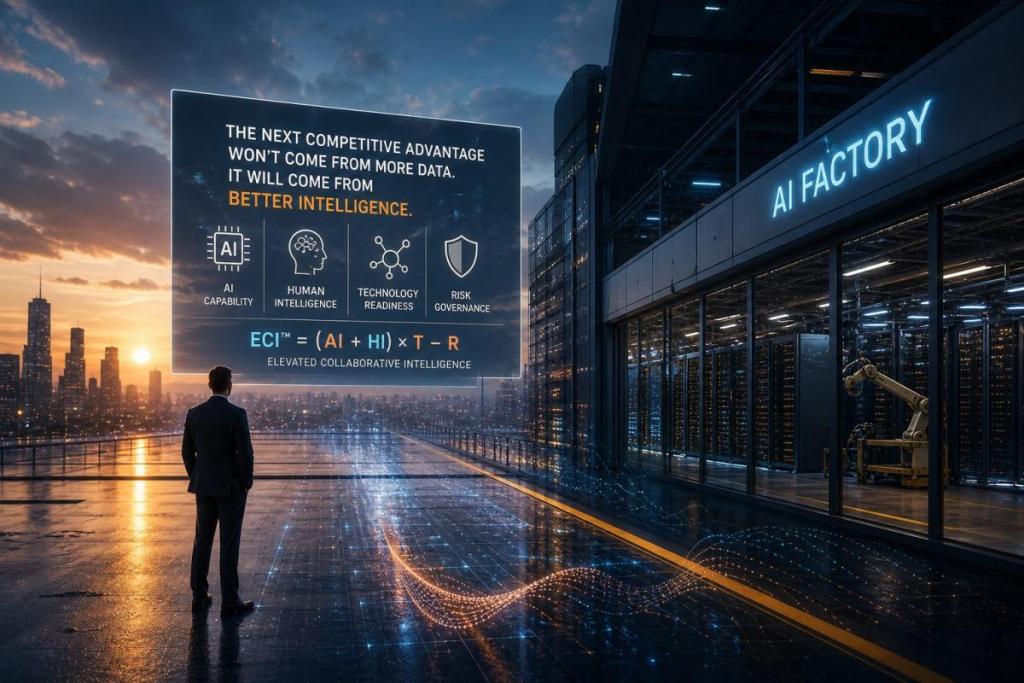
The AI Factory Era Is Here — But Most Enterprises Are Producing Noise, Not Intelligence
Why Data Centers Are Becoming Strategic Weapons — and Why Leadership Still Lags Behind
By Carsten Krause
May 1, 2026
The Shift Most Leaders Still Underestimate
A quiet but fundamental transformation is underway—and it is not being led by software teams or even AI labs.
It is being led by infrastructure.
In a recent perspective, Manish Kumar of Schneider Electric outlined a reality that deserves far more executive attention: data centers are no longer just digital infrastructure. They are evolving into AI factories: systems that generate tokens, insights, decisions, and increasingly, business outcomes.
“Data centres are evolving into AI factories… generating tokens, images, voice, and intelligence at scale.” Manish Kumar, Executive Vice President at Schneider Electric
https://www.expresscomputer.in/news/data-centres-are-evolving-into-ai-factories-manish-kumar-executive-vp-schneider-electric/134311/
This is not an incremental evolution. It is a structural shift in how value is created in the digital enterprise.
The implication is straightforward but uncomfortable:
If your data center strategy is still framed around uptime, storage, and cost efficiency, you are already behind.
Jensen Huang, CEO of NVIDIA, has been even more direct:
“Data centers are becoming AI factories.”
https://blogs.nvidia.com/blog/ai-factories/
Because the game has changed from managing infrastructure to producing intelligence at scale.
From Data Storage to Intelligence Production
Historically, data centers existed to support applications. Their success was measured in availability, latency, and cost optimization.
That model is now obsolete.
AI-driven workloads have fundamentally altered the equation:
- Large-scale training requires massive compute clusters
- Real-time inference requires ultra-low latency environments
- Continuous learning loops demand persistent processing pipelines
More importantly, the output has changed. Data centers are no longer processing transactions. They are generating:
- predictive insights
- generated content
- automated decisions
- software code
- real-time recommendations
In other words, they are producing intelligence as a product.
This is why the term “AI factory” is not marketing language. It is an architectural reality.
The Constraint No One Wants to Talk About: Energy
There is a second, more critical shift embedded in this transformation—one that many CIOs and CDOs are still underestimating.
AI is no longer constrained primarily by compute innovation.
It is constrained by energy availability.

According to Deloitte, data center power consumption driven by AI is expected to rise sharply toward the end of the decade, potentially doubling in key markets.
https://www.deloitte.com/us/en/insights/industry/technology/technology-media-and-telecom-predictions/2025/genai-power-consumption-creates-need-for-more-sustainable-data-centers.html
Sam Altman, CEO of OpenAI, has publicly acknowledged this emerging bottleneck:
“The cost of intelligence will converge to the cost of energy.”
https://www.sequoiacap.com/article/ai-as-a-new-operating-system/
That single statement reframes enterprise AI strategy.
This creates a new strategic reality:
- AI strategy becomes energy strategy
- Infrastructure decisions become location decisions
- Sustainability becomes a competitive differentiator
Organizations that fail to align AI ambitions with energy constraints will not scale—regardless of their technology investments.
The Illusion of Progress: Why More AI Does Not Mean More Value
Despite this massive infrastructure investment, many enterprises are experiencing a familiar problem.
AI adoption is rising.
Productivity metrics are improving.
But enterprise value is not scaling accordingly.
Research from Stanford and MIT shows measurable productivity gains from AI tools, particularly among less experienced workers.
https://arxiv.org/abs/2304.11771
Nielsen Norman Group reports up to a 66% increase in task throughput for business users leveraging AI tools.
https://www.nngroup.com/articles/ai-tools-productivity-gains
These are real gains. But they are not the same as transformation.
The problem is structural.
Most organizations are optimizing for local productivity improvements, while failing to redesign:
- decision-making processes
- operating models
- cross-functional workflows
As a result, they are building powerful AI factories that generate outputs—but not necessarily outcomes.
The Missing Layer: Elevated Collaborative Intelligence (ECI™)
This is where most AI strategies quietly break.
Technology is scaling.
Infrastructure is expanding.
But leadership alignment is lagging.
The reality can be summarized through a simple equation:
ECI = (AI + HI) × T – R
Where:
- AI represents technological capability
- HI represents human intelligence, leadership, and decision-making
- T represents technology readiness
- R represents risk
What we are seeing today is a clear imbalance:
- AI is increasing exponentially
- Technology readiness is uneven due to energy and integration constraints
- Risk is rising (cost, sustainability, governance)
- Human intelligence is not scaling at the same rate
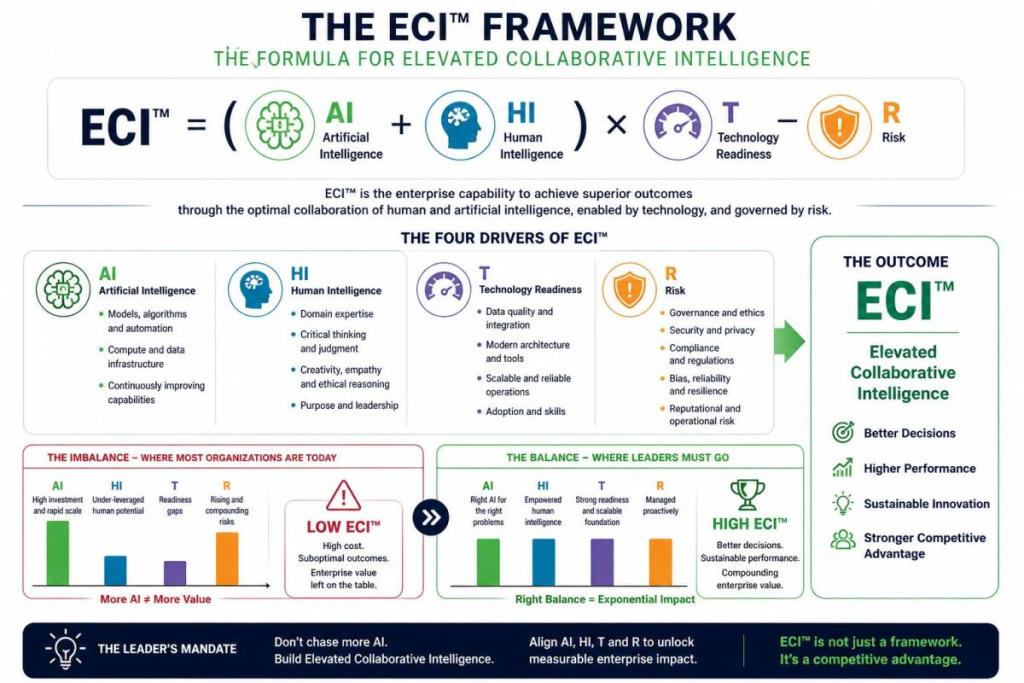
The result is predictable:
High investment, limited enterprise impact.
Satya Nadella, CEO of Microsoft, has emphasized this gap:
“The next phase of AI is not just about tools—it’s about workflows.”
https://blogs.microsoft.com/blog/2023/05/23/introducing-microsoft-365-copilot/
Most organizations are still deploying AI as tools layered onto existing processes.
They are optimizing tasks, not transforming outcomes.
Scaling Infrastructure Without Scaling Decisions
Manish Kumar’s observations about the rapid expansion of AI infrastructure highlight a broader global trend.
Regions such as India are seeing exponential growth in data center capacity, positioning themselves for the AI-driven economy.
But scale alone is not enough.
Andy Jassy, CEO of Amazon, framed this challenge clearly:
“Most companies are still early in their AI journey.”
https://www.aboutamazon.com/news/company-news/andy-jassy-shareholder-letter-2023
What he is implicitly pointing to is not a lack of technology—but a lack of organizational readiness.
Enterprises are building AI factories.
But they are not yet operating intelligence-driven enterprises.
Data centers—and by extension AI factories—are becoming:
- economic infrastructure
- geopolitical assets
- competitive differentiators
But scale alone does not create value.

Without aligning AI outputs to business decisions, organizations risk:
- generating excessive, unused intelligence
- increasing operational complexity
- driving up cost without proportional return
This is the equivalent of building a manufacturing plant without defining the product.
What Leading Organizations Are Starting to Do Differently
The organizations that are beginning to unlock real value from AI factories are not the ones with the most compute.
They are the ones that are redesigning how intelligence flows through the enterprise.
There are five emerging patterns:
1. Defining Intelligence Output Metrics
Leading organizations are shifting from measuring:
- model accuracy
- system performance
to measuring:
- decision quality
- revenue impact
- cycle time reduction
This reframes AI from a technical initiative to a business capability.
2. Aligning AI Workloads with Energy Strategy
AI workloads are being prioritized based on:
- business value per compute unit
- energy consumption
- sustainability impact
This introduces discipline into what is otherwise an unconstrained demand environment.
3. Moving Beyond Pilot Thinking
Pilots are no longer treated as isolated experiments.
Instead, organizations are:
- designing for scale from day one
- embedding AI into core workflows
- integrating across functions
This is the difference between experimentation and transformation.
4. Embedding AI into Decisions, Not Tools
The shift is subtle but critical.
Instead of deploying AI tools alongside existing workflows, leading companies are:
- redesigning workflows around AI
- redefining roles between humans and machines
- eliminating redundant decision layers
5. Rebalancing Human and Artificial Intelligence
Not every decision should be automated.
High-performing organizations are explicitly defining:
- where AI leads
- where humans lead
- where collaboration is required
This is where Elevated Collaborative Intelligence™ becomes operational.
The Leadership Challenge Ahead
The next phase of AI transformation will not be defined by who builds the largest models or the biggest data centers.
It will be defined by who can:
- align infrastructure with business value
- balance AI capability with human judgment
- scale intelligence without scaling risk
The organizations that succeed will not just operate AI factories.
They will operate intelligence-driven enterprises.
The CDO TIMES Bottom Line
The transformation of data centers into AI factories is real—and accelerating.
But infrastructure alone will not determine the winners.
Enterprises must move beyond scaling compute to scaling intelligence outcomes.
They must align AI investments with energy constraints, governance models, and business decisions.
Most importantly, they must rebalance the relationship between human and artificial intelligence.
Because value is not created by generating more intelligence.
It is created by applying the right intelligence, at the right time, to the right decisions.
That is the difference between AI adoption and Elevated Collaborative Intelligence™.
Love this article? Embrace the full potential and become an esteemed full access member, experiencing the exhilaration of unlimited access to captivating articles, exclusive non-public content, empowering hands-on guides, and transformative training material. Unleash your true potential today!
Order the AI + HI = ECI book by Carsten Krause today! at cdotimes.com/book

Subscribe on LinkedIn: Digital Insider
Become a paid subscriber for unlimited access, exclusive course content, no ads: CDO TIMES
Do You Need Help?
Consider bringing on a fractional CIO, CISO, CDO or CAIO from CDO TIMES Leadership as a Business Consulting Service. The expertise of CDO TIMES becomes indispensable for organizations striving to stay ahead in the digital transformation journey. Here are some compelling reasons to engage their experts:
- Deep Expertise: CDO TIMES has a team of experts with deep expertise in the field of Cybersecurity, Digital, Data and AI and its integration into business processes. This knowledge ensures that your organization can leverage digital and AI in the most optimal and innovative ways.
- Training, developing, arranging, and conducting educational conferences and programs and providing courses of instruction.
- Strategic Insight: Not only can the CDO TIMES team help develop a Digital & AI strategy, but they can also provide insights into how this strategy fits into your overall business model and objectives. They understand that every business is unique, and so should be its Digital & AI strategy.
- Future-Proofing: With CDO TIMES, organizations can ensure they are future-proofed against rapid technological changes. Our experts stay abreast of the latest AI, Data and digital advancements and can guide your organization to adapt and evolve as the technology does.
- Risk Management: Implementing a Digital & AI strategy is not without its risks. The CDO TIMES can help identify potential pitfalls and develop mitigation strategies, helping you avoid costly mistakes and ensuring a smooth transition with fractional CISO services.
- Competitive Advantage: Finally, by hiring CDO TIMES experts, you are investing in a competitive advantage. Their expertise can help you speed up your innovation processes, bring products to market faster, and stay ahead of your competitors.
By employing the expertise of CDO TIMES, organizations can navigate the complexities of digital innovation with greater confidence and foresight, setting themselves up for success in the rapidly evolving digital economy. The future is digital, and with CDO TIMES, you’ll be well-equipped to lead in this new frontier.
Do you need help with your digital transformation initiatives? We provide fractional CAIO, CDO, CISO and CIO services, do a Preliminary ECI and Tech Navigator Assessment and we will help you drive results and deliver winning digital and AI strategies for you!
Subscribe now for free and never miss out on digital insights delivered right to your inbox!