Case Study Schneider Electric: The Rise of Sustainable Infrastructure
Why AI Is Forcing CIOs, digital leaders and Enterprise Architects to Redesign the Relationship Between Computing, Energy and Business Value
By Carsten Krause
The CDO TIMES Sustainable Enterprise Architecture Series
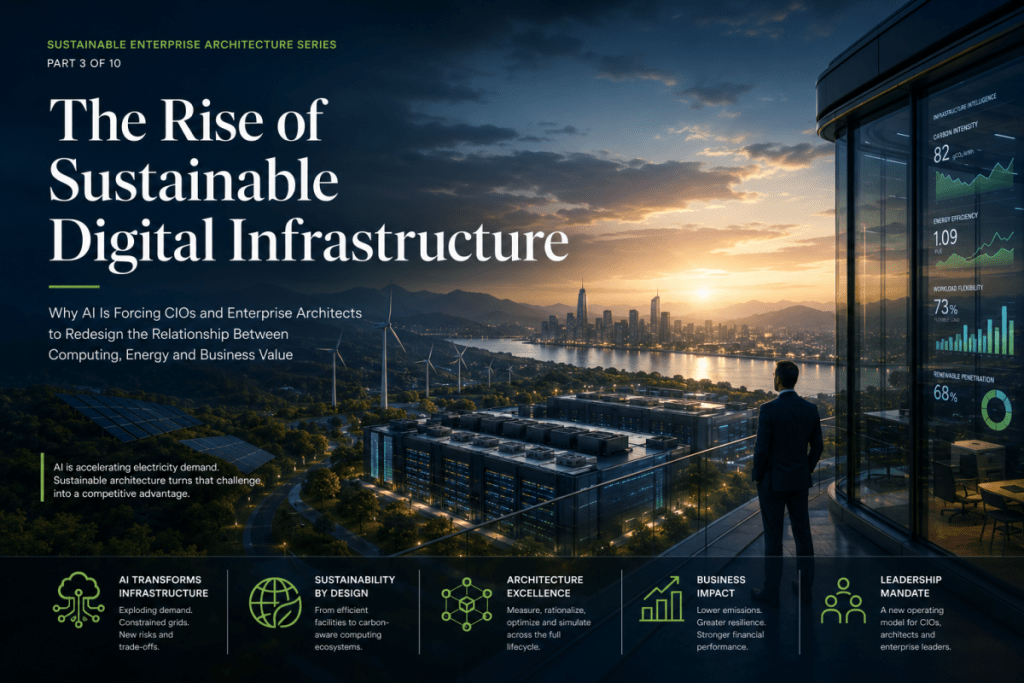
Artificial intelligence is turning digital infrastructure into an energy, architecture and business strategy issue. Schneider Electric’s experience shows why sustainable infrastructure must be designed across the full lifecycle—from digital demand and model selection to data centers, microgrids, equipment reuse and simulation.
The AI Boom Has Become an Infrastructure Reckoning
Artificial intelligence is changing the infrastructure equation faster than most enterprise operating models can adapt. Every AI assistant, predictive-maintenance application, digital twin and autonomous agent ultimately depends on physical equipment, electricity, cooling, networking, data storage and increasingly constrained grid capacity. For decades, technology leaders optimized infrastructure around cost, performance, availability and security. Those criteria remain essential, but they are no longer sufficient. Energy efficiency, carbon intensity, water consumption, equipment lifecycle and access to reliable electricity are becoming architecture concerns that directly affect growth, resilience and financial performance.
The International Energy Agency estimates that data centers consumed approximately 415 terawatt-hours of electricity in 2024, representing about 1.5% of global electricity demand. Under its base-case projection, that consumption rises to approximately 945 terawatt-hours by 2030, just under 3% of global electricity demand. Accelerated servers, which include much of the computing infrastructure used for AI, account for almost half of the projected increase. Their electricity consumption is expected to grow by approximately 30% annually through 2030, compared with 9% for conventional servers.
These figures do not suggest that data centers will consume all available energy. They confirm something more operationally important: AI infrastructure is growing considerably faster than the wider electricity system, and much of that demand is concentrated in specific regions. Data centers can therefore represent a modest share of global consumption while creating severe local problems involving grid capacity, interconnection queues, generation, transmission and energy prices.
The strategic question is not simply whether the world can generate enough electricity in aggregate. It is whether enterprises can secure affordable, reliable and lower-carbon power where and when their digital infrastructure needs it. This is pushing digital infrastructure beyond the boundaries of the traditional IT organization. Cloud strategy can no longer be separated cleanly from energy availability. Software design can no longer be separated from compute intensity. Data-center architecture can no longer be separated from cooling, water and grid constraints.

Figure 1. AI is driving a step change in data-center electricity demand. Source: International Energy Agency projections summarized by The CDO TIMES.
The Old Boundaries Between IT, Facilities and Energy Are Breaking Down
Most enterprises still govern technology demand through fragmented processes. Business units propose digital initiatives. Architecture teams evaluate technology fit. Cybersecurity assesses exposure. Finance reviews costs. Infrastructure teams provision capacity. Facilities teams manage buildings and cooling, while sustainability teams calculate emissions after many of the critical design decisions have already been made. Each function may perform its individual task well, yet the organization lacks a mechanism for optimizing the complete system.
AI exposes the weakness of that fragmentation because its resource requirements can vary dramatically depending on how a solution is designed. A large general-purpose model may consume considerably more computing capacity than a smaller domain-specific model. An application that generates thousands of unnecessary inference requests may create energy and cost without corresponding business value. A workload placed in one cloud region may have a different emissions profile, energy price and grid-reliability risk from the same workload operating elsewhere.
Architecture decisions also create effects that extend far beyond operational electricity. Servers, networking equipment, batteries and employee devices carry embodied emissions from raw-material extraction, manufacturing and transportation. Cooling systems use energy and, in some configurations, substantial amounts of water. Equipment refresh cycles affect both capital expenditure and electronic waste. Annual renewable-energy purchasing does not necessarily mean that a data center is powered by renewable electricity every hour, particularly when generation and consumption occur at different times or on different grids.
The strategic consequence is significant. Digital infrastructure is no longer simply the technical foundation beneath business strategy. In an AI-intensive enterprise, infrastructure capacity can determine whether the strategy is operationally possible. Grid access can affect where organizations expand. Cooling requirements can affect which sites are viable. GPU availability can influence product roadmaps. Energy prices can change the economics of AI services. Infrastructure has moved from the basement to the board agenda.
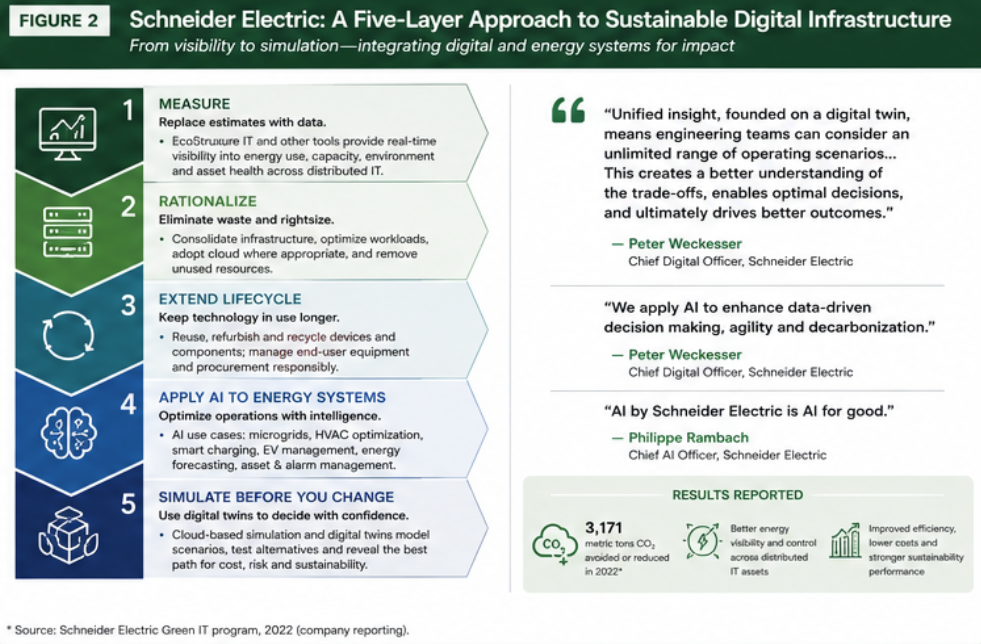
Figure 2. Sustainable digital infrastructure must be designed across the full technology lifecycle, from demand and model design through energy supply, placement and circularity.
Schneider Electric: Sustainability as a Digital Operating Discipline
Schneider Electric provides a useful case study because it operates at the intersection of energy management, industrial automation, software, data centers and enterprise technology. Its public position does not treat digitalization and sustainability as separate programs. Instead, the company argues that digital information, automation and analytics are necessary to understand and optimize complex energy and industrial systems. This position is particularly relevant because Schneider is both a technology provider and a global enterprise confronting its own IT footprint.
Peter Weckesser, Schneider Electric’s Chief Digital Officer, has repeatedly connected digital transformation with operational sustainability. In a World Economic Forum article, he argued that organizations can combine data, decarbonization tools and digital work processes to improve business decisions. His discussion of digital twins is especially important because it moves the sustainability conversation from reporting previous outcomes to evaluating future possibilities.
“Unified insight, founded on a digital twin, means engineering teams can consider an unlimited range of operating scenarios.”
— Peter Weckesser, Chief Digital Officer, Schneider Electric
A conventional monitoring system explains what equipment consumed yesterday. A digital twin can help an organization test how a plant, building, data center or energy system might behave under different operating conditions. It can model the consequences of changing cooling configurations, adding storage, shifting demand, introducing renewable generation or modifying industrial processes. The organization can then compare cost, resilience, production and sustainability outcomes before implementing the chosen option.
Schneider has also linked AI with practical energy and operational applications. Its published AI-at-scale strategy identifies use cases involving microgrid management, heating and cooling optimization, smart charging, electric-vehicle management, asset management and industrial operations. Weckesser summarized the objective as applying AI to improve data-driven decision-making, agility and decarbonization.
Microgrids illustrate that system-level approach. As organizations add solar generation, batteries, electric vehicles and other distributed energy resources, they must continuously coordinate local production, consumption, storage and interaction with the wider grid. AI can help forecast demand, evaluate weather patterns, anticipate renewable generation and optimize assets around cost, carbon emissions and availability. The grid becomes a digital ecosystem requiring real-time orchestration rather than a static mechanical network.
The Case for Frugal, Value-Led AI
The energy efficiency of infrastructure cannot be addressed only after AI demand has been created. Organizations must also question whether each proposed AI use case requires the largest available model, continuous inference or AI at all. This is where Philippe Rambach, Schneider Electric’s Chief AI Officer, adds an important dimension to the case study. His public messaging emphasizes measurable value, scalability and purposeful implementation rather than AI adoption for its own sake.
When Schneider established its global AI Hub, the stated objective was to create scalable AI capabilities that could deliver measurable value and improve both efficiency and sustainability. Rambach subsequently described Schneider’s approach with the phrase “AI for good,” explicitly connecting the company’s AI program to the challenge of climate change. The operating principle behind the phrase is more useful than the slogan: AI investments should be challenged against the business and sustainability outcomes they are intended to produce.
Schneider’s discussion of frugal AI strengthens this principle. Frugal AI asks organizations to evaluate when AI is necessary, how much computational complexity is justified and whether smaller or more targeted approaches can achieve the required outcome. The most sustainable inference request is not necessarily the one executed in the most efficient data center. It may be the request that never needed to be made.
This is an architectural issue because the demand for computing is shaped long before infrastructure is provisioned. Product owners define features. Data scientists select models. Software teams determine how often systems make requests. Architects choose integration patterns and deployment models. Procurement teams select providers. A sustainability strategy focused only on power usage effectiveness or renewable procurement arrives too late.
Turning Green IT Into an Internal Transformation Program
The Schneider case becomes more credible when examining how the company has addressed its own IT estate. Elizabeth Hackenson’s public writing on Green IT describes a practical internal challenge: the organization had accumulated close to half a million technology assets, while the energy consumption of many distributed assets had not been comprehensively understood. These included equipment in server rooms across offices, factories and other locations—effectively a network of small data centers operating outside the visibility normally applied to major centralized facilities.
This is a familiar enterprise problem. Large data centers usually receive significant operational scrutiny, yet considerable technology capacity can remain distributed across offices, industrial facilities, laboratories and warehouses. Those environments may contain underutilized servers, oversized power systems, older cooling equipment and devices with weak lifecycle governance. The resulting footprint is difficult to measure because the supporting data sits across asset-management, procurement, facilities, cloud, finance and sustainability systems.
Schneider’s Green IT program addressed the issue across four areas: end-user devices, IT infrastructure, collaboration practices and employee behavior. The device component included reuse, refurbishment and recycling. The infrastructure component included measurement, consolidation, energy management and cloud adoption. Collaboration practices were examined for their effect on travel and operational efficiency, while employee engagement was treated as necessary for changing consumption behavior.
Schneider reported that the program avoided or reduced 3,171 metric tons of carbon dioxide emissions during 2022. This is a company-reported figure rather than an independently validated industry benchmark, but the significance of the program is not the individual number. It is the recognition that sustainable IT requires a portfolio approach spanning technology demand, infrastructure, assets, employees and lifecycle management.
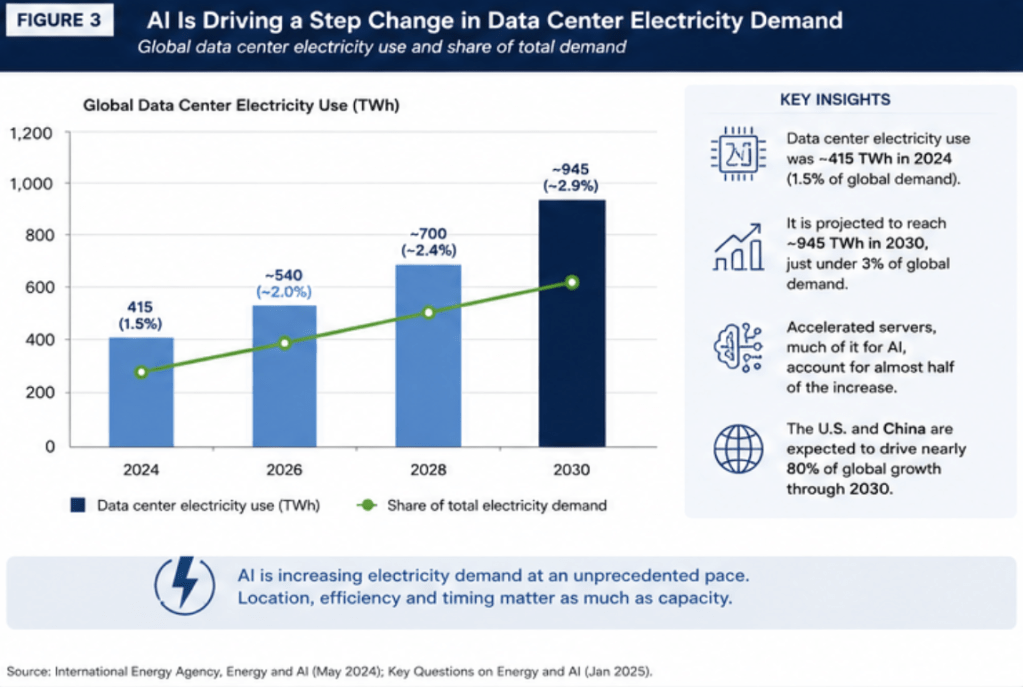
Figure 3. Schneider Electric’s five-layer approach moves from measurement and rationalization to lifecycle extension, AI-enabled energy optimization and simulation.
The Industry Is Moving Toward Carbon-Aware Computing
Schneider Electric is not alone in treating energy as an architectural variable. Google has developed carbon-aware computing capabilities that can shift flexible workloads toward times and locations where electricity is less carbon intensive. The company has also explored demand response, reducing or rescheduling data-center electricity use when the grid is constrained. This approach is materially different from annual renewable-energy matching because it recognizes that the time and location of consumption affect the actual electricity supplying a workload.
The broader implication is that some digital workloads can become flexible grid participants. Batch analytics, model training, software builds and other delay-tolerant tasks do not always have to execute immediately. When operational and regulatory constraints allow, they can be scheduled around electricity availability, grid congestion or emissions intensity. The International Energy Agency estimates that data centers could deploy 20–25 gigawatts of battery storage globally by 2030, potentially allowing facilities to support the grid rather than function only as inflexible loads.
AWS has approached sustainability as an architecture quality attribute through its Well-Architected Framework. Its guidance connects sustainability with workload utilization, managed services, modernization, regional selection, removal of unused resources and measurement of emissions associated with cloud usage. AWS documentation for industrial workloads recommends selecting regions that reduce carbon impact while continuing to meet performance, compliance, sovereignty and operational requirements.
These examples demonstrate an industry transition. The first phase of digital sustainability focused heavily on efficient facilities and renewable-energy purchasing. The next phase includes workload design, software efficiency, geographic placement, execution timing, hardware utilization, grid interaction, embodied carbon and circularity. Sustainability is moving upward from the physical infrastructure layer into enterprise and solution architecture.
Sustainable Enterprise Architecture Moves Into the Mainstream
Architecture communities are beginning to formalize this shift. The Sustainable Architectures initiative, co-founded by Lisa Pratico and Kacy Clarke, describes a global community focused on green AI, cloud computing and responsible technology. Its public work emphasizes reusable patterns, common metrics, implementation cases and a stronger role for architects in turning sustainability and responsible-AI principles into operating practices.
The initiative should not yet be characterized as a finalized or universally adopted framework. Its public materials instead reflect an emerging professional movement. The core proposition is that sustainability must be incorporated while systems are being designed, not calculated only after deployment. Architects influence model selection, data movement, platform choices, cloud regions, availability patterns, hardware demand, application lifecycles and integration complexity.
Academic research points in the same direction. A 2023 synthesis of green architectural tactics for machine-learning systems identified 30 design techniques drawn from 51 peer-reviewed publications. The work covers ways to reduce the energy and carbon impact of ML-enabled systems through software and architecture choices, reinforcing the argument that environmental sustainability can be treated as a system quality rather than as an external reporting obligation.
The theoretical shift is straightforward: architects already evaluate performance, availability, security, maintainability, interoperability and cost. Sustainability must become another explicit quality attribute. That does not mean it automatically overrides the others. A lower-carbon design that creates unacceptable resilience or regulatory risks may not be viable. Architecture is the discipline of understanding and managing those trade-offs rather than optimizing a single measure in isolation.
Seven Decisions That Define Sustainable Digital Infrastructure
1. Govern demand. Determine whether the proposed digital capability creates enough value to justify its cost and resource consumption. AI should not be the default solution simply because it is available.
2. Design efficient software and models. Use appropriate algorithms, smaller models, reduced data movement, caching and optimized inference to lower infrastructure demand before additional capacity is purchased.
3. Improve compute utilization. Rightsize servers, GPUs, storage and networks, and actively remove idle or underused capacity.
4. Optimize facilities. Address power distribution, cooling, water consumption, heat reuse and physical design as AI changes data-center density.
5. Understand energy supply. Evaluate local grid composition, reliability, price exposure and hourly carbon intensity—not only annual renewable-energy claims.
6. Optimize placement and timing. Move or schedule flexible workloads when cleaner or less constrained power is available, subject to latency, sovereignty, resilience and regulatory requirements.
7. Manage lifecycle and circularity. Incorporate procurement, reuse, refurbishment, component longevity and responsible disposal into architecture and portfolio decisions.
What CIOs, Digital Leaders and Chief Architects Should Do Now
CIOs should begin by establishing a baseline that connects technology consumption with business activity. Total energy or carbon figures provide limited decision value unless leaders can relate them to applications, workloads, locations, products or business transactions. Useful measures might include energy per AI inference, emissions per customer transaction, utilization per server, compute cost per business outcome or carbon impact per workload.
Architecture governance should add sustainability questions to existing review processes. Teams should document model size, expected inference volume, infrastructure requirements, cloud-region choices, scaling behavior, equipment lifecycle and expected business value. Large or energy-intensive proposals should explain why less demanding alternatives are insufficient. This should function as an engineering and investment discipline rather than a bureaucratic obstacle.
Enterprises should also connect GreenOps, FinOps, cloud architecture, facilities and sustainability teams. Cost and carbon are not identical, but they are often influenced by the same inefficiencies: idle resources, overprovisioning, unnecessary data movement, forgotten storage and poorly governed demand. Coordinated action can produce financial and environmental benefits, while explicit architecture trade-offs help when the objectives diverge.
Finally, leaders should begin developing simulation capability. Digital twins will not immediately model the entire enterprise, but organizations can start with bounded scenarios involving data centers, plants, buildings, microgrids or application portfolios. The goal is to test alternatives before capital and operational decisions become difficult to reverse.

Figure 4. The CIO and chief architect action model embeds sustainability into governance, measurement, design, operations, simulation and continuous improvement.
The CDO TIMES Bottom Line
The AI boom is not only a software revolution. It is an infrastructure and energy transformation.
Data-center electricity demand is rising rapidly, but the strategic challenge is more complex than securing additional megawatts. Enterprises must decide which AI workloads deserve to exist, how software should be designed, where computing should run, when flexible workloads should execute, how physical infrastructure should be cooled and powered, and what happens to equipment at the end of its useful life. These choices have traditionally been distributed across organizations. AI is making that fragmentation increasingly expensive.
Schneider Electric offers a valuable case study because its approach connects both sides of the equation. Peter Weckesser’s emphasis on data, digital twins and simulation shows how digitalization can improve energy and operational decisions. Philippe Rambach’s focus on value-led and frugal AI challenges organizations to control digital demand before optimizing its infrastructure. Elizabeth Hackenson’s Green IT work demonstrates that a global enterprise must apply these principles to its own devices, cloud platforms, server rooms and employee practices.
The conclusion for CIOs and chief architects is direct. Sustainability can no longer remain a specialist report produced after technology decisions have been made. It must become an architecture quality attribute evaluated beside cost, security, resilience, performance and business value.
The enterprises that lead the AI economy will not simply be those with the most computing capacity. They will be the organizations that convert electricity, infrastructure, data and intelligence into measurable value with the least avoidable waste.
Primary Sources
International Energy Agency, Energy and AI: Energy Demand from AI
https://www.iea.org/reports/energy-and-ai/energy-demand-from-ai
International Energy Agency, Energy and AI: Executive Summary
https://www.iea.org/reports/energy-and-ai/executive-summary
International Energy Agency, Data Centres and Data Transmission Networks
https://www.iea.org/energy-system/buildings/data-centres-and-data-transmission-networks
International Energy Agency, Key Questions on Energy and AI
https://www.iea.org/reports/key-questions-on-energy-and-ai/executive-summary
World Economic Forum, Peter Weckesser, Digitalization and Net Zero
https://www.weforum.org/stories/2022/05/digitalization-key-net-zero-schneiderelectric/
Schneider Electric, AI-at-Scale Strategy Progress
https://www.se.com/sg/en/about-us/newsroom/news/press-releases/schneider-electric-accelerates-its-ai-at-scale-strategy-with-solid-progress-in-the-first-year-6396944ebd0f46ac4d054db4
Schneider Electric, AI at SCALE: How, When and Why?
https://blog.se.com/digital-transformation/artificial-intelligence/2024/05/27/podcast-ai-at-scale-how-when-and-why/
Schneider Electric, Industrial AI
https://blog.se.com/sustainability/2024/05/09/what-is-industrial-ai/
Google, Making Data Centers More Flexible to Benefit Power Grids
https://blog.google/innovation-and-ai/infrastructure-and-cloud/global-network/how-were-making-data-centers-more-flexible-to-benefit-power-grids/
AWS, Sustainability in the Well-Architected Framework
https://docs.aws.amazon.com/wellarchitected/latest/financial-services-industry-lens/sustainability.html
Sustainable Architectures
https://sustainablearchitectures.org/
Green Architectural Tactics for ML-Enabled Systems
https://arxiv.org/abs/2312.09610
Turn insight into action with CDO TIMES.
CDO TIMES helps executives move from AI awareness to AI execution through practical frameworks, tools, executive research, and advisory support.
Explore the Frameworks
Continue with Enterprise AI 2030, HI + AI = ECI, AI Governance, and executive playbooks.
Explore Enterprise AI 2030 →Use the Free Tools
Assess readiness, estimate AI ROI, model AI costs, and prioritize AI initiatives.
Open Executive Tools →Read the Book
Explore the HI + AI = ECI leadership model in The AI-Ready Leader.
Order The AI-Ready Leader →Go deeper with CDO TIMES Pro.
Unlock premium research, executive playbooks, templates, advanced tools, and member-only briefings.
Need executive help?
Explore advisory, workshops, fractional CIO/CDO/CISO/CAIO support, and AI operating model design.
Explore Advisory →Attend executive events
Join leadership forums, executive dinners, webinars, and strategic AI briefings.
View Events →Build AI capability
Use CDO TIMES Academy for executive learning, AI leadership development, and implementation training.
Explore Academy →