the AI Control Tower Wars Have Begun

The AI Control Tower Wars Have Begun
Why the Market Is Far Larger Than Any Four-Vendor News Cycle
By Carsten Krause | The CDO TIMES | July
EXECUTIVE SUMMARY
Enterprise AI has crossed a threshold that most technology portfolios were not designed to manage. Models are becoming agents, agents are receiving identities, and those identities are acquiring permission to read data, call tools, alter records and initiate transactions. The resulting contest is often described as the “AI control tower” market, but the phrase understates what is really at stake: authority over how digital work is discovered, governed, observed, secured, recovered and valued. ServiceNow, Microsoft, SAP and AWS have the scale to shape this market, yet architecture, governance, security, resilience, observability, data and decision-intelligence providers still control critical parts of the enterprise. The latest announcements from Snowflake and Alation confirm that the competitive perimeter is expanding, not narrowing. The likely winner will therefore be neither a single dashboard nor a single vendor, but a federated operating environment that connects authoritative controls to accountable human decisions.
A New War Is Forming Above the Models
On July 28, Snowflake announced Cortex AI Gateway, a planned gateway for governing how first- and third-party agents access models, tools, Model Context Protocol servers and enterprise systems, while also tracking consumption and cost.[1] Two weeks earlier, Alation introduced AIOS, an intelligence operating system intended to connect governed data, business context and agents.[2] Earlier in the quarter, ServiceNow expanded AI Control Tower beyond its own platform, Microsoft made Agent 365 generally available, SAP positioned AI Agent Hub as a vendor-agnostic command center, and AWS continued to build production controls into Amazon Bedrock AgentCore.[3][4][7][9] None of these moves is identical, and several announced capabilities remain in preview or are scheduled for later availability. Taken together, however, they reveal the same strategic ambition: to become the place where enterprises decide which AI systems exist, what they may do, how they are monitored and whether they are creating value.
That ambition reaches far beyond another software console. The control layer for enterprise AI will sit between employees and agents, between agents and data, between business intent and automated execution, and between innovation and regulatory accountability. Whoever occupies that position gains influence over identity, architecture, workflow, risk, security, economics and the evidence presented to executives. The market is therefore not forming as a neat replacement cycle in which buyers compare four products with equivalent features. It is forming through the collision of software categories that were previously sold to different executives, governed by different teams and connected only loosely inside most enterprises.

Figure 1. The CDO TIMES AI Control Tower Market: Six Competitive Arenas
The Headlines Are Real. The Four-Vendor Story Is Not.
The temptation is to reduce the market to the vendors making the loudest announcements in a particular week. That would confuse news velocity with strategic authority. ServiceNow, Microsoft, SAP and AWS deserve particular attention because they combine distribution, enterprise relationships and control over major systems of work or infrastructure. Snowflake and Alation matter because trusted data, metadata, context, identity and cost control are moving closer to agent execution. But the complete field also includes enterprise architecture platforms, dedicated AI-governance providers, cybersecurity companies, resilience specialists, observability tools and decision-intelligence platforms, each entering from a domain in which it may know more than the broad platform does.
This is why “AI control tower” should be treated as an umbrella term rather than a stable product category. ServiceNow uses the language of a control tower; Microsoft calls Agent 365 a control plane; SAP describes a command center; ModelOp sells an Enterprise AI Command Center; Snowflake is building a gateway; and Rubrik describes an enterprise control layer for agents.[3][5][7][14][1][11] The labels differ because the products begin from different sources of authority. A workflow platform can route an exception, an identity platform can constrain access, an architecture repository can reveal dependencies, a governance system can map obligations, an observability platform can reconstruct behavior, and a resilience platform can reverse damage. No label erases those differences, and no marketing claim proves that one product can perform every role with equal depth.
A Control Tower Is Not a Dashboard. It Is an Operating Authority.
The first generation of enterprise AI governance was built around inventories, model cards, ownership, risk classification and periodic review. Those controls remain necessary, but they are not sufficient for agents that can choose tools, interact with other agents and act with delegated or independent credentials. A credible control environment must discover models, agents, MCP servers and shadow AI; connect them to owners, applications, data, processes and business capabilities; establish identity and access boundaries; translate policy into enforceable controls; observe behavior at runtime; contain or reverse harmful actions; and connect technical activity to business outcomes. That is not simply a larger registry. It is an operating authority whose decisions can alter the speed, safety and economics of work.
The distinction matters because enterprises are vulnerable to a familiar mistake: buying a pane of glass before deciding which systems own the truth. An executive dashboard may display an agent count, a risk score and a cost trend while silently reconciling contradictory records from identity, cloud, architecture, governance and security platforms. If ownership is unclear, the dashboard can make fragmentation look orderly without resolving it. If enforcement is detached from the workflow, a risk alert may arrive after an agent has already changed a customer record or initiated a financial action. If value measures are based on activity rather than verified outcomes, the control tower can turn token consumption and task completion into a false impression of return.
Four Enterprise Ecosystems Can Shape the Control-Plane War
ServiceNow: The Workflow-Native Contender
ServiceNow begins with one of the strongest operational positions in the market: workflow, service management, configuration data, risk, security operations and portfolio processes already used across large enterprises. Its May 5 announcement described an expansion of AI Control Tower to discover, observe, govern, secure and measure AI deployed across third-party systems, with announced coverage spanning major clouds and enterprise applications.[3] That breadth is strategically important because findings can be routed into approvals, remediation and accountable work rather than left in a separate governance console. The availability details require precision, however: ServiceNow said the new AI Control Tower enhancements would enter its Innovation Lab in May, with general availability expected in August 2026.[3] The advantage is therefore not just the feature list; it is the possibility of connecting AI oversight to systems through which operational decisions already move. The unresolved question is how consistently ServiceNow can discover and enforce controls outside its own ecosystem, especially where the configuration-management and ownership data underneath the workflow are incomplete.
Microsoft: Identity Becomes the Center of Agent Administration
Microsoft’s position starts with a different premise: agents are a new population of identities that must be administered with the same seriousness as employees, applications and devices. Agent 365 became generally available for commercial customers on May 1, 2026, and Microsoft describes it as a control plane for observing, governing and securing agents.[4][5] The product extends familiar administrative domains across Microsoft 365, Entra, Defender and Purview, while Microsoft has also announced discovery for shadow agents and registry synchronization with AWS Bedrock and Google Cloud connections.[4]This creates formidable distribution leverage because many enterprises already depend on Microsoft for productivity, endpoint, identity, data-protection and security controls. It also creates a clear architectural question: whether Agent 365 can become equally authoritative for agents operating deep inside non-Microsoft workflows, transaction systems and business processes. Microsoft may own the identity perimeter for many organizations without automatically owning the business context needed to judge whether an agent’s action was strategically correct.
SAP: Business Context May Be the Most Valuable Control
SAP is assembling the market’s most explicit argument that an agent cannot be governed properly without understanding the enterprise it is changing. SAP AI Agent Hub is presented as a vendor-agnostic command center that discovers and governs agents, large language models and MCP servers while grounding them in architecture and business context.[7] SAP can connect that proposition to LeanIX for applications, capabilities, dependencies and architecture decisions; Signavio for processes and conformance; SuccessFactors for workforce context; and SAP’s transaction systems for operational consequence. In May, SAP reported that the hub was already being used by 150 companies with more than 100,000 agents under management, although those are vendor-reported adoption figures rather than independently audited market data.[8] The combination gives SAP a plausible route from inventory to process impact and financial value, particularly in enterprises where SAP systems already carry critical business transactions. Its watchpoint is the same source of its strength: buyers must test whether “vendor agnostic” produces equivalent depth outside SAP landscapes or whether the richest context remains naturally concentrated around SAP data, processes and architecture.
AWS: Production Infrastructure Is Becoming Governance Infrastructure
AWS enters from the execution layer rather than from the executive dashboard. Amazon Bedrock AgentCore is positioned as a platform for deploying agents built with different frameworks and models, with services for runtime, gateway, identity, memory, observability and tool access.[9] In June, AWS documented how AgentCore Gateway can combine deterministic policies written in Cedar with Lambda interceptors that validate, enrich or filter requests before and after tool calls.[10] The significance is architectural: a control decision made at the gateway can become part of the execution path, producing an auditable allow-or-deny result before an agent reaches a sensitive tool. AWS therefore has the potential to control agent behavior close to the infrastructure on which it runs, rather than merely report on it afterward. Its limitation is equally clear: runtime authority in one cloud does not provide a complete view of enterprise processes, application dependencies, regulatory evidence or the value of decisions that cross clouds and software suites.

Figure 3. Four Platform-Scale AI Control Contenders
The Most Important Rivals May Own Only One Piece of the Sky
Platform scale is powerful, but control depth often lives elsewhere. OneTrust, Credo AI, ModelOp and IBM are extending AI governance from inventories and assessments toward continuous assurance, runtime controls, connected evidence and agent-specific oversight.[12][13][14][15] Rubrik is treating agent failure as a resilience problem, combining monitoring and policy with the ability to reverse unwanted or destructive actions.[11] Palo Alto Networks and CrowdStrike are moving from cybersecurity and identity into the discovery, assessment and protection of autonomous systems.[20][21] Arize, Fiddler, LangSmith, Langfuse and Weights & Biases occupy the engineering and observability layer where traces, evaluations, performance and model behavior are examined. These providers may not own the enterprise interface, but they can own the evidence on which the interface depends.
Enterprise architecture and decision intelligence form another decisive front. SAP LeanIX, Ardoq, Bizzdesign, Orbus, MEGA, Avolution and Capsifi maintain models of capabilities, applications, technologies, owners, dependencies and transformation roadmaps that an agent cannot infer safely from raw documents alone. Ardoq’s 2026 announcements emphasize a live architecture graph and a time-aware enterprise context graph, while Bizzdesign argues that enterprise architecture is shifting from documentation toward operational intelligence.[16][17][18] Palantir competes from the other end of the chain, using its Ontology and AIP to connect governed data with operational entities, workflows, actions and decisions.[19] Snowflake’s gateway announcement and Alation’s AIOS launch add data, metadata, lineage, access and consumption to this contest, but they should be understood as strong domain-based entries rather than proof of leadership across the full control plane.[1][2] The strategic lesson is that a specialist can be indispensable without being comprehensive, just as a broad platform can be influential without being authoritative in every domain.
The CDO TIMES Market Scope Shows a Market Defined by Strategic Tension
The CDO TIMES Q3 2026 Enterprise AI Control Tower Market Scope maps representative vendors across two forces that are shaping the category.[26] The vertical dimension distinguishes broad platform integration and scale from specialized capability and depth. The horizontal dimension separates operational control and execution from strategic context and decision support. Neither direction is inherently superior, because the correct position depends on the problem an enterprise is trying to solve. A security team trying to contain destructive agent behavior needs different authority from a transformation office trying to decide which AI investments should scale. The Market Scope is therefore an editorial assessment of public product breadth and strategic orientation as of the research date, not a ranking of product quality, market share, financial performance or customer satisfaction.

Figure 2. The CDO TIMES Q3 2026 AI Control Tower Market Scope — Article Edition
CONTINUE WITH THE FULL CDO TIMES RESEARCH
The complete CDO TIMES Q3 2026 Enterprise AI Control Tower Market Scope examines vendor placement, competitive segments, buyer watchpoints, unresolved risks, minimum evidence requirements and a recommended evaluation sequence. Access the full Market Scope.
The scope also explains why recent announcements should be interpreted as movement across the map rather than automatic changes in market leadership. Snowflake is moving from the data plane toward identity, agent access, interoperability and cost control.[1] Alation is moving from catalog, metadata and lineage toward governed context and agent operations.[2] Governance specialists are moving closer to runtime enforcement, while security companies are moving toward agent identity and behavior.[12][13][20][21] Architecture vendors are moving toward AI grounding and decision intelligence, while platform vendors are reaching downward into technical control and upward into executive value.[16][17][18] The market is converging, but convergence is not the same as consolidation.
The Market Will Be Won at the Seams
The deepest enterprise risk is not that one control product will fail. It is that several products will each work as designed while disagreeing about identity, ownership, policy, context or consequence. An agent may be registered in Microsoft, deployed in AWS, connected to data in Snowflake, mapped to an application in LeanIX, governed in OneTrust, observed through an engineering platform and embedded in a ServiceNow workflow. A control decision at any one point can be technically correct and still conflict with another source of authority. The winning architecture must therefore reconcile evidence across domains without pretending that one platform suddenly owns every underlying truth.
That architecture is federated by necessity, not by preference. Identity may remain authoritative in Entra, CyberArk or another identity system; architecture in LeanIX, Ardoq or Bizzdesign; workflow in ServiceNow; business transactions in SAP, Oracle or Salesforce; risk in OneTrust or IBM; runtime traces in an observability platform; and recovery in Rubrik. The enterprise needs common identifiers, semantic mapping, lineage, confidence levels and explicit rules for resolving conflicting controls. It also needs an operating model that converts technical signals into decisions about priority, funding, risk acceptance, remediation and value. Integration alone cannot provide that accountability, because accountability belongs to leaders who retain authority over outcomes.

Figure 4. A Federated Enterprise AI Control Environment
Manulife Is a Signal of Enterprise Direction, Not Yet a Verdict
The five-year partnership announced by Manulife and Microsoft on July 22 offers a useful view of how a large enterprise is approaching the problem.[6] Manulife said it would deploy Microsoft Agent 365 to govern, monitor and secure agents at enterprise scale while expanding Microsoft 365 Copilot to more than 30,000 employees.[6] The announcement describes Agent 365 as a registry and a single interface for observing and managing agents, and it states that Manulife already has agent solutions in production with more in development. This is strategically significant because it joins workforce adoption, security, administration and agent governance inside one enterprise program rather than treating them as separate experiments. It is not, however, an independent outcome study: the announcement does not provide audited improvements in risk, productivity, cost or business performance. The correct conclusion is that a major insurer has selected identity-centered agent administration as part of its scaling architecture, not that the wider control-tower market has been settled.
The case also illustrates why vendor selection is only one layer of the decision. Manulife will still need authoritative context about the business processes, applications, data, controls and jurisdictions touched by each agent. It will need to distinguish read-only assistants from agents that recommend actions, agents that act with approval and agents that operate autonomously. It will need evidence that controls work across non-Microsoft systems and that exceptions reach accountable owners before harm occurs. It will also need measures that separate usage from value, because deploying a platform to 30,000 employees does not by itself establish that work has been redesigned or that financial outcomes have improved. The operating model surrounding Agent 365 will ultimately determine whether the technology becomes a control plane or merely a larger registry.
Control Without Context Is Just Faster Bureaucracy
Most control-tower demonstrations begin with visibility, because inventory is easy to understand and difficult to dispute. The harder question is what the inventory means. An agent connected to a payroll system, for example, cannot be governed intelligently without knowing which process it supports, which employee populations are affected, which data is sensitive, which jurisdictions apply, who owns the process and what happens when an action is wrong. Architecture graphs, process models, metadata, lineage and operational ontologies are therefore becoming strategic assets. They convert a list of technical components into a map of consequence.
This is the strongest argument for the architecture, data and decision-intelligence contenders. Alation can contribute governed data, metadata and lineage; Snowflake can contribute data access, agent connections and consumption; LeanIX, Ardoq and Bizzdesign can contribute enterprise structures and dependencies; Palantir can connect context to operational action.[1][2][16][17][18][19] Yet none of those strengths eliminates the need for identity, policy enforcement, security monitoring or recovery. Context without control can explain a dangerous action without stopping it, while control without context can block a useful action without understanding its business purpose. The enterprise needs both, joined in the execution path and governed through clear authority.
Governance Must Rise With Autonomy
Gartner warned in May that applying uniform governance to all agents can create two opposite failures: simple agents become so constrained that teams route around controls, while highly autonomous agents receive controls that are too weak for their reach.[22] The firm predicts that by 2027, 40% of enterprises will demote or decommission autonomous agents after governance gaps are discovered through production incidents.[22] That forecast should not be treated as certainty, but the mechanism behind it is credible. Risk grows with the combination of autonomy, access, materiality, external exposure and tolerance for error. A summarization agent with read-only access does not require the same control architecture as an agent that can modify production configurations, approve a payment or communicate with a customer.
Proportional governance is therefore more demanding than a standard checklist. It requires the enterprise to classify agents by what they can observe, recommend, change and execute without approval; to define trust boundaries around each level; and to increase testing, monitoring, circuit breakers, rollback and ownership as consequence rises. Human approval should not be treated as a magic control, because repetitive approvals can decay into rubber-stamping under time pressure. Autonomous operation should not be treated as the absence of human oversight, because humans still define objectives, permissions, thresholds and escalation paths. A mature control tower must make those distinctions operational rather than merely document them.
Regulation Turns Fragmented Evidence Into an Executive Problem
The European Union’s AI Act makes the evidence problem more immediate. On July 20, the European Commission published guidance for transparency obligations that begin to apply on August 2, 2026, including requirements related to informing people when they interact with AI and marking certain AI-generated or manipulated content.[23] The Commission’s updated implementation page also states that, from August 2, the AI Office and national authorities assume enforcement responsibilities, while other obligations follow the timetable established by the Act and the 2026 amendments.[24] For multinational enterprises, the practical challenge is not simply knowing that a rule exists. It is assembling evidence across model documentation, data lineage, agent identity, tool calls, approval records, architecture decisions, user disclosures, incidents and remediation.
No single control tower is likely to contain that entire chain. A regulator or internal auditor may need information from a governance platform, identity provider, architecture repository, observability system, workflow engine and system of record. Evidence must therefore be linked, time-stamped, attributable and exportable across platforms. Enterprises should test whether a vendor can reconstruct a consequential decision from business purpose to technical execution and human accountability, not merely produce a list of applicable controls. The ability to demonstrate what happened, why it was permitted, which data was used, who owned the outcome and how the organization responded will become as important as the ability to detect a policy violation.
Human Agency Remains the Final Control Plane
The control-tower market is being built around machine activity, but its success will be determined by human leadership. Microsoft’s 2026 Work Trend Index analyzed surveys of 20,000 AI users in ten countries and reported that organizational factors such as culture, manager support and talent practices accounted for twice the reported AI impact of individual effort alone.[25] The same company research found that 66% of surveyed AI users said AI allowed them to spend more time on high-value work, while 58% said they were producing work they could not have produced a year earlier.[25] Those figures are vendor-sponsored research and should be read in that context, but they reinforce a broader point: technology adoption and organizational capability are not the same thing. A control tower can constrain an agent, yet it cannot decide what work should exist, which trade-offs are acceptable or who remains accountable for the result.
The executive task is therefore to design the relationship between human intelligence and machine execution. Leaders must define intent, decision rights, escalation thresholds, learning loops and the conditions under which an agent’s authority expands or contracts. They must also prevent control towers from becoming substitutes for judgment, because an aggregated score can hide uncertainty just as easily as it can expose risk. The strongest operating model will allow low-risk work to move quickly while bringing high-consequence choices to people with the context and authority to decide. Human agency is not the friction that automation should remove; it is the source of purpose and accountability that makes automation legitimate.
Five Tests That Separate a Control Plane From a Sales Demo
A credible evaluation should begin with discovery under imperfect conditions. The vendor should identify internally built and third-party agents across at least two platforms, including an agent that was not pre-registered through the vendor’s preferred deployment path. The demonstration should show how the product associates that agent with an owner, identity, application, process, data source and business capability. It should reveal which connections are automatic, which require custom work and which remain unsupported. A connector count is not evidence of coverage unless representative agents can be found in the buyer’s own environment.
The second test is an end-to-end trace of authority. The buyer should follow one consequential action from human intent through agent identity, policy evaluation, tool selection, data access, execution, outcome and exception handling. Every step should retain timestamps, lineage and sufficient context to explain why the action was allowed. The test should include a conflicting signal—for example, an identity permission that allows an action while a business policy prohibits it—to expose how the platform resolves disagreement. If the demonstration ends with a risk alert but cannot show who acts next, the product is providing visibility rather than operational control.
The third test is failure under production conditions. Buyers should introduce an unsafe action, a stale source, a policy-service outage, an unavailable integration and a high-latency control check. The platform should demonstrate containment, graceful degradation, circuit breaking and recovery without hiding manual steps. Resilience claims should be tested against both data changes and actions in transaction systems. A product that can explain a failure but cannot limit or reverse its impact covers only part of the control problem.
The fourth test is value with an auditable baseline. The vendor should connect agent activity to a business outcome owned by a business leader, distinguish avoided cost from realized savings, and show how quality and risk are reflected in the calculation. Token reduction, task completion and user adoption are operational measures, not automatically financial value. The buyer should be able to export the assumptions and reproduce the result outside the platform. If the business case depends on a proprietary score that cannot be audited, the control tower is grading its own performance.
The fifth test is portability and authority. Inventories, policies, traces, mappings, decisions and evidence should be accessible through documented APIs and export mechanisms. The vendor should explain which data remains authoritative in source systems, which data is copied, how conflicts are reconciled and what happens if the platform is unavailable or replaced. Buyers should also test role separation so that the team operating the control tower cannot silently change the controls by which it is judged. A platform positioned as enterprise oversight must itself be governable.
The CDO TIMES Bottom Line
The AI control tower wars have begun, but they will not produce a simple winner-takes-all market. ServiceNow, Microsoft, SAP and AWS have the distribution and installed authority to shape the category, while Snowflake, Alation, Rubrik, Palantir, architecture platforms, governance specialists, security providers and observability vendors are advancing from strategically important domains. The decisive enterprise question is not which vendor has the most complete slide; it is which systems are authoritative for identity, architecture, data, policy, runtime behavior, recovery, value and executive decisions. Organizations should establish those authorities before selecting a primary interface, apply governance in proportion to autonomy and consequence, and test discovery, enforcement, failure, recovery and value in their own environment. They should expect a federated control environment and demand evidence that can move across it without losing lineage or accountability. The durable advantage will belong to enterprises that connect governed context to runtime control while preserving human intent, judgment and responsibility.
Sources
This analysis uses The CDO TIMES Q3 2026 Enterprise AI Control Tower Market Scope, primary vendor announcements and product material, an official European Commission source, Gartner research and Microsoft workforce research current through July 31, 2026. Market placement is a proprietary CDO TIMES editorial assessment of public product breadth and strategic orientation—not a ranking of product quality, revenue, market share or customer satisfaction. Vendor-reported adoption, outcomes and forecasts are identified as company claims rather than independent audits. Product availability and market positioning can change after publication. Readers should confirm regulatory obligations with qualified counsel for their use cases and jurisdictions.
1. Snowflake, “Snowflake Advances the Trusted Agentic Enterprise Era with Unified Monitoring and Cost Management,” July 28, 2026:
https://www.snowflake.com/en/news/press-releases/snowflake-advances-the-trusted-agentic-enterprise-era-with-unified-monitoring-and-cost-management/
2. Alation, “Alation Launches AIOS: All-New Intelligence Operating System for Enterprise AI,” July 14, 2026:
https://www.alation.com/news-and-press/alation-launches-aios-intelligence-operating-system/
3. ServiceNow, “ServiceNow Expands AI Control Tower to Discover, Observe, Govern, Secure, and Measure AI Deployed Across Any System in the Enterprise,” May 5, 2026:
https://newsroom.servicenow.com/press-releases/details/2026/ServiceNow-expands-AI-Control-Tower-to-discover-observe-govern-secure-and-measure-AI-deployed-across-any-system-in-the-enterprise/default.aspx
4. Microsoft, “Microsoft Agent 365, Now Generally Available, Expands Capabilities and Integrations,” May 1, 2026:
https://www.microsoft.com/en-us/security/blog/2026/05/01/microsoft-agent-365-now-generally-available-expands-capabilities-and-integrations/
5. Microsoft, “Microsoft Agent 365: The Control Plane for Agents,” accessed July 31, 2026:
https://www.microsoft.com/en-us/microsoft-agent-365
6. Microsoft and Manulife, “Manulife Expands Partnership with Microsoft to Accelerate Enterprise AI Governance and Innovation,” July 22, 2026:
https://news.microsoft.com/source/canada/2026/07/22/manulife-expands-partnership-with-microsoft-to-accelerate-enterprise-ai-governance-and-innovation/
7. SAP, “SAP AI Agent Hub,” accessed July 31, 2026:
https://www.sap.com/products/artificial-intelligence/ai-agent-hub.html
8. SAP News, “Business Transformation Management Helps Lay the Foundation for the Autonomous Enterprise,” May 13, 2026:
https://news.sap.com/2026/05/business-transformation-management-foundation-autonomous-enterprise/
9. Amazon Web Services, “Amazon Bedrock AgentCore,” accessed July 31, 2026:
https://aws.amazon.com/bedrock/agentcore/
10. Amazon Web Services, “Secure AI Agents with Policy and Lambda Interceptors in Amazon Bedrock AgentCore Gateway,” June 1, 2026:
https://aws.amazon.com/blogs/machine-learning/secure-ai-agents-with-policy-and-lambda-interceptors-in-amazon-bedrock-agentcore-gateway/
11. Rubrik, “Rubrik Agent Cloud,” accessed July 31, 2026:
https://www.rubrik.com/products/rubrik-agent-cloud
12. OneTrust, “AI Governance Software,” accessed July 31, 2026:
https://www.onetrust.com/solutions/ai-governance/
13. Credo AI, “Introducing Credo AI Agent Governor,” July 14, 2026:
https://www.credo.ai/blog/introducing-credo-ai-agent-governor
14. ModelOp, “Enterprise AI Command Center,” accessed July 31, 2026:
https://www.modelop.com/enterprise-ai-command-center
15. IBM, “Watsonx.governance,” accessed July 31, 2026:
https://www.ibm.com/products/watsonx-governance
16. Ardoq, “Ardoq Launches AI-First Enterprise Architecture Platform,” May 28, 2026:
https://www.ardoq.com/news/ai-first-enterprise-architecture-platform
17. Ardoq, “Ardoq Acquires GraphLake to Establish the EA-Grade Context Graph for Enterprise AI,” June 8, 2026:
https://www.ardoq.com/news/ardoq-graphlake-context-graph-enterprise-ai
18. Bizzdesign, “Enterprise Transformation Shifts That Will Define 2026,” December 18, 2025:
https://bizzdesign.com/blog/enterprise-transformation-shifts-will-define-2026
19. Palantir, “AIP Overview,” accessed July 31, 2026:
https://palantir.com/docs/foundry/aip/overview/
20. Palo Alto Networks, “Palo Alto Networks Secures Agentic AI with Prisma AIRS 3.0,” March 23, 2026:
https://www.paloaltonetworks.com/company/press/2026/palo-alto-networks-secures-agentic-ai-with-prisma-airs-3-0
21. CrowdStrike, “CrowdStrike Unveils Continuous Identity for AI Agents,” accessed July 31, 2026:
https://www.crowdstrike.com/en-us/press-releases/crowdstrike-unveils-continuous-identity-for-ai-agents/
22. Gartner, “Applying Uniform Governance Across AI Agents Will Lead to Enterprise AI Agent Failure,” May 26, 2026:
https://www.gartner.com/en/newsroom/press-releases/2026-05-26-gartner-says-applying-uniform-governance-across-ai-agents-will-lead-to-enterprise-ai-agent-failure
23. European Commission, “Commission Publishes Guidelines on Transparency Obligations for Providers and Deployers of Certain AI Systems,” July 20, 2026:
https://digital-strategy.ec.europa.eu/en/news/commission-publishes-guidelines-transparency-obligations-providers-and-deployers-certain-ai-systems
24. European Commission, “AI Act: Regulatory Framework for Artificial Intelligence,” updated July 31, 2026:
https://digital-strategy.ec.europa.eu/en/policies/regulatory-framework-ai
25. Microsoft, “2026 Work Trend Index Annual Report: Agents, Human Agency, and the Opportunity for Every Organization,” May 5, 2026:
https://www.microsoft.com/en-us/worklab/work-trend-index/agents-human-agency-and-the-opportunity-for-every-organization
26. The CDO TIMES, “Q3 2026 Enterprise AI Control Tower Market Scope,” published July 21, 2026:
https://cdotimes.com/membership/
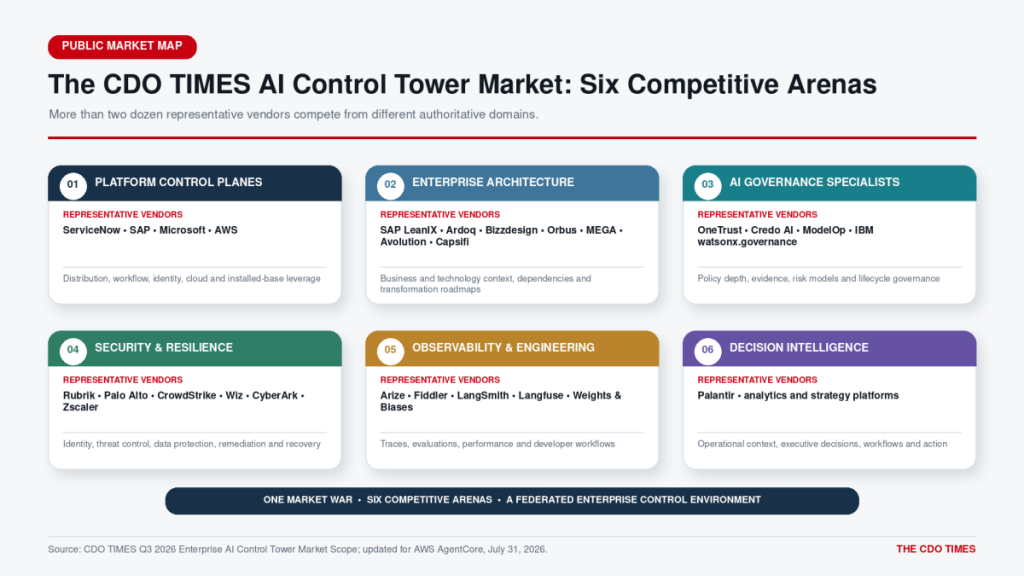
Figure 1. The CDO TIMES AI Control Tower Market: Six Competitive Arenas
The CDO TIMES Market Scope Reveals Six Competitive Arenas
The public market map begins with six competitive arenas. Platform control planes include ServiceNow, SAP and Microsoft in the July 21 report, with AWS now joining the front rank as Amazon Bedrock AgentCore expands across runtime, gateway, identity, policy, observability and evaluation.[5][8][9] Enterprise architecture providers include SAP LeanIX, Ardoq, Bizzdesign, Orbus, MEGA, Avolution and Capsifi, which contribute governed context about applications, capabilities, processes, owners, dependencies and transformation roadmaps. AI-governance specialists include OneTrust, Credo AI, ModelOp and IBM watsonx.governance, while security and resilience providers include Rubrik, Palo Alto Networks, CrowdStrike, Wiz, CyberArk and Zscaler. Observability and engineering providers such as Arize, Fiddler, LangSmith, Langfuse and Weights & Biases compete around traces, evaluations, performance and developer workflows. Decision-intelligence and operational-context providers, most visibly Palantir, compete for the layer where governed data becomes decisions, workflows and action.
That public scope is deliberately useful without publishing the entire premium analysis. Free readers should be able to understand the market structure, see the breadth of participants and recognize why the category is converging. The Pro and Executive report goes further by providing the full-resolution Market Scope, the editorial rationale behind vendor placement, vendor-by-vendor analysis, buyer watchpoints, areas of convergence, unresolved market risks, an enterprise evaluation framework and the Q3 outlook.[5] The figure is not a ranking of product quality, revenue, market share or customer satisfaction. It is a CDO TIMES editorial assessment of public product breadth and strategic orientation as of the research date.
Four Platform-Scale Contenders Can Shape the Enterprise War
The most consequential contenders are not necessarily the vendors using the phrase “AI control tower” most aggressively. Platform-scale power comes from installed distribution, authoritative enterprise data, workflow reach, identity, security, cloud infrastructure and the ability to integrate control into daily operations. On that basis, ServiceNow, Microsoft, SAP and AWS form the strongest current group of platform-scale war contenders. They enter from different directions and none has demonstrated authority over every control domain. Their competitive advantage is the ability to make AI control part of an ecosystem customers already operate at scale.
ServiceNow: Workflow-Native Control
ServiceNow approaches the market through workflows, configuration data, service operations, risk, security and portfolio processes. Its AI Control Tower proposition spans discovery, observability, governance, security and value measurement, including AI deployed outside the ServiceNow environment.[2] That breadth makes ServiceNow one of the clearest enterprise control-plane contenders because it can connect a finding to an approval, remediation workflow, service record or management process. The strategic question is how completely it can govern assets outside its ecosystem and how reliable the enterprise’s configuration and workflow data is. ServiceNow can become a powerful operational front door, but an interface does not automatically become the authoritative source for identity, architecture, data lineage, runtime recovery or business value.
Microsoft: Identity and Administration for the Agent Population
Microsoft approaches the war through Microsoft 365, Azure, Entra, Defender, Intune, the developer ecosystem and a vast enterprise identity footprint. Agent 365 is positioned as a control plane for registering, observing, governing and securing agents, including partner and independently operating agents.[3] This is strategically significant because autonomous systems increasingly require their own identities, credentials, permissions and lifecycle controls. Microsoft can extend familiar administrative and security practices from human users and applications to a growing machine workforce. Its market test is whether those controls can extend deeply enough across non-Microsoft agents, line-of-business systems and business outcomes to support a genuinely multi-vendor enterprise.
SAP: Business Architecture, Processes and Transactions
SAP enters from a different and strategically valuable position. SAP AI Agent Hub connects agent discovery and governance with SAP LeanIX architecture context, SAP Signavio process intelligence, workforce implications and the transactional systems in which many enterprise decisions become real.[6][7] This creates the potential to link an agent not only to a technical owner but also to the business capability, process, application, dependency and transformation program it affects. SAP’s advantage is strongest when organizations need to understand the operational and architectural consequence of AI across complex enterprise landscapes. The trade-off is that customers must evaluate how vendor-neutral the control layer remains when its richest context naturally comes from the SAP ecosystem.
AWS: Agent Infrastructure Is Becoming a Control Plane
AWS does not need to use the exact control-tower label to become a major contender. Amazon Bedrock AgentCore now brings together agent runtime, gateway, identity, policy, observability, evaluation and tool access, while AWS emphasizes support for different models and frameworks.[8] AgentCore Gateway can centralize MCP and API tool access, and AgentCore Policy can evaluate tool calls using deterministic Cedar rules with audit logging before execution.[9] AgentCore Observability adds production traces, execution-path visibility and operational monitoring, while IAM, CloudTrail, CloudWatch and the broader AWS security ecosystem extend the control surface. This gives AWS a credible platform-scale route based on infrastructure, developer adoption, security primitives and control over agent execution rather than on an executive governance dashboard.
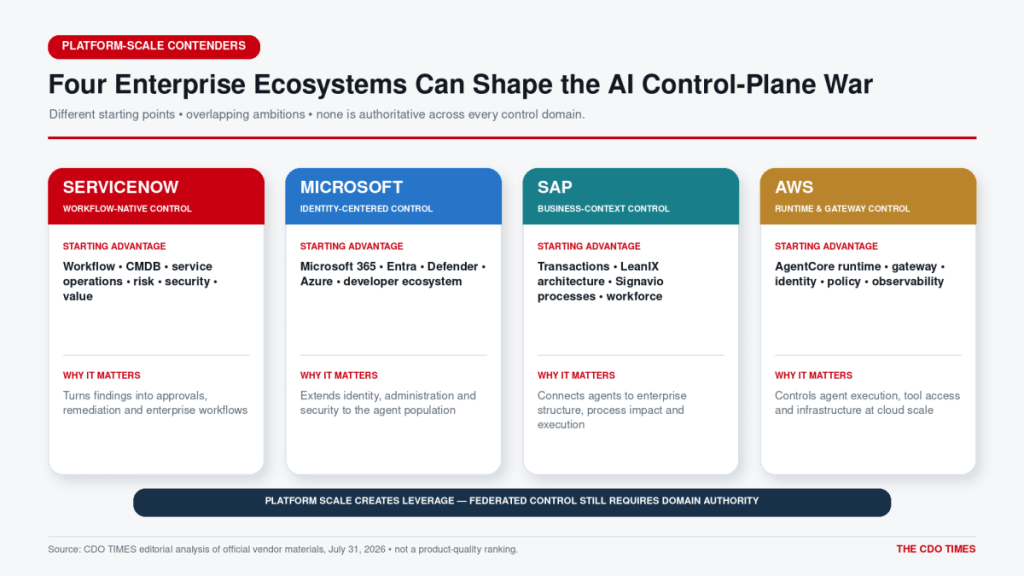
Figure 3. Four Platform-Scale AI Control Contenders
The Rest of the Market Is Not Secondary—It Controls Critical Domains
Calling ServiceNow, Microsoft, SAP and AWS the platform-scale leaders does not reduce the rest of the market to spectators. Enterprise architecture platforms may hold the best available map of applications, capabilities, processes, technologies, owners and dependencies. Governance specialists may provide stronger policy models, regulatory evidence and lifecycle controls than broad platforms. Security and resilience vendors may be better positioned to stop, contain, investigate or reverse harmful actions at runtime. Observability providers may hold the most granular traces and evaluation evidence for agent behavior. Decision-intelligence platforms may provide the closest link between governed enterprise context and consequential operational decisions.
Rubrik is a strong example of a differentiated contender rather than a smaller copy of a general platform. Rubrik Agent Cloud emphasizes discovery, monitoring, policy control, immutable evidence and the ability to reverse unwanted agent actions through Agent Rewind.[10] Palo Alto Networks and CrowdStrike enter through runtime security and identity, where the relevant question is not merely whether an agent complied with a documented policy but whether its action can be prevented, constrained or contained.[17][18] OneTrust, Credo AI, ModelOp and IBM enter through governance depth, evidence and control translation rather than through an installed workflow suite.[11][12][13] Ardoq, Bizzdesign and the broader architecture market enter through context and traceability, while Palantir competes for the strategically valuable connection among data, ontology, workflows and decisions.[14][15][16]
Snowflake and Alation belong in this broader competitive field, but they should be described according to their actual starting points. Snowflake’s Cortex AI Gateway makes AI access, routing, interoperability and consumption economics part of the data-platform contest, which can become highly influential in enterprises where Snowflake is already a major AI and data workload platform.[1] Alation AIOS approaches the market through governed data, metadata, context and lineage, making it relevant to the information foundation that agents require.[4] Neither announcement by itself establishes comprehensive authority across identity, workflow, enterprise architecture, security, resilience, regulatory evidence and executive portfolio decisions. The correct editorial conclusion is that these vendors demonstrate convergence from the data layer, not that recent launch timing makes them the overall market leaders.
The Market Scope Is Public—the Placement Analysis Is Premium
The lower-resolution preview below is the actual CDO TIMES Q3 2026 AI Control Tower Market Scope, not a new four-vendor chart. It lets every reader see that the market spans control-plane leaders, context and decision platforms, architecture and governance providers, specialist controls, and different combinations of operational execution and strategic decision focus. The full-resolution version belongs in the Pro and Executive report because the value is not only the location of the dots. The premium value is the analysis explaining why each vendor is placed where it is, which public capabilities support that placement, what each starting point enables, where the architectural limitations remain and what enterprise buyers should validate. This follows the right research model: publish enough scope to establish authority and market awareness, then reserve the decision-grade analysis for paying members.

Figure 2. The CDO TIMES Q3 2026 AI Control Tower Market Scope
ACCESS THE FULL CDO TIMES MARKET SCOPE
Get the full-resolution CDO TIMES Q3 2026 Enterprise AI Control Tower Market Scope, including the placement rationale, vendor analysis, buyer watchpoints, enterprise evaluation framework and Q3 outlook. The report is available to CDO TIMES Pro and Executive members through the CDO TIMES membership page.
The Manulife Case Shows Why Product Selection Is Only One Layer
Manulife provides a current large-enterprise example of how control-plane adoption must connect to a broader operating model. The company announced a five-year expansion of its Microsoft relationship, deployment of Microsoft Agent 365 and expansion of Microsoft 365 Copilot to more than 30,000 employees.[3] Manulife reported that AI-enabled solutions support more than 110 million customer calls annually across North America and that its developers increased productivity by 30 percent through assisted and autonomous capabilities.[3] It also reported $300 million in enterprise value as of year-end 2025 and a target of more than $1 billion by 2027, with expected value including expense reduction, revenue uplift, fraud reduction and growth absorption.[3] These are company-reported results and targets rather than independently audited measures, but they demonstrate the scale of the operating-model challenge.
The significance of the case is not simply that Manulife selected Agent 365. The company is connecting platform deployment with security standards, employee adoption, software delivery, customer operations, use cases and an explicit enterprise-value objective. A registry can identify agents, and an identity platform can govern permissions, but neither decides which underwriting, service, development or sales outcomes deserve investment. Those decisions require business ownership, process redesign, data quality, workforce adoption and value discipline. Two enterprises can buy the same control platform and produce very different outcomes because the operating model around the technology determines whether evidence becomes accountable action.
The Winning Architecture Will Be Federated, Not Monolithic
The CDO TIMES Market Scope concludes that buyers should expect a federated architecture.[5] Identity may remain authoritative in Microsoft Entra, CyberArk or another identity system; workflow may remain in ServiceNow; architecture context may reside in SAP LeanIX, Ardoq, Bizzdesign or Orbus; risk evidence may sit in OneTrust or IBM; agent traces may remain in an observability platform; recovery may depend on Rubrik; and transactions may occur in SAP, Oracle, Salesforce or industry systems. Attempting to make one vendor authoritative for every domain can create a new governance silo rather than reduce fragmentation. A stronger design establishes authority by control domain, reconciles evidence across platforms and makes decision rights explicit.
The same principle separates a control plane from an enterprise AI operating model. A control plane can answer which agents exist, what they access, what policies apply, how they behave and what they consume. An operating model must decide which outcomes matter, who owns them, how human and artificial intelligence should collaborate, which risks the enterprise will accept, how value will be measured and when an initiative should scale, change or stop. Technology produces signals, but accountable leaders interpret those signals within strategy, architecture, economics, workforce and risk. The enterprise therefore needs the smallest coherent control architecture that can support decisions without duplicating inventories, policies and ownership.

Figure 4. A Federated Enterprise AI Control Environment
Uniform Governance Can Become Its Own Failure Mode
The rush to impose control can create a second problem: applying the same governance burden to every agent. Gartner warned in May 2026 that uniform governance can fail when organizations ignore differences in autonomy and access.[19] Gartner predicted that by 2027, 40 percent of enterprises would demote or decommission autonomous agents because governance gaps were identified only after production incidents.[19] A read-only summarization agent does not create the same exposure as an agent that can change production configurations, communicate externally or initiate financial transactions. Mature governance should therefore scale according to autonomy, permissions, data sensitivity, decision influence, potential impact and reversibility.
This proportional approach prevents both under-governance and over-governance. Heavy controls applied to low-risk assistance can slow adoption and drive employees toward unsanctioned tools. Weak controls applied to high-autonomy agents can allow errors to propagate at machine speed. High-consequence agents require continuous monitoring, explicit identity, circuit breakers, incident response, recovery and named accountability. Low-risk assistants may need lighter controls focused on transparency, data handling and human review. The operating model must define those differences before a vendor platform automates them.
Regulation Turns Fragmented Evidence Into an Executive Problem
The regulatory environment makes control architecture more than a technology decision. On July 20, the European Commission published guidance for AI Act transparency obligations applying from August 2, 2026, including disclosure when people interact with certain AI systems and identification of some AI-generated or manipulated content.[20] The broader implementation schedule reflects July 2026 changes, but enterprises still need to determine which systems are affected, who acts as provider or deployer and what evidence supports compliance.[21] That evidence may span inventory, architecture, identity, risk assessments, policies, logs, approvals, incidents and remediation records. No single control-tower dashboard removes the need for legal interpretation or cross-system evidence.
An effective operating model can nevertheless make compliance operational rather than episodic. It can connect regulatory obligations to policies, policies to enforceable controls, controls to accountable owners and owners to reviewable evidence. It can also prevent low-risk assistance from becoming trapped in the same bureaucracy as high-consequence autonomous execution. This is another reason the market is likely to remain federated: the full evidence chain rarely lives in one product. Enterprise governance must follow the business context and consequence of the system, not only the vendor that produced it.
Human Agency Remains the System Requirement
The control-tower war is ultimately about how enterprises combine machine execution with accountable human judgment. Microsoft’s 2026 Work Trend Index analyzed trillions of anonymized Microsoft 365 productivity signals and surveyed 20,000 workers using AI across 10 countries.[22] Microsoft reported that organizational factors including culture, manager support and talent practices accounted for twice the AI impact of individual effort alone, while 66 percent of surveyed users said AI allowed them to spend more time on high-value work.[22] It also reported that quality control and critical thinking were the two human skills most frequently identified as becoming more important as AI assumes more work.[22] Although this is Microsoft-sponsored research, the conclusion aligns with a broader operational reality: technology value depends on the system around people, not only on tool adoption.
Elevated Collaborative Intelligence provides a useful leadership lens for that system. The formula ECI = (HI + AI) × T − R frames value as human intelligence and artificial intelligence working together, amplified by the technology accelerator and reduced by risk impact. The enterprise should therefore avoid measuring success only through the number of agents deployed, the percentage of tasks automated or the volume of tokens consumed. It should measure whether humans and AI together make better decisions, execute faster, improve quality, create measurable value and retain appropriate accountability. A control plane can supply evidence for that judgment, but it cannot replace the judgment itself.
The Full Report Is the Decision-Grade Layer
This free article establishes the public thesis: the AI control-tower market is larger than four vendors, the strongest platform-scale contenders are ServiceNow, Microsoft, SAP and AWS, specialist providers remain essential, and the likely architecture is federated. The Pro and Executive Market Scope converts that thesis into a decision tool. It provides the full-resolution CDO TIMES Market Scope, the analysis behind vendor placement, deeper segment coverage, buyer watchpoints, unresolved risks, minimum evidence to request, the recommended buying sequence and five developments expected to shape the next phase of the market.[5] That separation gives free subscribers a valuable and credible market view while giving serious enterprise buyers a reason to upgrade. Join CDO TIMES Pro or Executive to access the complete report at https://cdotimes.com/membership/.
The CDO TIMES Bottom Line
The AI control-tower war is real, but it is not a four-vendor race and it is not one clean software category. ServiceNow, Microsoft, SAP and AWS currently have the strongest platform-scale routes into enterprise control because they combine AI capabilities with workflow, identity, business applications, architecture, cloud infrastructure or security. Rubrik, OneTrust, Credo AI, ModelOp, IBM, Palo Alto Networks, CrowdStrike, Ardoq, Bizzdesign, Palantir, Snowflake, Alation and many others compete from specialized positions that can be authoritative within their domains. The market will not be won simply by the vendor with the largest inventory or newest announcement. It will be won by the platforms and enterprise architectures that connect governed context to runtime control, measurable outcomes and accountable decisions.
The practical buyer conclusion is federated control with explicit authority. Enterprises should decide which systems own identity, workflow, architecture, data lineage, policy, observability, recovery, value and executive decisions before adding another dashboard. They should apply controls proportionately to autonomy and consequence, validate multi-vendor discovery and enforcement in their own environment, and require evidence that technical activity connects to business outcomes. The public CDO TIMES Market Scope shows how large the war has become. The Pro and Executive report explains how the competitors are placed, where their strengths and limitations lie, and what buyers should test before committing.
THE CDO TIMES | ENTERPRISE AI 2030 JULY 2026
Sources
This analysis uses The CDO TIMES Q3 2026 Enterprise AI Control Tower Market Scope, primary vendor announcements and product material, an official European Commission source, Gartner research and Microsoft workforce research current through July 31, 2026. The public article provides the high-level market map; the Pro and Executive report provides the full-resolution scope, placement rationale and detailed vendor and buyer analysis. Market placement is a proprietary CDO TIMES editorial assessment of public product breadth and strategic orientation—not a ranking of product quality, revenue, market share or customer satisfaction. Vendor-reported adoption, outcomes and forecasts are identified as company claims rather than independent audits. Readers should confirm regulatory obligations with qualified counsel for their use cases and jurisdictions.
1. Snowflake, “Snowflake Advances the Trusted Agentic Enterprise Era with Unified Monitoring and Cost Management,” July 28, 2026:
https://www.snowflake.com/en/news/press-releases/snowflake-advances-the-trusted-agentic-enterprise-era-with-unified-monitoring-and-cost-management/
2. ServiceNow, “ServiceNow expands AI Control Tower to discover, observe, govern, secure, and measure AI deployed across any system in the enterprise,” May 5, 2026:
https://newsroom.servicenow.com/press-releases/details/2026/ServiceNow-expands-AI-Control-Tower-to-discover-observe-govern-secure-and-measure-AI-deployed-across-any-system-in-the-enterprise/default.aspx
3. Microsoft and Manulife, “Manulife Expands Partnership with Microsoft to Accelerate Enterprise AI Governance and Innovation,” July 22, 2026:
https://news.microsoft.com/source/canada/2026/07/22/manulife-expands-partnership-with-microsoft-to-accelerate-enterprise-ai-governance-and-innovation/
4. Alation, “Alation Launches AIOS: All-New Intelligence Operating System for Enterprise AI,” July 14, 2026:
https://www.alation.com/news-and-press/alation-launches-aios-intelligence-operating-system/
5. The CDO TIMES, “Q3 2026 Enterprise AI Control Tower Market Scope,” published July 21, 2026; available to Pro and Executive members:
https://cdotimes.com/membership/
6. SAP, “SAP AI Agent Hub,” accessed July 31, 2026:
https://www.sap.com/products/artificial-intelligence/ai-agent-hub.html
7. SAP News, “Business Transformation Management: Foundation for the Autonomous Enterprise,” May 13, 2026:
https://news.sap.com/2026/05/business-transformation-management-foundation-autonomous-enterprise/
8. AWS, “Amazon Bedrock AgentCore,” accessed July 31, 2026:
https://aws.amazon.com/bedrock/agentcore/
9. AWS, “Secure AI agents with Policy and Lambda interceptors in Amazon Bedrock AgentCore Gateway,” June 1, 2026:
https://aws.amazon.com/blogs/machine-learning/secure-ai-agents-with-policy-and-lambda-interceptors-in-amazon-bedrock-agentcore-gateway/
10. Rubrik, “Rubrik Agent Cloud,” accessed July 31, 2026:
https://www.rubrik.com/products/rubrik-agent-cloud
11. OneTrust, “AI Governance Software,” accessed July 31, 2026:
https://www.onetrust.com/solutions/ai-governance/
12. Credo AI, “Agent Governor: Control and Trust Your Agents,” July 14, 2026:
https://www.credo.ai/agent-governor
13. ModelOp, “ModelOp and Kong Partner to Deliver Zero-Trust Enforcement for the Agentic Enterprise,” July 16, 2026:
https://www.modelop.com/blog/modelop-kong-partnership-zero-trust-security-agentic-ai
14. Ardoq, “Ardoq AI: Capabilities, Controls, and FAQs,” July 16, 2026:
https://help.ardoq.com/en/articles/131863-ardoq-ai-capabilities-controls-and-faqs
15. Bizzdesign, “Transformation Collaboration: How Enterprise Leaders Are Turning AI Ambition into Execution,” June 4, 2026:
https://bizzdesign.com/blog/transformation-collaboration-how-enterprise-leaders-are-turning-ai-ambition-execution
16. Palantir, “AIP Overview,” accessed July 31, 2026:
https://palantir.com/docs/foundry/aip/overview/
17. Palo Alto Networks, “Palo Alto Networks Secures Agentic AI with Prisma AIRS 3.0,” March 23, 2026:
https://www.paloaltonetworks.com/company/press/2026/palo-alto-networks-secures-agentic-ai-with-prisma-airs-3-0
18. CrowdStrike, “CrowdStrike Unveils Continuous Identity for AI Agents,” June 15, 2026:
https://www.crowdstrike.com/en-us/press-releases/crowdstrike-unveils-continuous-identity-for-ai-agents/
19. Gartner, “Applying Uniform Governance Across AI Agents Will Lead to Enterprise AI Agent Failure,” May 26, 2026:
https://www.gartner.com/en/newsroom/press-releases/2026-05-26-gartner-says-applying-uniform-governance-across-ai-agents-will-lead-to-enterprise-ai-agent-failure
20. European Commission, “Commission Publishes Guidelines on Transparency Obligations for Providers and Deployers of Certain AI Systems,” July 20, 2026:
https://digital-strategy.ec.europa.eu/en/news/commission-publishes-guidelines-transparency-obligations-providers-and-deployers-certain-ai-systems
21. European Commission, “AI Act: Regulatory Framework for Artificial Intelligence,” updated July 2026:
https://digital-strategy.ec.europa.eu/en/policies/regulatory-framework-ai
22. Microsoft, “2026 Work Trend Index Annual Report: Agents, Human Agency, and the Opportunity for Every Organization,” May 5, 2026:
https://www.microsoft.com/en-us/worklab/work-trend-index/agents-human-agency-and-the-opportunity-for-every-organization
Continue the Research
The CDO TIMES provides executive analysis across AI strategy, digital strategy, data, cybersecurity and enterprise transformation. Its research connects current market developments to the decisions C-level leaders must make. The Enterprise AI 2030 series examines how operating models, architecture, economics and human leadership are changing together. Executive briefings and deeper research are available for leaders who need to convert these signals into an actionable enterprise roadmap. Explore the latest analysis at https://cdotimes.com.
CDO TIMES PRO RESEARCH
Get the full Q3 2026 Enterprise AI Control Tower Market Scope.
Full-resolution scope, placement rationale, vendor analysis and buyer guidance: Join Pro or Executive