Data Privacy Regulation in the Age of Data Lakehouses and AI Architectures: Navigating GDPR, EU AI Act, AIDA, and DORA
By Carsten Krause, October 10, 2024
In an era where data drives decision-making and artificial intelligence (AI) accelerates innovation, data privacy and regulatory compliance have emerged as critical priorities for businesses, especially those building advanced data architectures like data lakehouses. These architectures blend the best of data lakes and data warehouses, enabling companies to store, process, and analyze large volumes of structured and unstructured data. While the flexibility and power of data lakehouses and AI architectures offer immense opportunities for innovation, they also expose organizations to regulatory challenges, particularly around data privacy and security.
Key regulatory frameworks—such as the General Data Protection Regulation (GDPR), the EU Artificial Intelligence Act (EU AI Act), Canada’s Artificial Intelligence and Data Act (AIDA), and the Digital Operational Resilience Act (DORA)—play a pivotal role in shaping how companies design, deploy, and manage their data lakehouses and AI architectures.
GDPR: A Bedrock of Data Privacy in the EU
The General Data Protection Regulation (GDPR), which took effect in May 2018, remains one of the most stringent data protection laws in the world. It governs how organizations collect, process, and store personal data of EU residents, applying to any entity that handles EU citizens’ data, regardless of where it is headquartered. For further information about GDPR, visit https://gdpr.eu.
For companies using data lakehouses, GDPR poses challenges in ensuring that personal data is protected throughout its lifecycle—from storage to processing in AI models. A core aspect of GDPR compliance is the principle of data minimization—only collecting and processing data necessary for a specific purpose. In AI-driven architectures, this requires a delicate balance between gathering enough data for model training and complying with the regulation’s privacy standards.
Additionally, GDPR’s right to be forgotten introduces technical hurdles for data lakehouses, where data is often stored in large volumes and multiple formats. Ensuring that personal data can be permanently deleted from a data lakehouse and any related AI models necessitates robust data governance practices, meticulous auditing, and advanced tools for data erasure.
EU AI Act: Balancing AI Innovation and Compliance
The EU AI Act is one of the most anticipated regulatory frameworks that directly addresses the risks and benefits of AI technologies. Introduced in 2021, the EU AI Act categorizes AI systems into different risk levels, from high-risk applications (such as AI in critical infrastructure) to low-risk AI tools (like chatbots or spam filters). To read more about the EU AI Act, check https://artificialintelligenceact.eu.
For companies building AI systems on top of data lakehouses, the EU AI Act mandates stricter requirements for high-risk AI applications, such as financial services or healthcare. These requirements include transparency, human oversight, and risk management strategies, which must be integrated into the design and operational processes of the AI models.
One of the key challenges with the EU AI Act is ensuring that AI models built on data lakehouses are both compliant and efficient. High-risk AI applications must be explainable, auditable, and bias-free, necessitating transparent data pipelines and rigorous validation mechanisms. Furthermore, companies need to keep comprehensive documentation to prove compliance during audits.
AIDA: Canada’s Approach to AI and Data Governance
Canada’s Artificial Intelligence and Data Act (AIDA), introduced in 2022, focuses on promoting the responsible development and deployment of AI systems while protecting personal data. Like GDPR and the EU AI Act, AIDA emphasizes privacy, transparency, and accountability in AI-driven data architectures. For more on AIDA, visit https://canada.ca/en/innovation-science-economic-development.
For companies leveraging data lakehouses, AIDA requires an ethical AI framework that ensures the fairness, accuracy, and security of AI models. This is particularly important when dealing with sensitive personal information, such as in healthcare or financial services. In practice, this means implementing bias detection algorithms and robust encryption standards in data storage and AI model training processes.
DORA: Strengthening Financial Sector Resilience
The Digital Operational Resilience Act (DORA), enacted in 2022, is designed to strengthen the financial sector’s resilience to cyberattacks and operational disruptions. For companies in the financial industry using data lakehouses and AI architectures, DORA introduces specific requirements for IT risk management, incident reporting, and third-party service providers. Further details about DORA can be found at https://ec.europa.eu/info/law/digital-operational-resilience.
Given that financial firms are increasingly adopting AI for fraud detection, credit scoring, and risk management, DORA mandates that these systems are secure, resilient, and compliant with privacy regulations. Operational resilience is a key tenet of DORA, and it requires financial institutions to ensure that their data lakehouses and AI systems can recover from cyber incidents without compromising data integrity or regulatory compliance.
Case Study: ING Group – AI Innovation in Financial Services and Regulatory Compliance
The Dutch multinational ING Group has been at the forefront of AI-driven innovation in the financial sector, implementing data lakehouse architectures to support its digital transformation. ING’s use of AI spans from fraud detection to customer service chatbots, and its data lakehouse allows the company to manage vast amounts of structured and unstructured data efficiently. However, the rise of GDPR and DORA posed significant challenges for the bank in maintaining compliance while leveraging cutting-edge AI technologies. More details on ING Group’s digital transformation can be found at https://www.ing.com.
Challenge: Balancing Innovation with Regulatory Compliance
ING faced the challenge of complying with GDPR while building sophisticated AI models for credit risk analysis and customer insights. Additionally, as a financial institution subject to DORA, ING had to ensure its AI systems were resilient to cyber threats and operational disruptions.
Solution: Building a Compliance-First Data Lakehouse
To address these challenges, ING established a compliance-first AI architecture that integrated privacy-preserving techniques directly into its data pipelines. For GDPR compliance, ING deployed advanced data anonymization techniques within its data lakehouse to protect customer identities, while still enabling AI models to train on relevant data. Furthermore, to comply with DORA, ING implemented robust cybersecurity protocols, including encryption and real-time monitoring, across its AI systems to ensure operational resilience.
Outcome: Enhanced AI Capabilities with Full Regulatory Adherence
By integrating compliance into its AI systems from the ground up, ING was able to leverage data lakehouses for advanced AI-driven decision-making while remaining fully compliant with GDPR and DORA. The result was a 25% improvement in credit risk assessment accuracy, coupled with increased resilience against cyber threats—allowing ING to continue its AI innovation without sacrificing data privacy or security.
Executive Insights: Data Privacy and AI Innovation
Impact of Data Privacy Regulations on AI Innovation
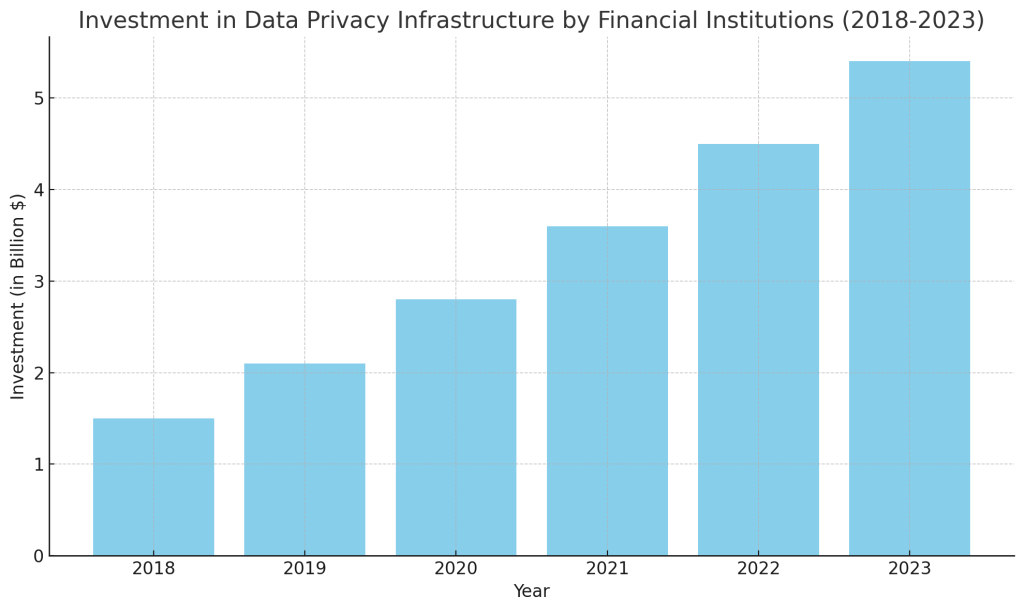
While regulations such as GDPR and DORA ensure data privacy and operational resilience, they also create challenges for AI innovation. As the chart below shows, financial institutions must invest heavily in data privacy infrastructure to stay compliant while leveraging AI.
Source: https://www.statistacom/statistics/1035323/financial-institutions-data-privacy-investment
AI Adoption in the Financial Sector
Financial institutions are leading in the adoption of AI technologies, particularly for fraud detection and credit risk assessment. The chart below highlights the rise in AI adoption across the financial sector from 2019 to 2024.

Source: https://www.mckinsey.com/business-functions/mckinsey-digital/our-insights/the-journey-to-ai-maturity
Cost of Regulatory Compliance for AI in Financial Services
The financial burden of complying with data privacy and AI regulations is significant. This chart shows the cost of compliance as a percentage of total AI investments in the financial sector.

Source: https://www.pwc.com/gx/en/services/financial-services/regulation/data-privacy.html
The CDO TIMES Bottom Line
As data lakehouses and AI architectures evolve, so do the regulatory challenges surrounding data privacy and security. Regulations like GDPR, the EU AI Act, AIDA, and DORA ensure responsible use of data but also add complexity to how companies manage data across distributed systems and AI models. Organizations that fail to proactively address compliance risk exposure to severe financial penalties, reputational damage, and reduced trust from customers and partners. On the other hand, those that strategically embed compliance frameworks into their data and AI architectures will find themselves well-positioned to leverage data for innovation while maintaining operational resilience and regulatory alignment.
Key Takeaway: Building compliant, resilient, and transparent AI-driven data architectures is not just about meeting regulatory obligations—it’s an opportunity to build long-term trust with customers and create sustainable value through innovation.
Actionable Next Steps for Data Leaders
- Embed Compliance into Data Architecture Design
- Design data lakehouses with privacy and security by default. Use anonymization, encryption, and data minimization techniques to ensure compliance with GDPR, AIDA, and other regulations.
- Implement automated tools for monitoring compliance and auditing data flows across AI models to meet the requirements of the EU AI Act and DORA.
- Strengthen Data Governance Frameworks
- Create a robust data governance structure that addresses data lineage, accountability, and auditing mechanisms. Ensure transparency and traceability of data usage, particularly in AI models subject to high-risk regulations.
- Establish cross-functional compliance teams that include legal, IT, and business departments to continuously monitor the evolving regulatory landscape.
- Enhance AI Model Oversight
- Prioritize explainability and transparency in AI models, especially for high-risk AI applications (e.g., financial services, healthcare) covered under the EU AI Act.
- Conduct regular bias audits and integrate fairness checks into AI model development to ensure ethical AI practices, as required by AIDA.
- Invest in Cybersecurity and Resilience
- Implement real-time threat detection and response systems within your data architecture to meet DORA’s requirements for operational resilience in the financial sector.
- Continuously update disaster recovery plans and incident reporting protocols to ensure quick recovery from cyber incidents without compromising data integrity.
- Educate and Upskill Your Workforce
- Provide ongoing training for data professionals on the evolving regulatory frameworks, AI ethics, and secure data handling practices.
- Encourage data literacy across the organization to foster a culture of compliance and innovation in the AI era.
By adopting these steps, data leaders can future-proof their organizations against regulatory risks while unleashing the full potential of AI and data lakehouses.
Love this article? Embrace the full potential and become an esteemed full access member, experiencing the exhilaration of unlimited access to captivating articles, exclusive non-public content, empowering hands-on guides, and transformative training material. Unleash your true potential today!
Order the AI + HI = ECI book by Carsten Krause today! at cdotimes.com/book

Subscribe on LinkedIn: Digital Insider
Become a paid subscriber for unlimited access, exclusive course content, no ads: CDO TIMES
Do You Need Help?
Consider bringing on a fractional CIO, CISO, CDO or CAIO from CDO TIMES Leadership as a Business Consulting Service. The expertise of CDO TIMES becomes indispensable for organizations striving to stay ahead in the digital transformation journey. Here are some compelling reasons to engage their experts:
- Deep Expertise: CDO TIMES has a team of experts with deep expertise in the field of Cybersecurity, Digital, Data and AI and its integration into business processes. This knowledge ensures that your organization can leverage digital and AI in the most optimal and innovative ways.
- Training, developing, arranging, and conducting educational conferences and programs and providing courses of instruction.
- Strategic Insight: Not only can the CDO TIMES team help develop a Digital & AI strategy, but they can also provide insights into how this strategy fits into your overall business model and objectives. They understand that every business is unique, and so should be its Digital & AI strategy.
- Future-Proofing: With CDO TIMES, organizations can ensure they are future-proofed against rapid technological changes. Our experts stay abreast of the latest AI, Data and digital advancements and can guide your organization to adapt and evolve as the technology does.
- Risk Management: Implementing a Digital & AI strategy is not without its risks. The CDO TIMES can help identify potential pitfalls and develop mitigation strategies, helping you avoid costly mistakes and ensuring a smooth transition with fractional CISO services.
- Competitive Advantage: Finally, by hiring CDO TIMES experts, you are investing in a competitive advantage. Their expertise can help you speed up your innovation processes, bring products to market faster, and stay ahead of your competitors.
By employing the expertise of CDO TIMES, organizations can navigate the complexities of digital innovation with greater confidence and foresight, setting themselves up for success in the rapidly evolving digital economy. The future is digital, and with CDO TIMES, you’ll be well-equipped to lead in this new frontier.
Do you need help with your digital transformation initiatives? We provide fractional CAIO, CDO, CISO and CIO services, do a Preliminary ECI and Tech Navigator Assessment and we will help you drive results and deliver winning digital and AI strategies for you!
Subscribe now for free and never miss out on digital insights delivered right to your inbox!