Stop Automating Broken Work: The Hidden Integration Tax of Agentic AI
The next competitive advantage will not come from deploying more agents. It will come from removing the handoffs, duplicate data and obsolete decisions that agents would otherwise reproduce at machine speed.
BY CARSTEN KRAUSE | CDO TIMES | OCTOBER 26, 2026
The most consequential AI question may be the one no vendor wants to lead with: why does this work exist in its current form at all? |
The Employee With Two Screens Is Not an Integration Strategy
In a complex enterprise, one of the most important pieces of integration technology is often a person who knows which application to open next. That person copies an order number, interprets an exception, checks a spreadsheet, searches for the latest approval and sends another email so the process can continue. The work may be invisible to the transformation portfolio because none of those activities is a named system. Yet customers experience the delay, colleagues absorb the effort and managers build contingencies around a flow that was never truly designed. Audrey Hazak made this point vividly in her Day 45 reflection as Schneider Electric Group CIO, arguing that AI risks automating the very complexity leaders ought to remove [1].
The fashionable response is to build an assistant that performs those steps more quickly. That can create legitimate short-term value, especially when legacy replacement is uneconomic or a regulated control must remain intact. But it can also preserve five weak interfaces, three ambiguous data definitions and a decision that should have disappeared years ago. Faster navigation of a broken process is not the same thing as a better operating model. The strategic question is whether the enterprise is increasing throughput through necessary work or accelerating avoidable work at a lower unit cost.
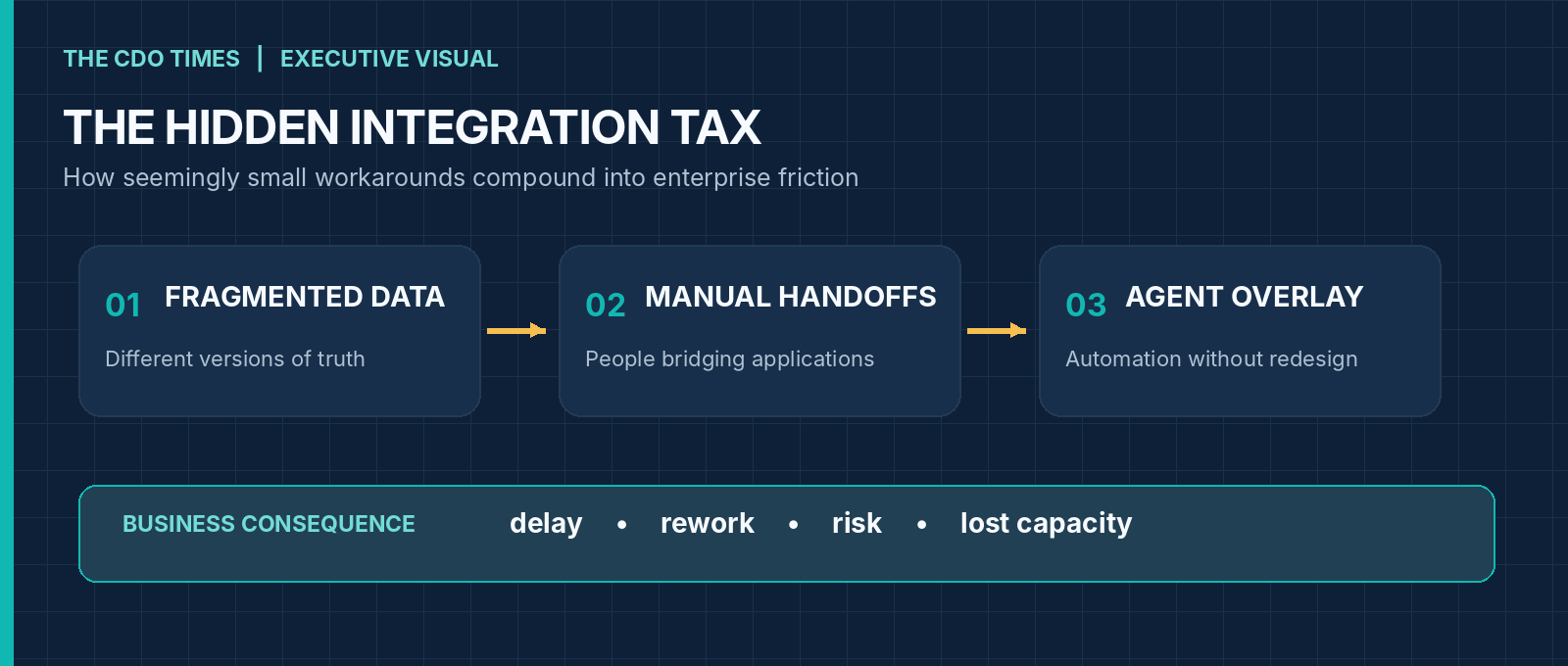
FIGURE 1 | The integration tax accumulates across data, decisions and handoffs before it appears in customer outcomes. Original conceptual visualization.
The Integration Tax: The Cost That Never Appears on an Invoice
The integration tax is the cumulative economic drag created when information, responsibilities and decisions must be reconciled across disconnected organizational and technology boundaries. It includes the employee minutes consumed by re-entry, the queues between handoffs, exceptions that need specialist intervention, reconciliation failures, duplicate controls, and the customer contact generated by inconsistent status. It also includes an opportunity cost: the analyst who cannot improve a service because the day is consumed by moving information between systems. Traditional cost accounting distributes this burden across departments, making it difficult to see as one enterprise-wide liability. Agents can reduce some of that burden, but agents can also conceal it behind a polished conversational interface if underlying ownership is unchanged.
There is a second dimension that leaders often overlook: the risk premium of automation over weak foundations. An agent that reads an outdated customer record may prepare the wrong response, while an agent that can update multiple applications may propagate an error at greater speed and scale. Ambiguous permissions, inconsistent policies and missing audit trails turn integration defects into authorization problems. BCG has documented why agent permissions differ from conventional human and application access models, because an agent can choose a sequence of actions across systems rather than follow a single predefined path [9]. That makes process simplification, trusted data and access design inseparable questions, not three workstreams to be reconciled after a pilot.
The Numbers Expose a Design Problem, Not an Adoption Problem
In McKinsey’s 2026 research, 80 percent of respondents said AI had improved their individual productivity, while 37 percent reported a positive impact on organizational EBIT and only 6 percent qualified as AI high performers [3]. These measures describe different outcomes, so they should not be treated as one conversion funnel, but the contrast is nevertheless revealing. People can work faster inside an unchanged operating model without creating proportionate enterprise earnings. The same analysis found that nearly three-quarters of high performers had substantially redesigned workflows, compared with roughly one-quarter of other organizations [3]. The association does not prove that redesign alone causes superior performance, but it makes a strong case for treating work design as a core management decision.
McKinsey’s separate work on the coordination tax places the opportunity between tasks rather than merely inside them [4]. A company may automate a document classification step while leaving the waiting time for legal review, pricing approval and account reconciliation untouched. Another may reduce manual data extraction yet fail to correct an inconsistent definition of the customer or product across applications. In both cases the local productivity metric can improve while the end-to-end customer outcome barely moves. Executives therefore need to observe the full journey from request to realized result, including waiting time, rework and ownership changes, rather than count the number of tasks an agent now performs.

FIGURE 2 | 2026 AI performance signals. Survey measures are distinct; the chart does not represent a conversion funnel. Source: McKinsey [3].
Case Study: Why a Banking Agent Needs a Better Process Around It
Microsoft’s published Banco Bradesco case describes a platform called Bridge that supports internal and customer-facing processes through governed AI orchestration and API management [6]. Microsoft reports an 83 percent resolution rate in digital customer service and an 80 percent resolution rate for employee queries, together with a technology-cost reduction of more than 30 percent in the described initiative. The important design point is not the percentage alone, because the published account is a vendor customer story rather than an independently controlled experiment. It is the combination of agent orchestration, managed interfaces and a shared platform that merits scrutiny. The bank did not present a collection of unconnected chatbots as its target operating model; it built reusable connective infrastructure through which multiple interactions could be governed.
BNY provides a second, more nuanced illustration of redesign around a regulated customer journey. A Microsoft customer account reports that an AI-enabled onboarding workflow assists with document review and research and supports onboarding for 25 percent of new customers, with some processes completing 20 percent faster [7]. These percentages should not be generalized to every customer or every onboarding stage, and they are not evidence that risk decisions should be delegated without oversight. Rather, the case shows why the economically valuable unit is a complete journey with documentation, controls and human accountability, not a single model response. The lesson for every industry is to ask which handoff can be eliminated and which control must become clearer before widening agent autonomy.
A Five-Decision Framework for Every AI Automation Proposal
Before approving a new enterprise agent, the sponsor should complete a five-decision review that begins with the customer or employee outcome rather than the preferred technology. First, eliminate work that no longer has a regulatory, commercial, safety or service purpose. Second, standardize the remaining business rules and data definitions wherever variability adds no value. Third, integrate authoritative sources and expose governed interfaces so that neither people nor agents have to invent context. Fourth, automate repeatable, bounded execution where quality can be tested and monitored. Fifth, augment genuinely judgment-intensive work with AI while reserving consequential decisions for accountable humans.
These are alternatives and design choices, not a mandatory waterfall in which every process receives every intervention. Some useful complexity must remain because customers have legitimately different needs or regulations require separation of duties. Some temporary bridges may be rational while a core platform is being replaced, provided they have owners and retirement dates. The test is whether leadership can explain why each retained handoff exists and what measurable benefit it protects. If the answer is merely that the current organization has always worked that way, the handoff is a redesign candidate rather than an automation requirement.

FIGURE 3 | The CDO TIMES five-decision workflow triage. Original editorial framework; not a measured company process.
Measure the Complexity Dividend, Not the Number of Agents
An AI business case should contain a before-and-after map of the full business outcome, an economic baseline and a named operational owner. The measures should distinguish active labor time from elapsed cycle time, because saving ten minutes of work does not necessarily remove a two-day customer wait. They should separate exception frequency from exception severity, because a low-volume failure can still be expensive or dangerous. A good scorecard tracks manual transfers, reconciliation corrections, reopen rates, policy overrides, user adoption and downstream customer effort. Where money is claimed, the business owner should explain whether the result is realized cost reduction, additional productive capacity, reduced loss, revenue uplift or improved service capacity.
The calculation should be conservative and transparent: estimated annual net benefit equals verified value from removed effort, reduced errors and better outcomes, less recurring technology, human review, monitoring and change costs. The numerator must not count the same released hours both as labor savings and as new revenue without evidence that the extra work was sold and delivered. Teams should record a measurement window, seasonal effects and any changes in volume or policy that could explain part of the improvement. Risk-adjusted value matters too, especially when an agent can modify orders, payments or customer entitlements. NIST’s AI Risk Management Framework provides a useful discipline for defining accountability and testing performance throughout the lifecycle, rather than signing off governance once at launch [8].

FIGURE 4 | What an AI overlay can hide versus what outcome-led redesign removes. Conceptual comparison; no quantified savings are implied.
What Process Mining Can See and What People Still Know
Process and task mining can reveal looping tickets, repeated approvals and queues that are distributed across systems. Yet event logs rarely explain why a frontline colleague bypasses an official path, why a policy is interpreted differently by region, or why a customer repeatedly calls after receiving an apparently complete answer. IBM’s analysis of intelligent business process automation argues for pairing process evidence with human investigation and illustrates how employee feedback exposes information-quality and service-desk friction missed by simple automation logic [5]. This is a strong reason to bring employees, operations managers, compliance staff and architects into discovery before selecting tools. Treat their workarounds as evidence of design problems, not automatically as behaviors to suppress.
An executive who wants a truthful transformation portfolio should ask for three artifacts at the first gate. The first is a current-state process map that includes unofficial spreadsheets, re-keying and manual decisions, not only applications on an architecture diagram. The second is a proposed future-state journey that explicitly identifies steps removed, steps redesigned, and controls retained. The third is a metric contract stating who owns the outcome, which system supplies each measure and what would count as failure. When these artifacts are absent, the team may be ready to demonstrate an agent but is not yet ready to justify enterprise transformation.
A Practical 30/60/90-Day Executive Mandate
In the first 30 days, select one high-friction, high-volume journey with an accountable business owner and capture how work actually moves. Include exceptions, cross-functional queues and the hidden spreadsheet layer, and establish baseline service, quality and labor measures. By day 60, remove redundant decisions, clarify authoritative data ownership and test a simplified workflow against a constrained AI-assisted alternative. By day 90, scale only the design that demonstrates an end-to-end improvement under acceptable risk, and set a retirement date for temporary bridges. The purpose of the schedule is not to guarantee ROI in one quarter; it is to force decision-quality evidence before technical enthusiasm creates another permanent dependency.
Not every organization can replace a legacy system on that timetable, and not every control can be removed. The more practical move is to stop financing new friction while making incremental progress against the most consequential one or two bottlenecks. Sponsors should require a plan for what happens when the AI service is unavailable, data are ambiguous or operators reject a recommendation. They should also treat employees who identify unnecessary work as contributors to value creation, not as obstacles to automation. The winning metric is not autonomous actions per month; it is how much unnecessary effort, delay and risk has permanently disappeared from the enterprise.
The CDO TIMES Bottom Line
Agentic AI gives enterprises the ability to execute work at unprecedented speed, but speed cannot compensate for a defective operating model. The most important investment may therefore be the removal of an approval, interface, spreadsheet or workaround that should never have become permanent. The evidence favors organizations that redesign workflows and measure outcomes, while real deployments illustrate the value of governed orchestration rather than disconnected assistants. CIOs, CDOs and business leaders should stop celebrating the count of deployed agents and start reporting the complexity dividend they create together. The next wave of AI leadership will be judged not by how many digital workers were added, but by how much unnecessary work no longer exists. |
CDO TIMES | Strategic analysis for CIOs, CDOs, enterprise architects and operational leaders.
Sources
[1] Audrey Hazak, Day 45 and Day 35 as Group CIO https://fr.linkedin.com/in/audreyhazak
[2] Audrey Hazak, “Building resilient technology for a customer experience that is simpler, faster, and more human,” Schneider Electric, July 30, 2026 https://blog.se.com/digital-transformation/2026/07/30/building-a-resilient-tech-stack-for-customer-experience/
[3] McKinsey, “AI is changing work. Now it has to change the organization,” October 5, 2026 https://www.mckinsey.com/capabilities/people-and-organization/our-insights/ai-is-changing-work-now-it-has-to-change-the-organization
[4] McKinsey, “Cutting the coordination tax: How agentic AI can reshape workflows,” September 18, 2026 https://www.mckinsey.com/industries/industrials/our-insights/cutting-the-coordination-tax-how-agentic-ai-can-reshape-workflows
[5] IBM, “Stop automating blindly: Why human insight is key for intelligent business process automation,” 2025 https://www.ibm.com/think/insights/intelligent-business-process-automation
[6] Microsoft Customer Stories, Banco Bradesco AI platform, November 15, 2025 https://www.microsoft.com/en/customers/story/25660-banco-bradesco-sa-azure-ai-foundry
[7] Microsoft Customer Stories, BNY client onboarding and Eliza, 2026 https://www.microsoft.com/en/customers/story/27322-bny-microsoft-365-copilot
[8] NIST, AI Risk Management Framework, official resource center https://airc.nist.gov/airmf-resources/airmf/5-sec-core/
[9] BCG, “The Authorization Gap: Why Yesterday’s Controls Won’t Work with Today’s Agents,” September 22, 2026 https://www.bcg.com/publications/2026/authorization-gap-ai-agent-governance
[10] McKinsey, “The State of AI: Global Survey 2026” https://www.mckinsey.com/capabilities/quantumblack/our-insights/the-state-of-ai
Evidence note. Published company case studies and self-reported survey responses are identified as such. No unpublished Schneider Electric operating metrics are used. Figures with original frameworks are editorial analysis, not observed company results.