Case Study: SAP’s Autonomous Enterprise AI Bet
How SAP Is Rewriting ERP from System of Record to System of Reasoning
By Carsten Krause
May 18, 2026
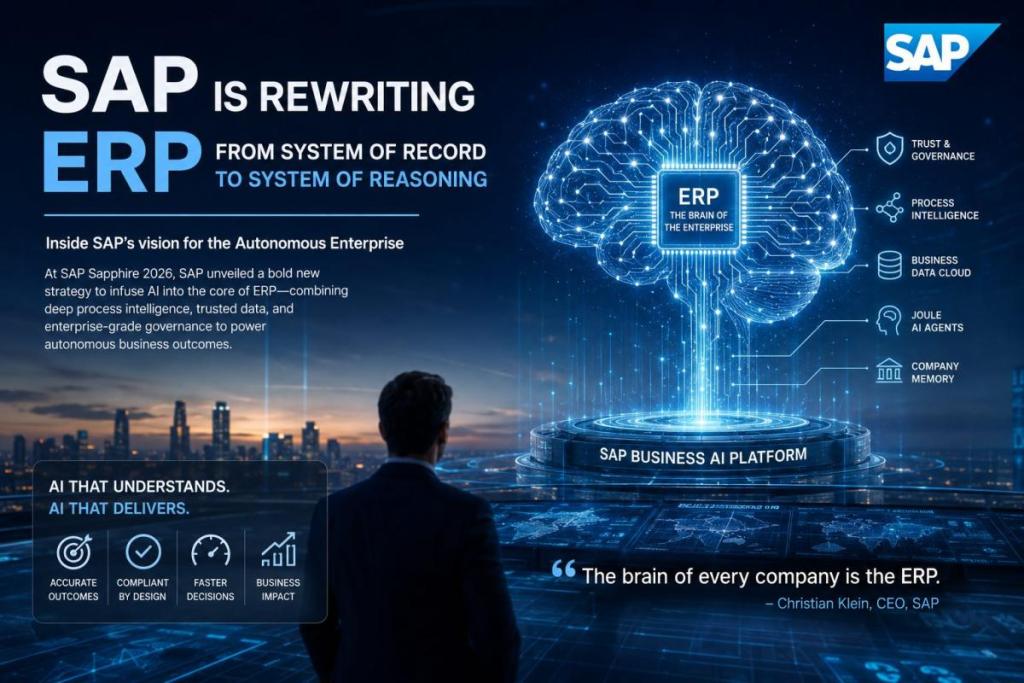
At SAP Sapphire 2026, SAP did not merely announce product enhancements. It declared a fundamental rewrite of the ERP model itself.
For decades, ERP systems were systems of record — transactional engines designed to standardize finance, supply chain, HR, procurement, and operations. SAP is now attempting something much larger: transforming ERP into an autonomous operational intelligence platform where AI agents reason, decide, orchestrate, and execute business processes with governance built directly into the core.
The implications are enormous.
This is no longer about copilots generating emails or summarizing meetings. SAP is positioning itself to become the orchestration layer for enterprise AI operations — with ERP acting as the “brain of the enterprise.”
The keynote revealed a strategic shift that every CIO, Chief Architect, CFO, COO, and Chief AI Officer should pay attention to.
The message from SAP CEO Christian Klein was direct:
“The brain of every company is the ERP.”
And SAP’s strategy is now centered around embedding AI directly into that brain.
The Real Problem SAP Is Trying to Solve
Most enterprise AI deployments today remain disconnected from operational systems.
Organizations are experimenting with:
- LLM copilots
- Chat interfaces
- Standalone AI assistants
- Shadow AI agents
- Department-level automations
But most AI systems lack:
- business context
- process understanding
- authorization awareness
- compliance controls
- traceability
- enterprise-grade governance
SAP’s leadership repeatedly emphasized that generic AI models are insufficient for enterprise operations.
Christian Klein summarized the core issue perfectly:
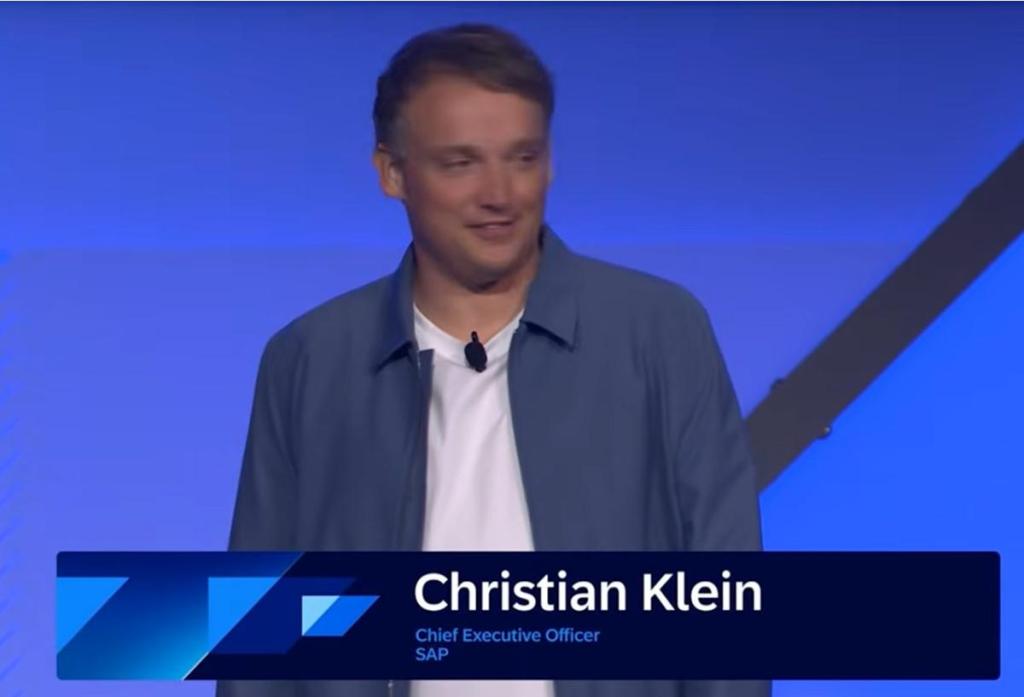
“If AI agents run your payroll, your financial close, or do the demand and supply chain planning, 80% accuracy is just not good enough.”
That single statement captures the architectural divide emerging in enterprise AI:
- Consumer AI tolerates hallucinations.
- Enterprise operational AI cannot.
SAP is betting that the future winners in AI will not simply have the best models. They will have:
- the best enterprise context,
- the cleanest process intelligence,
- the strongest governance,
- and the deepest operational data integration.
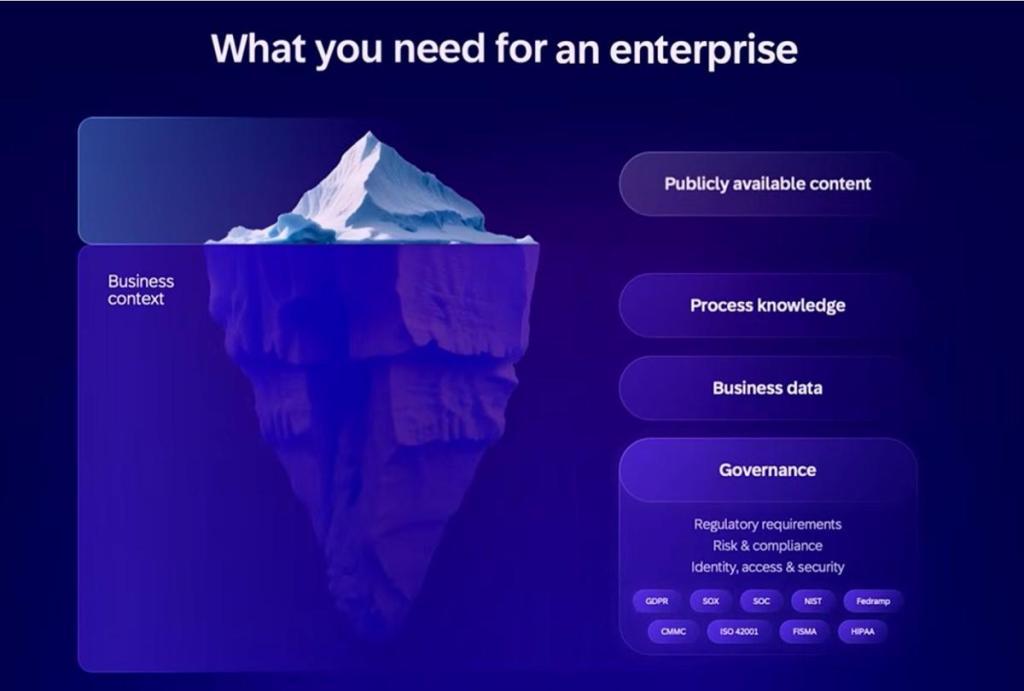
The key differentiator is the proprietary business context that is not available to the public. As laid out in this visual it expands from publicly available date to process knowledge, business data and governance of how AI agents are deployed in line with regulatory and policy requirements:
This aligns directly with the HI + AI = ECI™ philosophy:
AI without organizational intelligence, governance, and operational trust creates amplified chaos, not Elevated Collaborative Intelligence™.
SAP Is Repositioning ERP as an AI Context Engine
The most important strategic concept introduced at Sapphire was SAP’s “context layer.”
SAP repeatedly emphasized that LLMs alone cannot understand enterprise operations.
Christian Klein explained the challenge:
“None of these models are trained on your business data and processes.”
SAP’s answer is the new SAP Business AI Platform.
The architecture combines:
- ERP process intelligence
- Knowledge Graphs
- Business Data Cloud
- authorization frameworks
- semantic data layers
- governance controls
- AI orchestration
- domain-specific business models

The key architectural insight:
SAP is attempting to transform ERP from a transactional system into a reasoning system.
That is a massive shift.
Historically:
- ERP stored transactions.
- Humans interpreted the meaning.
- Analytics systems created reports.
- Decision-making remained largely human-driven.
SAP now wants AI agents to:
- understand business intent,
- navigate processes,
- orchestrate actions,
- and execute workflows autonomously.
“No AI Agent Can Compensate for a Broken Data Model”
One of the most memorable and important quotes from the keynote came from Philipp Herzig, SAP’s Chief AI Officer:
“No AI agent can compensate for a broken data model.”
This statement should be framed in every enterprise architecture office.
The AI market currently suffers from a dangerous illusion:
that organizations can bypass years of technical debt simply by layering generative AI on top.
SAP is effectively arguing the opposite.
Its thesis is:
- AI magnifies operational maturity.
- AI amplifies data quality.
- AI accelerates governance weaknesses.
- AI exposes process fragmentation.
This is precisely why many early enterprise AI projects struggle to scale beyond pilots.
JPMorganChase CFO Jeremy Barnum reinforced this reality:
“The risk of that is that you sprinkle AI on broken processes.”
That may have been the most strategically important statement from the entire keynote.
SAP’s New AI Governance Model Could Become an Enterprise Standard
One of the most mature aspects of SAP’s announcement was its governance architecture.
Unlike many AI vendors focusing only on model capability, SAP focused heavily on:
- traceability,
- auditability,
- compliance,
- telemetry,
- observability,
- and policy enforcement.
The new AI Agent Hub built on LeanIX introduces:
- centralized AI agent inventories,
- risk classification,
- architecture boundary conditions,
- compliance validation,
- agent verification,
- runtime observability,
- and enterprise telemetry.
Philipp Herzig described it as:
“One command center to discover, manage, and govern SAP and non-SAP agents.”
This is strategically significant because enterprises are rapidly heading toward AI agent sprawl.
The next major enterprise risk wave is not simply shadow IT.
It is:
- Shadow AI agents
- Rogue orchestration
- Untraceable autonomous workflows
- Compliance drift
- AI-generated process fragmentation
SAP clearly recognizes this.
Their AI governance positioning may become one of the strongest competitive differentiators in regulated industries.
SAP’s “Company Memory” Could Be the Most Underrated Innovation
Among all the announcements, one concept stood out as potentially transformative:
Company Memory.
Muhammad Alam described it as:
“The organizational memory of your company that sits in the minds of people that have executed those processes for years and years.”
This addresses one of the biggest unsolved problems in enterprise AI:
tribal knowledge.
Most organizations operate on undocumented operational intelligence:
- exception handling
- escalation patterns
- policy interpretation
- approval logic
- institutional workarounds
- informal business rules
Traditional ERP systems never captured this effectively.

SAP’s Company Memory concept attempts to:
- ingest process models,
- emails,
- Teams chats,
- policy documents,
- exception chains,
- and workflow decisions,
then convert them into reusable “process atoms.”
This is extremely important.
Why?
Because operational intelligence is rarely fully codified.
This is where many AI systems fail:
they understand structured data but not organizational behavior.
SAP is effectively trying to operationalize institutional memory.
That could become one of the most valuable enterprise AI assets over the next decade.
SAP Is Quietly Rewriting the User Experience Model
Another major architectural shift:
SAP is moving away from traditional applications entirely.
Muhammad Alam introduced the concept of:
- “app-less”
- “no-apps”
- dynamically generated experiences
He stated:
“We like to call it an app-less experience and a no-apps experience.”
This is bigger than it sounds.
ERP historically required:
- navigation menus,
- transaction codes,
- reports,
- dashboards,
- process training,
- and specialized user expertise.
SAP now wants AI to dynamically generate interfaces, workflows, and execution environments in real time.
This represents:
- the death of rigid ERP interaction models,
- and the emergence of intent-driven enterprise systems.
Instead of navigating applications:
users define outcomes.
The system orchestrates execution.
That is a generational platform shift.
The Financial Close Demo Revealed SAP’s Real AI Ambition
The Financial Closing Assistant demonstration may have been the clearest glimpse into SAP’s future vision.
Sophia Levins described a world where:
- AI agents reconcile accounts,
- detect anomalies,
- understand company-specific thresholds,
- learn controller behaviors,
- and continuously improve each financial close cycle.
From Insight to Impact to Value: The visual below shows where SAP sees the biggest impact leveraging their AI Joule Studio suite of tools:

One quote captured the transformation:
“The system doesn’t close the books. It learns the company that’s closing them.”
That statement represents a radical departure from traditional ERP logic.
Traditional ERP:
- executes predefined rules.
SAP’s new AI model:
- learns operational patterns dynamically.
That moves ERP toward adaptive enterprise intelligence.
JPMorganChase Validated SAP’s Strategic Direction
The JPMorganChase discussion added significant credibility to SAP’s positioning.
Jeremy Barnum emphasized three critical principles:
- scale,
- speed,
- trust.
His most important insight:
“AI is only as good as the data and processes underneath it.”
This aligns perfectly with the ECI™ framework:
technology readiness and governance maturity determine whether AI becomes force multiplication or force amplification of dysfunction.
JPMorgan’s use case was particularly revealing:
AI agents proactively identifying systemic financial feed issues before ledger posting.
That is not chatbot AI.
That is operational intervention AI.
Huge difference.
SAP Is Building an Enterprise AI Operating System
When you step back from the individual announcements, SAP’s broader ambition becomes clear.
SAP is no longer positioning itself as:
- an ERP vendor,
- an analytics platform,
- or even simply an AI company.

SAP is positioning itself as:
the operating system for autonomous enterprises.
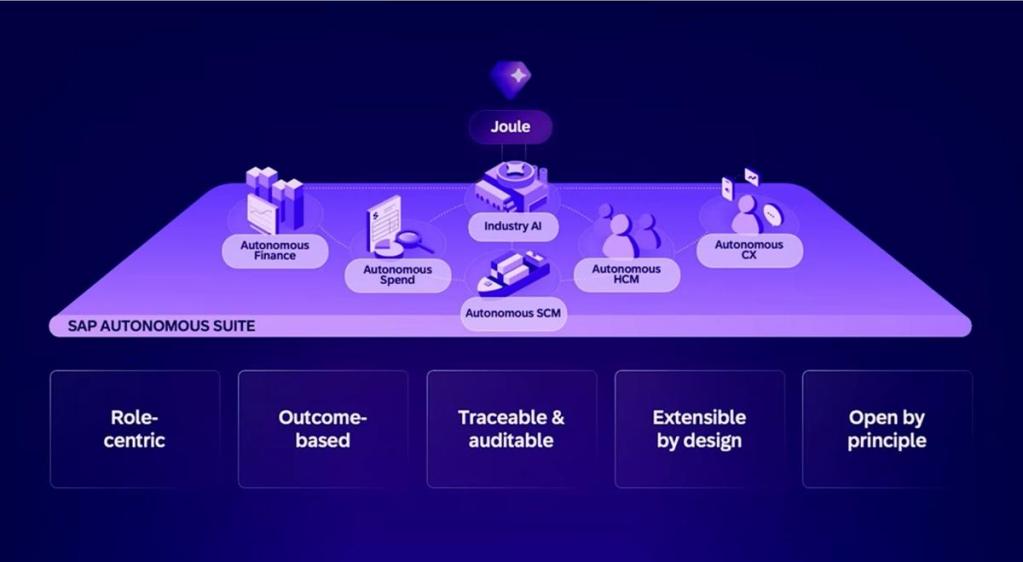
The components are now aligning:
- ERP as context engine
- Business Data Cloud as semantic fabric
- LeanIX as governance layer
- Joule as orchestration interface
- AI Agent Hub as control tower
- Company Memory as institutional intelligence layer
- Industry AI as vertical operational specialization
This is not incremental evolution.
This is architectural reinvention.
The Hidden Risk: Enterprises May Not Be Ready
Despite the impressive vision, most enterprises are nowhere near ready for this level of AI orchestration.
SAP itself acknowledged this repeatedly.
Christian Klein stated:
“Technology alone, and plugging AI agents into your existing system landscape will drive zero value.”
This is the uncomfortable truth many executives still underestimate.
Most organizations still struggle with:
- fragmented data,
- disconnected processes,
- unclear ownership,
- poor governance,
- technical debt,
- weak master data,
- and inconsistent operating models.
AI will not magically solve these problems.
It will expose them faster.
What CIOs and Enterprise Architects Should Do Next
The Sapphire 2026 keynote provides a clear roadmap for enterprise leaders.
1. Stop Treating AI as a Standalone Initiative
AI strategy must connect directly to:
- ERP modernization,
- process redesign,
- governance,
- architecture,
- and operational simplification.
2. Prioritize Data Semantics Over AI Hype
Clean semantic business models matter more than flashy copilots.
3. Build an AI Governance Architecture Now
Agent governance will soon become as important as cybersecurity governance.
4. Focus on Process Intelligence
Organizations that deeply understand their operational workflows will scale AI faster.
5. Prepare for Human + AI Operating Models
The future is not AI replacing humans.
It is AI reshaping decision execution and operational collaboration.
That is exactly where Elevated Collaborative Intelligence™ becomes critical.
The CDO TIMES Bottom Line
SAP Sapphire 2026 may eventually be remembered as the moment ERP officially entered the AI-native era.
SAP is attempting something few enterprise vendors have successfully done:
rewriting the enterprise operating model while preserving the trust and governance large organizations require.
The company’s biggest strategic insight is likely correct:
generic AI without enterprise context will struggle to scale in mission-critical operations.
The future winners in enterprise AI will not necessarily have the biggest models.
They will have:
- the deepest process intelligence,
- the cleanest semantic data layers,
- the strongest governance,
- the best operational telemetry,
- and the ability to orchestrate humans and AI agents together safely.
SAP is betting its future on becoming that orchestration layer.
Now the real question becomes:
Are enterprises operationally mature enough to follow?
Love this article? Embrace the full potential and become an esteemed full access member, experiencing the exhilaration of unlimited access to captivating articles, exclusive non-public content, empowering hands-on guides, and transformative training material. Unleash your true potential today!
Order the AI + HI = ECI book by Carsten Krause today! at cdotimes.com/book

Subscribe on LinkedIn: Digital Insider
Become a paid subscriber for unlimited access, exclusive course content, no ads: CDO TIMES
Do You Need Help?
Consider bringing on a fractional CIO, CISO, CDO or CAIO from CDO TIMES Leadership as a Business Consulting Service. The expertise of CDO TIMES becomes indispensable for organizations striving to stay ahead in the digital transformation journey. Here are some compelling reasons to engage their experts:
- Deep Expertise: CDO TIMES has a team of experts with deep expertise in the field of Cybersecurity, Digital, Data and AI and its integration into business processes. This knowledge ensures that your organization can leverage digital and AI in the most optimal and innovative ways.
- Training, developing, arranging, and conducting educational conferences and programs and providing courses of instruction.
- Strategic Insight: Not only can the CDO TIMES team help develop a Digital & AI strategy, but they can also provide insights into how this strategy fits into your overall business model and objectives. They understand that every business is unique, and so should be its Digital & AI strategy.
- Future-Proofing: With CDO TIMES, organizations can ensure they are future-proofed against rapid technological changes. Our experts stay abreast of the latest AI, Data and digital advancements and can guide your organization to adapt and evolve as the technology does.
- Risk Management: Implementing a Digital & AI strategy is not without its risks. The CDO TIMES can help identify potential pitfalls and develop mitigation strategies, helping you avoid costly mistakes and ensuring a smooth transition with fractional CISO services.
- Competitive Advantage: Finally, by hiring CDO TIMES experts, you are investing in a competitive advantage. Their expertise can help you speed up your innovation processes, bring products to market faster, and stay ahead of your competitors.
By employing the expertise of CDO TIMES, organizations can navigate the complexities of digital innovation with greater confidence and foresight, setting themselves up for success in the rapidly evolving digital economy. The future is digital, and with CDO TIMES, you’ll be well-equipped to lead in this new frontier.
Do you need help with your digital transformation initiatives? We provide fractional CAIO, CDO, CISO and CIO services, do a Preliminary ECI and Tech Navigator Assessment and we will help you drive results and deliver winning digital and AI strategies for you!
Subscribe now for free and never miss out on digital insights delivered right to your inbox!