Real-Time Self-Learning Cognitive AI vs. LLM-Based Generative AI: The Next Architectural Battleground
By Carsten Krause — April 20, 2026
The Shift No One Can Ignore
Enterprise AI is entering a decisive phase. The early wave—dominated by large language models (LLMs) and generative AI—proved that machines can produce human-like content at scale. But now the limitations are becoming visible, especially in environments where decisions must evolve continuously, adapt to new data, and operate under uncertainty.
This is where a different paradigm is gaining traction: real-time self-learning cognitive AI.
The distinction is not academic. It directly impacts how organizations design systems, govern risk, and—most importantly—whether AI delivers sustained business value or stalls after initial pilots.
If you reduce it to one line:
- LLM Generative AI = probabilistic pattern reproduction from static training
- Cognitive AI = adaptive learning systems that evolve in real time based on feedback and context
That difference sounds subtle. It is not.
What LLM Generative AI Actually Does (and Doesn’t Do)
LLMs like GPT, Claude, Gemini, and others are fundamentally prediction engines. They generate outputs by calculating the probability of the next token based on massive training datasets.
Strengths
- Exceptional at language, summarization, coding, and content generation
- Scales quickly across use cases (marketing, support, documentation)
- Can be fine-tuned or augmented with retrieval (RAG) for better grounding
Structural Limitations
- Static Learning Model
- Once trained, the model does not inherently “learn” in real time
- Updates require retraining or fine-tuning cycles
- No True Memory or Context Continuity
- Context is session-based, not persistent intelligence
- Long-term reasoning across time remains weak
- No Native Feedback Loop Integration
- Feedback is external (human reinforcement, logs, retraining pipelines)
- Not inherently self-correcting in production environments
- Probabilistic, Not Deterministic
- Outputs are plausible, not necessarily correct
- Hallucinations remain a structural issue
- Weak in Dynamic Environments
- LLMs struggle when the environment changes faster than retraining cycles
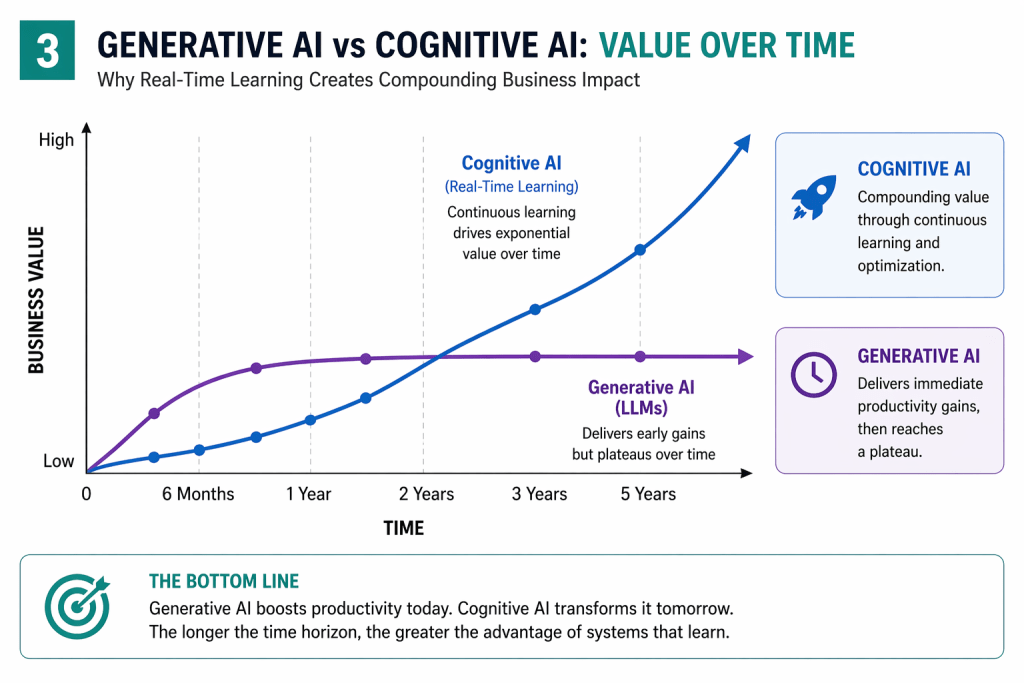
This is why many organizations hit the “90% problem”: strong pilots, weak production impact.
What Real-Time Self-Learning Cognitive AI Changes
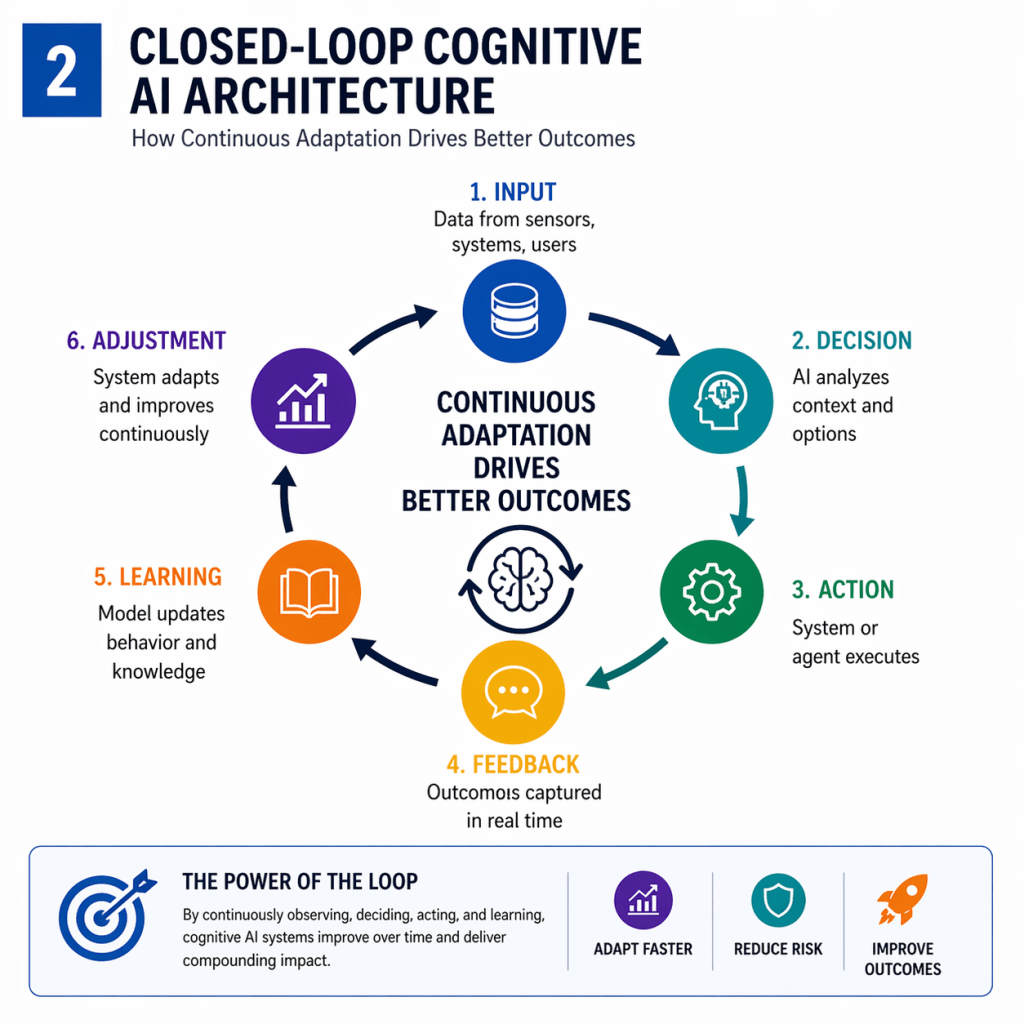
Cognitive AI systems are designed differently from the ground up. They are not just models—they are adaptive systems.
Core Characteristics
- Continuous Learning Loop
- Systems update behavior based on real-time feedback
- Learning is embedded in operation, not a separate phase
- Context Awareness Over Time
- Maintains state, history, and evolving understanding
- Moves closer to “situational intelligence”
- Goal-Oriented Decision Making
- Not just generating outputs, but optimizing toward outcomes
- Often integrated with reinforcement learning or agentic frameworks
- Closed-Loop Feedback Systems
- Input → Decision → Outcome → Feedback → Adjustment
- This loop is the core differentiator
- Integration with Operational Systems
- Directly embedded in workflows (supply chain, finance, IT operations)
- Not just an interface layer like chatbots
Side-by-Side: The Architectural Reality
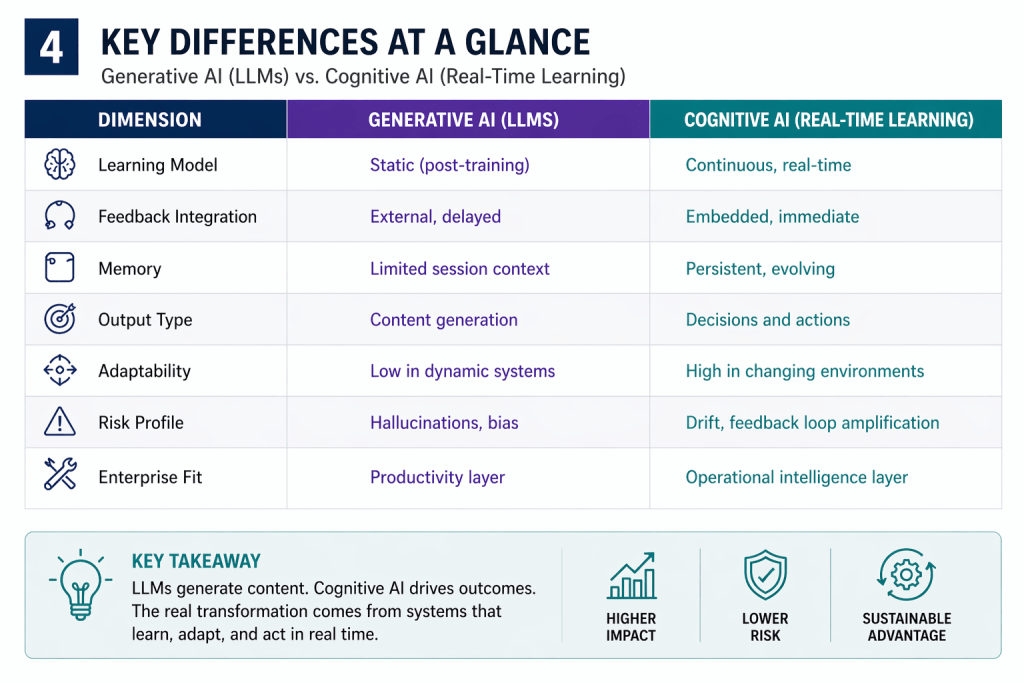
| Dimension | LLM Generative AI | Cognitive Self-Learning AI |
|---|---|---|
| Learning Model | Static (post-training) | Continuous, real-time |
| Feedback Integration | External, delayed | Embedded, immediate |
| Memory | Limited session context | Persistent, evolving |
| Output Type | Content generation | Decisions and actions |
| Adaptability | Low in dynamic systems | High in changing environments |
| Risk Profile | Hallucination risk | Drift and feedback loop risk |
| Enterprise Fit | Productivity layer | Operational intelligence layer |
Where LLMs Excel—and Where They Break
Strong Use Cases for LLMs
- Knowledge work augmentation (coding, writing, research)
- Customer support copilots
- Internal knowledge retrieval (with RAG)
- Training and onboarding tools
Where They Fail
- Real-time decision environments (trading, logistics, fraud detection)
- Systems requiring continuous adaptation
- High-stakes autonomous operations
- Complex multi-step reasoning over time
This is why many CIOs are seeing a pattern:
LLMs increase productivity, but they do not fundamentally transform operations.
Where Cognitive AI Starts to Win
Cognitive AI becomes critical when:
1. The Environment Changes Continuously
Example: Supply chain optimization
- Demand shifts, disruptions occur, constraints evolve
- Static models become outdated quickly
2. Feedback Is Immediate and Valuable
Example: Fraud detection
- Each decision generates feedback (fraud/not fraud)
- System improves continuously
3. Decisions Have Compounding Impact
Example: Energy grid optimization
- Small improvements compound into massive efficiency gains
4. Human Oversight Must Scale
Example: IT operations (AIOps)
- Systems learn from incidents and reduce recurrence automatically
The Misconception: “LLMs Will Evolve Into Cognitive AI”
This is where many executives get it wrong.
LLMs can be part of cognitive systems—but they are not sufficient on their own.
To move toward cognitive AI, you need:
- Memory architectures (vector DBs, knowledge graphs)
- Feedback loops (reinforcement learning, human-in-the-loop)
- Agent frameworks (multi-step planning and execution)
- System integration layers (APIs into operational systems)
- Governance models (to manage drift and risk)
Without this, you are just scaling a very advanced autocomplete engine.
The Rise of Agentic AI: The Bridge Between Both Worlds
Agentic AI is emerging as the bridge architecture:
- Uses LLMs for reasoning and language
- Adds tools, memory, and planning
- Introduces feedback loops and execution capabilities
However, most agentic systems today are still:
- Pseudo-cognitive (limited real learning)
- Heavily orchestrated (not truly autonomous)
- Dependent on human correction
The gap to true cognitive AI is still significant.
The Risk Equation Changes
This is where your HI + AI = ECI™ framework becomes relevant.
LLM Risk Profile
- Hallucinations
- Bias from training data
- Misinterpretation of context
Cognitive AI Risk Profile
- Feedback loop amplification (learning the wrong behavior)
- Drift over time
- Lack of explainability in adaptive systems
This shifts leadership responsibility:
With LLMs, you validate outputs.
With cognitive AI, you govern behavior.
That is a fundamentally different operating model.
Real-World Examples
1. Generative AI (LLM)
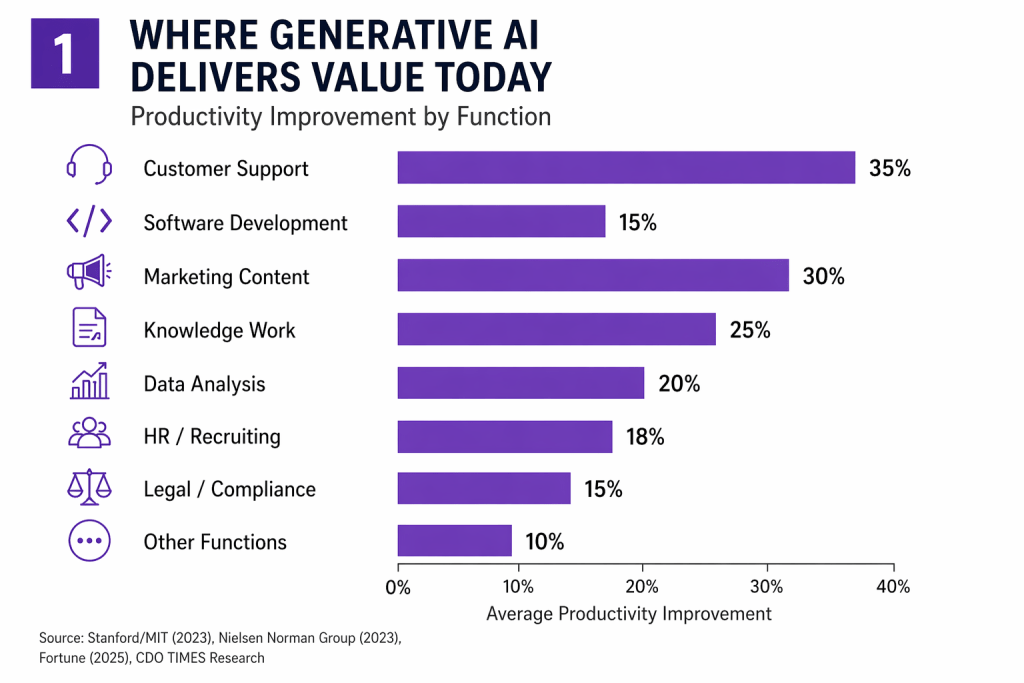
- GitHub Copilot → boosts developer productivity ~15% (https://fortune.com/2025/02/25/ai-worker-productivity-stats/)
- Customer support copilots → up to 35% improvement for less experienced agents (https://arxiv.org/abs/2304.11771)
These are augmentation wins.
2. Cognitive AI
- Autonomous supply chain optimization systems adjusting inventory in real time
- Fraud detection systems continuously learning from transaction patterns
- Predictive maintenance systems adapting based on sensor data streams
These are operational transformation wins.
The Strategic Mistake Most Organizations Make
They treat AI as a tool deployment problem, not a system design problem.
So they:
- Roll out copilots
- Add chat interfaces
- Improve productivity marginally
But they do not:
- Redesign workflows
- Embed feedback loops
- Enable real-time learning
Result:
They automate existing inefficiencies instead of transforming them.
What CIOs and CDOs Should Do Now
1. Separate Your AI Strategy Into Two Tracks
- Productivity AI (LLMs)
- Operational AI (Cognitive Systems)
Mixing them leads to confusion and underperformance.
2. Invest in Data Feedback Infrastructure
- Real-time data pipelines
- Event-driven architectures
- Continuous monitoring systems
Without this, cognitive AI cannot exist.
3. Redesign Workflows Before Automating Them
If the process is broken:
- LLMs will scale the problem
- Cognitive AI will learn the wrong behavior
4. Build Governance for Adaptive Systems
You need:
- Drift detection
- Feedback validation
- Human override mechanisms
5. Start with High-Impact Closed-Loop Use Cases
- IT operations (incident resolution loops)
- Supply chain (demand-response loops)
- Finance (fraud detection loops)
The Bigger Picture: HI + AI = ECI™
This is not about choosing between LLMs and cognitive AI.
It is about how they work together.
- LLMs → amplify human intelligence (HI)
- Cognitive AI → amplify system intelligence
- Leadership → orchestrates both into Elevated Collaborative Intelligence™
Your formula holds:
ECI = (AI + HI) × T – R
Where:
- LLMs increase AI capability
- Cognitive systems increase T (technology effectiveness)
- Governance reduces R (risk)
The CDO TIMES Bottom Line
LLMs changed how we interact with machines.
Cognitive AI will change how systems think, adapt, and operate.
If you stay at the LLM layer, you get productivity gains.
If you move into cognitive AI, you unlock transformation.
Most companies are still in phase one.
The competitive advantage will come from those who build phase two—deliberately, architecturally, and with governance in mind.
Love this article? Embrace the full potential and become an esteemed full access member, experiencing the exhilaration of unlimited access to captivating articles, exclusive non-public content, empowering hands-on guides, and transformative training material. Unleash your true potential today!
Order the AI + HI = ECI book by Carsten Krause today! at cdotimes.com/book

Subscribe on LinkedIn: Digital Insider
Become a paid subscriber for unlimited access, exclusive course content, no ads: CDO TIMES
Do You Need Help?
Consider bringing on a fractional CIO, CISO, CDO or CAIO from CDO TIMES Leadership as a Business Consulting Service. The expertise of CDO TIMES becomes indispensable for organizations striving to stay ahead in the digital transformation journey. Here are some compelling reasons to engage their experts:
- Deep Expertise: CDO TIMES has a team of experts with deep expertise in the field of Cybersecurity, Digital, Data and AI and its integration into business processes. This knowledge ensures that your organization can leverage digital and AI in the most optimal and innovative ways.
- Training, developing, arranging, and conducting educational conferences and programs and providing courses of instruction.
- Strategic Insight: Not only can the CDO TIMES team help develop a Digital & AI strategy, but they can also provide insights into how this strategy fits into your overall business model and objectives. They understand that every business is unique, and so should be its Digital & AI strategy.
- Future-Proofing: With CDO TIMES, organizations can ensure they are future-proofed against rapid technological changes. Our experts stay abreast of the latest AI, Data and digital advancements and can guide your organization to adapt and evolve as the technology does.
- Risk Management: Implementing a Digital & AI strategy is not without its risks. The CDO TIMES can help identify potential pitfalls and develop mitigation strategies, helping you avoid costly mistakes and ensuring a smooth transition with fractional CISO services.
- Competitive Advantage: Finally, by hiring CDO TIMES experts, you are investing in a competitive advantage. Their expertise can help you speed up your innovation processes, bring products to market faster, and stay ahead of your competitors.
By employing the expertise of CDO TIMES, organizations can navigate the complexities of digital innovation with greater confidence and foresight, setting themselves up for success in the rapidly evolving digital economy. The future is digital, and with CDO TIMES, you’ll be well-equipped to lead in this new frontier.
Do you need help with your digital transformation initiatives? We provide fractional CAIO, CDO, CISO and CIO services, do a Preliminary ECI and Tech Navigator Assessment and we will help you drive results and deliver winning digital and AI strategies for you!
Subscribe now for free and never miss out on digital insights delivered right to your inbox!