The MIT AI Reality Check: Why 93% of Executives Are Scaling the Wrong AI Strategy
Bruce Lawler’s Data, My Questions, and the Hard Truth About Why AI Isn’t Delivering ROI
By Carsten Krause | April 17, 2026
The Moment That Should Have Made Every Executive Uncomfortable
At the 2026 AI conference at the Massachusetts Institute of Technology (MIT) in Boston, one exchange captured the state of enterprise AI better than any keynote, panel, or vendor pitch.
Bruce Lawler, who leads AI research in manufacturing and operations at MIT, asked a simple question to the audience:
“How many of you are accelerating digitization efforts?”
Roughly two-thirds of the room raised their hands.
He followed immediately:
“How many of you have a well-defined AI strategy?”
The room went quiet.
Then he delivered the number:
“Seven percent.”
That single statistic explains why so many AI initiatives stall, fail, or never scale. It also exposes a much deeper issue—one that most organizations are not ready to confront.
Because the problem is not AI.
The problem is leadership.
The Data Executives Can’t Ignore: The AI Gap Is Accelerating
Bruce Lawler didn’t rely on opinions. He presented longitudinal research across 175 companies over multiple years, measuring real business outcomes—not AI hype.
The results are clear and consistent:
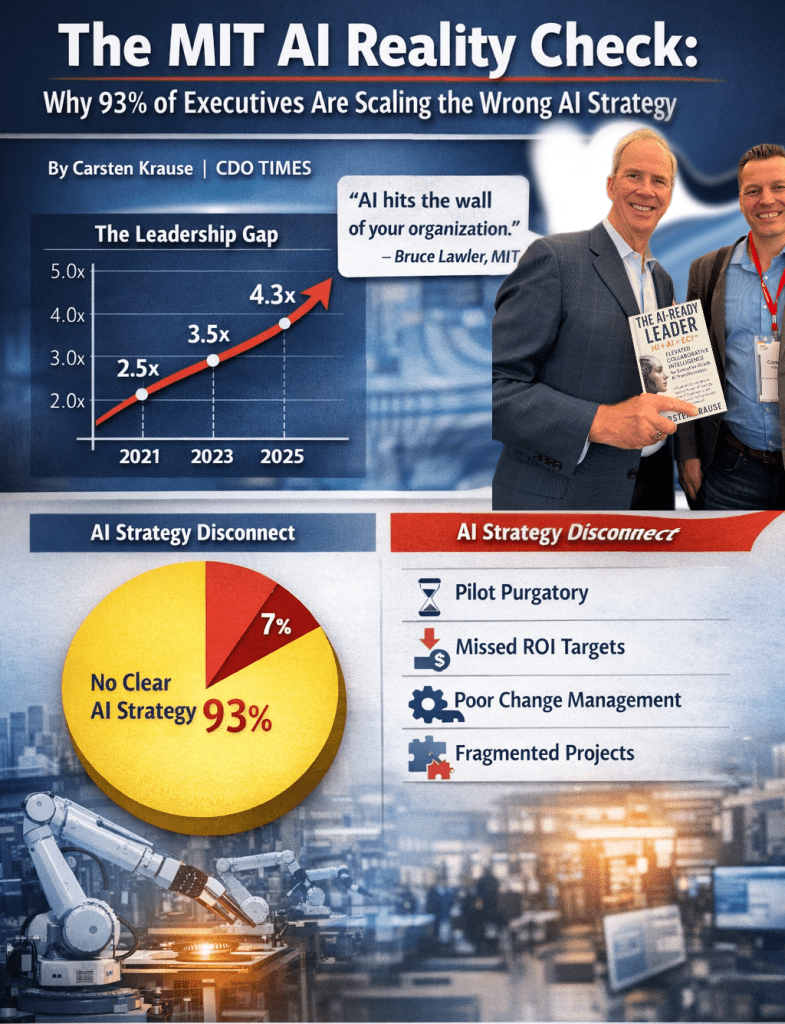
- In 2021, AI leaders outperformed laggards by 2.5x
- In 2023, that gap increased to 3.5x
- In 2025, it reached 4.3x
- In 2026, the trajectory continues upward
His conclusion was direct:
“What we see is that the gap between leaders and the rest is widening… leaders are getting even better.”
This is not a maturity curve.
This is compounding competitive advantage.
And then came the most important data point in the entire session:
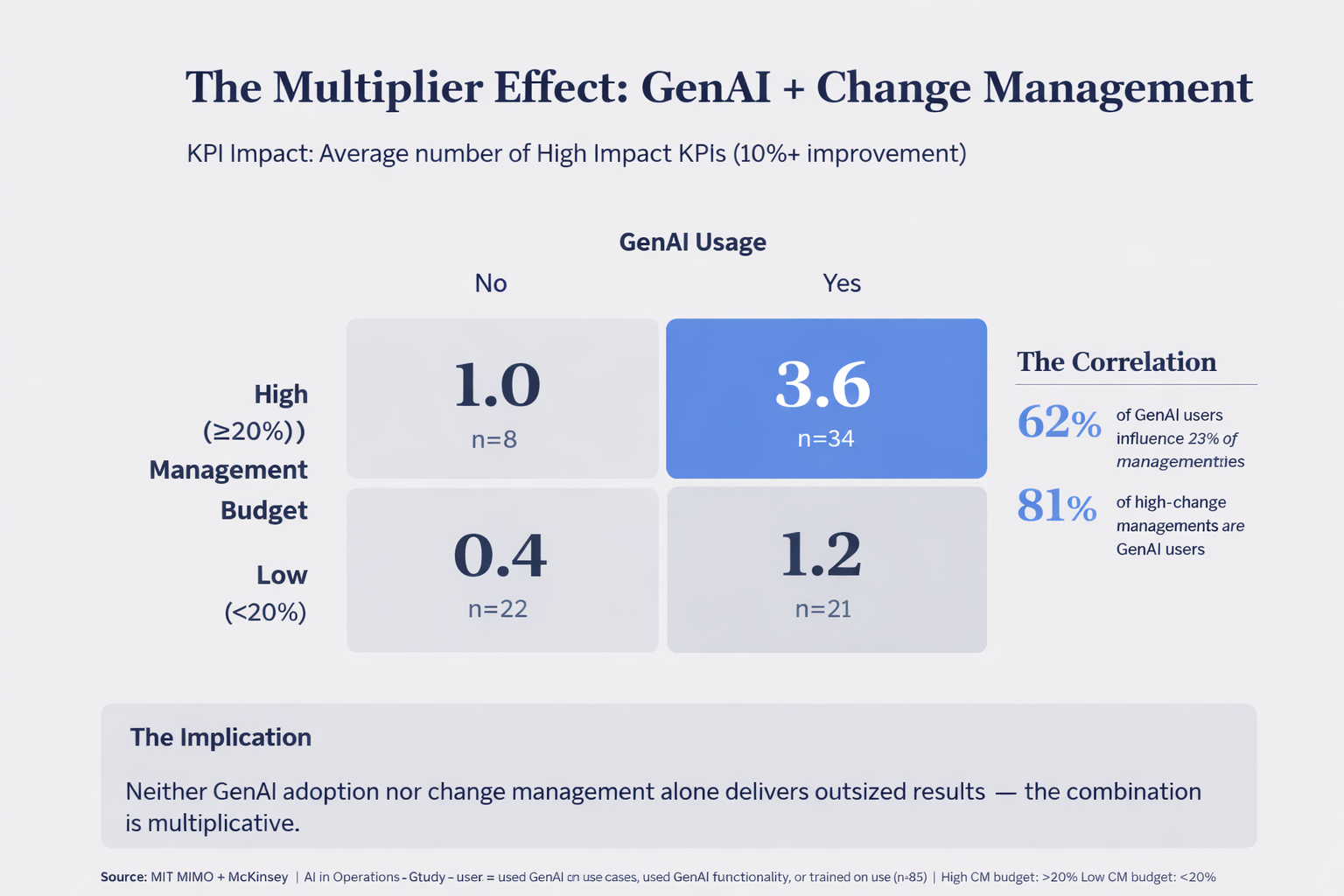
“Generative AI users have three times the number of high-impact KPIs.”
A high-impact KPI, as defined in the study, means achieving more than a 10% measurable improvement in a business outcome.
Not a pilot.
Not a proof of concept.
Not a demo.
Real impact.
The Strategy Execution Gap: Where Most AI Initiatives Collapse

Here is the contradiction that should concern every CIO, CDO, and CEO:
- 68% of companies are increasing digital and AI investment
- Only 7% have a defined AI strategy
- 42% are still figuring out their strategy
- Only 11% have scaled AI into production
Bruce Lawler summarized it bluntly:
“I’m going to go spend the money, but don’t know what I’m doing.”
This creates what many executives now recognize as:
- Pilot purgatory
- Fragmented use cases
- Missed ROI targets
- Organizational fatigue
But what’s often missed is the underlying pattern.
Companies are not failing to adopt AI.
They are successfully scaling confusion!
The Question That Cut Through the Narrative
During the session, I asked a question that reframed the discussion:
“If adoption is accelerating this quickly, how do we know organizations are actually creating business impact—and not just increasing activity?”
The response, while not explicitly stated, was embedded in the data:
Adoption is easy to measure.
Impact is not.
And most organizations are not measuring the right thing.
Because activity—number of pilots, tools deployed, models tested—creates the illusion of progress.
But KPI performance reveals the truth.
Where AI Actually Works—and Where It Doesn’t
One of the most practical parts of the session was the breakdown of where generative AI is delivering real value today.
Where GenAI Is Winning
- AI copilots for documentation and workflows
- Knowledge retrieval using RAG (retrieval augmented generation)
- Internal AI assistants and chatbots (used by 95% of leading companies)
Lawler explained why these succeed:
“It works because it’s using existing data… human-readable data that organizations already understand.”
These use cases benefit from:
- Unstructured data availability
- Low integration complexity
- Immediate productivity gains
Where GenAI Is Overused or Misapplied
- Defect detection
- Sensor-based anomaly detection
- Logistics optimization
These areas still favor traditional machine learning.
Why?
Because they require:
- Structured data
- Sensor integration
- Data labeling and engineering
Lawler clarified:
“You have to collect the data, structure it, label it… it’s much harder.”
Yet many organizations continue to force GenAI into these domains leading to underperformance and frustration.

The Second Question: Are We Solving the Right Problems?
I pushed further:
“Are companies prioritizing AI use cases based on strategic value—or based on what’s easiest to implement?”
The reality became obvious through both data and examples.
Most companies start with:
- Chatbots
- Content generation
- Internal assistants
Lawler even reinforced this:
“The most impactful thing you can do first is some kind of AI assistant.”
That statement is true.
But it is also incomplete.
Because starting there is not the problem.
Stopping there is.
These use cases create early wins, but often fail to connect to:
- Core operations
- Revenue growth
- Competitive differentiation
Which leads to a dangerous illusion:
AI appears to be working… while the business remains unchanged.
Case Studies: What Real AI Impact Looks Like
The conference highlighted several real-world examples that move beyond theory.
Tesla: AI-Driven Maintenance Intelligence
- Trained on over 1 million historical trouble tickets
- Enabled faster technician onboarding
- Reduced production line downtime by 10%
- Deployed within six months
This is AI embedded into operations—not layered on top.
Nissan: Scaling Human Expertise with AI
- AI assistant capturing expert technician knowledge
- Supporting less experienced workers in real-time
- Reducing reliance on individual expertise
This is a textbook example of HI + AI = ECI™ (Elevated Collaborative Intelligence) in action.
Komatsu: Agentic AI in Finance Operations
- Processing 600,000 invoices annually
- Targeting automation of 50% initially
- Expanding toward 70% automation
This demonstrates how agent-based AI is moving into structured, high-volume processes.
The Third Question: What Actually Blocks Scale?
This was the most important moment of the session.
I asked directly:
“If the technology is clearly delivering results, what is actually preventing organizations from scaling AI?”
Bruce Lawler answered without hesitation:
“The big constraint… is organizational readiness.”
Then he added the line that every executive should write down:
“AI hits the wall of your organization.”
The Most Underrated Investment: Change Management
One of the most overlooked insights from the research:
Companies that allocate more than 20% of their AI project budget to change management significantly outperform others.
Change management includes:
- Training employees
- Redesigning workflows
- Adjusting roles and responsibilities
- Aligning incentives and governance
This is where most AI strategies fail.
Not because the models don’t work.
But because the organization doesn’t.
What AI Leaders Do Differently
MIT’s research identified nine dimensions where leaders outperform:
- Governance and decision-making structures
- Data strategy and accessibility
- Talent and skill development
- KPI alignment and measurement
- Use case prioritization
- Organizational readiness
- Change management investment
- Executive sponsorship
- Workflow integration
Lawler summarized it clearly:
“A well-defined strategy means aligning across governance, data, talent, KPIs, and business outcomes.”
Notice what’s missing from that definition.
Technology.
The Bigger Pattern: Why Most AI Strategies Fail
When you step back, the pattern becomes clear:
- Companies invest before they align
- They deploy tools before defining outcomes
- They prioritize easy wins over strategic impact
- They underestimate organizational complexity
- They ignore change management
The result?
AI becomes another layer of complexity—rather than a driver of transformation.
The ECI Perspective: Why This Was Predictable
What MIT’s data confirms is exactly what the ECI framework has been highlighting:
AI alone does not create advantage.
Advantage comes from the equation:
HI + AI = ECI™ (Elevated Collaborative Intelligence)
Where:
- Human intelligence (HI) provides context, leadership, and decision-making
- AI provides scale, speed, and pattern recognition
- Organizational readiness determines whether the two can actually work together
Most companies are investing in AI.
Very few are investing in the integration of AI and human intelligence.
That is the difference.
The CDO TIMES Bottom Line
The MIT AI 2026 conference delivered a clear message—one that many executives will find uncomfortable but necessary.
Executive Summary
- The performance gap between AI leaders and laggards is accelerating
- Generative AI is delivering measurable business impact—but only when applied correctly
- Most organizations lack a defined AI strategy despite increasing investment
- Organizational readiness—not technology—is the primary barrier to scale
- Change management is the most underestimated driver of success
What You Should Do Next
- Audit your AI initiatives against KPI impact—not activity
- Prioritize use cases tied to core business outcomes—not convenience
- Invest in change management as a core capability—not an afterthought
- Align governance, data, talent, and workflows before scaling AI
- Assess your organization’s readiness using frameworks like ECI™
Resources to Explore
- MIT AI research and benchmarking studies
- Industry case studies on AI at scale (Tesla, Nissan, Komatsu)
- CDO TIMES frameworks on Elevated Collaborative Intelligence™
The uncomfortable truth is this:
If you are not seeing measurable business impact from AI today,
you are not behind on technology.
You are behind on execution.
And that gap is growing faster than most organizations are prepared to catch up with.
Love this article? Embrace the full potential and become an esteemed full access member, experiencing the exhilaration of unlimited access to captivating articles, exclusive non-public content, empowering hands-on guides, and transformative training material. Unleash your true potential today!
Order the AI + HI = ECI book by Carsten Krause today! at cdotimes.com/book

Subscribe on LinkedIn: Digital Insider
Become a paid subscriber for unlimited access, exclusive course content, no ads: CDO TIMES
Do You Need Help?
Consider bringing on a fractional CIO, CISO, CDO or CAIO from CDO TIMES Leadership as a Business Consulting Service. The expertise of CDO TIMES becomes indispensable for organizations striving to stay ahead in the digital transformation journey. Here are some compelling reasons to engage their experts:
- Deep Expertise: CDO TIMES has a team of experts with deep expertise in the field of Cybersecurity, Digital, Data and AI and its integration into business processes. This knowledge ensures that your organization can leverage digital and AI in the most optimal and innovative ways.
- Training, developing, arranging, and conducting educational conferences and programs and providing courses of instruction.
- Strategic Insight: Not only can the CDO TIMES team help develop a Digital & AI strategy, but they can also provide insights into how this strategy fits into your overall business model and objectives. They understand that every business is unique, and so should be its Digital & AI strategy.
- Future-Proofing: With CDO TIMES, organizations can ensure they are future-proofed against rapid technological changes. Our experts stay abreast of the latest AI, Data and digital advancements and can guide your organization to adapt and evolve as the technology does.
- Risk Management: Implementing a Digital & AI strategy is not without its risks. The CDO TIMES can help identify potential pitfalls and develop mitigation strategies, helping you avoid costly mistakes and ensuring a smooth transition with fractional CISO services.
- Competitive Advantage: Finally, by hiring CDO TIMES experts, you are investing in a competitive advantage. Their expertise can help you speed up your innovation processes, bring products to market faster, and stay ahead of your competitors.
By employing the expertise of CDO TIMES, organizations can navigate the complexities of digital innovation with greater confidence and foresight, setting themselves up for success in the rapidly evolving digital economy. The future is digital, and with CDO TIMES, you’ll be well-equipped to lead in this new frontier.
Do you need help with your digital transformation initiatives? We provide fractional CAIO, CDO, CISO and CIO services, do a Preliminary ECI and Tech Navigator Assessment and we will help you drive results and deliver winning digital and AI strategies for you!
Subscribe now for free and never miss out on digital insights delivered right to your inbox!
Turn insight into action with CDO TIMES.
CDO TIMES helps executives move from AI awareness to AI execution through practical frameworks, tools, executive research, and advisory support.
Explore the Frameworks
Continue with Enterprise AI 2030, HI + AI = ECI, AI Governance, and executive playbooks.
Explore Enterprise AI 2030 →Use the Free Tools
Assess readiness, estimate AI ROI, model AI costs, and prioritize AI initiatives.
Open Executive Tools →Read the Book
Explore the HI + AI = ECI leadership model in The AI-Ready Leader.
Order The AI-Ready Leader →Go deeper with CDO TIMES Pro.
Unlock premium research, executive playbooks, templates, advanced tools, and member-only briefings.
Need executive help?
Explore advisory, workshops, fractional CIO/CDO/CISO/CAIO support, and AI operating model design.
Explore Advisory →Attend executive events
Join leadership forums, executive dinners, webinars, and strategic AI briefings.
View Events →Build AI capability
Use CDO TIMES Academy for executive learning, AI leadership development, and implementation training.
Explore Academy →