Agentic AI Architecture And Enterprise Security In Multi-Agent Systems + Video – Undercode Testing – Howl.Link
Hackers Monitor
Hackers Monitor 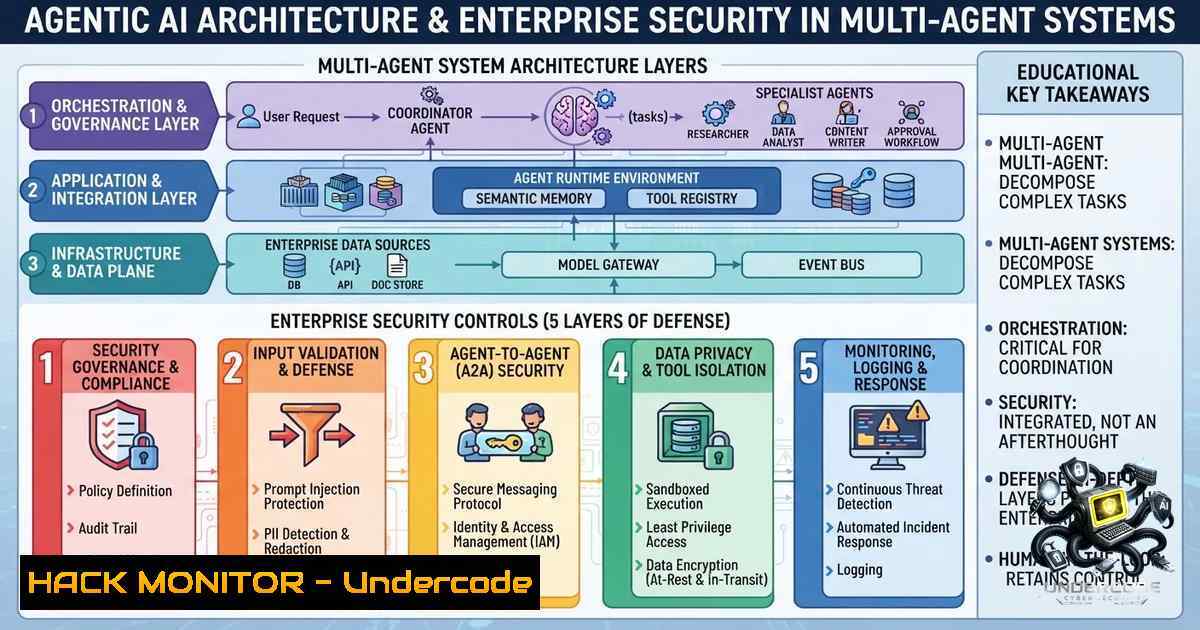
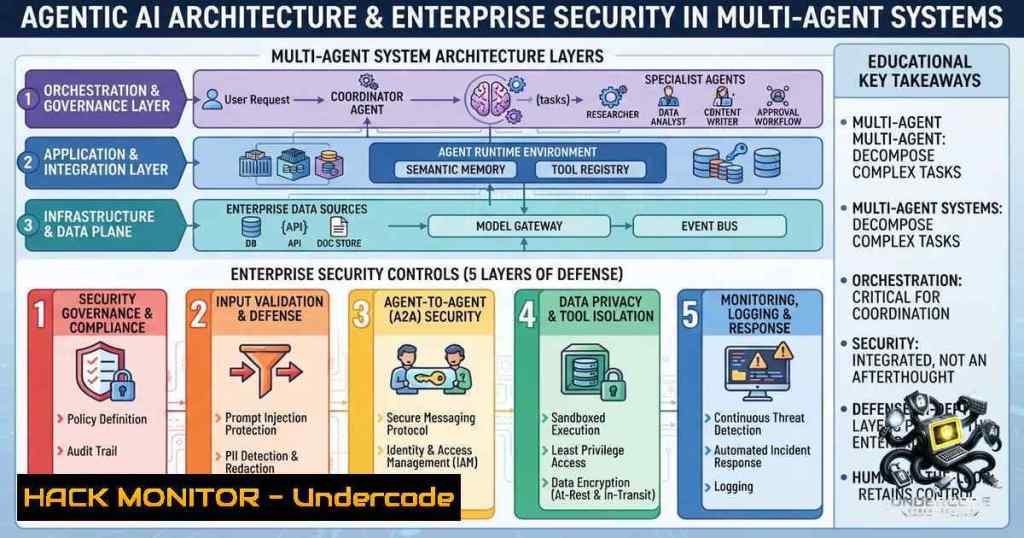
Agentic AI shifts enterprise artificial intelligence from passive text generation to autonomous systems capable of planning, invoking tools, and executing multi-step workflows across cloud and data environments. When paired with ecosystems like Microsoft Azure, Microsoft Fabric, and Copilot Studio alongside cybersecurity and forensics practices, these agents expand both operational velocity and the enterprise attack surface. Securing identity boundaries, API integrations, and execution environments is essential as organizations deploy multi-agent architectures at scale.
Design agentic-first business solutions and multi-agent orchestration workflows across Microsoft AI and enterprise data platforms
Enforce least-privilege identities, scoped API access, and deterministic tool validation to prevent prompt injection and privilege escalation
Instrument telemetry, audit trails, and runtime containment across Linux, Windows, and cloud workloads supporting autonomous agents
Agentic business solutions decompose complex operational goals into sub-tasks handled by specialized agents—such as planners, retrieval agents, code/data execution agents, and verification agents—coordinated through structured state and tool interfaces. Rather than relying on a single monolithic prompt, multi-agent designs isolate responsibilities so each component operates with clear inputs, explicit schemas, and bounded permissions. When integrating with data platforms such as Microsoft Fabric or Azure services, agents often bridge business intelligence queries, workflow triggers, and external APIs, making strict schema enforcement and human-in-the-loop checkpoints critical for high-impact actions.
Step-by-step guide explaining what this does and how to use it:
Step-by-step guide explaining what this does and how to use it:
Step-by-step guide explaining what this does and how to use it:
Step-by-step guide explaining what this does and how to use it:
Combining cybersecurity and digital forensics readiness with AI engineering ensures teams can detect, contain, and investigate anomalous agent behavior quickly. When an agent loops infinitely, accesses unusual tables, or makes unexpected external API calls, defenders need immutable logs, correlation IDs across agent hops, and clear containment playbooks. Regular red-teaming of prompt injection and tool misuse alongside forensic evidence preservation turns reactive firefighting into repeatable resilience.
Step-by-step guide explaining what this does and how to use it:
Treat every external data source and tool output consumed by an AI agent as untrusted input subject to validation and containment.
Pair rapid AI and business solution delivery with least-privilege identity, network egress controls, and end-to-end observability.
Enterprise adoption of agentic AI and multi-agent architectures is accelerating across software engineering, analytics, and business operations, driven by platforms that connect language models to real enterprise tools and data. While this capability unlocks substantial automation and productivity, it also introduces non-deterministic execution paths where model reasoning interacts with live APIs, credentials, and infrastructure. Security teams cannot rely solely on system prompts to enforce boundaries because prompts operate in the same context channel as retrieved data. Instead, defense-in-depth must anchor security outside the model—inside gateways, identity policies, sandboxed runtimes, and strict data access controls. Organizations that combine strong software engineering fundamentals with proactive threat modeling and forensic visibility will capture agentic efficiency safely, whereas those granting broad permissions to autonomous workflows risk silent data exposure, unauthorized actions, and complex multi-system incidents.
Securing agentic AI workflows requires enforcing least-privilege access, API gateway controls, and runtime isolation around every tool and data source an autonomous agent touches. Without strong identity boundaries and anomaly monitoring, multi-agent systems can become high-speed vectors for data exfiltration, prompt-driven privilege abuse, and cascading cloud compromise.
Enforce deterministic policy checks and least-privilege scopes at the API and data layer rather than trusting model output alone.
Maintain comprehensive audit trails and rapid kill-switches across multi-agent orchestrators and underlying cloud hosts.
Join Undercode Academy for Verified Certifications
Secure, high-velocity infrastructure and disruptive technological engineering. Contact our engineering team for high-tier development and proprietary systems:
[email protected]
💎 Smart Architecture | 🛡️ Secure by Design | ⭐ Trusted by Thousands
Reported By: https://lnkd.in/p/dcRyiXqF – Hackers Feeds
Extra Hub: Undercode MoN
Basic Verification: Pass ✅
💬 Whatsapp | 💬 Telegram
𝕏 formerly Twitter 🐦 | @ Threads | 🔗 Linkedin | 🦋BlueSky
AI Hyperscaler Capex Meets Seoul’s Economy: Rate Hikes, Household Debt, and Supply Chain Risk + Video
Sovereign AI Accelerates in Switzerland as Hack Apertus Launches in Zurich and Basel + Video
© 2016-2025 Undercode. All rights reserved.
To provide the best experiences, we use technologies like cookies to store and/or access device information. Consenting to these technologies will allow us to process data such as browsing behavior or unique IDs on this site. Not consenting or withdrawing consent may adversely affect certain features and functions.
We do not sell your personal data. If you wish to exercise your rights under applicable privacy laws, please visit our Do Not Sell My Personal Information page.
source
This is a newsfeed from leading technology publications. No additional editorial review has been performed before posting.