
Enterprise Architecture in 2027: Designing for AI at Scale
BY CARSTEN KRAUSE | CDO TIMES | UPDATED NOVEMBER 13, 2026 | 3,230 WORDS OF ANALYSIS
Research from Gartner, Forrester, McKinsey and MIT points to a new enterprise architecture mandate: prepare for autonomous systems while making data, identity, controls, cost and operating ownership explicit.
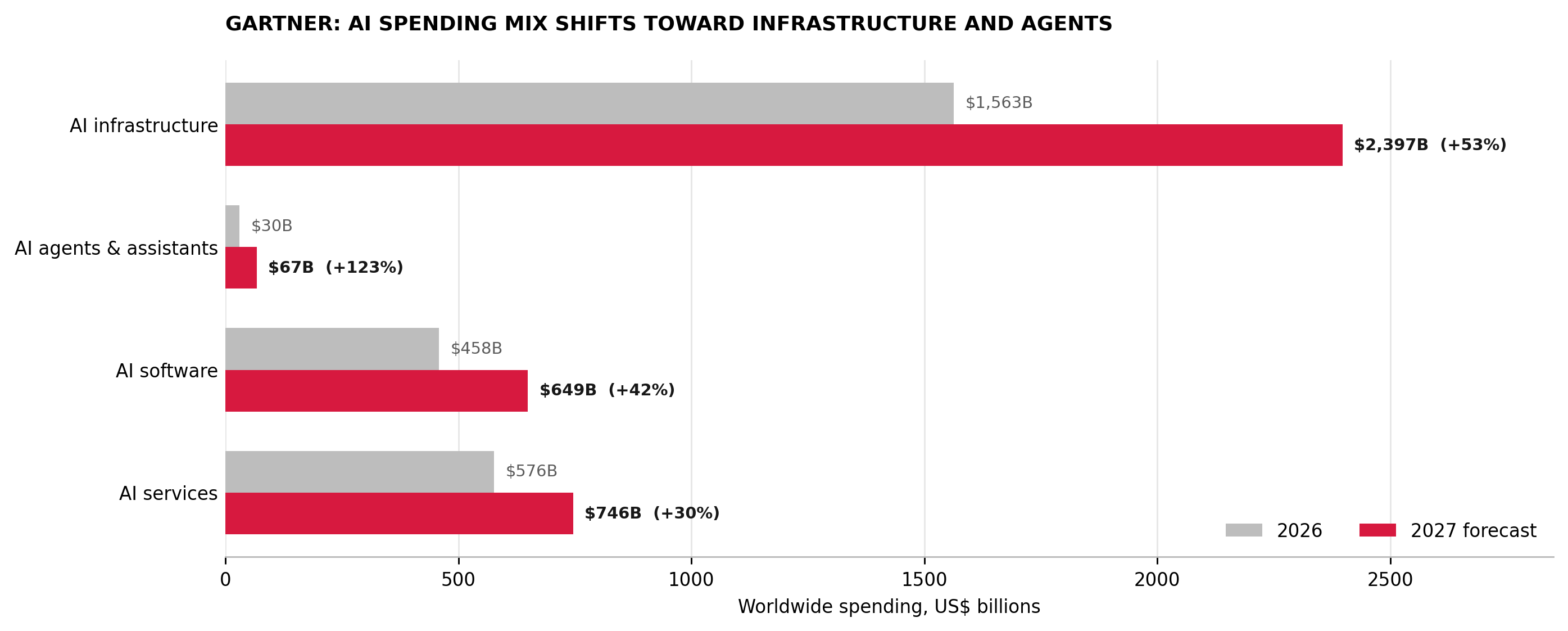
FIGURE 1 | Gartner’s November 2026 forecast for selected AI market segments, in US$ billions. Growth rates are calculated from Gartner’s 2026 and 2027 estimates; forecasts are not actual enterprise spending. Source: [3].
The investment forecast makes architecture a value discipline. Enterprise leaders must connect AI spending to governed data, secure platforms, measurable outcomes and operating accountability.
2027 is the year architecture meets the economics of AI
Enterprise architecture is moving into a more consequential phase as AI shifts from isolated assistants toward systems that retrieve enterprise information, call tools, coordinate workflows and act across applications. The 2027 question is not simply which model to buy or where to host it. It is whether the company can connect models to trusted context, grant bounded access, observe actions, manage changing costs and remain accountable when systems behave unexpectedly. Gartner’s technology trends for 2027 describe the rise of an autonomous agent platform alongside nontextual AI and durable agility [2]. Forrester’s 2027 analysis expects business technology spending to exceed $6 trillion, with one dollar in five directed to AI [1].
Those forecasts do not mean every organization should deploy agents everywhere. They indicate that AI will consume more infrastructure, platform capacity and management attention, while business leaders will demand value from larger investments. The architect’s work therefore shifts from producing target-state diagrams to shaping the conditions under which systems can safely change and operate. That includes setting reusable patterns, exposing dependencies, connecting platform decisions to business outcomes and helping leaders choose where autonomy is acceptable. The central 2027 requirement is architectural control that enables delivery rather than slowing it.
The investment curve is changing what architecture must optimize
Gartner forecasts worldwide AI spending at about $4.05 trillion in 2027, with AI infrastructure reaching approximately $2.40 trillion and 59 percent of the total [3]. Within that forecast, AI agents and assistants rise from $30 billion in 2026 to $67 billion in 2027, while AI software rises from $458 billion to $649 billion. AI services grow from $576 billion to $746 billion, reflecting ongoing work in strategy, data preparation, integration and deployment [3]. These are market forecasts, not guaranteed enterprise budgets or confirmed productivity results. They nevertheless show why architecture teams will need to plan for capacity, consumption, integration and lifecycle cost as first-class design concerns.
Forrester adds a useful constraint: although it projects that AI will take 20 percent of business technology spending in 2027, just 53 percent of surveyed technology leaders expect their budgets to outpace inflation [1]. That tension makes indiscriminate platform expansion harder to justify. Architecture must help organizations decide where shared infrastructure is economic, where a specialist model or service is warranted, and when a use case should be stopped. It must also help finance and product leaders see unit costs, model consumption, vendor exposure and the cost of human review. Efficiency in this environment comes from avoiding duplicated pipelines and unnecessary tool sprawl, not from assuming that each AI feature reduces total cost.
The architecture agenda grows beyond text and chat
Gartner’s ten strategic technology trends for 2027 group into three themes: extending AI beyond text, governing autonomous agent platforms and building durable agility [2]. The nontextual frontier includes quantitative models, speech reasoning and world models, which expand the kinds of inputs and environments AI systems can interpret. For enterprise architects, that means data architectures will need to account for audio, images, structured numeric data, simulations and physical-world signals. The governance implications also widen because multimodal systems may expose sensitive information through new inputs and outputs. A technology plan designed only around chat interfaces will miss these enterprise dependencies.
The autonomous platform theme names AI context platforms, coding-agent harnesses, agent identity and autonomous exposure remediation [2]. Each points to a concrete architecture requirement: maintain semantic context, test and supervise machine-generated changes, assign agents attributable identities, and continuously detect and remediate security weaknesses. Gartner predicts organizations prioritizing semantics in AI-ready data could improve agentic AI accuracy by up to 80 percent and reduce costs by up to 60 percent [2]. These are Gartner’s forecasted upper-bound improvements, not universal outcomes; they depend on the organization’s data, use case and implementation. The architectural implication is clear: context and identity are platform capabilities, not prompt-writing details.
Durable agility covers sovereign technology, disposable applications and human capability [2]. Sovereignty affects where data and models can be processed, which suppliers can be used, and how quickly an organization can change providers or jurisdictions. Disposable applications suggest that AI may make it cheaper to generate short-lived software, but companies still need to manage its access, data dependencies, operational owner and retirement. Gartner’s “wetware as a service” term also signals that workforce and process design remain part of the architecture landscape. The enterprise must plan for change without allowing experimental applications to become invisible production dependencies.
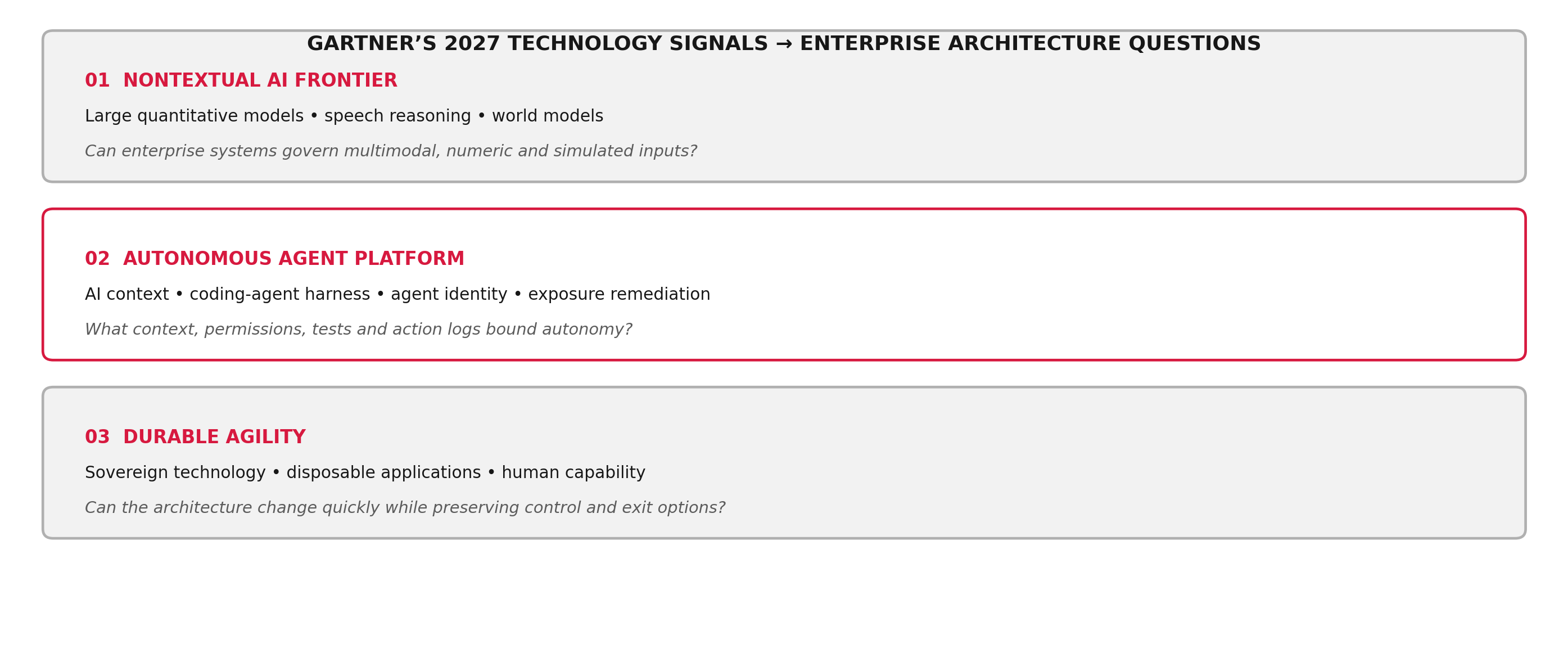
FIGURE 2 | Gartner’s 2027 strategic technology themes translated into the architectural questions they create for enterprise leaders.
The shift from pilot to scale exposes the real bottleneck
Research suggests that experimentation is widespread, while scaled value remains much less common. McKinsey reports that nearly two-thirds of enterprises have experimented with agents, but fewer than 10 percent have scaled them to deliver tangible value; eight in ten organizations cite data limitations as a roadblock [4]. These figures show a gap between trying agent technology and making it dependable enough to support enterprise work. They also reinforce that architecture challenges sit beneath the model layer. If agents lack consistent access to governed information, operational context and stable interfaces, coordination across systems becomes fragile.
McKinsey’s foundation recommendations include treating ingestion as a product, sharing meaning through common definitions, using a unified data foundation, embedding security and access controls, exposing stable APIs, measuring performance and coordinating agents through a governed execution layer [4]. Together, these requirements move data architecture from a reporting concern to an operational prerequisite for autonomous work. A semantic layer can help systems interpret business entities and relationships, but it must be backed by clear ownership, lineage and access policies. The architecture should also provide feedback when data quality, retrieval relevance or model performance falls below agreed thresholds. This makes continuous measurement part of platform design, not an afterthought in production support.
The same pattern appears in McKinsey’s 2026 State of AI survey: 44 percent of respondents said AI was scaling across their enterprise, up from 38 percent a year earlier, while 40 percent of large-company respondents reported scaling agents in at least one function, up from 27 percent [6]. The survey also found 32 percent of respondents said their organization had chosen not to buy at least one software product or feature because coding agents enabled an internal build [6]. That creates a new portfolio question for architecture: which applications should be bought, extended, generated or retired? Lower-cost software creation does not remove the need for security review, data contracts, lifecycle ownership or integration discipline. It may make those controls more important as the number of small applications increases.
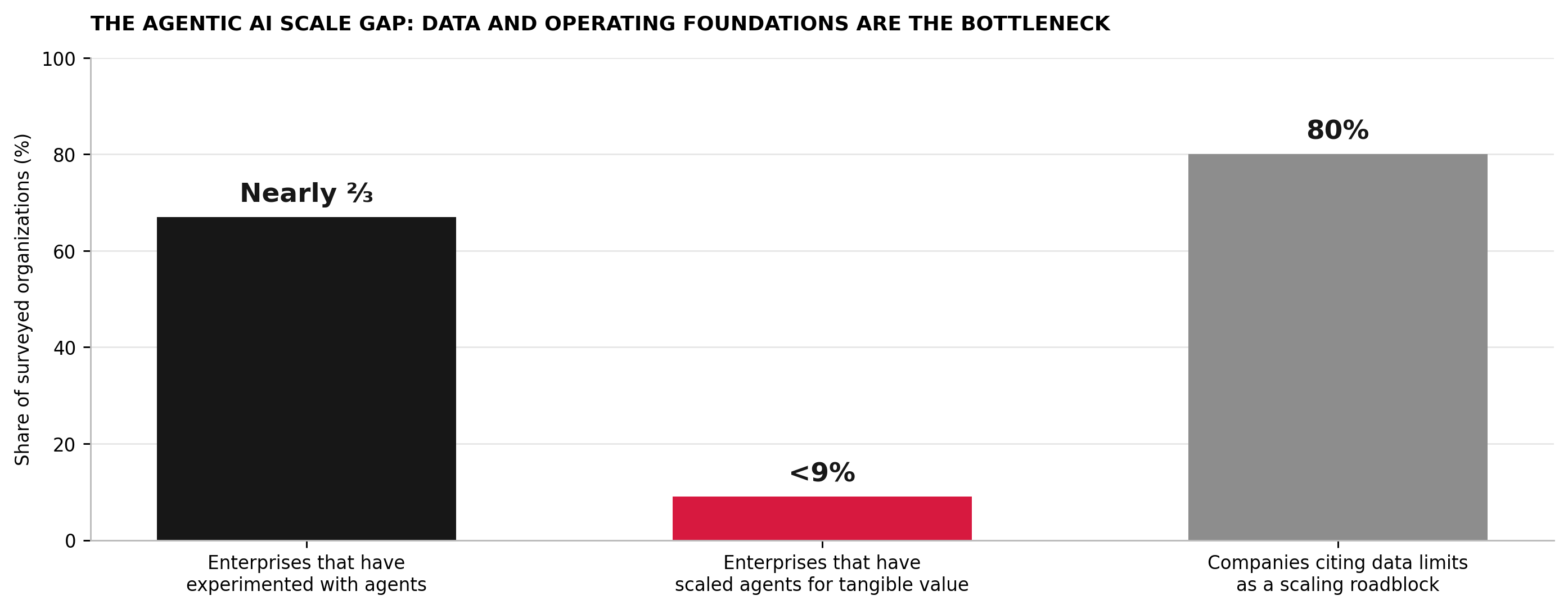
FIGURE 3 | McKinsey’s reported agent experimentation and scaling findings, plus reported data constraints. “Fewer than 10%” is displayed as an upper-bound marker; survey results are directional, not guarantees for an individual company.
Enterprise architecture becomes the control plane for bounded autonomy
Forrester argues that as architecture knowledge becomes machine-readable, enterprise architects must govern the context, authority, patterns and controls that shape machine and agent behavior [7]. Its formulation of EA as a control plane for bounded autonomy captures the emerging mandate well. An architecture repository can increasingly serve as an input to AI-assisted planning, software generation and agent decisions. That only works if its information is current, authoritative, permissioned and connected to accountable owners. Architecture records therefore need to evolve from static descriptions into governed operational knowledge.
MIT CISR identifies four domains where organizations need visibility, oversight and the ability to intervene: architecture compliance, innovation management, workforce enablement and supplier governance [8]. Its research describes integrated but separately governed data, AI and agent platforms, with semantic context, model evaluation, monitoring, action logs and escalation to human review. It also recommends central technology ownership for moving AI applications into production, while centers of excellence provide standards, tools and secure experimentation environments [8]. This is a federated model: common architecture and controls provide consistency, while business and product teams remain close to their domain outcomes. The enterprise architect can connect those layers and clarify who is responsible for decisions, exceptions, operation and remediation.
This model requires risk to shape design, not merely approval paperwork. An agent that summarizes a public policy document can operate under a different control profile from one that updates a customer record or initiates a payment. Data sensitivity, action authority, reversibility and business impact should influence identity scope, human approval, logging, testing and runtime monitoring. Gartner warns that by 2028, 25 percent of enterprise security breaches may trace back to AI agent abuse tied to unmanaged machine privileges and legacy credentials [2]. That is a forecast, but it highlights a practical design issue now: agents need attributable identities and just-in-time, least-privilege access. Organizations also need a way to suspend, inspect and recover an agent’s actions.
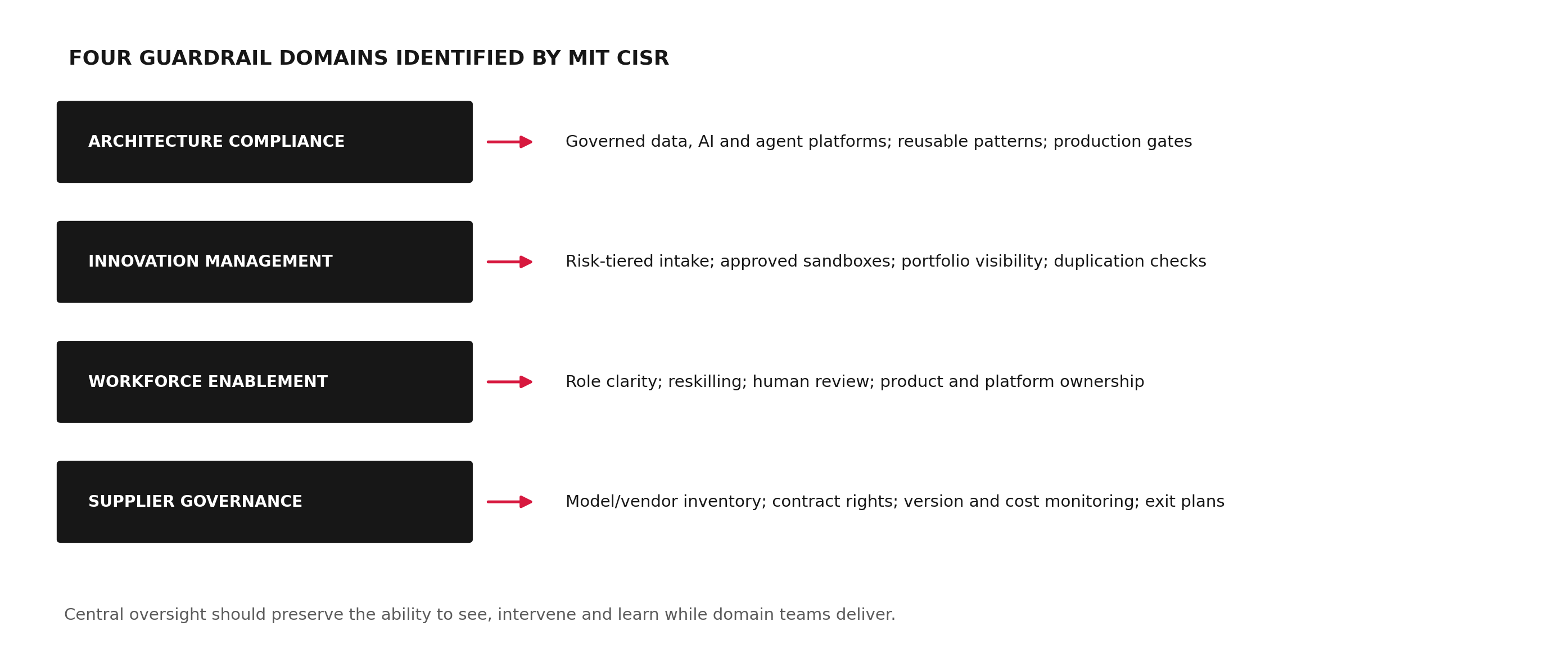
FIGURE 4 | MIT CISR’s four governance domains translated into enterprise architecture guardrails and operating controls.
The new mandate: strategic enterprise architects shape both direction and delivery
The role-detail framework behind this article points to a broader strategic enterprise architect mandate. The architect is expected to connect business strategy, product decisions, information architecture, technology patterns, risk and delivery rather than arrive only at a review gate. This calls for early engagement with business leaders and vendors, plus a clear view of capability gaps, investment trade-offs and operating implications. It also means translating architecture principles into patterns teams can apply in product and agile settings. The architect increasingly helps design how AI-enabled work is governed, measured and improved.
Strategic engagement and partnerships — The shift is from reviewing projects after key choices have been made to shaping options while business and product boundaries are still open. Architects need to help executives connect capabilities to AI-enabled workflows and make fit-for-purpose build, buy or partner decisions. That includes explaining total cost of ownership, reuse, security exposure, financial risk and expected business outcomes in terms leaders can act on. Strong executive communication, storytelling, negotiation and facilitation become core architecture tools. The role also requires working productively with vendors, finance, security, data and operations before commitments become difficult to change [1,7,8].
Principle-led architecture — The shift is from document-led standards applied application by application to a small set of clear principles embodied in reusable platforms, APIs and delivery patterns. Those principles should support evolutionary change, sustainability, security and privacy by design, managed data, cloud as an enabler, and API-first integration. Architects need capability modeling, portfolio and TCO analysis to identify where reuse or rationalization makes sense. They also need practical fluency in AI product and agent frameworks, retrieval-augmented generation, knowledge graphs and enterprise knowledge architecture. The goal is not to standardize every solution, but to make sound choices easier to repeat and costly exceptions visible [2,4,7].
Human-centered innovation — The shift is from technology-first pilots with limited user input toward designs grounded in the work people need to do and the information they can trust. Architects should bring users, process owners and domain experts into discovery and test how AI changes decisions, handoffs and accountability. That depends on information architecture, data quality strategy, metadata, knowledge systems and, where useful, graph-based representations of enterprise relationships. Privacy, security and responsible-AI requirements should be embedded in patterns that teams can reuse rather than added as late approvals. Design thinking, innovation facilitation and the ability to translate governance into practical design constraints are therefore increasingly valuable [4,8,9].
Agile ways of working and AI orchestration — The shift is from being perceived mainly as a governance layer with a static target state, or from tolerating disconnected AI pilots, to enabling continuous learning inside agile product teams. The architect helps create an AI operating system: approved patterns, secure sandboxes, production pathways, agent identity and inventory, evaluation, monitoring, escalation and retirement. Orchestration should support repeatable collaboration across agents and enterprise systems while keeping human oversight proportionate to the action and its consequences. This can reduce shadow AI by giving teams a usable, supported route to experimentation and scale. Relevant skills include agile and product operating methods, change leadership, AI governance, architecture automation and observability; training such as IAPP’s AIGP or combining TOGAF principles with SAFe practices may help, but credentials do not replace delivery evidence [2,8].
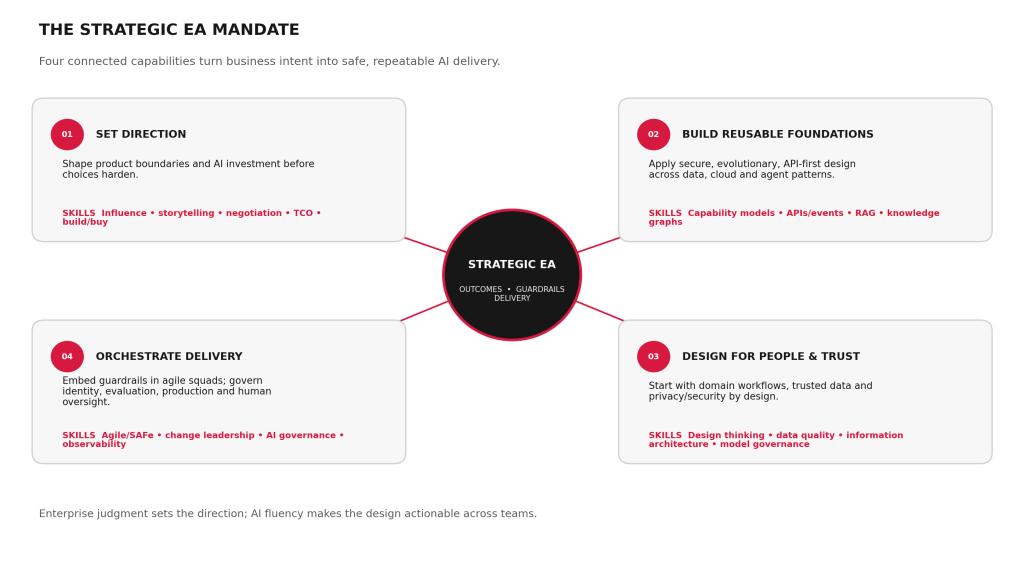
FIGURE 5 | The strategic enterprise architect transition: four focus areas, the shift from today’s practice, and the skills and methods needed to make the 2027 mandate real.
Two case studies show the path from architecture to operating value
MIT CISR’s research on enterprise AI maturity describes four challenges on the move from pilots to scaled ways of working: aligning strategy, modernizing systems, synchronizing people and teams, and embedding stewardship [9]. Its Guardian Life case illustrates how those dimensions connect. Guardian used AI to support its employee benefits request-for-proposal and quoting process, reducing proposal turnaround from five to seven days to 24 hours in the reported pilot; the company planned to move the work from pilot to scale in 2026 [9]. MIT CISR reports that Guardian first had to upgrade legacy systems, consolidate fragmented data and create a product-and-platform operating model. The case suggests process improvement came alongside foundational architecture and operating changes, rather than from model selection alone.
McKinsey describes a Latin American bank that modernized a 20-year-old corporate banking platform using a comprehensive transformation model. With a reported $600 million budget, the bank built an agent factory of more than 100 AI systems to redesign legacy code, build interfaces and optimize data structures, operating within guardrails [5]. This is a large, consulting-supported transformation and should not be treated as a typical investment level or an independent benchmark. It does illustrate a potential pattern: reusable agent components, shared controls and a coordinated modernization program can be applied to a portfolio of legacy work. The choice between incremental integration and comprehensive transformation depends on business urgency, system condition, regulatory constraints, talent and capital. Enterprise architecture helps leadership make that choice explicit and stage investments against evidence.
Efficiency is real only when the operating model can absorb it
AI can reduce repetitive work, shorten some cycle times and make information easier to access, but these gains depend on changes to processes and roles. Architects can help teams remove unnecessary handoffs, make data and APIs reusable, and identify where human judgment should remain in the loop. They can also use AI tools inside the architecture practice to summarize systems, trace dependencies and compare alternatives, creating more time for stakeholder decisions. Generated analysis must still be checked against source systems and domain owners, especially when it influences investment, security or risk decisions. A faster draft is an efficiency only if it improves the quality or timing of the decision that follows.
The architecture function should measure outcomes that match the system’s purpose and risk. A knowledge service might be assessed by task completion, answer grounding, source permissions and time to resolve a request. An agentic process might be measured by successful completion, exception rates, unauthorized actions, recovery time and cost per case. A development agent could be assessed through delivery lead time, review burden, defects and maintainability. These are candidate metrics, not promised improvements, and each use case needs a baseline and accountable owner. Evidence should determine whether the organization expands, changes or retires the capability.
Shared platforms can create efficiency when they reduce repeated security work and duplicated infrastructure while serving genuinely common needs. A central model gateway, agent registry, semantic layer, identity service, evaluation harness or audit pipeline may provide a repeatable foundation. However, shared services can become a bottleneck if teams cannot use them flexibly or if they impose excessive latency and cost. Conversely, uncontrolled local builds may multiply overlapping agents, data pipelines, vendor contracts and support obligations. Enterprise architects should track reuse as a design outcome, while allowing bounded experimentation where the business case and risks justify it.
The 2027 risks are architectural and organizational
The first risk is mistaking autonomy for value. An agent may take more actions while increasing exception handling, hidden errors or downstream rework. The second is architectural fragmentation: business units may select incompatible models, store context in disconnected systems and create agents with unclear owners. A third risk is privilege accumulation, in which credentials built for humans are reused by unattended systems with broader access than they need. These problems are difficult to solve after production because the organization may not know which agent used which data or changed which record. Design-time inventories and runtime observability reduce that uncertainty.
A fourth risk is cost volatility. Agent workloads can consume tokens, compute and external services in ways that are hard to predict from licensing assumptions or pilot activity. A fifth risk is supplier dependence, especially when model capabilities, prices, terms and data locations change rapidly. A sixth risk is governance overload, where every decision waits for a central committee and teams respond by adopting tools outside enterprise controls. The operating model must establish standard patterns for common risk levels, clear escalation paths for exceptions and practical ownership for monitoring. Architecture should make the safe route the easiest route to use.
None of these risks means organizations should halt innovation. They mean architecture must define which actions can be autonomous, which require human approval and which should remain off limits. Testing should include adversarial inputs, permission checks, failure and recovery, data freshness, model changes and downstream effects. Production readiness should include support ownership, incident response, vendor and model inventory, rollback and retirement. The system should also be able to explain what it accessed and what actions it took, to the extent needed for audit and remediation. These requirements are part of building reliable digital capabilities, not separate compliance tasks.
How enterprise architects should prepare now
Enterprise architects can prepare for 2027 by shifting from artifact production to decision enablement. They should keep business capabilities, data products, applications, APIs, models, agents, vendors and owners connected in a living enterprise view. That view helps reveal duplicated capabilities and makes impact analysis more useful when models, workflows or suppliers change. It also gives AI assistants and coding agents authoritative architecture context to work from. The human architect remains responsible for validating assumptions, resolving conflicts and helping executives understand the consequences of design options.
The strongest learning agenda combines existing EA strengths with technical depth in AI context, data semantics, model selection, retrieval, agent orchestration, identity and observability. Architects should understand enough about evaluation to set acceptance criteria and enough about security to challenge excessive permissions or unsafe integrations. They should become fluent in platform economics, including infrastructure, inference, vendor commitments, energy and lifecycle costs. Business architecture and process design remain essential because AI changes where work happens and how decisions are made. Executive communication is also critical because the architect must explain risk, value and alternatives in business terms.
Organizations should reset architecture governance around enablement and accountability. Common AI patterns need to be discoverable, supported and flexible enough for teams to adopt. Review intensity should scale with data sensitivity, degree of autonomy and consequence of failure. Central teams can own platform standards, production pathways and shared controls, while domain teams own business outcomes and local data meaning. Leaders should create feedback loops from incidents, evaluations, adoption and cost to update patterns as technology and operating context change. That is how enterprise architecture can support speed without losing coherence.
The CDO TIMES Bottom Line
The enterprise architecture requirement for 2027 is to design the conditions for safe, measurable autonomy. Gartner’s spending outlook points to a sharp increase in infrastructure, agent and software investment, while McKinsey’s research shows that many companies still struggle to move from agent experimentation to tangible scaled value, often because data foundations are weak [3,4]. Gartner, Forrester and MIT research converge on a practical agenda: AI-ready context, interoperable platforms, machine identity, secure production paths, cost transparency, human intervention and clear supplier accountability [1,2,7,8]. These needs expand enterprise architecture beyond static documentation and technology alignment. They make EA a coordinating discipline for business outcomes, platform choices, operating controls and change.
The opportunity is not simply to deploy more AI. It is to use architecture to make successful AI capabilities reusable, auditable and economically sustainable. That requires enterprise architects to connect strategy, process, data, applications, platforms and human roles in one coherent decision model. Companies will still need room for local experimentation, but they will also need common foundations and timely intervention when risk or cost rises. The best architecture makes the organization both faster to change and better able to govern what it changes. In 2027, that balance will distinguish AI activity from an AI-enabled enterprise.
Sources
[1] Forrester, “Predictions 2027: Disruption Unleashed,” October 2026. https://www.forrester.com/blogs/predictions-2027-disruption-unleashed/
[2] Gartner, “Top Strategic Technology Trends for 2027,” October 2026. https://www.gartner.com/en/articles/top-technology-trends-2027
[3] Gartner, “Gartner Forecasts AI Infrastructure Spending to Represent 59% of Total Global AI Spending in 2027,” November 12, 2026. https://www.gartner.com/en/newsroom/press-releases/2026-11-12-gartner-forecasts-artificial-intelligence-infrastructure-spending-to-represent-59-percent-of-total-global-artificial-intelligence-spending-in-2027
[4] McKinsey, “Building the Foundations for Agentic AI at Scale,” April 2, 2026. https://www.mckinsey.com/capabilities/mckinsey-technology/our-insights/building-the-foundations-for-agentic-ai-at-scale
[5] McKinsey, “Rethinking Enterprise Architecture for the Agentic Era,” March 12, 2026. https://www.mckinsey.com/capabilities/mckinsey-technology/our-insights/rethinking-enterprise-architecture-for-the-agentic-era
[6] McKinsey, “The State of AI: Global Survey 2026,” 2026. https://www.mckinsey.com/capabilities/quantumblack/our-insights/the-state-of-ai
[7] Forrester, “The AI Enterprise Architect: AI Moves Enterprise Architecture Up the Value Chain,” September 16, 2026. https://www.forrester.com/report/the-ai-enterprise-architect/RES201854
[8] MIT CISR, “Establishing Guardrails on the AI Roller Coaster,” September 2026. https://cisr.mit.edu/publication/2026_0901_AIRollerCoaster_ThorogoodReynoldsGill
[9] MIT CISR, “Grow Enterprise AI Maturity for Bottom-Line Impact,” August 2025. https://cisr.mit.edu/publication/2025_0801_EnterpriseAIMaturityUpdate_WoernerSebastianWeillKaganer


