
Teaching The Next Generation of CPAs in the Age of AI – The CPA Journal
Get Copyright Permission
Artificial intelligence (AI) is reshaping the accounting profession and redefining accounting education. As AI automates routine tasks, higher-order skills—data analysis, strategic thinking, and ethical judgment—become essential. Yet, a gap persists between the competencies new CPAs need and those taught in current accounting programs. This article explains why AI literacy is critical, outlines curriculum redesign frameworks and integration strategies, examines ethical and professional responsibilities, and highlights what educational institutions and professional firms must do to prepare CPAs to thrive as ethical, tech-savvy advisors in an AI-driven world.
***
Artificial intelligence (AI) is transforming accounting by automating data entry, reconciliations, and contract analysis while detecting anomalies in audits. Major firms have invested heavily in these technologies. For example, KPMG announced a $2 billion investment in AI and cloud services in 2023, aimed at enhancing its audit, tax, and advisory capabilities. (Robbie Bishop-Monroe and Lesia Quamina, “Strategies for CPAs to Become Artificial Intelligence (AI) Savvy,” The CPA Journal, May/June 2025, https://tinyurl.com/2z89r6v5). As automation expands, accountants now supervise AI outputs, interpret insights, and apply strategic judgment. Algorithms can detect outliers, but professional judgment remains indispensable in determining materiality (Bishop-Monroe and Quamina 2025).
Recognizing this shift, professional bodies and universities are integrating technology and AI literacy into curricula. The AICPA and NASBA’s 2024 CPA Evolution model embeds technology, digital acumen, and analytics across all exam sections (Bishop-Monroe and Quamina 2025). Similarly, IFAC underscores AI competency as foundational, preparing accountants for a future where AI augments—not replaces—professional judgment (D. Thody, “AI’s Impact on Accountancy Education: A Student’s Perspective,” IFAC Knowledge Gateway, Aug. 7, 2024, https://tinyurl.com/4883j6ju). AI literacy is now essential to professional competence; graduates lacking fluency in AI tools and concepts will struggle to add value in a data-driven profession.
A gap persists between what many employers demand and what a traditional accounting education provides. Employers seek “Industry 5.0” skills—AI, automation, and data analytics—while students focus on traditional reporting and auditing (A. Tiron-Tudor, A. Labaditis, and D. Deliu, “Future-ready Digital Skills in the AI Era: Bridging Market Demands and Student Expectations in the Accounting Profession,” Technological Forecasting and Social Change, vol.215, p.124105, 2025 https://doi.org/10.1016/j.techfore.2025.124105). As a result, graduates remain underprepared. Fewer than half of programs teach predictive analytics, cybersecurity, or digital acumen (Bishop-Monroe and Quamina 2025). Students recognize this gap, but report limited hands-on AI experience and instructor expertise (R. Gilreath, D. Hernandez, and V. Ingalls, “Student Perceptions of AI Integration in Accounting Education: Exploring the Value, Challenges, and Career Readiness,” The Transnational Journal of Business, vol.10, no.1, pp.45–62, 2025).
Expanding accounting competencies is essential. Technical proficiency—data management, programming, and AI platforms—must complement analytical abilities such as modeling and evaluation. Human skills—communication, critical thinking, adaptability, skepticism, and ethics—remain vital (W. Moran, “The Essential AI Skills and Knowledge that Business Accounting Students Should Acquire,” Journal of Management and Business Education, vol.8, no.2, pp.147–167, 2025 https://journaljmbe.com/article/view/7563). Exhibit 1 summarizes these AI-related competencies, organizing them into technical, analytical, and professional domains to guide curriculum and assessment design.
AI Competency Framework for Future CPAs

As Ballantine, Boyce, and Stoner note, generative AI offers both a “change-inducing crisis” and an opportunity to reaffirm the CPA’s ethical and technological leadership (“A Critical Review of AI in Accounting Education: Threat and Opportunity,” Critical Perspectives on Accounting, vol.99, p.102711, 2024 https://doi.org/10.1016/j.cpa.2024.102711). Embedding AI throughout accounting curricula is thus not merely about adopting new tools, but rather reaffirming the CPA’s role as both technologist and ethical decision-maker in the public interest.
Integrating AI into accounting education requires a systematic redesign aligned with a data-driven profession. The CPA Evolution Model Curriculum, launched by the AICPA and NASBA in 2021, provides a foundation for embedding technology, analytics, and AI across financial reporting, auditing, tax, and information systems. Developed through collaboration among academia, practitioners, and regulators, it is intended to align accounting education with modern CPA licensure expectations.
Exhibit 2 presents a “Curriculum Integration Map” linking courses to AI competencies, tools, and standards—such as AI-driven audit risk assessment (see SAS 142, Audit Evidence. New York, NY: AICPA, SAS 145, Understanding the Entity and Its Environment and Assessing the Risks of Material Misstatement), visualization tools in AIS, and the IESBA’s 2023 Code revisions emphasizing competence, due care, and confidentiality (IESBA, “Technology-Related Revisions to the International Code of Ethics for Professional Accountants,” 2023, https://www.ethicsboard.org/publications/final-pronouncement-technology-related-revisions-code).
Curriculum Integration Map for AI-Enabled Accounting Education
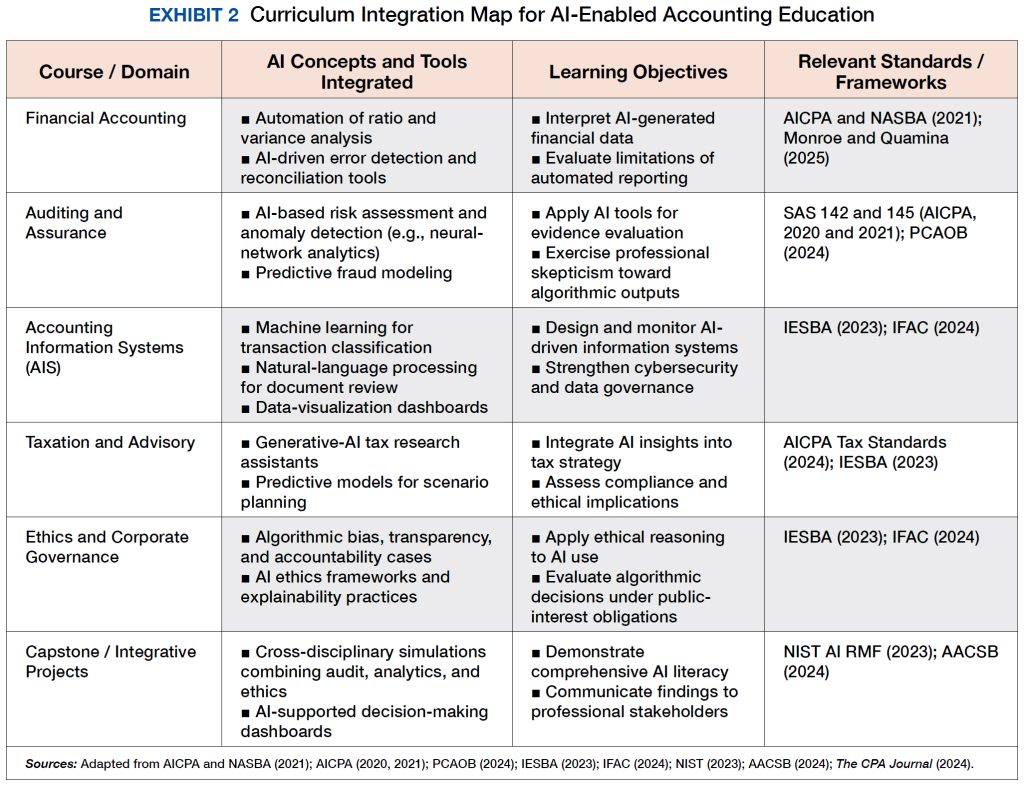
Interdisciplinary collaboration is imperative. As AI and data analytics redefine the competencies expected of professional accountants, accounting education should foster integration between business and computing disciplines to ensure graduates possess both technological proficiency and professional judgment (Thody 2024; IFAC, “Exploring the IESBA Code: A Focus on Technology,” 2022, https://tinyurl.com/42rc5v95). Curricula must undergo continuous refinement through modular updates [Center for Curriculum Redesign (CCR), Four-Dimensional Framework for Future-Ready Education, CCR Press, 2023] and periodic evaluation by advisory boards (M. Mulyadi, and Y. Anwar, “Alternatives in Accounting Education: Rethinking the CPA Pathway in the Age of AI,” The CPA Journal, July/August 2025). Exhibit 2 should function as a dynamic framework, updated regularly to incorporate emerging technologies such as generative AI, robotic process automation (RPA), and blockchain applications.
As Ballantine, Boyce, and Stoner (2024) argue, AI’s disruption offers an opportunity to “rethink the purpose of accounting education,” integrating ethical and human perspectives—bias, job displacement, and data privacy—across sustainability, governance, and ethics courses.
An effective redesign integrates three layers:
Together, these layers are intended to produce graduates who are both technologically fluent and ethically grounded, able to serve as interpreters of data and guardians of integrity in the AI age.
While frameworks like the CPA Evolution Model Curriculum provide some structure, educators and firm trainers still face challenges in promoting technological fluency while maintaining professional ethical foundations. Effective AI integration requires a holistic approach—embedding AI in core subjects, creating specialized courses, fostering partnerships, expanding micro-credentials, and empowering faculty. The following strategies—drawn from current guidance and best practices—illustrate effective AI integration. Programs adopting this model will align with CPA Evolution’s technological vision, producing graduates who combine data fluency, ethical reasoning, and professional skepticism to lead in a digital economy.
Embed AI within core accounting courses. The most effective approach is to embed content in context—integrating AI into existing courses rather than as stand-alone electives. Auditing students might use anomaly-detection tools to identify irregularities, for example, while financial accounting students might automate ratio analysis or generate disclosures. These exercises train students to interpret—not merely operate—AI systems, strengthening professional skepticism and critical thinking (Bishop-Monroe and Quamina 2025). Experiential tasks such as comparing AI-generated and manual assessments reveal how outcomes depend on data quality and assumptions (Gilreath, Hernandez, and Ingalls 2025).
Develop courses on AI, analytics, and ethics. Dedicated courses can cover AI fundamentals—machine learning, NLP, neural networks—alongside audit analytics and governance frameworks (Thody 2024). For example, the AI and Ethics course at UMass Amherst’s Isenberg School of Management merges technical learning with case studies on bias, privacy, and automation, reflecting Ballantine et al.’s (2024) call for “critical engagement with technology.” Case-based projects, such as evaluating AI-generated audit reports for compliance under the IESBA Code (2023), show that technical skill and ethical reasoning are interdependent.
Leverage partnerships and micro-credentials. When universities collaborate with CPA firms, technology vendors, and associations, they can help ensure the curriculum remains relevant. Professional bodies such as AICPA, IFAC, and IMA support programs through certifications and training resources. Exhibit 3 presents a Pedagogical Toolkit of AI-enabled classroom activities, from chatbot tutors to analytics simulations. Short, modular micro-credentials and intensive bootcamps in analytics or AI auditing can expand professionals’ access to technology and reinforce continuous learning (Moran 2025).
Pedagogical Toolkit—AI-Enabled Activities for Accounting Education

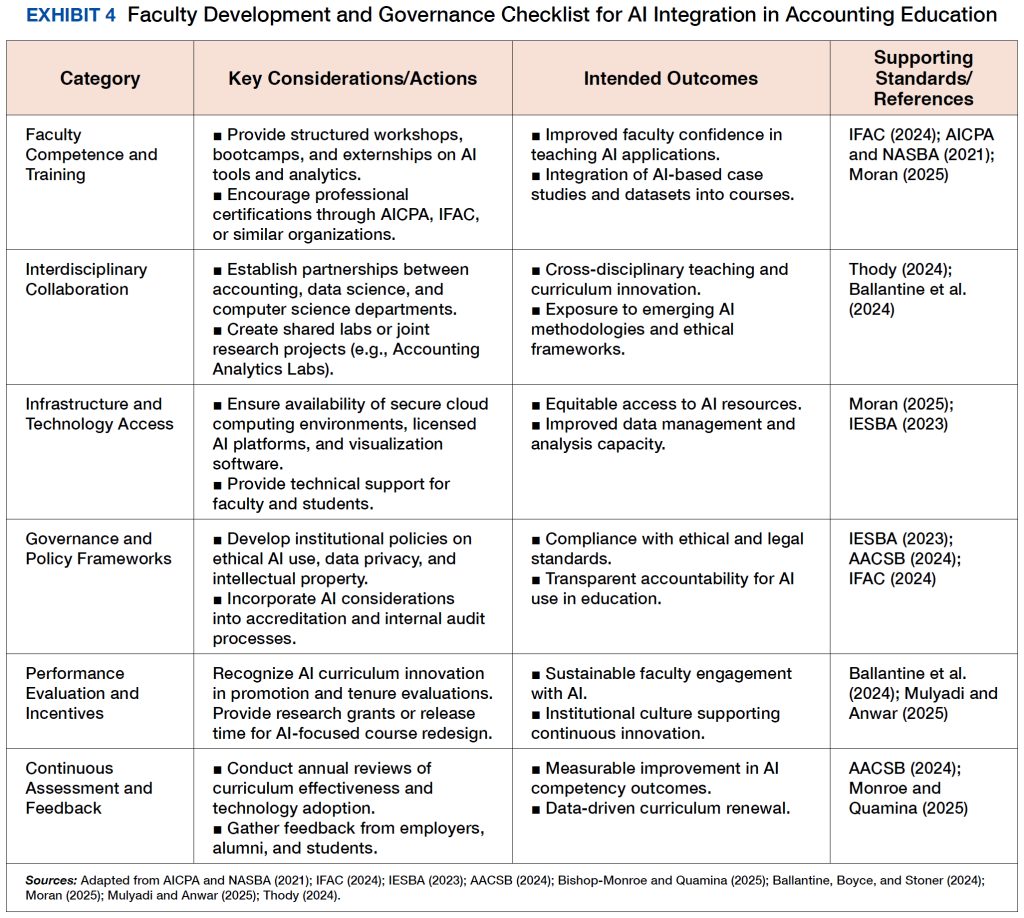
Upskill and empower faculty. Successful reform relies upon faculty proficiency, yet many educators lack AI experience (Gilreath, Hernandez, and Ingalls 2025). Universities can invest in workshops, cross-disciplinary partnerships, and industry collaborations to build such experience. Integrating small AI components—such as automated grading or generative tools—builds confidence (Bishop-Monroe and Quamina 2025). Collaboration with computer science departments enhances rigor (Thody 2024). Exhibit 4 provides a Faculty Development and Governance Checklist to assess institutional readiness and support.
Faculty Development and Governance Checklist for AI Integration in Accounting Education
Integrating AI into accounting education requires consideration of CPAs’ ethical obligations. As AI becomes integral to accounting—from automated journal entries to predictive forecasting—the profession must ensure its use upholds integrity, objectivity, and due care (IESBA 2023). Accounting education should prepare CPAs to use AI effectively while exercising moral judgment when such tools influence decisions (Ballantine, Boyce, and Stoner 2024).
AI introduces complex ethical challenges. Systems may embed bias, distort outcomes, or obscure reasoning through “black-box” models (Thody 2024). Algorithms trained on historical fraud data can perpetuate misclassifications or bias. In the name of professional skepticism, CPAs should ask critical questions like: What data trained this model? Who validated its fairness? Can its results be verified?
Bias, transparency, and data integrity remain critical. Ballantine et al. (2024) urge educators to teach students to “challenge data provenance and algorithmic assumptions.” In valuation or tax compliance, small data flaws can lead to legal exposure. Scenario-based exercises help students test AI outputs, detect bias, and propose corrective actions—building analytical rigor and ethical awareness.
Confidentiality and accountability are equally vital. CPAs handle sensitive data, and cloud-based AI tools heighten privacy risks. The IESBA’s 2023 Code revisions require safeguarding data and maintaining competence and due care (IESBA 2023). Responsibility for AI outputs always rests with the professional, not the system (Bishop-Monroe and Quamina 2025). Exhibit 5 introduces an Ethical Decision Matrix to evaluate AI use cases—such as automated audit testing—by weighing stakeholder impact, bias, and confidentiality.
Ethical Decision Matrix for AI Use in Accounting Education and Practice

Professional skepticism must remain foundational. As the PCAOB (2024) notes, “technology does not relax evidentiary burdens” (“Spotlight: Inspection Observations Related to Auditor Use of Information Produced by the Company and External Sources,” https://tinyurl.com/2wemzv4p). Comparing AI-generated and human-prepared results under SAS 142 and 145 reinforces the need for corroboration and sound judgment when using AI.
In the AI era, classroom innovations are nothing without the institutional ecosystem that supports faculty, curriculum, and students. Effective integration requires institutional readiness—adequate resources, governance, and faculty development (Mulyadi and Anwar 2025). Exhibit 4 provides a Faculty Development and Governance Checklist to evaluate infrastructure, policy, and human capital for AI integration.
Faculty competence and professional development. Faculty expertise is central to curriculum reform, yet many accounting educators lack proficiency in AI, analytics, and programming (Gilreath, Hernandez, and Ingalls 2025). Instructors acknowledge AI’s importance but often lack pedagogical support and resources (Thody 2024). A three-pronged strategy can address this gap:
Infrastructure and technological resources. Institutional readiness depends upon robust technological infrastructure. AI-enabled instruction requires computing power, licensed software, and secure datasets—resources many programs lack (Moran 2025). Universities should fund these technologies and ensure equitable student access through labs or virtual systems.
Cybersecurity and data governance are equally essential. As cloud-based AI tools expand, institutions should adopt policies aligned with IT and ethical standards (IESBA 2023) and provide training on responsible data handling. Exhibit 4’s checklist supports auditing capabilities across infrastructure, policy frameworks, support systems, and feedback mechanisms to ensure continuous improvement.
Administrative leadership and change management. Effective leadership commitment is essential for curriculum reform. Deans and chairs should define a vision for technological innovation and streamline course approvals (AICPA and NASBA 2021). Establishing AI task forces or curriculum committees—comprising faculty, administrators, and practitioners—can help coordinate training and drive sustained progress (Mulyadi and Anwar 2025). Collaboration with CPA firms, professional bodies, and technology companies provides expertise, data, and funding, enhancing curricula and creating internship pathways for applied AI experience (Bishop-Monroe and Quamina 2025).
Continuous evaluation and quality assurance. Effective implementation requires continuous evaluation. Programs should track the following metrics:
Regular reviews should apply these indicators to assess program success. Accrediting bodies like AACSB and NASBA now emphasize data-based evaluation of technology integration (AACSB, “Accounting Accreditation Standards: Emphasis on Technology Integration and Curriculum Innovation,” 2024, https://www.aacsb.edu/insights/reports/2024/2024-state-of-accreditation-report). Embedding feedback loops allows institutions to adapt quickly to evolving standards, AI audit frameworks, and generative tools.
Extending institutional readiness to practice. Institutional readiness should also extend to CPA firms and continuing education. As AI reshapes client services, CPA firms should invest in training, governance, and internal controls for AI implementation (AICPA 2020; PCAOB 2024). Proprietary AI systems can only succeed when professionals can interpret and validate the outputs of those. University-firm partnerships—through joint certificates or research programs—can prepare students while upskilling practitioners. Ultimately, institutional readiness reflects the organizational counterpart to individual competence—integrating technology responsibly and aligning innovation with ethical standards.
As AI transforms professional services, accounting education stands at an inflection point. The next decade will determine whether CPAs remain passive technology users or become stewards of algorithmic integrity—professionals capable of governing, validating, and auditing intelligent systems (Ballantine, Boyce, and Stoner 2024). The classroom should be a kind of ethical AI laboratory, where students explore emerging tools under professional and ethical guidance.
This model rests on three imperatives:
Positioning classrooms as ethical AI labs aligns with the AICPA’s 2024 Technology Task Force, the NIST AI Risk Management Framework (https://www.nist.gov/itl/ai-risk-management-framework), and IFAC/IEBSA’s Code (2022) (https://www.ifac.org/knowledge-gateway/ethics/publications/exploring-iesba-code-focus-technology)on AI ethics, which emphasize documentation, transparency, and human oversight. This approach reaffirms accounting as a values-driven discipline, cultivating professionals who embody integrity, objectivity, and due care—principles no algorithm can automate.
AI represents both the greatest disruption and opportunity for the accounting profession since the dawn of the computer age. Whether it enhances or undermines public trust depends on how effectively educators and practitioners integrate technological competence with ethical responsibility. The CPA’s evolving role in this era of human–machine collaboration demands new judgment skills—interpreting data while critically evaluating the algorithms that generate it.
If universities and CPA firms invest in faculty development, infrastructure, and ethics, future CPAs will emerge as trusted algorithmic auditors and strategic advisors, ensuring that AI strengthens rather than diminishes professional skepticism and public confidence. The CPA’s enduring value lies not in data processing, but in interpreting information wisely and ethically for the benefit of business and society.
The CPA Journal is a publication of the New York State Society of CPAs, and is internationally recognized as an outstanding, technical-refereed publication for accounting practitioners, educators, and other financial professionals all over the globe. Edited by CPAs for CPAs, it aims to provide accounting and other financial professionals with the information and analysis they need to succeed in today’s business environment.
The CPA Journal
200 Madison Avenue, 11th Floor
New York, NY 10016
CPAJ-Editors@nysscpa.org
View the NYSSCPA privacy policy
Thomson Reuters Checkpoint
SmartBrief
source
This article was autogenerated from a news feed from CDO TIMES selected high quality news and research sources. There was no editorial review conducted beyond that by CDO TIMES staff. Need help with any of the topics in our articles? Schedule your free CDO TIMES Tech Navigator call today to stay ahead of the curve and gain insider advantages to propel your business!


