
New Penn center aims to tackle AI-backed cybersecurity threats – The Daily Pennsylvanian
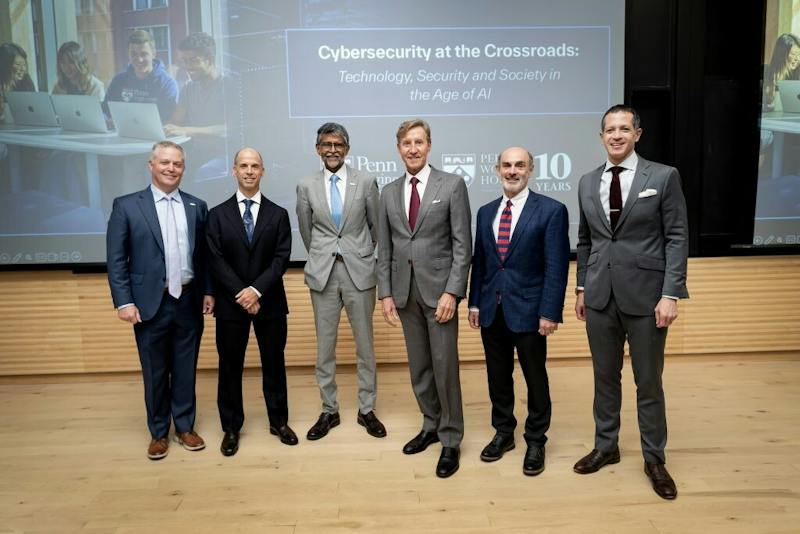
Penn launched the Schlein Center for Cybersecurity on Oct. 21, bringing together researchers and former national security leaders to discuss how artificial intelligence is intensifying internet threats.
The institution was established through a $5 million pledge from Penn trustee and 1986 College graduate Ted Schlein. Located on the sixth floor of Amy Gutmann Hall, it aims to develop computer systems that are secure from the outset, rather than relying on identifying and patching vulnerabilities after they emerge.
In an interview, Schlein said that the center could serve as “a great convening mechanism” for discussions involving cybersecurity policy. He added that much of the field’s future will depend on the policies individual governments choose to adopt or leave absent.
Schlein is also a cybersecurity investor and the founder of Ballistic Ventures.
During the opening, he explained that “innovation alone is not going to solve our problems,” and called for government policies, trustworthy communication systems, and the adoption of hospitals and medical devices resistant to attacks.
Get the DP delivered straight to your inbox.
The event began with a welcome from multiple University leaders.
School of Engineering and Applied Science Dean Vijay Kumar expressed hope that center will become “the connective tissue, bringing together people and ideas across campus.”
The institution will bring together researchers across multiple disciplines — including engineering, business, medicine, and law.
RELATED:
New Penn AI platform allows patients to communicate directly with their medical devices
Why Cybersecurity is Shifting from Detection to Prevention
“Our goal is not simply to identify vulnerabilities,” he added. “It’s about thinking about architecture design and making sure that these vulnerabilities are harder to introduce in the first place.”
Penn President Larry Jameson compared the center’s approach to preventive medicine in his introductory remarks.
“As a doctor, our preferred approach is to screen, and that’s the way we want to prevent these events from happening,” he said, contrasting early prevention with treating patients in an emergency room after other measures fail.
Center for Cybersecurity Director Michael Hicks, a Computer and Information Science professor, explained that the new institution brings together researchers who are able to pursue longer-term solutions outside the commercial pressures faced by private companies.
“We’re not constrained by profit motive,” he added in an interview, explaining that academic researchers can explore fundamental changes to computer systems that companies may be reluctant to adopt.
Hicks pointed to memory safety — which protects software from certain kinds of programming errors — as an example of a problem researchers have understood for decades without the widespread adoption of available solutions.
“There are things that we have known how to do for a long time, and we are not doing,” he added.
The center’s research goals include using AI to help translate existing software into safer programming languages and developing quantum-resistant cryptography for electronic voting systems.
According to Hicks, mathematical proofs can establish that systems prevent entire categories of vulnerabilities rather than requiring developers to address each new attack individually.
“Our mission is security by design, not patch after the fact,” Hicks explained in an interview, adding that “you’re just going to lose the patch battle with AI.”
Beyond engineering, Hicks is in conversation with University of Pennsylvania Carey Law School researchers about cyber insurance to determine how financial incentives could encourage companies to adopt safer systems. He also cited prospective collaborations with Perry World House and Penn Medicine.
During a moderated discussion, Schlein proposed a federal cybersecurity “hygiene standard” that would establish minimum security requirements for companies while offering certain legal protections to those meeting them.
A central theme of the event was the looming threat posed by AI.
During her keynote address, Jen Easterly — the former director of the Cybersecurity and Infrastructure Security Agency — warned that “perhaps the most dangerous failure is the failure to imagine” how technology can be ill-prepared.
“The AI that can protect can also attack,” she added, arguing that AI must be developed and deployed with security as a priority.
In an interview, Easterly noted that secure-by-design principles have been “a core mission” of hers for many years.
She highlighted that the center could help the field transition “from vulnerability hunting to secure construction,” and “from patching to priorities.”
Easterly also cautioned students against excessive reliance on AI, warning of “cognitive surrender” as they delegate the work that helps develop their judgment and critical thinking.
Retired Air Force General Timothy Haugh, who is also the former director of the National Security Agency and commander of United States Cyber Command, joined the center as a senior fellow this fall.
In an interview, he said that the outdated systems retained by governments and corporations — a problem known as technical debt — are becoming increasingly vulnerable as AI accelerates cyberattacks. He argued that research into secure-by-design systems could help institutions move beyond continually patching aging technology.
“For many universities, the challenge is not doing incredible research. It’s how that research becomes impactful,” Haugh said, adding that his connections to the federal government could help Penn researchers put their work into practice.
He also distinguished between the technical security of American elections — in which he expressed strong confidence — and declining public trust in the electoral process. He suggested that collaboration between cybersecurity researchers and Annenberg School for Communication experts could help address that divide.
The center has launched a master’s program in software systems and cybersecurity and a seminar series. Haugh plans to teach a spring 2027 course examining the relationship between technology and government.
RELATED:
New Penn AI platform allows patients to communicate directly with their medical devices
Why Cybersecurity is Shifting from Detection to Prevention
The Daily Pennsylvanian is an independent, student-run newspaper. Please consider making a donation to support the coverage that shapes the University. Your generosity ensures a future of strong journalism at Penn.
source
This is a newsfeed from leading technology publications. No additional editorial review has been performed before posting.


