Ministry of ICT Launches the Uganda National Data Strategy – PC Tech Magazine
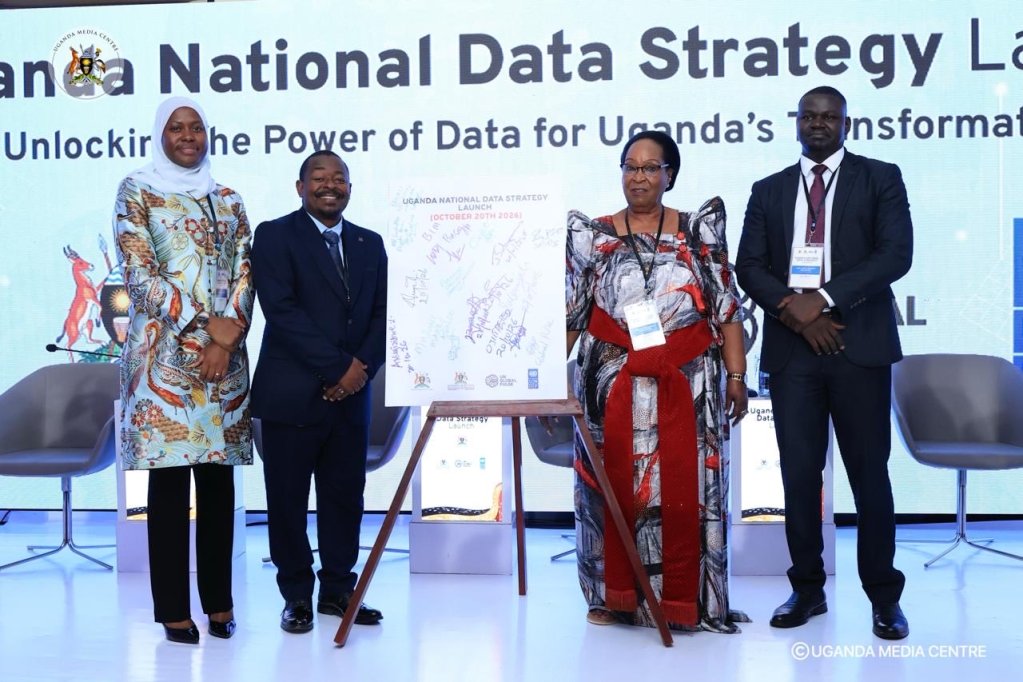
The Ministry of ICT and National Guidance, in partnership with UNDP Uganda and UN Global Pulse Uganda, launched the National Data Strategy yesterday at Mestil Hotel in Kampala. The event drew government officials, the private sector, academia, and development partners.
The strategy was officially launched by the State Minister of ICT, Hon. Joyce Nabbosa Ssebugwawo, who said it was more than a policy paper. “We are not simply launching a document. We are setting a shared direction for how Uganda can better manage, protect, share and use data to drive national development,” she said.
Hon. Ssebugwawo described data as a strategic national asset and gave practical examples of its value. Reliable data, she explained, can help local governments identify gaps in access to health facilities, schools and clean water, while businesses can use it to understand markets, improve productivity and develop new products and services.
The National Data Strategy, the State Minister said, provides a framework for harnessing these opportunities in line with Uganda Vision 2040, the Digital Uganda Vision and our national development priorities.
The strategy is anchored on three pillars: data governance, data infrastructure and strategic data utilization, supported by two enablers, People & Culture, and Research, Innovation & Entrepreneurship.
Equally important are the people, skills and innovative ideas needed to build a strong data-driven economy. She also pointed to the need for inclusion, saying, “We must promote data literacy, strengthen research and encourage entrepreneurship while ensuring that women, young people, persons with disabilities (PwDs) and other marginalised communities are not left behind.”
The Permanent Secretary of the Ministry of ICT and National Guidance, Dr. Aminah Zawedde, said the launch of the Uganda National Data Strategy marks a decisive milestone where Uganda shifts from treating data as a passive administrative byproduct to wielding it as a strategic national economic asset.
She said the strategy, which covers the period 2026/27 to 2030/31, was shaped by a consultative process that began in 2022. It drew on inputs from public institutions, the private sector, civil society and academia, and was formally validated by 131 state and non-state organizations. She thanked UN Global Pulse for technical expertise and futures foresight modelling, UNDP as the scaling partner, and the William and Flora Hewlett Foundation for financial backing.
She tied the strategy directly to the country’s economic ambitions under the Fourth National Development Plan (NDP IV), which targets growing GDP from US$50 billion to US$500 billion over 15 years. “Data is the lifeblood and fuel of this transformation. Without data, our tenfold growth aspirations remain aspirational; with coordinated data, they become operational realities,” she said. She explained how data will support the four priority growth sectors: agro-industrialization, tourism, minerals, oil and gas, and science, technology and innovation.
The scale of Uganda’s digital footprint, she noted, makes the case for the strategy. The 2024 National Population and Housing Census confirmed a population of 45.9 million. Figures from the Uganda Communications Commission (UCC) for the quarter ending December 2025 show 47.1 million mobile subscriptions, 18.5 million active mobile internet subscriptions and 36.3 million mobile money accounts. Yet much of this information, she said, has remained locked in institutional silos and fragmented systems, a problem the strategy is designed to address.
The strategy sets measurable targets for 2030/31. Government platforms integrated through the UG Hub are to rise from 135 to 300, while the share of NDP IV indicators backed by verifiable data is to grow from 36% to 80%. Other targets include a 20% direct cost saving through shared resources and infrastructure across ministries, departments and agencies (MDAs), a 40% saving on previously imported systems, and a 40% reduction in man-hours spent processing government services. On innovation, the strategy aims for 80% more data-driven startups, 600 intellectual property rights for data innovations, and a 10% increase in external investment attracted by Ugandan digital enterprises.
Implementing the strategy will cost UGX 1,662.6 billion over five years. Data infrastructure takes the largest share at UGX 684.9 billion, followed by data governance at UGX 553.3 billion, research, innovation and entrepreneurship at UGX 319 billion, strategic data utilization at UGX 71.4 billion, and people & culture at UGX 34 billion.
The government will finance UGX 1,220 billion through prioritization in MDA budgets. A further UGX 333.6 billion is expected as non-tax revenue from commercializing value-added data services, with UGX 55 billion from development partners and UGX 54 billion from private sector co-investment.
Delivery will be overseen by a National Data Steering Committee chaired by the Ministry of Finance, Planning and Economic Development and co-chaired by the Office of the Prime Minister. A National Data Office, housed at the Ministry of ICT and National Guidance and headed by a Chief Data Officer at Commissioner rank, will handle day-to-day implementation. On privacy, the Permanent Secretary said the Personal Data Protection Office (PDPO) will enforce the Data Protection and Privacy Act rigorously.
“Responsible data use is non-negotiable. Citizens must know their personal data is protected, secure, and used solely for their welfare,” she said.
Looking ahead to the era of artificial intelligence (AI), Dr. Zawedde described the Uganda National Data Strategy as the bedrock for the upcoming National AI Strategy, saying, “Artificial Intelligence is only as intelligent and ethical as the data that feeds it. By establishing robust data governance today, we are officially laying the groundwork and giving the green light for Uganda’s rapidly approaching AI-driven future”
Hon. Ssebugwawo, on the other hand, said Uganda must be ready to harness emerging technologies such as AI and big data analytics responsibly, with the goal of “an economy where reliable data informs decisions, secure systems enable collaboration, and innovation creates better opportunities and improved livelihoods for our people.”
Hon. Ssebugwawo was candid about the obstacles ahead, naming fragmented data systems, inconsistent standards, limited data sharing and inadequate infrastructure. She urged ministries, local governments, the private sector, academia, civil society and development partners to take ownership of the strategy, and said the Ministry would continue to provide leadership and coordination and monitor progress.
“Let us move from planning to action and work together to build a coordinated, inclusive and vibrant data-driven economy that supports Uganda’s socio-economic transformation,” she said.
Meanwhile, Dr. Zawedde said success would be judged by what ordinary Ugandans experience rather than by what is stored or published. “Our ultimate success will not be measured by the terabytes stored or documents published, but by the tangible transformations experienced by ordinary citizens,” she said, pointing to fewer duplicate queues, a lower cost of doing business, faster healthcare and education responses, transparent governance and real jobs for young people.
source
This is a newsfeed from leading technology publications. No additional editorial review has been performed before posting.