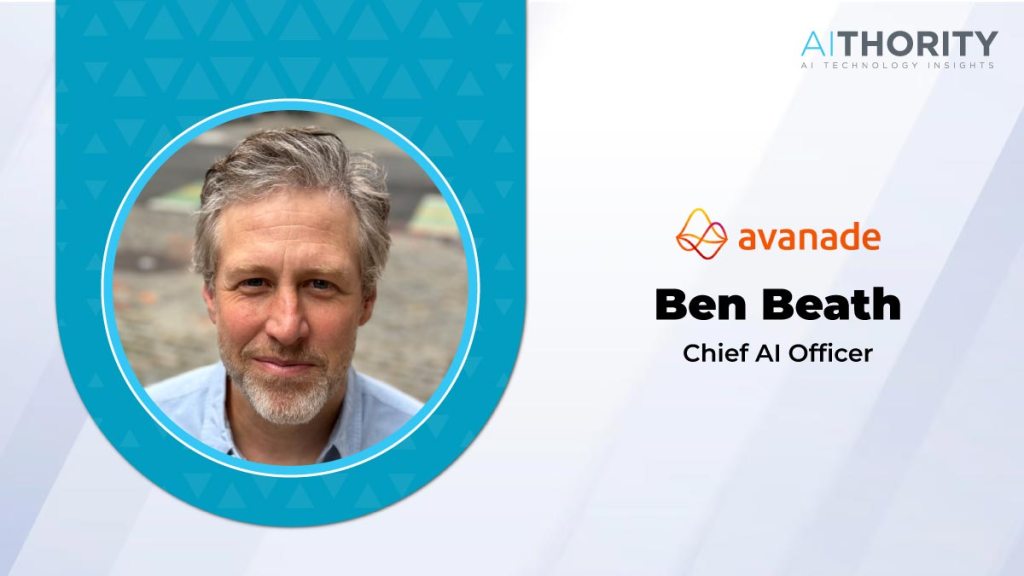
AiThority Interview with Ben Beath, Chief AI Officer, Avanade – AiThority
 AiThority – Artificial Intelligence | News | Insights | AiThority
My first priority is our clients. I want to keep working closely with their leaders as they build their AI roadmaps, so they feel genuinely confident they’re meeting this moment rather than reacting to it.
The second is our own transformation. Avanade has a unique role as Microsoft’s Client Zero partner: we test and deploy Microsoft AI in our own business before we ask any client to do the same. I want to accelerate that, because our credibility with clients comes from having already made the journey ourselves.
The third is our people. AI is resetting the benchmarks for what engineers and consultants can achieve, and I want to make sure every person at Avanade has the tools, the tokens and the training to meet those new benchmarks and turn them into meaningful outcomes for clients. I also want us to have some fun doing it. AI is disruptive, but it can be incredibly empowering, and this is a genuinely exciting time to be in our industry.
Also Read: AiThority Interview with Michael Kwok, Vice President, IBM Bob, and Canada Lab Director
We’re not in the business of building proprietary models. We’re in the business of capturing the value that frontier models create and turning it into outcomes for our clients and our own business.
Where I do see us being early adopters is local models. As models increasingly run on hardware an organization owns, there will be work companies want to do with AI that they won’t necessarily want to send through a frontier model, whether for reasons of cost, latency, sensitivity or control. I think that shift will be a real scale moment for AI. We want Avanade positioned early to understand it, use it ourselves and enable our people to use it, so we’re ready to help clients when they get there. That’s where a lot of our thinking about the next wave of innovation is focused.
We’re keeping it simple, with two measures.
The first is growth: is AI driving it? AI is unlocking an entirely new economy built around agentic workflows, and it’s requiring our clients to rethink how their data and digital core plug into that agentic future. We have very big ambitions to be the partner that helps them do that, and we’ll measure ourselves on it.
The second is internal ROI: can we capture and measure the return on our own AI spend, investment and training? That means looking beyond productivity. The real question is which processes in our own business we’ve been able to reinvent with AI, and how much that reinvention moves the bottom line. That’s the difference between doing the same work slightly faster and genuinely changing how the work gets done, and I think it’s the right lens for AI at this moment.
My observation is that AI in its modern form has been quite a lonely activity. Not by design, but for most people the AI experience is one person and a chatbot.
I believe in the power of teams. Teams of people are an incredible force for creativity, problem solving and getting things done, and we want to infuse AI into those teams rather than replace them. So for me, the collaboration question is bigger than humans working with AI. There’s a real gap in what I’d call multiplayer AI: how can a team of people, all using AI together, achieve more than individuals with AI or teams without it? That’s the gap we’re going after.
ECI Software Solutions Names Ron Books Chief Executive Officer
Klipboard Accelerates Agentic AI Across Its Business Software
Fulcra Launches Agent Skill to Build Apps People and Agents Can Use Together
On anxiety, I think much of it is an understandable response to bold headlines and predictions, and to not yet having enough hands-on experience with the tools. So we’re giving our people access and permission to play with AI, to understand both its power and its limitations, and to form their own perspective. Speaking personally, the more I use AI, the more optimistic I am about its place in the world, and the more tempered my expectations are about how close we are to anything like the singularity with today’s models.
We’re a long way from AI having judgment, taste and instinct the way people do, and further still from it forming the human connections that drive real businesses and the physical world. Those remain human strengths.
What’s especially valuable right now is people who combine real craft knowledge of AI, meaning how it works, what it can do and where its potential lies, with the ability to translate that for clients and find the right opportunity to go after. We’re not looking for people who can fire off AI-generated slop. We’re looking for people who can orchestrate multi-threaded AI, who understand that it can be deployed for everything from long-running research to quick-response chat to adversarial testing to synthesis at a scale that would take people weeks, and who can use those modes together in service of a clear goal.
What stands out in our business is that some people are switching on to this very quickly. Ultimately it’s the outcome that matters. Being able to say “this is what I think we can deliver,” and then trusting that you can orchestrate AI with your colleagues to get it done, is one of the most valuable skills anyone can build right now.
Governance is the foundation: the guardrails everything else sits on. I don’t think you’re doing meaningful work with AI unless it’s happening within clearly defined guardrails, and constraints are genuinely useful.
We’re in a funny era where anyone can vibe code almost anything. But to build something truly useful, something that connects different parts of a business, or different businesses, or people to their customers, you need data and you need identity, and you have to connect those dots securely. That’s where real value lives, and it’s impossible without governance.
Bias mitigation is part of the judgment we’re building in our people. Once you understand how these models come to exist, you start to see their biases, both in the data they’re trained on and in how they’re tuned. You only have to notice how often a word like “load-bearing” turns up in AI-generated writing to see that these models arrive with a point of view, often with far more confidence than is warranted. Our job as humans isn’t to inherit that perspective. It’s to recognize it as one perspective and apply our own judgment.
We have a real advantage here: tens of thousands of curious, technical people. Whenever something new enters the market, someone at Avanade picks it up, usually not because they’ve been told to but because they’re genuinely interested, puts it through its paces and reports back. That gives us a constant, grassroots stream of real-world signal.
Curiosity alone isn’t a filter, though, so we put new technology through three tests. First, does it hold up on real work? Through Microsoft Client Zero, we use it in our own business before recommending it to anyone. Second, does it survive contact with the enterprise? Plenty of things look brilliant in a demo and fall apart once they meet real data, identity, security and governance requirements. Third, does it change the economics of an outcome, or just the experience of a task? Transformative technology changes what’s possible for a business. Hype usually just makes something familiar look new.
The simplest way I’d put it: hype is usually a demo, transformation is usually a workflow. When we see people redesigning how work actually gets done around a technology, that’s the signal it’s here to stay.
As we head toward 2027, I think the key question for every organization is: what do only you know, and how do you enable AI to work with it? Your proprietary knowledge, processes and relationships are what AI can’t get anywhere else, and that’s where lasting advantage will come from.
Also Read: Why Coordination, Not Code, Is the Real Constraint on Shipping Software Today
[To share your insights with us, please write to psen@itechseries.com]
Avanade is the world’s leading Microsoft expert, helping more than 7,000 organizations modernize securely and scale AI using Microsoft technology, faster. Founded by Microsoft and Accenture, and operating as Microsoft’s Client Zero, Avanade brings deep expertise and proven delivery to simplify complexity, accelerate innovation, and deliver measurable results.
Ben Beath is Chief AI Officer at Avanade, where he leads the company’s AI strategy and helps organizations embed AI into how they operate, make decisions and serve customers. He also leads Avanade’s own AI transformation, developing AI fluency and capability across its teams and service delivery.
Paroma Sen is a contributing Editorial Director for AiThority.com
Prev Post
Ensono Appoints Ayush Mittal as Senior Vice President and Managing Director, India
Next Post
Cloudflare’s AI Workspace Platform Partners with Leading Applications and Deployment Teams to Make AI Productive in the Enterprise
ECI Software Solutions Names Ron Books Chief Executive Officer
Klipboard Accelerates Agentic AI Across Its Business Software
Fulcra Launches Agent Skill to Build Apps People and Agents Can Use Together
Vultr Advances Agentic AI Infrastructure for the Enterprise with New Platform…
Comments are closed.
AiThority.com covers AI technology news, editorial insights and digital marketing trends from around the globe. Updates on modern marketing tech adoption, AI interviews, tech articles and events.
Copyright © 2026 AiThority. All Rights Reserved. Privacy Policy
source
This is a newsfeed from leading technology publications. No additional editorial review has been performed before posting.