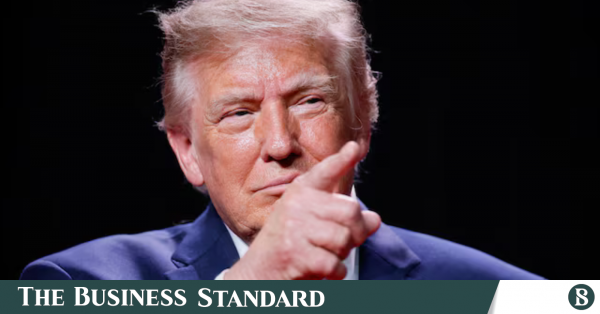
Trump calls users of term 'Artificial Intelligence' 'THE ENEMY!' – The Business Standard
Friday
October 09, 2026
US President Donald Trump has warned that people who continue to use the term “Artificial Intelligence” instead of his preferred phrase “Super Intelligence” will be considered enemies, escalating his campaign to replace the widely used terminology for the technology.
According to The Independent, Trump made the declaration in a Truth Social post on Thursday, saying the White House “considers anyone that uses the term, ‘Artificial Intelligence,’ as opposed to the highly accepted new and more accurate term, ‘Super Intelligence,’ THE ENEMY!”
The remarks follow an executive order he signed just over a week ago directing executive branch agencies to use “super intelligence” instead of “artificial intelligence” in government communications.
The order came after Trump met technology industry leaders, including Elon Musk, Sundar Pichai and Dario Amodei, at a White House lunch.
Trump had also promoted the terminology during his address to the United Nations General Assembly, where he rejected international efforts to regulate artificial intelligence and said the technology would be “hereinafter officially called super intelligence” because “use of the word artificial makes intelligence fake.”
“It makes it sound fake, and it is not fake. It’s actually amazing,” Trump said.
A week earlier, he had launched a poll on Truth Social asking users to choose between “Super Intelligence,” “Superior Intelligence,” and “Extreme Intelligence.”
Public concerns over AI
Trump’s push to popularise the new term comes as public opinion polls indicate widespread concern about artificial intelligence and its growing infrastructure in the United States.
A Quinnipiac University survey of 1,032 registered voters conducted late last month found that 73% opposed building an AI data centre in their community, including 55% of Republicans. The survey also found that 79% believed safety should take priority over keeping the United States at the forefront of AI development.
Only 25% approved of Trump’s handling of the technology, while 58% disapproved. Meanwhile, 71% said they would be more likely to support a political candidate who backed “stricter guardrails” on AI. That included 52% of Republicans and nearly three-quarters of independent voters.
A separate Fox News poll of 1,211 registered voters conducted earlier in September found that 37% viewed AI favourably, compared with 60% who viewed it unfavourably. The technology’s net favourability rating had deteriorated to minus 23, from minus 11 in April and minus 9 in July.
The same survey found that voters trusted Democrats over Republicans to handle AI data centres by 14 percentage points. Among voters opposed to such facilities in any location, Democrats led the generic ballot by at least 19 points.
A broader campaign to rename things
Trump’s latest demand follows other efforts to impose his preferred terminology on government communications and geographical names.
Just over a month ago, he issued an executive order directing the executive branch to rename Lake Ontario “Lake America”. The move came amid tensions with Canada over trade and followed his earlier attempt to rename the Gulf of Mexico the “Gulf of America”.
While the president can direct how the US government refers to geographical features and landmarks, he cannot compel Canada or individual citizens to adopt his preferred names.
The same limitation applies to “super intelligence”: Trump can instruct federal agencies to use the phrase, but he cannot force Americans or people elsewhere to abandon the established term “artificial intelligence”.
The Independent contacted NVIDIA, Palantir, Meta, OpenAI, Google, Tesla and Anthropic to ask whether they planned to adopt the terminology in promotional materials or customer communications. None responded, according to the report.
The White House, however, has highlighted several technology executives who have used the phrase, including Elon Musk and NVIDIA chief executive Jensen Huang.
What does ‘super intelligence’ mean?
The proposed terminology also carries a distinct technical meaning. Superintelligence generally refers to an AI system capable of surpassing human intellectual abilities across multiple fields, including reasoning, social skills and scientific research.
The concept is often discussed in debates over advanced AI systems, including concerns about their potential risks and the need for safeguards and emergency shutdown mechanisms.
Replacing the term “artificial intelligence” with “super intelligence” in government communications does not, by itself, change the technology’s capabilities or its established technical meaning.
Artificial Intelligence (AI) / Donald Trump
While most comments will be posted if they are on-topic and not abusive, moderation decisions are subjective. Published comments are readers’ own views and The Business Standard does not endorse any of the readers’ comments.
The Business Standard
Main Office -4/A, Eskaton Garden, Dhaka- 1000
Phone: +8801847 416158 – 59
Send Opinion articles to – [email protected]
For advertisement- [email protected]
source
This is a newsfeed from leading technology publications. No additional editorial review has been performed before posting.