Classifying AI Systems – CSET | Center for Security and Emerging Technology
CSET’s Jacob Feldgoise shared his expert insight in an article published by The Wall Street Journal. The article explores the U.S. government’s increasingly active role in supporting domestic semiconductor manufacturing and examines Intel’s efforts to reestablish itself as a leading American chipmaker amid growing competition.
Catherine Aiken
and Brian Dunn
This Classifying AI Systems Interactive presents several AI system classification frameworks developed to distill AI systems into concise, comparable and policy-relevant dimensions. It provides key takeaways and framework-specific results from CSET’s analysis of more than 1,800 system classifications done by survey respondents using the frameworks. You can explore the frameworks and example AI systems used in the survey, and even take the survey.
Policymakers and the public are concerned about the rapid adoption and deployment of AI systems. To address these concerns, governments are taking a range of actions, from formulating AI ethics principles to compiling AI inventories and mandating AI risk assessments. But efforts to ensure AI systems are safely developed and deployed require a standardized approach to classifying the varied types of AI systems.
This need motivated CSET, in collaboration with partners at OECD and DHS, to explore the potential of frameworks to enable human classification of AI systems. Building the frameworks involved the following two-step process:
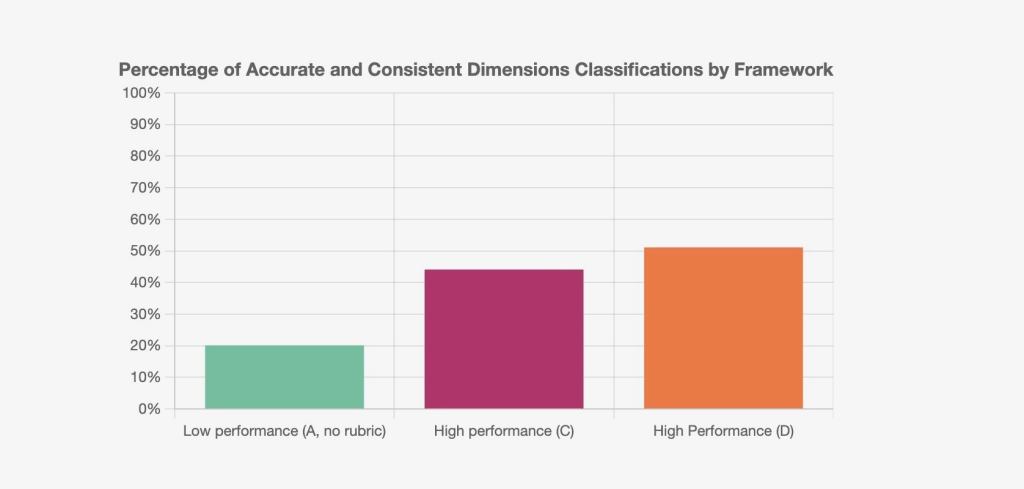
To test the usability of four resulting frameworks, CSET fielded two rounds of a survey experiment where more than 360 respondents completed more than 1,800 unique AI system classifications using the frameworks. We compared user classification consistency and accuracy across frameworks to provide insight into how the public and policymakers could use the framework and what frameworks may be most effective. We recently published a report that explores the development and testing of the frameworks in more detail.
This interactive complements that report by allowing readers to explore the frameworks, review framework-specific classification performance, and even try classifying a few systems. It includes key takeaways from the study and provides the definitions, rubrics, and classification results for the four tested frameworks: A, B, C and D.
December 2021
Applications
Assessment
The Center for Security and Emerging Technology within Georgetown University’s Walsh School of Foreign Service provides decision-makers with data-driven analysis on the security implications of emerging technologies.
cset@georgetown.edu
danny.hague@georgetown.edu
source
This article was autogenerated from a news feed from CDO TIMES selected high quality news and research sources. There was no editorial review conducted beyond that by CDO TIMES staff. Need help with any of the topics in our articles? Schedule your free CDO TIMES Tech Navigator call today to stay ahead of the curve and gain insider advantages to propel your business!
Catherine Aiken
and Brian Dunn
This Classifying AI Systems Interactive presents several AI system classification frameworks developed to distill AI systems into concise, comparable and policy-relevant dimensions. It provides key takeaways and framework-specific results from CSET’s analysis of more than 1,800 system classifications done by survey respondents using the frameworks. You can explore the frameworks and example AI systems used in the survey, and even take the survey.
Policymakers and the public are concerned about the rapid adoption and deployment of AI systems. To address these concerns, governments are taking a range of actions, from formulating AI ethics principles to compiling AI inventories and mandating AI risk assessments. But efforts to ensure AI systems are safely developed and deployed require a standardized approach to classifying the varied types of AI systems.
This need motivated CSET, in collaboration with partners at OECD and DHS, to explore the potential of frameworks to enable human classification of AI systems. Building the frameworks involved the following two-step process:
To test the usability of four resulting frameworks, CSET fielded two rounds of a survey experiment where more than 360 respondents completed more than 1,800 unique AI system classifications using the frameworks. We compared user classification consistency and accuracy across frameworks to provide insight into how the public and policymakers could use the framework and what frameworks may be most effective. We recently published a report that explores the development and testing of the frameworks in more detail.
This interactive complements that report by allowing readers to explore the frameworks, review framework-specific classification performance, and even try classifying a few systems. It includes key takeaways from the study and provides the definitions, rubrics, and classification results for the four tested frameworks: A, B, C and D.
December 2021
Applications
Assessment
The Center for Security and Emerging Technology within Georgetown University’s Walsh School of Foreign Service provides decision-makers with data-driven analysis on the security implications of emerging technologies.
cset@georgetown.edu
danny.hague@georgetown.edu
source
This article was autogenerated from a news feed from CDO TIMES selected high quality news and research sources. There was no editorial review conducted beyond that by CDO TIMES staff. Need help with any of the topics in our articles? Schedule your free CDO TIMES Tech Navigator call today to stay ahead of the curve and gain insider advantages to propel your business!