Steve Jobs Drew Four Boxes. It Saved Apple.
Why the Greatest Business Turnarounds Often Begin with Elimination, Not Innovation
By Carsten Krause | Chief Data Officer, The CDO TIMES
June 6, 2026
Most companies do not fail because they lack innovation.
They fail because they refuse to eliminate complexity.
In an era defined by artificial intelligence, digital transformation, cybersecurity threats, cloud modernization, and relentless competitive pressure, executives are under constant pressure to launch new initiatives. Boards demand innovation. Investors expect growth. Employees advocate for new technologies. Vendors promise transformational outcomes.
The instinctive response is often to add.
- Add more projects.
- Add more technology.
- Add more priorities.
- Add more transformation programs.
- Yet history suggests a different path.
Some of the most successful corporate turnarounds in modern business history did not begin with expansion. They began with ruthless simplification. Whether it was Steve Jobs at Apple, Andy Grove at Intel, or Satya Nadella at Microsoft, transformational leaders consistently demonstrated one critical capability: the willingness to eliminate distractions and focus organizational energy on what mattered most.
The lesson is particularly relevant today as enterprises struggle with AI pilot proliferation, application sprawl, fragmented data landscapes, and competing transformation agendas.
The organizations that thrive in the next decade may not be those that launch the most initiatives.
They may be the ones that have the courage to eliminate the most.
The Leadership Lesson Hidden Behind a Whiteboard
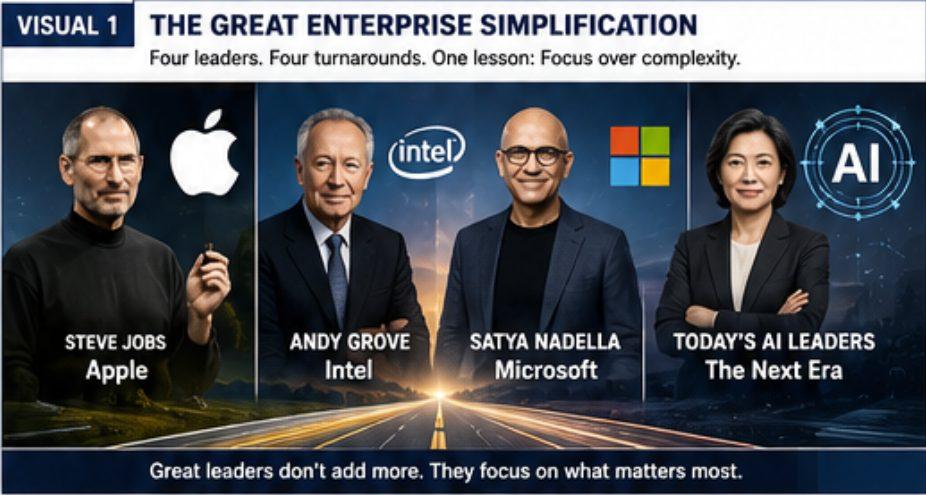
When Steve Jobs returned to Apple in 1997, the company was in crisis.
Apple had accumulated a sprawling portfolio of products, overlapping offerings, and competing priorities. Resources were spread across too many initiatives, making execution increasingly difficult. Employees lacked clarity. Customers were confused. Investors were losing confidence.
Most executives facing such a challenge would have launched a transformation office, commissioned a strategic review, or created a series of committees.
Case Study 1: Apple’s Four Boxes and the Power of Focus
The Apple story has become one of the most studied leadership examples in modern business.
What is often overlooked is that Jobs was not solving a technology problem.
He was solving a prioritization problem.
Apple had talented engineers.
Apple had innovative products.
Apple had strong brand recognition.
What Apple lacked was focus.
Jobs did something much simpler.
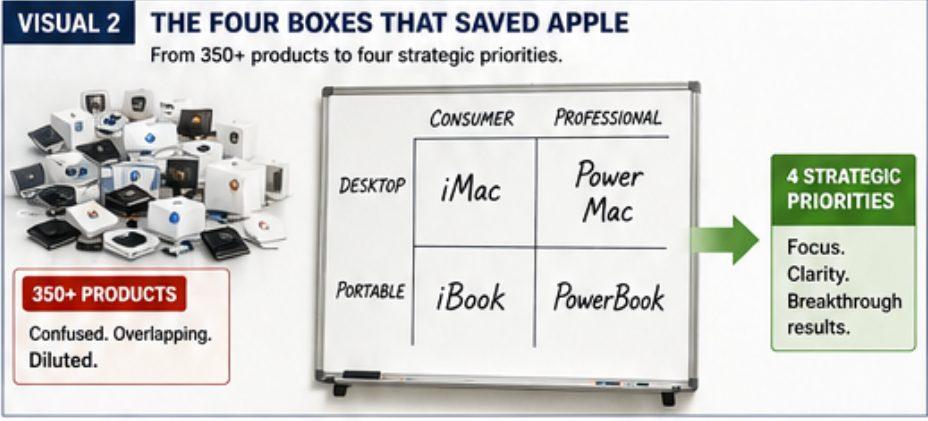
He walked into a meeting and drew four boxes on a whiteboard.
The categories were straightforward:
- Consumer Desktop
- Consumer Portable
- Professional Desktop
- Professional Portable
Then he asked a simple question:
Which products belong in these boxes?
Everything else became a candidate for elimination.
The brilliance of the exercise was not the matrix itself. It was the discipline behind it.
Jobs understood something many organizations still struggle to embrace today: focus is not created by selecting priorities. Focus is created by eliminating competing priorities.
Apple’s turnaround did not begin with the iPhone.
It did not begin with the App Store.
It began with simplification.
Within a few years, Apple regained profitability. Within a decade, it had become one of the most valuable companies in the world.
Jobs recognized that every project consumed resources. Every product required attention. Every initiative created complexity.
Rather than attempting to optimize hundreds of activities, he dramatically reduced the number of things Apple would do.
The lesson remains remarkably relevant.
Many organizations today suffer from the same condition. The difference is that instead of managing hundreds of products, they are managing hundreds of projects, platforms, pilots, and transformation initiatives.
The technology has changed.
The leadership challenge has not.
Case Study 2: Andy Grove’s Strategic Inflection Point at Intel

Apple’s story is famous.
Intel’s may be even more instructive.
In the 1980s, Intel faced intense competition in its memory chip business. Japanese manufacturers were producing memory chips more efficiently and at lower cost, placing enormous pressure on Intel’s core business.
For Andy Grove and Gordon Moore, the situation created a painful dilemma.
Memory chips were Intel’s heritage.
They represented the company’s identity and history.
Yet Grove recognized a difficult truth.
The future was shifting toward microprocessors.
Grove later described a pivotal moment when he asked:
“If we got kicked out and the board brought in a new CEO, what would he do?”
The answer was clear.
A new CEO would likely exit the memory business and focus on microprocessors.
So Grove made the decision himself.
Intel pivoted toward microprocessors and ultimately became one of the most influential technology companies in history.
The remarkable aspect of this story is not the strategic shift itself.
It is the willingness to abandon a business that had once defined the company.
Many organizations struggle to let go of products, processes, technologies, and operating models that were successful in the past.
Grove understood that yesterday’s success can become tomorrow’s constraint.
Case Study 3: Satya Nadella’s Microsoft Reset

When Satya Nadella became CEO of Microsoft in 2014, the company was still enormously successful.
Yet it was losing strategic momentum.
The organization remained heavily centered around Windows while cloud computing was reshaping the technology landscape. Internal silos, competing agendas, and a fragmented culture were slowing innovation.
Many leaders would have responded by creating additional initiatives.
Nadella did the opposite.
He simplified.
His early strategy was built around a clear vision:
Mobile First. Cloud First.
The statement was powerful not because it introduced new complexity, but because it created clarity.
Microsoft aligned around a smaller number of strategic priorities.
Cloud became central.
Azure became strategic.
The company embraced open ecosystems and partnerships.
The organization became more willing to support Linux, Android, and iOS rather than treating them as competitors.
Today, Microsoft’s leadership in cloud computing and artificial intelligence can be traced back to decisions made more than a decade ago.
The OpenAI partnership.
GitHub acquisition.
Azure AI services.
Copilot strategy.
All were enabled by the strategic clarity created during Nadella’s early years as CEO.
Microsoft’s AI leadership did not begin with AI.
It began with focus.
The New Challenge: From Product Sprawl to AI Sprawl
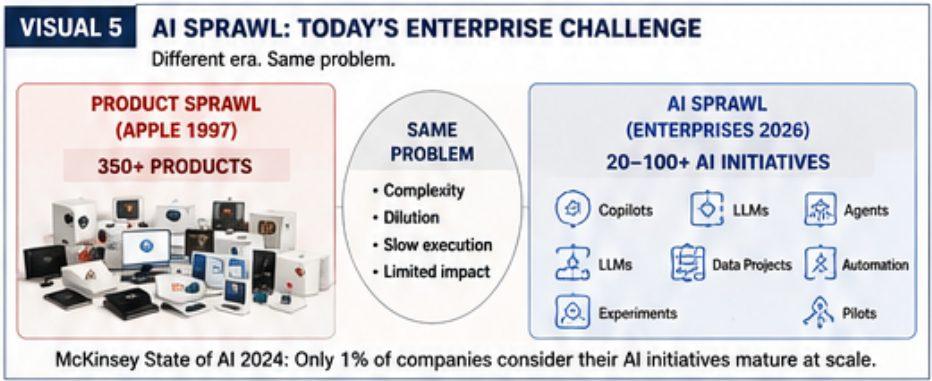
Today’s enterprises are facing a challenge that would have felt familiar to Steve Jobs.
The difference is that instead of product sprawl, organizations are facing AI sprawl.
Across industries, leaders are launching:
- Generative AI pilots
- AI copilots
- Agentic AI experiments
- Data modernization programs
- Intelligent automation initiatives
- Machine learning projects
- Innovation labs
Each initiative may appear valuable in isolation.
Collectively, they often create overwhelming complexity.
According to McKinsey’s State of AI research, organizations continue to struggle moving AI from experimentation to enterprise-scale value. While adoption rates continue to rise, relatively few organizations report achieving significant business impact across the enterprise.
The issue is often not the technology itself.
It is prioritization.
Many enterprises are attempting to pursue dozens of AI initiatives simultaneously while lacking the governance, talent, data maturity, and organizational focus required to scale them successfully.
In many ways, today’s enterprises resemble Apple in 1997.
Instead of 350 products, they may have:
- 100 AI use cases
- 25 copilots
- 15 AI vendors
- Multiple LLM platforms
- Competing automation programs
- Overlapping data initiatives
The result is the same.
Resources become diluted.
Focus disappears.
Execution suffers.
The Rise of the AI Portfolio Board
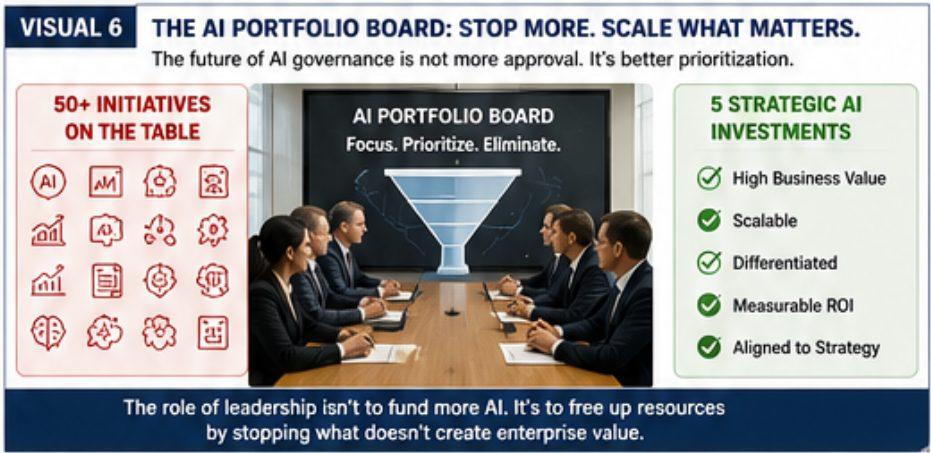
This is why a new executive discipline is emerging.
Over the next several years, many organizations will establish formal AI Portfolio Boards.
Their purpose will not be to approve more AI projects.
Their purpose will be to determine which projects deserve investment and which projects should be stopped.
The most successful organizations will likely treat AI investments the way venture capital firms treat startups.
Not every idea receives funding.
Not every pilot receives scale.
Not every experiment survives.
Resources are concentrated on the opportunities most likely to generate measurable business value.
The future of AI governance may have less to do with approving initiatives and more to do with eliminating distractions.
In other words, Steve Jobs’ whiteboard may become more relevant than ever.
Five Questions Every Executive Team Should Ask
Before launching another transformation initiative, leaders should ask five difficult questions:
1. What would we stop if we had to eliminate 80% of our initiatives?
Forced prioritization often reveals what truly matters.
2. Which five initiatives would survive?
If everything disappeared tomorrow, what would remain?
3. Which initiatives generate measurable business outcomes?
Activity is not impact.
4. Which initiatives consume resources without strategic value?
Every organization has them.
The challenge is identifying them honestly.
5. Are we creating innovation—or complexity?
The answer may determine future success.
The CDO TIMES Bottom Line
Steve Jobs’ four boxes were never really about products.
Andy Grove’s pivot was never really about semiconductors.
Satya Nadella’s transformation was never really about cloud computing.
Each leader understood the same fundamental truth:
Organizations do not transform when they pursue more opportunities.
They transform when they focus on the right opportunities.
In today’s AI-driven business environment, executives face unprecedented pressure to innovate, modernize, automate, and transform simultaneously.
History suggests a different path.
The organizations that win the next decade may not be the ones that launch the most AI initiatives.
They may be the ones with the discipline to eliminate the most distractions.
In an age obsessed with addition, the ultimate competitive advantage may be simplification.
The leaders who change their companies will not be remembered for everything they started.
They will be remembered for what they had the courage to stop.
Love this article? Embrace the full potential and become an esteemed full access member, experiencing the exhilaration of unlimited access to captivating articles, exclusive non-public content, empowering hands-on guides, and transformative training material. Unleash your true potential today!
Order the AI + HI = ECI book by Carsten Krause today! at cdotimes.com/book

Subscribe on LinkedIn: Digital Insider
Become a paid subscriber for unlimited access, exclusive course content, no ads: CDO TIMES
Do You Need Help?
Consider bringing on a fractional CIO, CISO, CDO or CAIO from CDO TIMES Leadership as a Business Consulting Service. The expertise of CDO TIMES becomes indispensable for organizations striving to stay ahead in the digital transformation journey. Here are some compelling reasons to engage their experts:
- Deep Expertise: CDO TIMES has a team of experts with deep expertise in the field of Cybersecurity, Digital, Data and AI and its integration into business processes. This knowledge ensures that your organization can leverage digital and AI in the most optimal and innovative ways.
- Training, developing, arranging, and conducting educational conferences and programs and providing courses of instruction.
- Strategic Insight: Not only can the CDO TIMES team help develop a Digital & AI strategy, but they can also provide insights into how this strategy fits into your overall business model and objectives. They understand that every business is unique, and so should be its Digital & AI strategy.
- Future-Proofing: With CDO TIMES, organizations can ensure they are future-proofed against rapid technological changes. Our experts stay abreast of the latest AI, Data and digital advancements and can guide your organization to adapt and evolve as the technology does.
- Risk Management: Implementing a Digital & AI strategy is not without its risks. The CDO TIMES can help identify potential pitfalls and develop mitigation strategies, helping you avoid costly mistakes and ensuring a smooth transition with fractional CISO services.
- Competitive Advantage: Finally, by hiring CDO TIMES experts, you are investing in a competitive advantage. Their expertise can help you speed up your innovation processes, bring products to market faster, and stay ahead of your competitors.
By employing the expertise of CDO TIMES, organizations can navigate the complexities of digital innovation with greater confidence and foresight, setting themselves up for success in the rapidly evolving digital economy. The future is digital, and with CDO TIMES, you’ll be well-equipped to lead in this new frontier.
Do you need help with your digital transformation initiatives? We provide fractional CAIO, CDO, CISO and CIO services, do a Preliminary ECI and Tech Navigator Assessment and we will help you drive results and deliver winning digital and AI strategies for you!
Subscribe now for free and never miss out on digital insights delivered right to your inbox!