RM staff debate ethics of AI usage in teaching – thermtide.com
What is your favorite winter activity?
Total Voters: 103
Three years ago, ChatGPT was released, and already, a student’s lesson, homework and test might be authored by generative AI. The county’s drafting of an official AI policy has been ongoing for months, which means that for now, the question of what constitutes ethical usage of AI is a Wild West left up to individual teachers’ discretion.
Faced with a lack of guidelines, some departments in RM have developed their own. Robert Barnhart, the chair of the math department, led professional development sessions during which he taught his team how to use Google’s Gemini. He says Gemini is helpful for generating practice problems—something that can save teachers hours of work—though he emphasizes the necessity of human verification before anything is assigned to a student.
Some in his department, like IB Business Management and finance teacher Stephen Kuhn, take it far beyond just practice problems. Because IB Business Management is a new class offered this year, there aren’t any resources from prior years to draw from. Instead, Mr. Kuhn, who has a background in business, relies on AI to create most of his lessons.
Mr. Kuhn begins by consulting his textbook and looking online. “And I already have basically a broad outline for the lesson,” he said. Next, he tells Gemini that he is an IB Business Management Teacher. “Then, I’ll say I’m teaching 11th and 12th grade students, and I say, ‘We are on lesson 1.4, please prepare a lesson outline.’ So AI is going to go out there, and I guess it just searches online for lesson 1.4, and then they’ll come back and they’ll structure a lesson,” he said. He then compares it to the outline, usually satisfied, and verifies the accuracy. “And I’ll say, ‘I didn’t think of that, that’s a good idea.’”
Mr. Kuhn also uses AI to create tests. If he wants to give an exit card, he says Gemini can generate one for him in seconds. “It’s a great time saver,” he said. “I don’t consider AI usage cheating or anything because I can get the same thing from a textbook… It’s all from IB. The lessons—they don’t vary.”
For longer assessments, Mr. Kuhn also requests scoring guidelines for the free response questions. Gemini will typically provide him a strong and a weak sample student response as baselines to compare to. “I’ve just started teaching actually, and that really helps me,” he said.
English teacher Stephanie Halloran, who has been teaching for more than 30 years, does not find any value in using AI for her teaching. While the department has held several discussions, English teachers currently do not have rigid guidelines on when or how AI can be used. Ms. Halloran’s class material include lessons and assignments passed down since the seventies, and she still teaches with handouts from her first-ever teaching job, long before the advent of the internet.
The main argument behind her AI refusal is the loss of what she calls a “human connection” essential to learning. She brought up the example of a recent in-class discussion about a “Macbeth” soliloquy. “You bring to the text, all of your experience, all of what you know,” she said. “However, if I had gone to AI to develop the discussion questions, that would not have resulted in something that would… have bridged the gap between what the writer has produced and what the reader is experiencing. But that gap is where meaning is created.”
Ms. Halloran says this “human connection” is part of learning in all subjects, including STEM. “Math is about how to think as well. And that’s the mistake that people make, is that they think math is just learning how to solve certain kinds of problem sets,” she said.
Her main objection to MCPS’ current stance on AI is that it is too eager and lacks caution. The rapid embrace of new technology, she says, is something that has always been part of human society; though in education specifically, a cycle that first began with the invention of the film strip.
Science teacher Stuart Albaugh’s objections are more practical. Large language models consume huge amounts of freshwater and electricity—mostly generated by fossil fuels—and as a chemistry teacher who often has his students apply their knowledge to real-world environmental case-studies, he says using such an environmentally harmful technology himself would amount to hypocrisy. Like Ms. Halloran, Mr. Albaugh has personally observed that the district appears to be very keen on having their staff incorporate AI into their workflow, as have many corporations—even if they have no officially stated policy. “I honestly just feel it’s a little bit tone deaf, because here they are, talking about all these things they want to do to try to conserve the environment, teaching the students about reducing their footprint, and then they are endorsing using AI,” he said.
Mr. Albaugh has never used AI, not even in the beginning when most people were playing around with prompts like “WRITE A BIBLICAL VERSE EXPLAINING HOW TO REMOVE A PEANUT BUTTER SANDWICH FROM A VCR,” blissfully unaware of the environmental harm. “I think it was just my laziness,” he said. “I have a very specific way I like doing things.”
Above all, Mr. Albaugh sees AI as a net negative to society even disregarding the environmental costs. “There’s a lot of critical thinking that’s being lost,” he said. “There’s a lot of people who will… no longer go through the effort of thinking through a problem just because they can look something up with AI.”
Social studies teacher Amber Myren argues that AI can bring less obvious benefits that fall outside its conventional usage by most of her colleagues. Ms. Myren primarily uses AI to tailor her class texts to match the reading level of her students. A significant portion of her students are part of the Emerging Multilingual Learner (EML) program. “Some of my students are EML level ones and twos, and so I’ll adapt the readings to fit their level. And that’s made it more equitable for them,” she said. “There’s less students who don’t start the work simply because it’s too hard for them.”
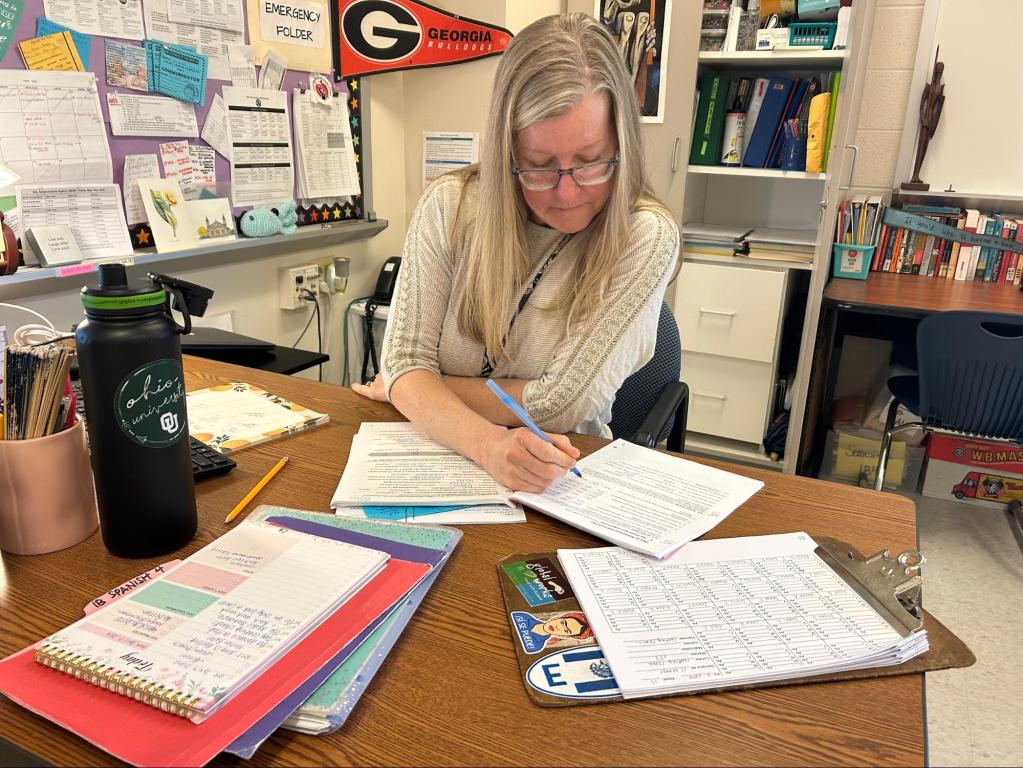
IB Spanish 4 and 6 teacher Laura Hodge agrees with Ms. Halloran. In fact, her classes are completely offline, almost never requiring technology beyond pencil and paper. Every day, as students approach the classroom door, Ms. Hodge will stand guard and bar them from entering until they’ve proven that their cellphones are zipped away in their “mochilas.” Her class homework is always contained in a nearly 100-page packet that she passes out every unit, and all her tests are completed on small answer slips to save paper.
“Our youngest generation depends on the quick answer from Google, as we all do,” she said. “But when it comes to learning, you need to problem-solve and use your own brain to think about how you would attack the problem, without going to the easy fix.”
Through her screen-free classroom, Ms. Hodge hopes to foster interpersonal skills, which she says are especially important in language learning. The majority of her class time is devoted to informal whole class discussions that make up a significant portion of students’ grades. “My classes are about communicating,” she said. “We sit in class and talk to each other.”
Your donation will support the student journalists of The Tide, Richard Montgomery High School’s student newspaper. Your contribution will allow us to purchase equipment and cover our annual website hosting costs.
The Student News Site of Richard Montgomery High School
source
This article was autogenerated from a news feed from CDO TIMES selected high quality news and research sources. There was no editorial review conducted beyond that by CDO TIMES staff. Need help with any of the topics in our articles? Schedule your free CDO TIMES Tech Navigator call today to stay ahead of the curve and gain insider advantages to propel your business!
Total Voters: 103
Three years ago, ChatGPT was released, and already, a student’s lesson, homework and test might be authored by generative AI. The county’s drafting of an official AI policy has been ongoing for months, which means that for now, the question of what constitutes ethical usage of AI is a Wild West left up to individual teachers’ discretion.
Faced with a lack of guidelines, some departments in RM have developed their own. Robert Barnhart, the chair of the math department, led professional development sessions during which he taught his team how to use Google’s Gemini. He says Gemini is helpful for generating practice problems—something that can save teachers hours of work—though he emphasizes the necessity of human verification before anything is assigned to a student.
Some in his department, like IB Business Management and finance teacher Stephen Kuhn, take it far beyond just practice problems. Because IB Business Management is a new class offered this year, there aren’t any resources from prior years to draw from. Instead, Mr. Kuhn, who has a background in business, relies on AI to create most of his lessons.
Mr. Kuhn begins by consulting his textbook and looking online. “And I already have basically a broad outline for the lesson,” he said. Next, he tells Gemini that he is an IB Business Management Teacher. “Then, I’ll say I’m teaching 11th and 12th grade students, and I say, ‘We are on lesson 1.4, please prepare a lesson outline.’ So AI is going to go out there, and I guess it just searches online for lesson 1.4, and then they’ll come back and they’ll structure a lesson,” he said. He then compares it to the outline, usually satisfied, and verifies the accuracy. “And I’ll say, ‘I didn’t think of that, that’s a good idea.’”
Mr. Kuhn also uses AI to create tests. If he wants to give an exit card, he says Gemini can generate one for him in seconds. “It’s a great time saver,” he said. “I don’t consider AI usage cheating or anything because I can get the same thing from a textbook… It’s all from IB. The lessons—they don’t vary.”
For longer assessments, Mr. Kuhn also requests scoring guidelines for the free response questions. Gemini will typically provide him a strong and a weak sample student response as baselines to compare to. “I’ve just started teaching actually, and that really helps me,” he said.
English teacher Stephanie Halloran, who has been teaching for more than 30 years, does not find any value in using AI for her teaching. While the department has held several discussions, English teachers currently do not have rigid guidelines on when or how AI can be used. Ms. Halloran’s class material include lessons and assignments passed down since the seventies, and she still teaches with handouts from her first-ever teaching job, long before the advent of the internet.
The main argument behind her AI refusal is the loss of what she calls a “human connection” essential to learning. She brought up the example of a recent in-class discussion about a “Macbeth” soliloquy. “You bring to the text, all of your experience, all of what you know,” she said. “However, if I had gone to AI to develop the discussion questions, that would not have resulted in something that would… have bridged the gap between what the writer has produced and what the reader is experiencing. But that gap is where meaning is created.”
Ms. Halloran says this “human connection” is part of learning in all subjects, including STEM. “Math is about how to think as well. And that’s the mistake that people make, is that they think math is just learning how to solve certain kinds of problem sets,” she said.
Her main objection to MCPS’ current stance on AI is that it is too eager and lacks caution. The rapid embrace of new technology, she says, is something that has always been part of human society; though in education specifically, a cycle that first began with the invention of the film strip.
Science teacher Stuart Albaugh’s objections are more practical. Large language models consume huge amounts of freshwater and electricity—mostly generated by fossil fuels—and as a chemistry teacher who often has his students apply their knowledge to real-world environmental case-studies, he says using such an environmentally harmful technology himself would amount to hypocrisy. Like Ms. Halloran, Mr. Albaugh has personally observed that the district appears to be very keen on having their staff incorporate AI into their workflow, as have many corporations—even if they have no officially stated policy. “I honestly just feel it’s a little bit tone deaf, because here they are, talking about all these things they want to do to try to conserve the environment, teaching the students about reducing their footprint, and then they are endorsing using AI,” he said.
Mr. Albaugh has never used AI, not even in the beginning when most people were playing around with prompts like “WRITE A BIBLICAL VERSE EXPLAINING HOW TO REMOVE A PEANUT BUTTER SANDWICH FROM A VCR,” blissfully unaware of the environmental harm. “I think it was just my laziness,” he said. “I have a very specific way I like doing things.”
Above all, Mr. Albaugh sees AI as a net negative to society even disregarding the environmental costs. “There’s a lot of critical thinking that’s being lost,” he said. “There’s a lot of people who will… no longer go through the effort of thinking through a problem just because they can look something up with AI.”
Social studies teacher Amber Myren argues that AI can bring less obvious benefits that fall outside its conventional usage by most of her colleagues. Ms. Myren primarily uses AI to tailor her class texts to match the reading level of her students. A significant portion of her students are part of the Emerging Multilingual Learner (EML) program. “Some of my students are EML level ones and twos, and so I’ll adapt the readings to fit their level. And that’s made it more equitable for them,” she said. “There’s less students who don’t start the work simply because it’s too hard for them.”
IB Spanish 4 and 6 teacher Laura Hodge agrees with Ms. Halloran. In fact, her classes are completely offline, almost never requiring technology beyond pencil and paper. Every day, as students approach the classroom door, Ms. Hodge will stand guard and bar them from entering until they’ve proven that their cellphones are zipped away in their “mochilas.” Her class homework is always contained in a nearly 100-page packet that she passes out every unit, and all her tests are completed on small answer slips to save paper.
“Our youngest generation depends on the quick answer from Google, as we all do,” she said. “But when it comes to learning, you need to problem-solve and use your own brain to think about how you would attack the problem, without going to the easy fix.”
Through her screen-free classroom, Ms. Hodge hopes to foster interpersonal skills, which she says are especially important in language learning. The majority of her class time is devoted to informal whole class discussions that make up a significant portion of students’ grades. “My classes are about communicating,” she said. “We sit in class and talk to each other.”
Your donation will support the student journalists of The Tide, Richard Montgomery High School’s student newspaper. Your contribution will allow us to purchase equipment and cover our annual website hosting costs.
The Student News Site of Richard Montgomery High School
source
This article was autogenerated from a news feed from CDO TIMES selected high quality news and research sources. There was no editorial review conducted beyond that by CDO TIMES staff. Need help with any of the topics in our articles? Schedule your free CDO TIMES Tech Navigator call today to stay ahead of the curve and gain insider advantages to propel your business!