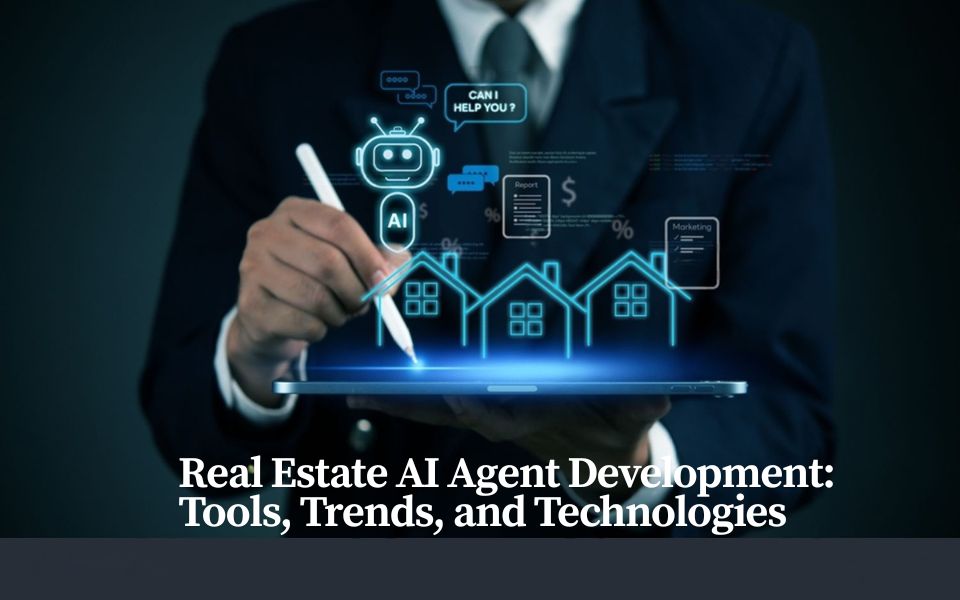
Real Estate AI Agent Development: Tools, Trends, and Technologies – NASSCOM Community
The use of this site and the content contained therein is governed by the Terms of Use. When you use this site you acknowledge that you have read the Terms of Use and that you accept and will be bound by the terms hereof and such terms as may be modified from time to time.
For any grievances under the Information Technology Act 2000, please get in touch with Grievance Officer, Mr. Anirban Mandal at data-query@nasscom.in.
No notification found.
June 20, 2025
33
0
The real estate industry is experiencing a profound shift as artificial intelligence (AI) moves from experimental to essential. Today’s AI technologies are far more advanced than simple chatbots or basic data analysis tools. They are evolving into intelligent digital agents capable of streamlining operations, enhancing customer interactions, and providing real-time, data-driven insights that empower smarter decision-making.
At the forefront of this transformation is Real Estate AI Agent Development—a rapidly growing field focused on building AI-powered systems tailored specifically to the needs of property professionals. These agents can analyze market trends, qualify leads, recommend listings, automate communications, and even assist with contract generation, reducing manual workload and increasing overall efficiency.
For real estate businesses aiming to stay competitive in a tech-driven marketplace, the ability to build AI agent for real estate is quickly becoming a strategic advantage. This guide explores the essential tools, emerging trends, and core technologies shaping the future of AI agent development for real estate.
At its core, Real Estate AI Agent Development refers to the process of creating smart, autonomous systems powered by machine learning, natural language processing, and data analytics specifically tailored for the real estate industry. These AI agents can serve multiple roles—from virtual assistants handling customer inquiries to complex decision-making systems for property valuation, investment analysis, and lead generation.
AI agents are transforming every aspect of the real estate value chain. Whether you’re a developer seeking to develop real estate AI agent systems or a brokerage exploring automation, understanding this space is essential to stay competitive.
Real estate transactions are inherently complex, data-driven, and people-centric. This makes the industry an ideal candidate for AI integration. Key benefits of AI agent development for real estate include:
Faster Decision-Making: AI can analyze thousands of data points—property history, pricing trends, crime rates, school ratings, etc.—in seconds.
Improved Customer Service: Chatbots and virtual assistants provide 24/7 support, reducing the workload on human agents.
Lead Qualification: AI tools can score leads based on engagement and past behavior, helping agents focus on high-quality prospects.
Property Recommendations: Machine learning algorithms can suggest homes to buyers based on previous search history and preferences.
Automated Documentation: AI can generate contracts, summarize legal documents, and flag inconsistencies, saving time and reducing errors.
Wondering how to build real estate AI agent systems? Here’s a step-by-step breakdown of the development process:
Start by defining what you want your AI agent to do. Will it serve as a chatbot? A recommendation engine? A market analyzer? The more specific you are, the better the outcome.
AI thrives on data. Gather structured and unstructured data from various sources such as MLS databases, CRM systems, transaction records, market reports, and customer interactions.
Several AI platforms can help build AI agent for real estate purposes. Some popular ones include:
OpenAI GPT-4 / GPT-4o: For natural language understanding and generation.
LangChain: Ideal for building conversational agents with multi-step reasoning.
Pinecone / FAISS: For semantic search and vector database capabilities.
Hugging Face Transformers: Offers pre-trained models that can be fine-tuned.
TensorFlow / PyTorch: For custom deep learning models.
Depending on your application, you may need supervised learning (e.g., price prediction), reinforcement learning (e.g., negotiation agents), or unsupervised learning (e.g., pattern recognition in buyer behavior). Always test your models with real-world scenarios to ensure accuracy.
To be functional, your AI agent must connect with CRM tools, property databases, email systems, and websites. Use APIs to create seamless integrations.
After deploying your AI agent, monitor its performance closely. Use feedback loops to fine-tune models, add new features, and address edge cases.
Building a real estate AI agent is a structured yet flexible process that evolves with technology and user needs. With the right foundation and continuous refinement, your AI agent can become a powerful asset in today’s digital real estate landscape.
Whether you’re a startup or an enterprise, choosing the right tech stack is crucial to successful Real Estate AI Agent Development. Here are some top tools and frameworks:
These large language models are powerful for developing conversational real estate agents capable of answering queries, summarizing listings, and generating content.
They excel at understanding natural language, making them ideal for client-facing chatbots and intelligent assistants.
Perfect for chaining LLM prompts and connecting to external data sources, LangChain is ideal for building context-aware agents that can search listings, summarize market trends, or even schedule showings.
It supports memory, tool usage, and decision-making logic—essential for multi-step reasoning in real estate workflows.
To build reliable systems, your agent will need up-to-date listings and pricing data. Realtor.com and Zillow offer APIs that feed accurate property information into your models.
These APIs also support historical pricing, property details, and regional trend insights for deeper analytics.
If you want a custom, on-premise conversational agent, Rasa offers open-source NLP pipelines for building voice or text-based AI agents.
Its flexibility and control over data privacy make it a strong choice for enterprise-grade deployments.
These are used to store and retrieve semantically similar content—crucial for recommendation engines and intelligent property searches.
They enable your AI to perform similarity-based retrieval across listings, user queries, and agent responses with high accuracy.
Choosing the right tools lays the foundation for robust and scalable real estate AI agent systems. With the right combination, you can ensure performance, flexibility, and seamless integration with your business goals.
The world of Real Estate AI Agent Development is evolving rapidly. Here are some of the most promising real estate AI agent trends to watch:
Next-gen AI agents can interpret not just text but images, videos, and even voice. Imagine uploading a photo of a room and having the AI suggest similar properties or renovations.
This capability enhances property discovery and enables richer, more intuitive user interactions.
Using user behavior data, AI agents can craft tailored property listings, financing options, and investment opportunities based on the buyer’s unique profile.
By adapting in real-time, these agents improve engagement and conversion rates across digital channels.
As smart speakers become mainstream, voice-enabled AI agents will play a more significant role in property searches and virtual tours.
These agents offer hands-free convenience, making property exploration more accessible and interactive.
Combining AI with AR/VR, agents can create immersive, interactive experiences for remote buyers. Some AI agents even auto-narrate virtual property tours.
This not only saves time but expands reach to global buyers unable to attend in-person showings.
AI agents are now being used to forecast market trends, rental yields, and even identify undervalued properties—helping investors stay ahead of the curve.
These insights empower users to make data-backed decisions with reduced risk.
From immersive experiences to intelligent forecasts, these trends are redefining the capabilities of AI in real estate. Staying ahead means embracing innovation and continuously evolving with emerging technologies.
If you’re looking for inspiration, here are some top AI agents for real estate already making waves in the industry:
Using machine learning models trained on millions of data points, Zestimate offers real-time home valuations.
It considers factors like recent sales, market trends, tax assessments, and user-submitted data to provide highly accurate property estimates.
An AI-powered chatbot that answers customer queries, suggests homes, and schedules showings.
It integrates with Redfin’s platform to deliver fast, responsive support while streamlining the home search experience.
OJO is a conversational AI assistant that guides buyers through the home buying process with personalized recommendations and insights.
Its natural language understanding and adaptive learning make it feel like a human advisor, offering value at every step.
Known for lead qualification and follow-ups, Structurely’s AI assistant integrates with CRM systems to keep agents focused on closing deals.
It engages leads via SMS, email, and chat with human-like conversations, helping nurture prospects until they’re ready to convert.
These successful AI agents showcase the real-world potential of Real Estate AI Agent Development. They serve as benchmarks for innovation, customer engagement, and practical value in today’s digital real estate landscape.
Despite its transformative potential, Real Estate AI Agent Development comes with its own set of complexities and obstacles that must be carefully addressed to ensure successful deployment and adoption.
Handling sensitive client information responsibly is critical. Real estate transactions involve financial records, identity documents, and personal preferences, all of which require strict compliance with data protection laws like GDPR and CCPA.
Ensuring end-to-end encryption, anonymization, and secure storage protocols is non-negotiable in AI agent design.
Inconsistent, outdated, or incomplete property data can severely impact model accuracy and user trust.
AI agents rely heavily on historical and real-time data from multiple sources—if this data isn’t clean or structured properly, it leads to poor recommendations, mispricing, or irrelevant listings.
Many real estate firms still operate on outdated, siloed systems that aren’t easily compatible with modern AI platforms.
Integrating AI agents into legacy CRMs, MLS databases, or marketing tools often requires extensive custom development and system upgrades.
Not all users are comfortable with AI handling high-stakes decisions, especially in real estate where emotions and finances run deep.
Building trust involves transparency in how decisions are made, offering human fallback options, and ensuring the AI supports—not replaces—human expertise.
AI must be developed with fairness and accountability in mind. Biased algorithms or opaque decision-making can lead to ethical dilemmas or legal risks, particularly in pricing or lending scenarios.
Proper auditing, explainable AI models, and ethical guidelines should be part of the development lifecycle.
The key to overcoming these challenges lies in a thoughtful, human-centric approach—grounded in strong data governance, ethical design, and clear transparency. By addressing these obstacles early, AI agents can deliver real value without compromising trust or integrity.
The future of real estate is intelligent, automated, and deeply data-driven. Real Estate AI Agent Development offers a competitive edge by reducing inefficiencies, enhancing customer experience, and unlocking new revenue opportunities.
If you’re ready to build AI agent for real estate, now is the perfect time. With the right mix of tools, data, and vision, you can create AI agents that don’t just assist but revolutionize the way real estate business is done.
Whether you’re exploring how to build real estate AI agent systems from scratch or seeking insights into the process to build real estate AI agent capabilities for your existing tech stack, one thing is clear: AI is not just the future—it’s the present.
That the contents of third-party articles/blogs published here on the website, and the interpretation of all information in the article/blogs such as data, maps, numbers, opinions etc. displayed in the article/blogs and views or the opinions expressed within the content are solely of the author’s; and do not reflect the opinions and beliefs of NASSCOM or its affiliates in any manner. NASSCOM does not take any liability w.r.t. content in any manner and will not be liable in any manner whatsoever for any kind of liability arising out of any act, error or omission. The contents of third-party article/blogs published, are provided solely as convenience; and the presence of these articles/blogs should not, under any circumstances, be considered as an endorsement of the contents by NASSCOM in any manner; and if you chose to access these articles/blogs , you do so at your own risk.
Sanjeev Verma, the CEO of Biz4Group LLC, is a visionary leader dedicated to harnessing technology for societal advancement. With a human-centric mindset, he spearheads innovative solutions, revolutionizing businesses through AI Development, IoT Development, eCommerce Development, and digital transformation. Sanjeev nurtures a culture of continuous growth, propelling Biz4Group’s mission toward technological excellence. He has been a featured author on Entrepreneur, IBM, and TechTarget.
How Generative AI Is Supercharging …
3
IDE Lab as a Service: Market Growth…
24
Demystifying Inference as a Service…
32
Regional AI Adoption: Why Asian Eco…
50
What is a Legal AI Assistant?
8
The Hidden Costs Of Poor IT Infrast…
7
AI Agents: The Intelligent Leap Bey…
9
AI-Led Risk Management Transformati…
44
AI-Led CX Transformation in Financi…
41
From Chatbots to Autonomous AI Agen…
51
Agentic AI: The Next Frontier in Au…
57
AI’s Biggest Contribution to Automo…
42
20 Jun 2025
Today, nearly every piece of data is linked to something else, and graph analytics has become the common method for spotting those hidden links. From mapping social networks and tracing supply chains to catching fraudulent activity, graph tools help…
Read More
19 Jun 2025
Introduction The rapid evolution of digital technologies has transformed how organizations innovate, develop, and deploy software solutions. One of the most significant advancements in this space is the emergence of IDE Lab as a Service (IDE-LaaS…
Read More
19 Jun 2025
Introduction In the rapidly evolving world of artificial intelligence, deploying models efficiently and at scale is a critical challenge. Enter Inference as a Service (IaaS)—a cloud-based paradigm that abstracts away infrastructure complexity,…
Read More
19 Jun 2025
The global ecommerce landscape is evolving faster than ever. Artificial intelligence (AI) is no longer just an enhancement—it’s the backbone of modern digital retail. Among all regions, Asia stands out as the undisputed leader in AI-powered…
Read More
19 Jun 2025
A legal AI assistant is an AI‑powered tool designed to support legal professionals in routine to complex tasks—everything from contract drafting and document review to legal research and summarization. These assistants can cross‑reference past…
Read More
18 Jun 2025
Generative AI is transforming customer service, automating interactions, resolving queries faster, and offering personalized experiences at scale. The AI transformation in the customer service environment offers the opportunity for transformation in…
Read More
© Copyright nasscom. All Rights Reserved.
or use your registered email
For now on you can edit the blog only once, for more you can contact us at communityadmin@nasscom.in
Only 1 edit allowed, for more you can contact us at communityadmin@nasscom.in
Blog has been submitted for review and it will be live after approval.
source
This article was autogenerated from a news feed from CDO TIMES selected high quality news and research sources. There was no editorial review conducted beyond that by CDO TIMES staff. Need help with any of the topics in our articles? Schedule your free CDO TIMES Tech Navigator call today to stay ahead of the curve and gain insider advantages to propel your business!
For any grievances under the Information Technology Act 2000, please get in touch with Grievance Officer, Mr. Anirban Mandal at data-query@nasscom.in.
No notification found.
June 20, 2025
33
0
The real estate industry is experiencing a profound shift as artificial intelligence (AI) moves from experimental to essential. Today’s AI technologies are far more advanced than simple chatbots or basic data analysis tools. They are evolving into intelligent digital agents capable of streamlining operations, enhancing customer interactions, and providing real-time, data-driven insights that empower smarter decision-making.
At the forefront of this transformation is Real Estate AI Agent Development—a rapidly growing field focused on building AI-powered systems tailored specifically to the needs of property professionals. These agents can analyze market trends, qualify leads, recommend listings, automate communications, and even assist with contract generation, reducing manual workload and increasing overall efficiency.
For real estate businesses aiming to stay competitive in a tech-driven marketplace, the ability to build AI agent for real estate is quickly becoming a strategic advantage. This guide explores the essential tools, emerging trends, and core technologies shaping the future of AI agent development for real estate.
At its core, Real Estate AI Agent Development refers to the process of creating smart, autonomous systems powered by machine learning, natural language processing, and data analytics specifically tailored for the real estate industry. These AI agents can serve multiple roles—from virtual assistants handling customer inquiries to complex decision-making systems for property valuation, investment analysis, and lead generation.
AI agents are transforming every aspect of the real estate value chain. Whether you’re a developer seeking to develop real estate AI agent systems or a brokerage exploring automation, understanding this space is essential to stay competitive.
Real estate transactions are inherently complex, data-driven, and people-centric. This makes the industry an ideal candidate for AI integration. Key benefits of AI agent development for real estate include:
Faster Decision-Making: AI can analyze thousands of data points—property history, pricing trends, crime rates, school ratings, etc.—in seconds.
Improved Customer Service: Chatbots and virtual assistants provide 24/7 support, reducing the workload on human agents.
Lead Qualification: AI tools can score leads based on engagement and past behavior, helping agents focus on high-quality prospects.
Property Recommendations: Machine learning algorithms can suggest homes to buyers based on previous search history and preferences.
Automated Documentation: AI can generate contracts, summarize legal documents, and flag inconsistencies, saving time and reducing errors.
Wondering how to build real estate AI agent systems? Here’s a step-by-step breakdown of the development process:
Start by defining what you want your AI agent to do. Will it serve as a chatbot? A recommendation engine? A market analyzer? The more specific you are, the better the outcome.
AI thrives on data. Gather structured and unstructured data from various sources such as MLS databases, CRM systems, transaction records, market reports, and customer interactions.
Several AI platforms can help build AI agent for real estate purposes. Some popular ones include:
OpenAI GPT-4 / GPT-4o: For natural language understanding and generation.
LangChain: Ideal for building conversational agents with multi-step reasoning.
Pinecone / FAISS: For semantic search and vector database capabilities.
Hugging Face Transformers: Offers pre-trained models that can be fine-tuned.
TensorFlow / PyTorch: For custom deep learning models.
Depending on your application, you may need supervised learning (e.g., price prediction), reinforcement learning (e.g., negotiation agents), or unsupervised learning (e.g., pattern recognition in buyer behavior). Always test your models with real-world scenarios to ensure accuracy.
To be functional, your AI agent must connect with CRM tools, property databases, email systems, and websites. Use APIs to create seamless integrations.
After deploying your AI agent, monitor its performance closely. Use feedback loops to fine-tune models, add new features, and address edge cases.
Building a real estate AI agent is a structured yet flexible process that evolves with technology and user needs. With the right foundation and continuous refinement, your AI agent can become a powerful asset in today’s digital real estate landscape.
Whether you’re a startup or an enterprise, choosing the right tech stack is crucial to successful Real Estate AI Agent Development. Here are some top tools and frameworks:
These large language models are powerful for developing conversational real estate agents capable of answering queries, summarizing listings, and generating content.
They excel at understanding natural language, making them ideal for client-facing chatbots and intelligent assistants.
Perfect for chaining LLM prompts and connecting to external data sources, LangChain is ideal for building context-aware agents that can search listings, summarize market trends, or even schedule showings.
It supports memory, tool usage, and decision-making logic—essential for multi-step reasoning in real estate workflows.
To build reliable systems, your agent will need up-to-date listings and pricing data. Realtor.com and Zillow offer APIs that feed accurate property information into your models.
These APIs also support historical pricing, property details, and regional trend insights for deeper analytics.
If you want a custom, on-premise conversational agent, Rasa offers open-source NLP pipelines for building voice or text-based AI agents.
Its flexibility and control over data privacy make it a strong choice for enterprise-grade deployments.
These are used to store and retrieve semantically similar content—crucial for recommendation engines and intelligent property searches.
They enable your AI to perform similarity-based retrieval across listings, user queries, and agent responses with high accuracy.
Choosing the right tools lays the foundation for robust and scalable real estate AI agent systems. With the right combination, you can ensure performance, flexibility, and seamless integration with your business goals.
The world of Real Estate AI Agent Development is evolving rapidly. Here are some of the most promising real estate AI agent trends to watch:
Next-gen AI agents can interpret not just text but images, videos, and even voice. Imagine uploading a photo of a room and having the AI suggest similar properties or renovations.
This capability enhances property discovery and enables richer, more intuitive user interactions.
Using user behavior data, AI agents can craft tailored property listings, financing options, and investment opportunities based on the buyer’s unique profile.
By adapting in real-time, these agents improve engagement and conversion rates across digital channels.
As smart speakers become mainstream, voice-enabled AI agents will play a more significant role in property searches and virtual tours.
These agents offer hands-free convenience, making property exploration more accessible and interactive.
Combining AI with AR/VR, agents can create immersive, interactive experiences for remote buyers. Some AI agents even auto-narrate virtual property tours.
This not only saves time but expands reach to global buyers unable to attend in-person showings.
AI agents are now being used to forecast market trends, rental yields, and even identify undervalued properties—helping investors stay ahead of the curve.
These insights empower users to make data-backed decisions with reduced risk.
From immersive experiences to intelligent forecasts, these trends are redefining the capabilities of AI in real estate. Staying ahead means embracing innovation and continuously evolving with emerging technologies.
If you’re looking for inspiration, here are some top AI agents for real estate already making waves in the industry:
Using machine learning models trained on millions of data points, Zestimate offers real-time home valuations.
It considers factors like recent sales, market trends, tax assessments, and user-submitted data to provide highly accurate property estimates.
An AI-powered chatbot that answers customer queries, suggests homes, and schedules showings.
It integrates with Redfin’s platform to deliver fast, responsive support while streamlining the home search experience.
OJO is a conversational AI assistant that guides buyers through the home buying process with personalized recommendations and insights.
Its natural language understanding and adaptive learning make it feel like a human advisor, offering value at every step.
Known for lead qualification and follow-ups, Structurely’s AI assistant integrates with CRM systems to keep agents focused on closing deals.
It engages leads via SMS, email, and chat with human-like conversations, helping nurture prospects until they’re ready to convert.
These successful AI agents showcase the real-world potential of Real Estate AI Agent Development. They serve as benchmarks for innovation, customer engagement, and practical value in today’s digital real estate landscape.
Despite its transformative potential, Real Estate AI Agent Development comes with its own set of complexities and obstacles that must be carefully addressed to ensure successful deployment and adoption.
Handling sensitive client information responsibly is critical. Real estate transactions involve financial records, identity documents, and personal preferences, all of which require strict compliance with data protection laws like GDPR and CCPA.
Ensuring end-to-end encryption, anonymization, and secure storage protocols is non-negotiable in AI agent design.
Inconsistent, outdated, or incomplete property data can severely impact model accuracy and user trust.
AI agents rely heavily on historical and real-time data from multiple sources—if this data isn’t clean or structured properly, it leads to poor recommendations, mispricing, or irrelevant listings.
Many real estate firms still operate on outdated, siloed systems that aren’t easily compatible with modern AI platforms.
Integrating AI agents into legacy CRMs, MLS databases, or marketing tools often requires extensive custom development and system upgrades.
Not all users are comfortable with AI handling high-stakes decisions, especially in real estate where emotions and finances run deep.
Building trust involves transparency in how decisions are made, offering human fallback options, and ensuring the AI supports—not replaces—human expertise.
AI must be developed with fairness and accountability in mind. Biased algorithms or opaque decision-making can lead to ethical dilemmas or legal risks, particularly in pricing or lending scenarios.
Proper auditing, explainable AI models, and ethical guidelines should be part of the development lifecycle.
The key to overcoming these challenges lies in a thoughtful, human-centric approach—grounded in strong data governance, ethical design, and clear transparency. By addressing these obstacles early, AI agents can deliver real value without compromising trust or integrity.
The future of real estate is intelligent, automated, and deeply data-driven. Real Estate AI Agent Development offers a competitive edge by reducing inefficiencies, enhancing customer experience, and unlocking new revenue opportunities.
If you’re ready to build AI agent for real estate, now is the perfect time. With the right mix of tools, data, and vision, you can create AI agents that don’t just assist but revolutionize the way real estate business is done.
Whether you’re exploring how to build real estate AI agent systems from scratch or seeking insights into the process to build real estate AI agent capabilities for your existing tech stack, one thing is clear: AI is not just the future—it’s the present.
That the contents of third-party articles/blogs published here on the website, and the interpretation of all information in the article/blogs such as data, maps, numbers, opinions etc. displayed in the article/blogs and views or the opinions expressed within the content are solely of the author’s; and do not reflect the opinions and beliefs of NASSCOM or its affiliates in any manner. NASSCOM does not take any liability w.r.t. content in any manner and will not be liable in any manner whatsoever for any kind of liability arising out of any act, error or omission. The contents of third-party article/blogs published, are provided solely as convenience; and the presence of these articles/blogs should not, under any circumstances, be considered as an endorsement of the contents by NASSCOM in any manner; and if you chose to access these articles/blogs , you do so at your own risk.
Sanjeev Verma, the CEO of Biz4Group LLC, is a visionary leader dedicated to harnessing technology for societal advancement. With a human-centric mindset, he spearheads innovative solutions, revolutionizing businesses through AI Development, IoT Development, eCommerce Development, and digital transformation. Sanjeev nurtures a culture of continuous growth, propelling Biz4Group’s mission toward technological excellence. He has been a featured author on Entrepreneur, IBM, and TechTarget.
How Generative AI Is Supercharging …
3
IDE Lab as a Service: Market Growth…
24
Demystifying Inference as a Service…
32
Regional AI Adoption: Why Asian Eco…
50
What is a Legal AI Assistant?
8
The Hidden Costs Of Poor IT Infrast…
7
AI Agents: The Intelligent Leap Bey…
9
AI-Led Risk Management Transformati…
44
AI-Led CX Transformation in Financi…
41
From Chatbots to Autonomous AI Agen…
51
Agentic AI: The Next Frontier in Au…
57
AI’s Biggest Contribution to Automo…
42
20 Jun 2025
Today, nearly every piece of data is linked to something else, and graph analytics has become the common method for spotting those hidden links. From mapping social networks and tracing supply chains to catching fraudulent activity, graph tools help…
Read More
19 Jun 2025
Introduction The rapid evolution of digital technologies has transformed how organizations innovate, develop, and deploy software solutions. One of the most significant advancements in this space is the emergence of IDE Lab as a Service (IDE-LaaS…
Read More
19 Jun 2025
Introduction In the rapidly evolving world of artificial intelligence, deploying models efficiently and at scale is a critical challenge. Enter Inference as a Service (IaaS)—a cloud-based paradigm that abstracts away infrastructure complexity,…
Read More
19 Jun 2025
The global ecommerce landscape is evolving faster than ever. Artificial intelligence (AI) is no longer just an enhancement—it’s the backbone of modern digital retail. Among all regions, Asia stands out as the undisputed leader in AI-powered…
Read More
19 Jun 2025
A legal AI assistant is an AI‑powered tool designed to support legal professionals in routine to complex tasks—everything from contract drafting and document review to legal research and summarization. These assistants can cross‑reference past…
Read More
18 Jun 2025
Generative AI is transforming customer service, automating interactions, resolving queries faster, and offering personalized experiences at scale. The AI transformation in the customer service environment offers the opportunity for transformation in…
Read More
© Copyright nasscom. All Rights Reserved.
or use your registered email
For now on you can edit the blog only once, for more you can contact us at communityadmin@nasscom.in
Only 1 edit allowed, for more you can contact us at communityadmin@nasscom.in
Blog has been submitted for review and it will be live after approval.
source
This article was autogenerated from a news feed from CDO TIMES selected high quality news and research sources. There was no editorial review conducted beyond that by CDO TIMES staff. Need help with any of the topics in our articles? Schedule your free CDO TIMES Tech Navigator call today to stay ahead of the curve and gain insider advantages to propel your business!