A vision for the future of automation – MIT Technology Review
Sponsored
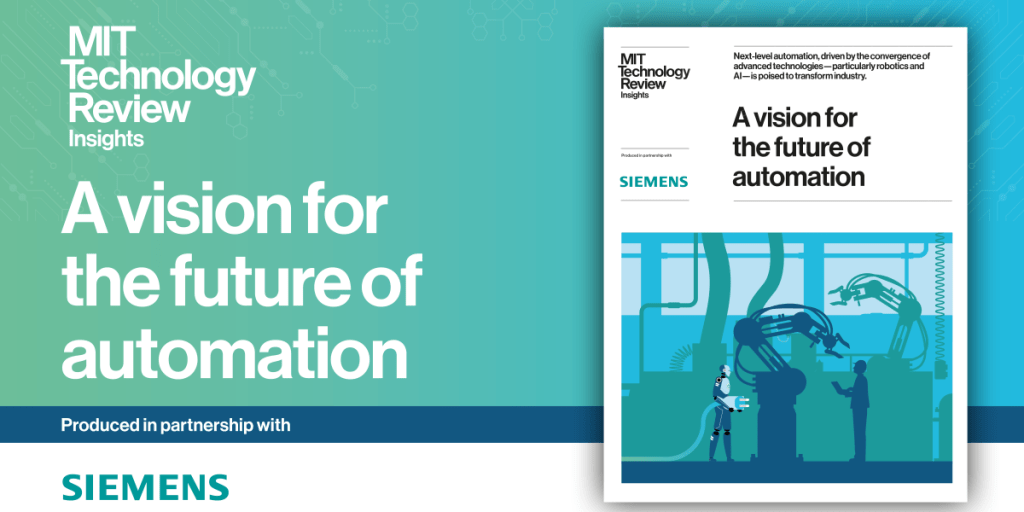
Next-level automation, driven by the convergence of advanced technologies—particularly robotics and AI—is poised to transform industry.
In partnership withSiemens
The manufacturing industry is at a crossroads: Geopolitical instability is fracturing supply chains from the Suez to Shenzhen, impacting the flow of materials. Businesses are battling rising costs and inflation, coupled with a shrinking labor force, with more than half a million unfilled manufacturing jobs in the U.S. alone. And climate change is further intensifying the pressure, with more frequent extreme weather events and tightening environmental regulations forcing companies to rethink how they operate. New solutions are imperative.
Meanwhile, advanced automation, powered by the convergence of emerging and established technologies, including industrial AI, digital twins, the internet of things (IoT), and advanced robotics, promises greater resilience, flexibility, sustainability, and efficiency for industry. Individual success stories have demonstrated the transformative power of these technologies, providing examples of AI-driven predictive maintenance reducing downtime by up to 50%. Digital twin simulations can significantly reduce time to market, and bring environment dividends, too: One survey found 77% of leaders expect digital twins to reduce carbon emissions by 15% on average.
Yet, broad adoption of this advanced automation has lagged. “That’s not necessarily or just a technology gap,” says John Hart, professor of mechanical engineering and director of the Center for Advanced Production Technologies at MIT. “It relates to workforce capabilities and financial commitments and risk required.” For small and medium enterprises, and those with brownfield sites—older facilities with legacy systems— the barriers to implementation are significant.
In recent years, governments have stepped in to accelerate industrial progress. Through a revival of industrial policies, governments are incentivizing high-tech manufacturing, re-localizing critical production processes, and reducing reliance on fragile global supply chains.
All these developments converge in a key moment for manufacturing. The external pressures on the industry—met with technological progress and these new political incentives—may finally enable the shift toward advanced automation.
Download the full report.
This content was produced by Insights, the custom content arm of MIT Technology Review. It was not written by MIT Technology Review’s editorial staff.
This content was researched, designed, and written entirely by human writers, editors, analysts, and illustrators. This includes the writing of surveys and collection of data for surveys. AI tools that may have been used were limited to secondary production processes that passed thorough human review.
Human “bodyoids” could reduce animal testing, improve drug development, and alleviate organ shortages.
The new general AI agent from China had some system crashes and server overload—but it’s highly intuitive and shows real promise for the future of AI helpers.
What the firm found challenges some basic assumptions about how this technology really works.
Federal scientists warn that Americans could feel the effects of the new administration's devastating cuts for decades to come.
Discover special offers, top stories, upcoming events, and more.
Thank you for submitting your email!
It looks like something went wrong.
We’re having trouble saving your preferences. Try refreshing this page and updating them one more time. If you continue to get this message, reach out to us at customer-service@technologyreview.com with a list of newsletters you’d like to receive.
© 2025 MIT Technology Review
source
This is a newsfeed from leading technology publications. No additional editorial review has been performed before posting.