Shadow IT 2.0 and the Rise of Rogue AI
By Carsten Krause, Chief Editor, The CDO TIMES, Book Author HI + AI = ECI™ (Elevated Collaborative Intelligence™), April 3rd 2025
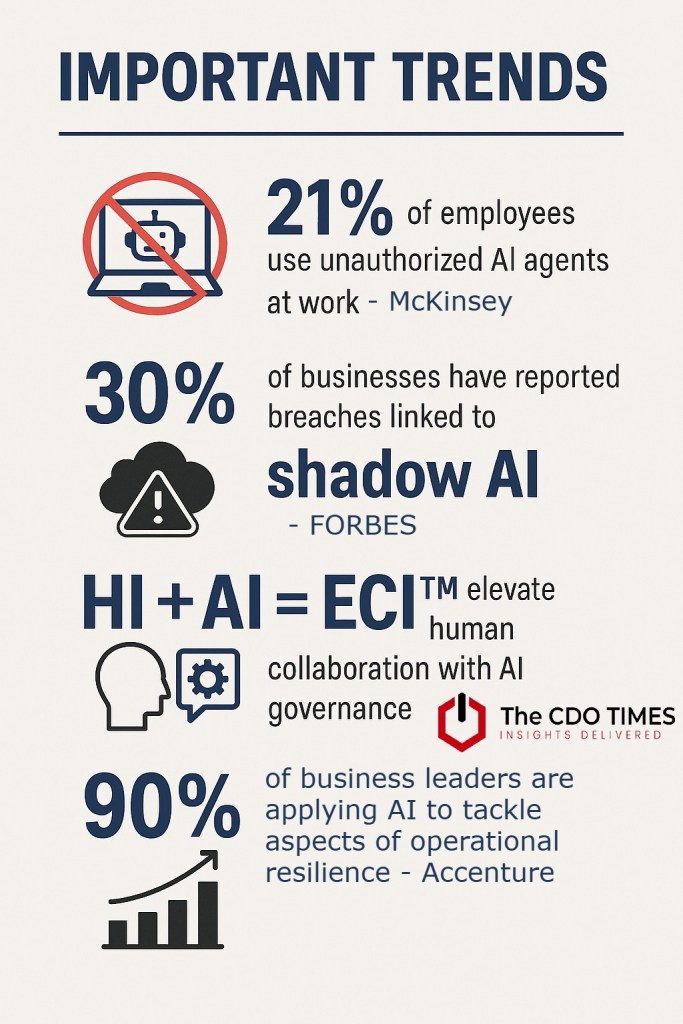
In boardrooms across the globe, a silent revolution is underway. Shadow IT – the unsanctioned apps and devices flourishing beyond IT’s watch – has a new and formidable ally: unauthorized AI agents. Employees, driven by burnout and impatience, are increasingly turning to generative AI tools on the sly, creating an unseen layer of IT that poses unprecedented risks. Gartner estimates that 30–40% of large enterprises’ IT spending now happens in the shadows. And by 2027, three-quarters of employees will use technology outside official oversight.
This viral adoption of “rogue AI” is forcing CDOs and CIOs to confront a sobering question: How do we transform these invisible threats into intelligent advantages? The answer lies in a new paradigm – “HI + AI = ECI™” – where Human Intelligence plus Artificial Intelligence yields Enterprise Collaborative Intelligence. In this CDO TIMES deep dive, we explore how C-level leaders can leverage this framework to align governance, strategy, and innovation, taming the chaos of Shadow IT’s AI surge while supercharging decision-making and performance.
The Rise of Shadow IT 2.0: Rogue AI Agents in the Wild

Shadow IT has evolved beyond unsanctioned apps – it now includes AI “agents” quietly deployed by employees. These rogue AI tools often operate under management’s radar, creating a parallel IT ecosystem outside official control.
Not long ago, Shadow IT primarily meant an employee using a cloud app or device without approval – perhaps a marketing team subscribing to an analytics SaaS or a developer spinning up an unsanctioned database. Today, it’s Shadow IT 2.0, fueled by a wave of generative AI. Recent surveys show 28% of workers are using generative AI at work – over half without any employer approval. In Microsoft’s 2024 Work Trend Index, more than three-quarters of employees who use AI admitted to “bringing their own AI” into the workplace. These AI agents range from ChatGPT answering customer emails to self-built Python scripts automating data tasks. The volume of unsanctioned AI usage has nearly doubled in six months, and it’s global – from U.S. tech firms to European manufacturers, staff are embracing AI tools wherever they find value. The result is a shadow ecosystem of AI: algorithms processing company data, making decisions, and interacting with customers without governance or oversight.
Why are employees turning to rogue AI? The drivers echo classic Shadow IT motives – productivity and impatience. Three in five workers report that the volume of work outpaces their ability to keep up. AI promises relief: automated reports, accelerated coding, instant answers. Yet official channels often lag; only 12% of IT departments can keep up with new tech requests
When corporate IT can’t deliver AI solutions quickly, ambitious employees take matters into their own hands. This DIY innovation is not ill-intentioned – in fact it’s highly rational from the employee’s perspective. Studies find 91% of teams feel pressure to prioritize business output over security, and slow IT approval drives 38% of employees to seek shadow solutions. In essence, your people want to excel, and AI is the new shiny tool to do so. Unfortunately, what boosts individual productivity can snowball into enterprise-level risk if left unchecked.
Data-Driven Insights: Shadow IT’s Growing Footprint and Risk
Shadow IT is no longer an edge case – it’s a major slice of enterprise tech. Gartner researchers estimate that shadow IT now accounts for 30% to 40% of all IT spending in large firms
In practice, this means millions of dollars in SaaS subscriptions, cloud services, and AI tools are being expensed or, worse, used for free without formal vendor assessment. The average company uses roughly 1,083 cloud services, yet IT often knows of less than 10% of them
Enterprises run 270–360 SaaS apps on average, and over half are unsanctioned
The sprawl is staggering – one analysis found the real number of applications in use is 14.6 times greater than what IT estimates
This visibility gap leaves security teams flying blind.
The implications are stark. Nearly 50% of cyberattacks now stem from shadow IT usage
IBM’s Threat Intelligence reports that shadow IT was a factor in almost one in two breaches, with an average mitigation cost of $4.2 million. Every unsanctioned cloud app or AI bot handling company data is a potential backdoor for attackers. In a recent global survey, 85% of businesses reported cyber incidents in the last two years, and 1 in 10 were directly linked to unauthorized IT or AI use. These aren’t just theoretical risks – they translate to real losses: data leaks, ransomware infections, compliance violations, and damaged reputations.
Equally concerning is the compliance fallout. Shadow IT means shadow data flows – customer data in an employee’s favorite AI writing app, financial records in a rogue cloud database, or personal data inadvertently fed into an AI model. All of this can run afoul of regulations. GDPR, for instance, requires strict control over personal data processing, with heavy fines for violations. If European employee data is being processed by an unsanctioned U.S.-based AI service, that’s a ticking bomb for GDPR compliance. The new NIS2 directive in the EU mandates robust cybersecurity risk management, explicitly including management of “unauthorized IT” in critical sectors. In other words, failing to police shadow systems can now be a legal violation, not just an IT problem. CDOs and CISOs are painfully aware that data protection regulators won’t accept “it was a shadow app” as an excuse for a breach. Unsanctioned AI usage could also violate intellectual property rules or industry-specific laws (think of FDA regulations on healthcare data, or FINRA rules on financial communications). The bottom line: shadow AI introduces shadow compliance risk – and regulators are sharpening their knives.
Rogue AI in Action: Cautionary Tales and Corporate Wake-Up Calls
When Samsung Electronics discovered in April 2023 that engineers had inadvertently leaked sensitive code to ChatGPT, it served as a brutal wake-up call. In this cautionary case study, a handful of employees used the popular AI chatbot to troubleshoot software, not realizing that they were effectively uploading crown-jewel intellectual property to an external server. Within weeks, Samsung moved to ban generative AI tools on company devices and networks. A memo to staff warned that data submitted to public AI services could be stored on external servers and become irretrievable – or worse, exposed to other users.
An internal survey found 65% of Samsung employees recognized the security risks of generative AI tools. Samsung’s response was swift: halt usage until proper controls are in place, and fast-track development of an in-house AI assistant where the data would remain internal. The incident also sparked a broader industry reaction – within months, major banks including JPMorgan, Bank of America, Citi, Deutsche Bank, Goldman Sachs, and Wells Fargo all restricted employee use of ChatGPT. Their concern was clear: confidential financial data and client information could leak through an uncontrolled AI channel, violating privacy laws and client trust. The Samsung saga underscores a crucial point for executives: one innocent use of AI can escalate into a corporate crisis if it’s outside the governance umbrella.
But not all stories are cautionary; some organizations have proactively turned rogue AI energy into positive outcomes. Consider Morgan Stanley, a case study in harnessing HI + AI for competitive advantage. In 2023, faced with advisors experimenting privately with AI tools, Morgan Stanley’s leadership chose to get ahead of the curve. They partnered with OpenAI to develop AI @ Morgan Stanley Assistant – a GPT-4 powered internal chatbot trained on the firm’s knowledge base. Rather than banning AI outright, they offered a sanctioned, secure alternative. The results have been remarkable.
Today over 98% of Morgan Stanley’s financial advisor teams use this AI assistant daily to retrieve research and answer client questions. By blending human expertise with AI speed, the firm reports that the tool saves each employee 10–15 hours per week on routine tasks– a massive productivity boost in an industry where time is money. The AI didn’t just stay a pilot; it helped drive tangible business outcomes. Morgan Stanley’s CEO credited their new AI platforms as a factor in the bank achieving record revenues of $61.8 billion in 2024. Equally important, they did this with governance in place: the AI was rigorously evaluated for accuracy, advisors were trained in its use, and data stays within compliant boundaries. This case highlights a powerful lesson: with the right strategy, what starts as shadow innovation can be integrated and scaled securely, turning a risk into a competitive weapon.
Cross-Industry Impact: Finance, Healthcare, and Beyond
No industry is immune from the lure – and risk – of shadow AI. In financial services, we’ve seen both extremes. Wall Street firms like Morgan Stanley chose to innovate, while others reacted with caution. JPMorgan Chase initially barred employees from using ChatGPT in early 2023 as a precaution for client data protection. Yet by late 2024, JPMorgan had launched its own internal large-language model for employees, indicating a shift from outright ban to controlled adoption. Banks are understandably cautious given stringent regulations on customer data (e.g. GLBA in the U.S.) and a history of massive fines for unmanaged electronic communications. It’s telling that more than 75% of employees using AI in one survey were doing so without CIO approval
ciodive.com, even in highly regulated finance environments. This speaks to the incredible demand for AI capabilities in roles like research analysis, trading, and customer service – and the need for governance to catch up. Forward-thinking financial CDOs are mapping unauthorized AI usage to existing risk frameworks. As one CIO quipped, “Our traders found a way to use GPT – we found a way to monitor it.” Increasingly, banks are implementing AI usage policies akin to their social media and personal device policies, requiring that any AI tool handling sensitive data be vetted by compliance and IT.
In healthcare and pharmaceuticals, the shadow AI phenomenon is equally pronounced, perhaps even more perilous. Doctors and researchers have experimented with GPT-style tools to summarize patient notes or even suggest diagnoses. The intent is noble – better patient outcomes – but without oversight, they run the risk of HIPAA violations or incorrect medical advice. A recent industry poll found a startling 87% of healthcare workers said their company lacks clear AI usage policies. This policy gap is dangerous when you consider that healthcare data is among the most sensitive. There have been anecdotal reports of hospital staff inputting patient details into free AI chatbots to draft referral letters, essentially uploading protected health information into unknown servers. European hospitals must consider GDPR as well – Italy’s data protection authority famously halted ChatGPT usage in 2023 until privacy safeguards were strengthened. On the flip side, some healthcare organizations are proactively embracing “approved AI.” For example, France’s AP-HP hospital network developed a secure medical chatbot to assist clinicians, after discovering many were quietly using ChatGPT. The lesson for healthcare: clinicians will use AI if it helps their workflow, so provide a safe channel for it or risk them going rogue.
Even in the public sector and manufacturing, shadow AI has crept in. A European government ministry recently found staff had been using an online translation AI to convert classified documents – a clear security issue. In one scenario, a law firm employee used an unauthorized AI tool to analyze legal documents, potentially exposing privileged client data externally. Meanwhile, manufacturing and retail companies report executives experimenting with AI for supply chain forecasts or marketing copy, sometimes pasting proprietary product data into web-based AI tools. These cross-industry examples underscore a unifying point: employees in every sector will find creative tech solutions to excel at their jobs, whether or not those solutions are sanctioned. C-level leaders must respond not by stifling innovation, but by channeling it.
The Compliance Crunch: GDPR, NIS2, and Emerging AI Regulations
The regulatory landscape around AI and shadow IT is tightening like a vise. In the EU, regulators have made it plain that data protection rules fully apply to AI usage – shadow or not. GDPR enforcement actions have already targeted companies whose employees inadvertently transferred EU personal data to external AI systems, viewing it as an unauthorized data export. The forthcoming EU AI Act, set to roll out in phases through 2025–2026, will impose explicit compliance requirements on organizations deploying AI. In fact, the first articles of the EU AI Act took effect in January 2025, marking the formal beginning of AI compliance enforcement. Under this law, companies will need to inventory their AI systems, perform risk assessments, ensure human oversight, and even register some systems with authorities. Critically, even general-purpose AI tools (like GPT models) will fall under certain provisions by 2025. This means that if your employees are quietly using a general AI service to handle customer data, your company could unknowingly become subject to “high-risk AI” obligations – such as documentation, transparency to users, and bias testing – under the EU AI Act. The message from Brussels is clear: get your AI house in order, or regulators will come knocking. Companies operating in Europe must start extending their compliance programs (from GDPR to ISO 27001) to encompass AI governance. That includes bringing shadow AI into the light, because one cannot manage or report on AI systems you don’t even know exist.
Across the Atlantic, U.S. regulators are also sharpening their focus. While there isn’t a federal AI law yet, agencies like the FTC have warned they will use existing consumer protection and privacy laws to punish misuse of AI (e.g., misleading AI outputs or negligent security of AI data). The National Institute of Standards and Technology (NIST) stepped in with an AI Risk Management Framework (RMF) in 2023, which many enterprises are adopting as a de facto standard. The NIST AI RMF provides guidance on mapping AI risks, measuring and managing them, and is being referenced in proposals for U.S. AI regulations. For CDOs, aligning with frameworks like NIST’s is a smart proactive move – it not only improves internal governance but also demonstrates to regulators that you are following recognized best practices. Notably, leading firms are already turning to NIST’s guidance to tame generative AI risks. Discover Financial Services’ CIO, for instance, implemented NIST-aligned guardrails and scenario testing as they rolled out AI pilots. In a world of emerging AI laws, being able to show auditors a robust AI governance framework – covering data privacy, security, transparency, and human oversight – will become a baseline expectation.
Furthermore, sector-specific rules are emerging. The EU’s Digital Operational Resilience Act (DORA) for finance and NIS2 for critical industries both implicitly require control over third-party and IT risks, which includes unsanctioned tech. Under NIS2, for example, a cyber incident resulting from a shadow AI tool could expose a company to regulatory penalties for lack of adequate risk management. Data residency laws could be violated if an employee’s pet AI tool stores data on foreign servers without proper contracts. And let’s not forget intellectual property: feeding proprietary code or designs into a public AI could jeopardize trade secret protections. All told, the compliance stakes around unauthorized AI have skyrocketed. CDOs must work hand-in-hand with Chief Risk Officers and legal teams to update policies (e.g. clear AI acceptable use policies), provide training on AI ethics and security, and implement technical controls (like DLP – Data Loss Prevention – monitoring for AI-related data exfiltration). Ignorance is no defense; as of 2025, regulators expect enterprises to know and control what AI is doing with their data. The era of the AI Wild West is closing, and enterprises that don’t institute law and order in their AI landscape will pay the price in fines and sanctions.
HI + AI = ECI™ – A Framework for Governance, Strategy and Innovation
Amid these challenges, the “HI + AI = ECI” framework emerges as a playbook for savvy organizations. At its core, this concept recognizes that combining Human Intelligence (HI) and Artificial Intelligence (AI) yields Enterprise Cognitive Intelligence (ECI) – a higher form of organizational brainpower. But achieving ECI isn’t automatic; it requires deliberate alignment of people, technology, and processes. How can enterprises practically apply HI+AI=ECI to rein in shadow risks and amplify rewards? It starts with governance as the backbone. Governance sets the guardrails so that human creativity with AI flourishes in a safe, compliant environment. This means establishing an AI Governance Council or similar body that includes IT, data science, compliance, and business leaders. Their mandate: create policies for AI usage, evaluate new AI tools, and monitor emerging risks. For example, a policy might require that any use of customer data in an AI system goes through a privacy review, or that only approved AI platforms (those vetted for security) can be used on core business processes. These policies shouldn’t be seen as stifling, but enabling – they create the conditions for trustworthy AI adoption, which encourages more people to innovate without fear. Crucially, governance must also involve training employees (building “AI literacy” as the EU AI Act calls it). A workforce educated on both the power and pitfalls of AI will make better decisions when using it.
Next is strategy. A strategy aligned with HI+AI=ECI treats AI not as a rogue experiment, but as a strategic asset. C-level leaders should articulate a clear vision: where will AI drive the most value in our enterprise? What data do we have, and how can human experts plus AI leverage it for superior outcomes? By setting strategic AI priorities, leadership can actually channel the grassroots shadow IT energy into sanctioned projects. For instance, noticing many marketers were using unapproved AI copywriting tools, one company launched an initiative to deploy a secure, enterprise-grade generative AI for marketing – turning a shadow habit into a strategic program with IT support. Strategy also means investing in enterprise AI platforms that are robust and compliant, so employees aren’t tempted to use risky alternatives. If data scientists are spinning up unapproved cloud ML environments, maybe it’s time to invest in an internal AI sandbox with ample resources and guardrails. Essentially, meet your innovators halfway: understand what they are trying to achieve and give them a pathway to do it safely within the enterprise strategy. This is where Human Intelligence (knowing your business, your domain, your customer) guides Artificial Intelligence deployment in the most impactful directions.
Finally, innovation must remain at the heart. Mitigating risk doesn’t mean squelching creativity. The HI+AI=ECI framework encourages elevated collaborative intelligence, where human expertise and machine insights feed off each other.
One practical approach is establishing fusion teams – cross-functional teams that pair domain experts with data scientists or AI engineers. These teams can rapidly prototype AI solutions to business problems, essentially offering an official outlet for what might have otherwise been shadow experiments. The difference is, these fusion teams operate under the CDO’s oversight, with proper data access controls and ethics checks. Weiyee Inn, a CDO TIMES contributing executive, describes this as creating “innovation sandboxes with guardrails”, where employees have freedom to build and test AI-driven ideas without endangering the business. For example, a fusion team in a retail company might experiment with a GPT-powered assistant for store managers to optimize inventory – something an ambitious manager might have tried on their own with a free tool, but now it’s done with IT’s blessing and support. By institutionalizing innovation, enterprises can capture the enthusiasm of shadow IT and redirect it to sanctioned R&D.
The goal is an ECI state: the organization as a whole becomes smarter, faster, and more adaptive because humans and AI are working in concert, everywhere from the back office to customer frontlines. In such an environment, shadow AI has no allure, because the official capabilities are just as good, if not better.
Sanctioned vs. Shadow AI: What’s the Difference?
To better understand the HI+AI=ECI approach, it’s useful to compare sanctioned enterprise AI platforms against the unruly shadow/unauthorized AI agents popping up informally. The table below highlights key characteristics:
| Characteristic | Sanctioned Enterprise AI Platforms | Shadow/Unauthorized AI Agents |
|---|---|---|
| Security & Compliance | Vetted for security; data encryption and access controls in place. Compliance-reviewed (GDPR, HIPAA, etc.) with audit logs. | Unknown security posture; potential data leakage (e.g. code leaked to ChatGPT). No compliance review, risky data handling. |
| Data Privacy | Uses enterprise data in controlled environments; options for on-prem or private cloud deployment. Data stays in-house or is governed by contracts. | Often cloud-based public services; data may be stored or used by provider (as happened with Samsung’s IP). No control once data is input. |
| Integration & Support | Integrated with enterprise systems (Single Sign-On, APIs, data lakes). IT support and training provided for users. | Siloed and ad-hoc; not integrated with other tools (leading to duplicate data). No formal support – users are on their own if issues arise. |
| Visibility & Monitoring | IT and CDO have visibility into usage (dashboards, user access logs). Can monitor performance, bias, and outcomes as per governance policies. | Largely invisible to IT – no centralized tracking of who is using what. Hard to detect issues or correct errors until after damage is done. |
| Innovation Speed | Development is deliberate but can be scaled enterprise-wide once approved. Sandboxes allow safe experimentation with IT oversight. | Quick to start using (anyone can sign up or download) – hence initial rapid innovation. But scaling is haphazard, and good ideas remain isolated hacks rather than company-wide solutions. |
| Cost Management | Costs are planned, budgeted, and optimized (enterprise licenses, volume discounts). FinOps can track ROI of AI projects. | Often “free” or expensed on a credit card – true costs hidden. Can lead to redundant spend (multiple teams paying for similar tools) and higher long-term costs due to inefficiencies. |
Table: Contrasting officially sanctioned enterprise AI platforms with unsanctioned shadow AI tools. Sanctioned AI operates within the enterprise cognitive intelligence framework (HI+AI=ECI), whereas shadow AI, while agile, introduces uncontrolled risks.
As the table illustrates, sanctioned AI platforms excel in governance, integration, and reliability, all crucial for enterprise-scale benefits. They ensure that AI isn’t a black box operating in a corner, but a well-monitored engine fueling the company’s objectives. Shadow AI, for all its agility, is a double-edged sword – it can spark quick wins, but at the cost of security exposures, siloed insights, and potential chaos. CDOs should use this comparison to communicate with the board and employees alike: it’s not about stifling innovation, it’s about doing innovation right. When employees see that an approved AI solution lets them achieve their goals with less friction and risk, the incentive to go rogue diminishes. A marketing manager will happily use the enterprise’s AI content generator (with customer data protections and CRM integration) instead of a random app, if it means better output and no fear of reprisal. Thus, migrating the organization from shadow to sanctioned AI is as much about providing superior tools and experience as it is about enforcement.
The CDO TIMES Bottom Line: Turning Shadow Risks into Strategic Rewards
Let’s not sugarcoat it. If your organization is ignoring the proliferation of shadow IT and rogue AI, you’re already behind the curve. The numbers don’t lie: hundreds of unsanctioned apps, potentially thousands of employees quietly using AI tools, and a significant chunk of cyber incidents linked to this very phenomenon. Shadow AI isn’t a minor IT policy violation – it’s a strategic business issue. It can undermine your data integrity, expose you to multi-million dollar breaches, and put you on the wrong side of regulators. But as we’ve explored, it’s also a glaring signal of untapped innovation. Your people are so eager to improve workflows with technology that they’re willing to skirt rules – imagine the value if you redirect that energy constructively.
Enterprise leaders must act on two fronts: risk mitigation and value realization.
First, shine a light on the shadows. Immediately inventory what cloud services and AI tools are in use (there are excellent discovery tools that can scan network logs for this). You might be startled by the results, but this data is power. Engage with those teams or individuals – not to scold, but to learn why they felt they needed those tools. This will inform where your official IT offerings are falling short. Next, establish clear guidelines and policies on AI and IT usage. Make it crystal clear what is allowed, what is discouraged, and the process for getting a new tool approved. Coupled with that, provide training on the risks (security, compliance) so everyone understands the why behind the rules.
On the value side, create pathways for innovation. Launch internal AI labs, hackathons or “approved experiment” programs to capture the great ideas percolating on the front lines. When Jane in finance builds a clever forecasting model in Python on her own, don’t shut it down – invite her to the analytics center of excellence to refine it with support and potentially scale it company-wide. In other words, turn shadow IT into fusion teams. Promote a culture where human expertise (HI) pairs with AI (artificial intelligence) to solve problems, and celebrate those wins. This is the essence of the HI+AI=ECI mindset – every employee becomes part of a collective intelligence network, amplifying their impact through safe and sanctioned AI.
Finally, lead from the top. Chief Data Officers and CIOs should brief the CEO and board on Shadow IT and AI risks regularly, armed with data and case studies. Frame it not as a technical issue, but as a business continuity and strategy issue – which it is. Highlight positive examples of competitors or peers turning these risks into advantages (as we did with Morgan Stanley, for instance). Nothing gets executive buy-in like showing how addressing shadow AI can drive productivity and growth while avoiding landmines. Allocate budget explicitly for AI governance and innovation programs; investments here will pay off multifold in both risk reduction and performance gains.
In the final analysis, shadow IT and rogue AI are symptoms of a gap – a gap between what employees feel they need and what the enterprise provides. The CDO’s job is to close that gap. By implementing strong governance, aligning AI deployment with strategy, and fostering an innovative culture, you transform a lurking liability into an engine of elevated collaborative intelligence. Organizations that master this balance will not only avoid the fate of those who learned the hard way (through leaks or fines), but will also outperform rivals by making smarter, faster decisions. The era of Enterprise Cognitive Intelligence is dawning, and it favors those who can bring human and artificial intelligence together under a unified, well-governed vision. That, more than anything, is the ultimate strategic reward hidden in the shadow risk.
This isn’t about policing employees—it’s about enabling them. Workers are turning to unauthorized AI because they see value. Forward-thinking leaders should treat this as a signal, not sabotage.
By adopting the HI + AI = ECI™ framework, enterprises can shift from reactive governance to elevated collaborative intelligence. This means standing up governance boards, enabling internal innovation hubs, and providing compliant, high-performing AI platforms that outshine shadow tools. It means recognizing that the enemy isn’t experimentation—it’s ungoverned risk.
Here’s your executive action plan:
Immediate Next Steps:
- Audit Shadow AI Usage: Use discovery tools to uncover unauthorized AI and cloud tools across the enterprise.
- Establish AI Governance Structures: Create an AI Risk Committee, publish acceptable use policies, and tie usage to existing compliance frameworks (GDPR, NIST RMF, EU AI Act).
- Launch Sanctioned AI Alternatives: Partner with vendors or build internal GPT-powered tools with proper security, privacy, and auditability.
- Train for AI Literacy: Educate all employees—not just tech teams—on risks, ethical use, and how to request new tools.
- Reward Constructive Innovation: Turn shadow innovators into sanctioned contributors through internal sandboxes, hackathons, and fusion teams.
Sources
- Gartner – “Market Guide for Shadow IT Discovery Tools”
https://www.gartner.com/en/documents/4012802 - Microsoft Work Trend Index 2024 – “AI at Work Is Here. Now Comes the Hard Part.”
https://www.microsoft.com/en-us/worklab/work-trend-index/ai-at-work-is-here - McKinsey & Company – “The State of AI in 2023: Generative AI’s Breakout Year”
https://www.mckinsey.com/capabilities/quantumblack/our-insights/the-state-of-ai-in-2023-generative-ais-breakout-year - IBM X-Force Threat Intelligence Index 2024
https://www.ibm.com/reports/threat-intelligence - NIST AI Risk Management Framework (AI RMF 1.0)
https://www.nist.gov/itl/ai-risk-management-framework - European Commission – The AI Act (2024/2025 Rollout Timeline)
https://artificialintelligenceact.eu - CNIL (France’s Data Protection Authority) on AI Risks and GDPR
https://www.cnil.fr/en/artificial-intelligence - The Verge – “Samsung Bans Use of Generative AI Like ChatGPT after Internal Data Leak”
https://www.theverge.com/2023/5/2/23707365/samsung-chatgpt-data-leak-ban-generative-ai - Reuters – “Goldman Sachs, JPMorgan Restrict Staff Use of ChatGPT”
https://www.reuters.com/technology/goldman-jpmorgan-restrict-staff-use-chatgpt-2023-02-24/ - OpenAI – Case Study: Morgan Stanley GPT-4 Deployment
https://openai.com/customer-stories/morgan-stanley - Financial Times – “Morgan Stanley Uses GPT to Help Financial Advisors”
https://www.ft.com/content/7adabcb1-bd5a-4526-84e2-96d087ef1484 - EU NIS2 Directive Overview
https://digital-strategy.ec.europa.eu/en/policies/nis2-directive - Wired – “Italy Blocks ChatGPT Over Privacy Concerns”
https://www.wired.com/story/italy-bans-chatgpt/ - Forbes – “Shadow IT: Risks and Benefits of IT Innovation Without Approval”
https://www.forbes.com/sites/forbestechcouncil/2023/08/15/shadow-it-risks-and-benefits - Accenture – “Technology Vision 2024: The Human-AI Symbiosis”
https://www.accenture.com/us-en/insights/technology/technology-trends-2024
Learn More at The CDO TIMES
Become a Pro Member to access:
- Exclusive interviews and members only articles with Fortune 500 CDOs, CIOs and CISOs
- AI governance toolkits and compliance templates
- In-depth reports on enterprise AI strategy
🔗 Subscribe for Unlimited Access:
https://www.cdotimes.com/sign-up/
🔗 Follow our Digital Insider Newsletter on LinkedIn:
https://www.linkedin.com/build-relation/newsletter-follow?entityUrn=7055213289537966082
Let’s not be blindsided by rogue innovation. Let’s govern it, elevate it, and own it. Because when HI + AI = ECI™, shadow becomes strategy.
Love this article? Embrace the full potential and become an esteemed full access member, experiencing the exhilaration of unlimited access to captivating articles, exclusive non-public content, empowering hands-on guides, and transformative training material. Unleash your true potential today!
Order the AI + HI = ECI book by Carsten Krause today! at cdotimes.com/book

Subscribe on LinkedIn: Digital Insider
Become a paid subscriber for unlimited access, exclusive course content, no ads: CDO TIMES
Do You Need Help?
Consider bringing on a fractional CIO, CISO, CDO or CAIO from CDO TIMES Leadership as a Business Consulting Service. The expertise of CDO TIMES becomes indispensable for organizations striving to stay ahead in the digital transformation journey. Here are some compelling reasons to engage their experts:
- Deep Expertise: CDO TIMES has a team of experts with deep expertise in the field of Cybersecurity, Digital, Data and AI and its integration into business processes. This knowledge ensures that your organization can leverage digital and AI in the most optimal and innovative ways.
- Training, developing, arranging, and conducting educational conferences and programs and providing courses of instruction.
- Strategic Insight: Not only can the CDO TIMES team help develop a Digital & AI strategy, but they can also provide insights into how this strategy fits into your overall business model and objectives. They understand that every business is unique, and so should be its Digital & AI strategy.
- Future-Proofing: With CDO TIMES, organizations can ensure they are future-proofed against rapid technological changes. Our experts stay abreast of the latest AI, Data and digital advancements and can guide your organization to adapt and evolve as the technology does.
- Risk Management: Implementing a Digital & AI strategy is not without its risks. The CDO TIMES can help identify potential pitfalls and develop mitigation strategies, helping you avoid costly mistakes and ensuring a smooth transition with fractional CISO services.
- Competitive Advantage: Finally, by hiring CDO TIMES experts, you are investing in a competitive advantage. Their expertise can help you speed up your innovation processes, bring products to market faster, and stay ahead of your competitors.
By employing the expertise of CDO TIMES, organizations can navigate the complexities of digital innovation with greater confidence and foresight, setting themselves up for success in the rapidly evolving digital economy. The future is digital, and with CDO TIMES, you’ll be well-equipped to lead in this new frontier.
Do you need help with your digital transformation initiatives? We provide fractional CAIO, CDO, CISO and CIO services, do a Preliminary ECI and Tech Navigator Assessment and we will help you drive results and deliver winning digital and AI strategies for you!
Subscribe now for free and never miss out on digital insights delivered right to your inbox!
Love this article? Embrace the full potential and become an esteemed full access member, experiencing the exhilaration of unlimited access to captivating articles, exclusive non-public content, empowering hands-on guides, and transformative training material. Unleash your true potential today!
Order the AI + HI = ECI book by Carsten Krause today! at cdotimes.com/book
Subscribe on LinkedIn: Digital Insider
Become a paid subscriber for unlimited access, exclusive course content, no ads: CDO TIMES
Do You Need Help?
Consider bringing on a fractional CIO, CISO, CDO or CAIO from CDO TIMES Leadership as a Business Consulting Service. The expertise of CDO TIMES becomes indispensable for organizations striving to stay ahead in the digital transformation journey. Here are some compelling reasons to engage their experts:
- Deep Expertise: CDO TIMES has a team of experts with deep expertise in the field of Cybersecurity, Digital, Data and AI and its integration into business processes. This knowledge ensures that your organization can leverage digital and AI in the most optimal and innovative ways.
- Training, developing, arranging, and conducting educational conferences and programs and providing courses of instruction.
- Strategic Insight: Not only can the CDO TIMES team help develop a Digital & AI strategy, but they can also provide insights into how this strategy fits into your overall business model and objectives. They understand that every business is unique, and so should be its Digital & AI strategy.
- Future-Proofing: With CDO TIMES, organizations can ensure they are future-proofed against rapid technological changes. Our experts stay abreast of the latest AI, Data and digital advancements and can guide your organization to adapt and evolve as the technology does.
- Risk Management: Implementing a Digital & AI strategy is not without its risks. The CDO TIMES can help identify potential pitfalls and develop mitigation strategies, helping you avoid costly mistakes and ensuring a smooth transition with fractional CISO services.
- Competitive Advantage: Finally, by hiring CDO TIMES experts, you are investing in a competitive advantage. Their expertise can help you speed up your innovation processes, bring products to market faster, and stay ahead of your competitors.
By employing the expertise of CDO TIMES, organizations can navigate the complexities of digital innovation with greater confidence and foresight, setting themselves up for success in the rapidly evolving digital economy. The future is digital, and with CDO TIMES, you’ll be well-equipped to lead in this new frontier.
Do you need help with your digital transformation initiatives? We provide fractional CAIO, CDO, CISO and CIO services, do a Preliminary ECI and Tech Navigator Assessment and we will help you drive results and deliver winning digital and AI strategies for you!
Subscribe now for free and never miss out on digital insights delivered right to your inbox!