Microsoft’s Quantum Computing ‘Breakthrough’ Faces Fresh Scrutiny – Sri Lanka Guardian
More clarity may emerge on March 18, when Nayak is scheduled to present Microsoft’s latest findings at the American Physical Society meeting in Anaheim, California.
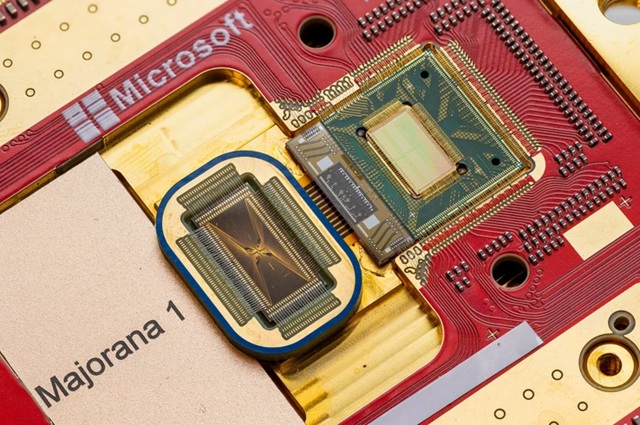
Microsoft’s claim to have created the first ‘topological qubits’—a milestone in quantum computing—has come under renewed scrutiny. A recent analysis questions the validity of the test Microsoft uses to detect Majorana quasiparticles, which are essential for topological qubits to function. The controversy arises amidst growing skepticism regarding the company’s February 19 announcement.
Physicist Henry Legg from the University of St Andrews, UK, has raised concerns about the ‘topological gap protocol’ (TGP), a test used to identify Majoranas. Microsoft has indicated that the TGP underpins its qubit breakthrough, though it was not explicitly mentioned in the initial announcement. Legg’s critique, published as a preprint, argues that flaws in the TGP undermine the foundation of Microsoft’s claim.
In response, Chetan Nayak, who leads Microsoft’s quantum computing research, dismissed the critique as a misrepresentation. However, the debate underscores the challenges of verifying topological qubits—a goal that has eluded scientists for years.
Majoranas have a history of being misidentified, leading to previous retractions in the field. In 2022, Microsoft researchers published a study in Physical Review B (PRB) claiming that the TGP could detect Majoranas with high probability. Legg and his colleagues at the University of Basel later pointed out that the test could yield false positives, identifying mimics rather than genuine Majoranas.
Legg’s latest analysis highlights further inconsistencies in Microsoft’s data, particularly variations in external conditions such as magnetic field strength during testing. This variation, he argues, makes the TGP unreliable as a means of confirming the presence of Majoranas. Nayak countered that Microsoft’s approach accounts for these variations, maintaining that the test remains valid.
Another issue concerns discrepancies between the protocol as described in the PRB paper and the actual code used in Microsoft’s research. Legg claims Nayak previously acknowledged this issue and intended to issue a correction before reversing course. Nayak now disputes Legg’s assertion, calling it a “non-issue.”
Several leading physicists have weighed in on the debate. Carlo Beenakker from Leiden University acknowledges Legg’s critique but remains optimistic about Microsoft’s topological qubit research. Delft University’s Anton Akhmerov, however, argues that Microsoft owes the scientific community a public response to Legg’s concerns.
Adding to the uncertainty, Microsoft researchers withheld key details from their PRB publication, citing intellectual property concerns. The journal’s editorial board noted that this lack of transparency was unusual and urged Microsoft to release additional data by the end of 2024. Akhmerov insists that full validation of Microsoft’s claims is impossible without access to the source code for their simulations.
While Microsoft has shared some device parameters with Nature’s news team, this has not settled the debate. Nature—which published an accompanying paper detailing Microsoft’s measurement method but not confirming the existence of topological qubits—has acknowledged the concerns but maintains that its publication’s validity remains unaffected.
More clarity may emerge on March 18, when Nayak is scheduled to present Microsoft’s latest findings at the American Physical Society meeting in Anaheim, California. Until then, skepticism remains. As Beenakker put it, “There’s no convincing, even mildly convincing, evidence for Majoranas.”
The Sri Lanka Guardian is an online web portal founded in August 2007 by a group of concerned Sri Lankan citizens including journalists, activists, academics and retired civil servants. We are independent and non-profit. Email: editor@slguardian.org
Your email address will not be published.
A trove of leaked documents has unveiled a covert operation exposing the Turkish defence industry’s deep
China has long been a hub for global scientific research, attracting foreign scholars with promising funding
Artificial intelligence (AI) is increasingly being used to detect errors in scientific research papers, an effort
The article from Nature highlights the uncertain fate of the Athena lunar lander, which touched down
Scientists are pushing the boundaries of genetic technology in an effort to resurrect traits from extinct
NDB Bank is excited to introduce ‘NDB Pixel,’ an innovative digital banking solution designed specifically for
The involvement of external forces in the internal politics of sovereign nations remains a contentious issue
The late 19th century saw economists, mainly German and Austrian, create a mythology of money’s origins
Introduction In recognition of International Women’s Day on 8th march this year, Sri Lanka has taken
India’s External Affairs Minister S. Jaishankar has dismissed the notion that BRICS is working against the
source
This is a newsfeed from leading technology publications. No additional editorial review has been performed before posting.