
2 Top Picks for Investing in the Cybersecurity Industry – Morningstar
Get 14 Days Free

In an increasingly dangerous digital world, cybersecurity firms are more indispensable than ever.
Amid a growing number of cybersecurity threats, the shift to cloud storage, and the artificial intelligence boom, we expect the cybersecurity industry to outgrow overall IT spending and match software industry growth.
In particular, we believe firms offering solutions in newer areas of cybersecurity will spearhead growth for the coming years.
Over the next five years, we believe the security market is going to see marked growth in areas such as identity, infrastructure, application, and data. While traditional bastions of security spending such as network, services, and consumer are also slated for growth, we believe even within these end markets, the drivers of growth will be cloud-native security solutions.
Here, we outline our expectations for the cybersecurity industry and the companies that are best positioned to succeed amid this environment.
Our outlook for the cybersecurity industry is centered on three key industry themes:
As firms secure their businesses against nefarious activity in a cloud-first world, we believe that newer, more nascent areas such as cloud, endpoint, and data are all projected to grow meaningfully. Meanwhile, traditional security end markets such as security services, consumer, and network are projected to expand at a slower pace.
As the broader cybersecurity market grows, we expect the companies under our coverage to drive operating leverage throughout their businesses and expand profitability. This ability to tone down sales and research spending as a percentage of revenue is particularly evident in moaty cybersecurity companies that enjoy higher customer switching costs and thus are able to decelerate some operating expenses without risking customer churn. For our no-moat cohort, we expect adjusted margins to remain roughly flat over the next five years.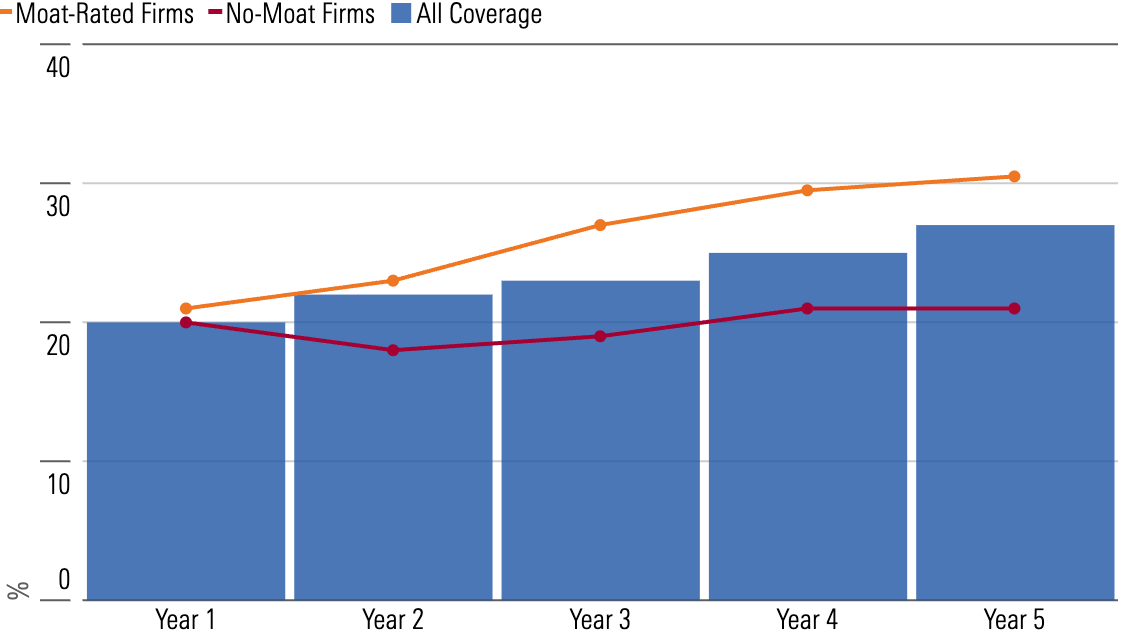
That said, we don’t believe that industry growth will be distributed equally. Cybersecurity is an incredibly fragmented market. While there are both macro and industry-specific reasons for the level of fragmentation in the space, we don’t see this as a permanent state. We hold the view that buyers are increasingly interested in consolidating their security spending on a smaller group of security vendors. We expect enterprises will buy a larger number of tools from fewer vendors, thereby making platform vendors the long-term winners. We expect this trend will be long term in nature, playing out over the next decade-plus.
We also believe that AI will be a new demand driver for the industry. AI will cause an increase in the number and sophistication of cyberattacks as attacks become more automated, personalized, and scalable. As the attack frequency and intensity increase, so will demand for cybersecurity solutions. AI-driven attacks will also likely cause new types of attacks and strategies, which will demand innovation within cybersecurity.
Morningstar covers 14 cybersecurity companies with market capitalizations ranging from $2 billion to nearly $115 billion. Because of the fast-paced nature of the industry and the constant threat of disruption, Morningstar Uncertainty ratings are typically High or Very High for cybersecurity firms.
Only two companies under our coverage merit a wide moat, largely because of their more complete platforms of security solutions that insulate their businesses from future disruption. They are:
Palo Alto Networks
We believe that Palo Alto Networks stands to materially benefit from secular tailwinds across its three key end markets as cloud migrations, shifts to zero-trust security, and expanded automation in cybersecurity increase the firm’s proposition to its clients.
We are encouraged by Palo Alto’s ability to sell more of its solutions to its customers. The firm’s success in cross-selling existing/new customers its three security platforms spanning network, cloud, and security operations is evidence of vendor consolidation—a trend that we see as likely to continue. As Palo Alto up/cross-sells its customers more solutions, we also see the entrenchment in its clients’ ecosystems increasing, driving retention rates and customer lifetime values higher.
Fortinet
In our view, the firm’s established customer switching costs, buttressed by its increasingly potent network effect, will allow Fortinet to continuously gain and expand its number of clients and has already enabled it to build a wide economic moat around its business.
While Fortinet’s build-versus-buy mentality has allowed it to expand its footprint in network security, we expect the firm to engage in inorganic methods to bolster its offerings in high-growth verticals such as security operations. In the long run, we expect these verticals to be key portions of an enterprise’s security spending, which Fortinet can tap into.
This article was compiled by Emelia Fredlick.
The author or authors do not own shares in any securities mentioned in this article. Find out about Morningstar’s editorial policies.
The information contained within is for educational and informational purposes ONLY. It is not intended nor should it be considered an invitation or inducement to buy or sell a security or securities noted within nor should it be viewed as a communication intended to persuade or incite you to buy or sell security or securities noted within. Any commentary provided is the opinion of the author and should not be considered a personalised recommendation. The information contained within should not be a person’s sole basis for making an investment decision. Please contact your financial professional before making an investment decision.
The trust, which was formed of a merger in 2024, has increased its dividend for the 58th time.
Celebrating women’s leadership and impact for International Women’s Day.
International Women’s Day: These managers and management teams consistently impress.
These undervalued stocks of high-quality companies are attractive investments today.
European Central Bank also lowers growth forecasts and upgrades its inflation projections.
Mining companies are operating in a challenging environment but could now be the time to top up o…
THE WEEK: Morningstar columnist Rodney Hobson provides two pieces of advice to George Osborne, an…
Businesses that have competitive advantages within their industry are good candidates for dividen…
Morningstar reveals the top 10 best performers over the last five years
Morningstar OBSR reveals the top funds for investors seeking exposure to European equities
The trust, which was formed of a merger in 2024, has increased its dividend for the 58th time.
Celebrating women’s leadership and impact for International Women’s Day.
International Women’s Day: These managers and management teams consistently impress.
These undervalued stocks of high-quality companies are attractive investments today.
European Central Bank also lowers growth forecasts and upgrades its inflation projections.
Malik Ahmed Khan is an equity analyst, technology, for Morningstar Research Services LLC, a wholly owned subsidiary of Morningstar, Inc.
About Us
Connect With Us
Get Help
Terms of Use Privacy Policy Modern Slavery Statement Cookie Settings Disclosures
The Morningstar Star Rating for Stocks is assigned based on an analyst’s estimate of a stocks fair value. It is projection/opinion and not a statement of fact. Morningstar assigns star ratings based on an analyst’s estimate of a stock’s fair value. Four components drive the Star Rating: (1) our assessment of the firm’s economic moat, (2) our estimate of the stock’s fair value, (3) our uncertainty around that fair value estimate and (4) the current market price. This process culminates in a single-point star rating that is updated daily. A 5-star represents a belief that the stock is a good value at its current price; a 1-star stock isn’t. If our base-case assumptions are true the market price will converge on our fair value estimate over time, generally within three years. Investments in securities are subject to market and other risks. Past performance of a security may or may not be sustained in future and is no indication of future performance. For detail information about the Morningstar Star Rating for Stocks, please visit here
Quantitative Fair Value Estimate represents Morningstar’s estimate of the per share dollar amount that a company’s equity is worth today. The Quantitative Fair Value Estimate is based on a statistical model derived from the Fair Value Estimate Morningstar’s equity analysts assign to companies which includes a financial forecast of the company. The Quantitative Fair Value Estimate is calculated daily. It is a projection/opinion and not a statement of fact. Investments in securities are subject to market and other risks. Past performance of a security may or may not be sustained in future and is no indication of future performance. For detail information about the Quantiative Fair Value Estimate, please visit here
The Morningstar Medalist Rating is the summary expression of Morningstar’s forward-looking analysis of investment strategies as offered via specific vehicles using a rating scale of Gold, Silver, Bronze, Neutral, and Negative. The Medalist Ratings indicate which investments Morningstar believes are likely to outperform a relevant index or peer group average on a risk-adjusted basis over time. Investment products are evaluated on three key pillars (People, Parent, and Process) which, when coupled with a fee assessment, forms the basis for Morningstar’s conviction in those products’ investment merits and determines the Medalist Rating they’re assigned. Pillar ratings take the form of Low, Below Average, Average, Above Average, and High. Pillars may be evaluated via an analyst’s qualitative assessment (either directly to a vehicle the analyst covers or indirectly when the pillar ratings of a covered vehicle are mapped to a related uncovered vehicle) or using algorithmic techniques. Vehicles are sorted by their expected performance into rating groups defined by their Morningstar Category and their active or passive status. When analysts directly cover a vehicle, they assign the three pillar ratings based on their qualitative assessment, subject to the oversight of the Analyst Rating Committee, and monitor and reevaluate them at least every 14 months. When the vehicles are covered either indirectly by analysts or by algorithm, the ratings are assigned monthly. For more detailed information about these ratings, including their methodology, please go to here
The Morningstar Medalist Ratings are not statements of fact, nor are they credit or risk ratings. The Morningstar Medalist Rating (i) should not be used as the sole basis in evaluating an investment product, (ii) involves unknown risks and uncertainties which may cause expectations not to occur or to differ significantly from what was expected, (iii) are not guaranteed to be based on complete or accurate assumptions or models when determined algorithmically, (iv) involve the risk that the return target will not be met due to such things as unforeseen changes in changes in management, technology, economic development, interest rate development, operating and/or material costs, competitive pressure, supervisory law, exchange rate, tax rates, exchange rate changes, and/or changes in political and social conditions, and (v) should not be considered an offer or solicitation to buy or sell the investment product. A change in the fundamental factors underlying the Morningstar Medalist Rating can mean that the rating is subsequently no longer accurate.
For information on the historical Morningstar Medalist Rating for any managed investment Morningstar covers, please contact your local Morningstar office.
For more detailed information about conflicts of interest, including EU MAR disclosures, please see the “Morningstar Medalist Rating Analyst Conflict of Interest & Other Disclosures for EMEA”here
source
This is a newsfeed from leading technology publications. No additional editorial review has been performed before posting.