AI in Music Creation: Opportunities and Challenges for Artists
How Michael Smith defrauded musici streaming services by $10 million dollars
By Carsten Krause, September 9th, 2024
Artificial intelligence (AI) is reshaping industries globally, from healthcare to finance, and now it’s making waves in the creative fields like music, visual arts, and journalism. While AI brings tremendous opportunities for efficiency, scalability, and innovation, it also introduces ethical challenges and risks, especially for artists and content creators. The recent case of a North Carolina man, Michael Smith, who allegedly defrauded music streaming services of $10 million using AI-generated songs, illustrates the dark side of AI in the music industry. In this article, we explore both the potential and pitfalls of AI-based business models, focusing on what they mean for artists and their rights.
The Promise of AI-Based Business Models
AI offers immense benefits for businesses, particularly by improving efficiency, automating processes, and providing new opportunities for innovation. In the music industry, AI-based business models are being adopted for everything from composing music to analyzing consumer behavior.
Chart 1: The Growth of AI-Generated Content Across Industries (2018-2024)
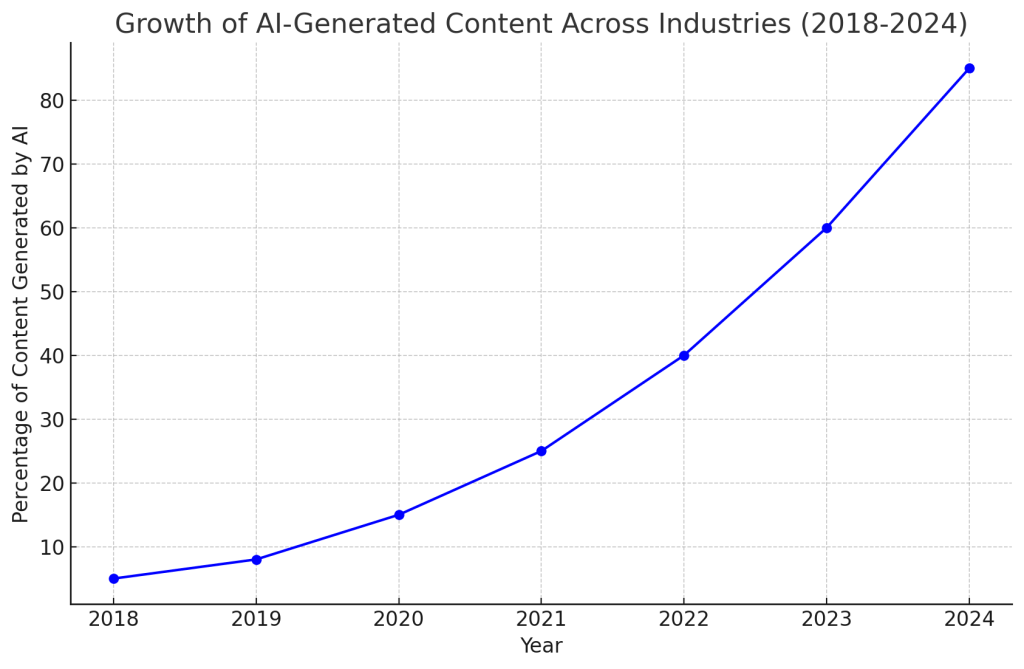
This chart highlights the rapid increase in AI-generated content across various sectors, from music and video to written articles.
1. AI in Music Creation
AI has become a powerful tool in music creation, enabling musicians to automate parts of the creative process, such as writing, composing, and mixing. Companies like AIVA Technologies are using AI to assist composers by generating original music in a variety of genres. This kind of technology allows musicians to scale their output, freeing them to focus on more creative elements.
An example of AI’s creative power can be seen in AIVA’s platform (https://www.aiva.ai/), where users can generate complete symphonies with minimal input. While this opens up possibilities for those without traditional musical training, it also raises questions about the ownership of AI-generated works.
2. Scalability and Automation
AI enables businesses to automate and scale operations quickly. In the music industry, services like Endel (https://endel.io/) use AI to generate personalized soundscapes based on factors such as time of day, weather, and user behavior. This type of customization, enabled by AI, is becoming increasingly popular as a way to enhance user engagement and improve user experience.
For example, AI platforms like Amper Music (https://www.ampermusic.com/) allow businesses to produce background music for commercials, videos, and games without needing a human composer. This ability to automate content creation at scale has clear benefits for businesses but poses risks to human artists whose livelihood depends on their creativity.
The Dark Side of AI: Exploitation and Fraud
Despite the benefits AI-based models offer, they can also be exploited. Michael Smith’s $10 million music streaming scam highlights the potential for abuse. Between 2017 and 2023, Smith allegedly used AI-generated songs and bot accounts to manipulate streaming platforms like Spotify, Apple Music, and YouTube Music, inflating streams to collect fraudulent royalty payments (https://www.forbes.com/sites/lesliekatz/2024/09/08/man-charged-with-10-million-streaming-music-scam-using-ai-generated-songs).
Chart 2: Decline in Artist Revenue Per Stream Since the Rise of AI-Generated Music (2017-2024)

This chart shows the decline in revenue per stream for musicians as AI-generated music increasingly floods streaming platforms.
AI-generated music can also be weaponized to bypass intellectual property protections. In April 2023, a fake Drake song, created using AI, went viral on platforms like TikTok and Spotify before being quickly removed due to copyright concerns (https://www.billboard.com/music/rb-hip-hop/fake-drake-weeknd-song-ai-viral-1235304239/). This event sparked a heated debate about the ethical and legal implications of using AI to replicate the likeness and style of established artists without their consent.
1. AI-Generated Music Fraud: The Michael Smith Case
The fraud committed by Michael Smith is one of the first known instances of large-scale abuse of AI in the music industry. Smith allegedly created hundreds of thousands of AI-generated songs using random artist names and streamed these tracks on repeat with the help of bot accounts. Each stream generated royalty payments, totaling more than $10 million, that should have gone to real artists (https://www.justice.gov/usao-sdny/pr/north-carolina-man-charged-10-million-streaming-fraud-scheme-using-ai-generated-music).
2. Threats to Artist Rights and Copyright
AI models need vast amounts of data to function effectively, and this often includes the creative works of artists, writers, and musicians. Content creators fear that their work is being used to train AI models without proper compensation. In 2023, the New York Times publicly stated concerns about how AI models scrape their articles to train algorithms without proper credit or compensation (https://www.nytimes.com/2023/09/04/business/media/new-york-times-openai-copyright.html).
AI’s Impact on Other Content Creators
It’s not just musicians who are feeling the impact of AI. Journalists, authors, and visual artists are all grappling with similar challenges. The New York Times and other major news outlets have expressed concerns about how their reporting is being used to train AI models without proper compensation or consent (https://www.nytimes.com/2023/08/16/technology/new-york-times-ai-rights.html).
Artists and authors also worry about AI’s ability to mimic their style. AI-generated visual art is gaining popularity on platforms like Artbreeder (https://www.artbreeder.com/), where users can generate entirely new artworks by blending different styles and artists’ works. The question of who owns these AI-generated pieces remains murky, leading to legal battles and calls for stronger intellectual property protections for creators.
3. Erosion of Human Creativity
Many artists fear that AI-generated content could homogenize creative fields. When machines generate music, art, or writing based on past data, they often replicate trends, potentially stifling innovation. While AI-generated art can create fascinating results, it lacks the depth, emotional resonance, and individuality that define human creativity. If left unchecked, this could reduce the value of original, human-made work, and create an environment where content becomes repetitive and formulaic.
Chart 3: Share of AI-Generated Music in Top Streaming Playlists (2020-2024)
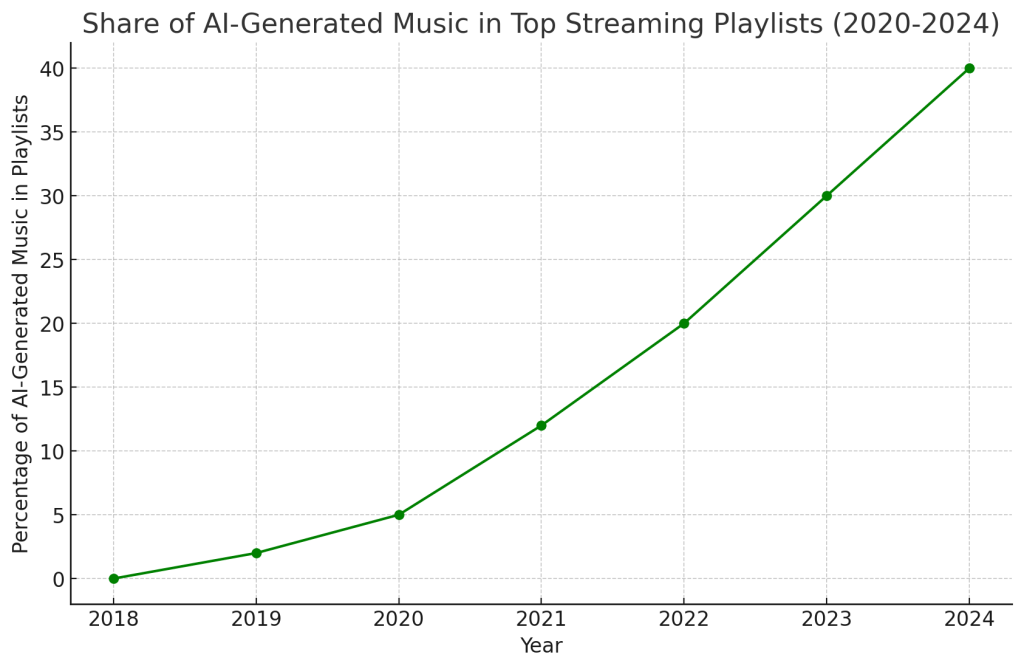
This chart illustrates the rising share of AI-generated music in popular streaming playlists on platforms like Spotify and YouTube Music.
Balancing Innovation and Protection for Artists
As AI continues to advance, a balance must be struck between the innovative potential of AI and the protection of human creators. Here are three critical areas of focus for ensuring a fairer system:
1. Stronger Regulation and Oversight
Regulators must establish clearer guidelines on the use of AI in content creation. There should be laws protecting artists whose works are used to train AI models, ensuring they are compensated fairly for their contributions. Streaming platforms and AI developers must also enforce stronger anti-fraud systems to prevent exploitation.
2. Transparent Royalty Systems
Artists are already facing challenges in receiving fair compensation for their work. As AI-generated music grows, platforms must develop more transparent royalty systems. Blockchain technology offers a promising solution, allowing every stream to be tracked and royalties distributed fairly to all stakeholders (https://openmusicinitiative.org/blockchain/).
3. Ethical AI Development
Developers must collaborate with artists to ensure AI models are trained ethically. This includes obtaining proper licenses for training data and providing artists with the ability to opt-out if they don’t want their work used by AI. Companies like Audoo (https://audoo.com/) are leading efforts to create ethical solutions for music streaming, helping artists protect their rights while still leveraging AI’s benefits.
The CDO TIMES Bottom Line
AI is a powerful tool that can transform industries, but it also presents risks to artists and creators. While AI enables new ways of creating and distributing content, it can also be exploited for fraudulent purposes, as seen in Michael Smith’s $10 million scam. For artists, AI-generated music, art, and writing raise critical questions about compensation, ownership, and the future of creativity. Protecting artists’ rights and ensuring the ethical use of AI is crucial as we move into a more automated and AI-driven future.
Love this article? Embrace the full potential and become an esteemed full access member, experiencing the exhilaration of unlimited access to captivating articles, exclusive non-public content, empowering hands-on guides, and transformative training material. Unleash your true potential today!
Order the AI + HI = ECI book by Carsten Krause today! at cdotimes.com/book

Subscribe on LinkedIn: Digital Insider
Become a paid subscriber for unlimited access, exclusive course content, no ads: CDO TIMES
Do You Need Help?
Consider bringing on a fractional CIO, CISO, CDO or CAIO from CDO TIMES Leadership as a Business Consulting Service. The expertise of CDO TIMES becomes indispensable for organizations striving to stay ahead in the digital transformation journey. Here are some compelling reasons to engage their experts:
- Deep Expertise: CDO TIMES has a team of experts with deep expertise in the field of Cybersecurity, Digital, Data and AI and its integration into business processes. This knowledge ensures that your organization can leverage digital and AI in the most optimal and innovative ways.
- Training, developing, arranging, and conducting educational conferences and programs and providing courses of instruction.
- Strategic Insight: Not only can the CDO TIMES team help develop a Digital & AI strategy, but they can also provide insights into how this strategy fits into your overall business model and objectives. They understand that every business is unique, and so should be its Digital & AI strategy.
- Future-Proofing: With CDO TIMES, organizations can ensure they are future-proofed against rapid technological changes. Our experts stay abreast of the latest AI, Data and digital advancements and can guide your organization to adapt and evolve as the technology does.
- Risk Management: Implementing a Digital & AI strategy is not without its risks. The CDO TIMES can help identify potential pitfalls and develop mitigation strategies, helping you avoid costly mistakes and ensuring a smooth transition with fractional CISO services.
- Competitive Advantage: Finally, by hiring CDO TIMES experts, you are investing in a competitive advantage. Their expertise can help you speed up your innovation processes, bring products to market faster, and stay ahead of your competitors.
By employing the expertise of CDO TIMES, organizations can navigate the complexities of digital innovation with greater confidence and foresight, setting themselves up for success in the rapidly evolving digital economy. The future is digital, and with CDO TIMES, you’ll be well-equipped to lead in this new frontier.
Do you need help with your digital transformation initiatives? We provide fractional CAIO, CDO, CISO and CIO services, do a Preliminary ECI and Tech Navigator Assessment and we will help you drive results and deliver winning digital and AI strategies for you!
Subscribe now for free and never miss out on digital insights delivered right to your inbox!