Researchers reduce bias in AI models while preserving or improving accuracy
A new technique identifies and removes the training examples that contribute most to a machine-learning model’s failures.
Read More

A new technique identifies and removes the training examples that contribute most to a machine-learning model’s failures.
Researchers propose a simple fix to an existing technique that could help artists, designers, and engineers create better 3D models.
Read MoreThis new device uses light to perform the key operations of a deep neural network on a chip, opening the door to high-speed processors that can learn in real-time.
Read MoreThe technique could make AI systems better at complex tasks that involve variability.
Read MoreResearchers show that even the best-performing large language models don’t form a true model of the world and its rules, and can thus fail unexpectedly on similar tasks.
Read More“Co-LLM” algorithm helps a general-purpose AI model collaborate with an expert large language model by combining the best parts of both answers, leading to more factual responses.
Read MoreA new algorithm helps robots practice skills like sweeping and placing objects, potentially helping them improve at important tasks in houses, hospitals, and factories.
Read MoreMAIA is a multimodal agent that can iteratively design experiments to better understand various components of AI systems.
Read MoreNew CSAIL research highlights how LLMs excel in familiar scenarios but struggle in novel ones, questioning their true reasoning abilities versus reliance on memorization.
Read MoreThe SPARROW algorithm automatically identifies the best molecules to test as potential new medicines, given the vast number of factors affecting each choice.
Read More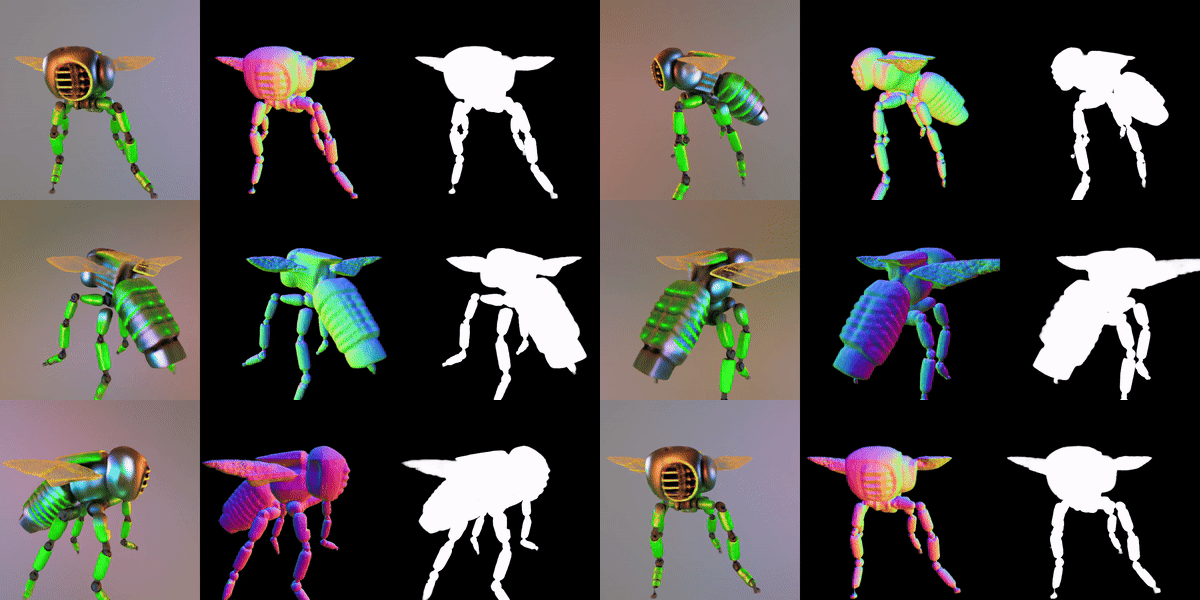

You must be logged in to post a comment.