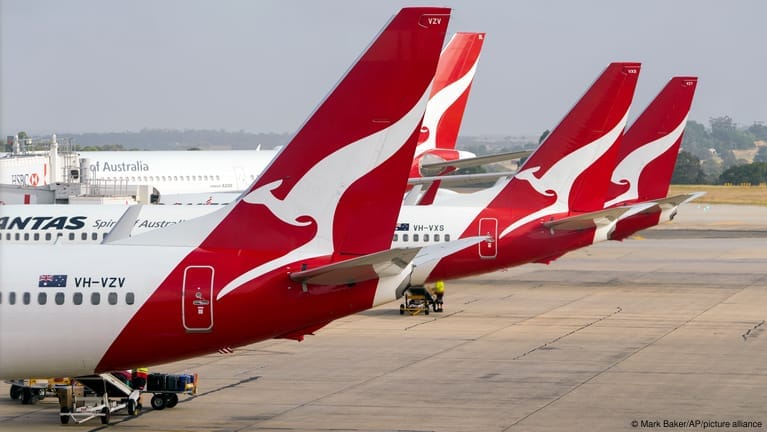
Qantas Restructures Head Office Operations, Affecting 850 Jobs – CIO Africa
On Tuesday, November 10, 2026, corporate staff at Qantas’s Mascot headquarters in Sydney received an email from Chief Executive Vanessa Hudson laying out the human cost of that overhaul. Around 850 back-office jobs will be cut and outsourced to Accenture, a massive global technology and management consulting firm, under a new multi-year technology and artificial intelligence partnership.
Rather than keeping all those roles local, Qantas confirmed that most of the outsourced work will be shifted to Accenture teams in India, with only a smaller portion remaining in Australia. “I know this is hard news for some, and I’m sorry for the uncertainty it brings,” Hudson wrote in the internal note, adding that the cuts are “not a reflection of their contribution or commitment”.
For more than a century, Qantas has been the aviation backbone of Australia. Founded in the Queensland outback in 1920, the country’s flagship carrier-affectionately known globally as the “Flying Kangaroo”-connects millions of travelers across domestic towns and long-haul international routes, employing roughly 28,000 people across Australia.
Yet behind the scenes of one of the world’s oldest and most recognizable airlines sits a modern technological headache: decades of piecemeal upgrades have left Qantas running on more than 1,000 separate legacy computer applications that were never designed to speak to one another. Now, the airline has decided to untangle that digital patchwork, and the people paying the price for the fix work in its own corporate headquarters.
The restructuring represents roughly 3% of Qantas’s Australian workforce and will happen gradually over several years rather than overnight. The first wave of job losses is scheduled to begin by mid-2027 and will target parts of four specific corporate divisions: finance, procurement, people (human resources), and marketing. Passengers will not see any disruption at the airport, as frontline operational staff – including pilots, cabin crew, aircraft engineers, and airport ground workers – are completely untouched by the cuts. Between now and the mid-2027 rollout, Qantas says it will consult with affected employees and labor unions, aiming to retrain and redeploy displaced workers into other open roles across the airline group wherever possible.
The overhaul is being billed by Qantas as a vital technical modernization rather than just cost-cutting. Accenture will link the airline’s 1,000-plus fragmented software systems and integrate artificial intelligence to streamline administrative tasks. Hudson noted that while Qantas already spends over A$1 billion annually on tech, partnering with Accenture addresses specialized skill shortages quickly, stating that “Standing still is not an option for us”.
The announcement coincides with financial pressures, including a 20% drop in annual net profit due to fuel costs. Despite the layoffs, Qantas shares rose over 6% in Sydney trading. The move follows a broader trend among Australian firms, such as NAB, Canva, Telstra, Woolworths, and Coles, shifting corporate roles to offshore hubs.
Unions strongly condemned the decision, pointing to prior assurances that jobs wouldn’t be offshored following the leaked “Project iQ” plan. Scott Cowen and Angus McFarland of the Australian Services Union (ASU) criticized the shift as a “smokescreen” for shipping local jobs overseas, though a Qantas spokesperson denied providing such assurances. Transport Workers Union official Michael Kaine also noted the parallels to Qantas’s illegal 2020 ground-handling outsourcing, which resulted in a landmark High Court loss, a A$120 million worker compensation fund, and a A$90 million Federal Court penalty.
While the full financial terms remain confidential, though comparable to Telstra’s A$700 million Accenture deal, Qantas has not disclosed the exact headcount distribution or total projected savings.
Your email address will not be published.
CIO Africa serves the enterprise community of CIOs and senior technology decision-makers with peer insight and expertise on Business Strategy, Innovation and Leadership. CIO attracts the highest concentration of enterprise CIOs and business technology executives of any media brand, reaching over one million.
© 2010 – 2026 Chief Information Officer Africa Ltd. All rights reserved.
Privacy Policy
Terms of Service
source
This is a newsfeed from leading technology publications. No additional editorial review has been performed before posting.