
IQM and Volkswagen Advance Quantum-Classical AFQMC to Simulate Next-Generation Battery Chemistry – Quantum Computing Report
 Written by the team at Global Quantum Intelligence
GQI’s intelligence platform, from the team that publishes QCR. Your QCR account includes a free preview.
2 min read
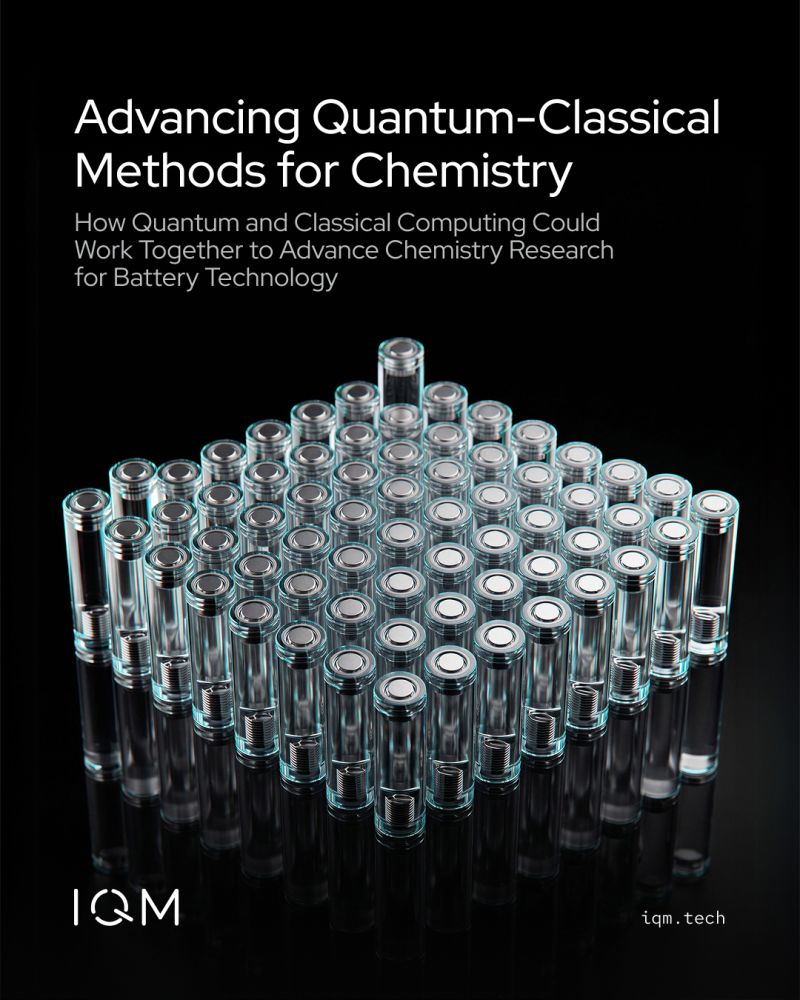
European quantum hardware manufacturer IQM Quantum Computers (Nasdaq: IQMX) and Volkswagen Group Innovation have demonstrated algorithmic and experimental advances in Quantum-Classical Auxiliary-Field Quantum Monte Carlo (QC-AFQMC), reducing the classical post-processing runtime scaling of the hybrid electronic structure algorithm by an order of magnitude. Detailed in a technical study titled Quantum-Classical Auxiliary-Field Quantum Monte Carlo at the Edge of Practicability, the collaboration achieved up to a 124× reduction in classical execution time for a 50-orbital benchmark and validated the workflow on IQM’s commercial Emerald superconducting processor.
Simulating complex chemical reactions—such as the intermediate stages of lithium-air battery cycles—presents severe challenges for classical electronic structure methods due to the exponential growth of Slater determinants needed to capture strong electron correlation. Standard classical phaseless AFQMC (ph-AFQMC) mitigates sign problems by projecting random walks against a trial wavefunction; however, the method incurs systematic bias if that trial state cannot accurately represent multi-reference character. While QC-AFQMC leverages a quantum computer to prepare high-fidelity multi-determinant trial states, calculating the overlaps between the quantum trial state and classical Monte Carlo walkers has historically created a prohibitive computational bottleneck.
Rather than using deep modified Hadamard test circuits (which the authors estimate would require millenia of execution time for even modest systems), the team utilized matchgate shadow tomography to reconstruct state overlaps via classical post-processing. By applying Aitken’s block transformation to resolve the singular Pfaffians that naturally arise in matchgate shadow kernels, the researchers reduced per-snapshot overlap evaluation from O(N4) to O(N3). Combined with algorithmic differentiation for Jacobian-vector products in the force bias calculations, the overall per-step classical post-processing dropped from Õ(N5.5) to Õ(N4.5).
To validate the workflow against physical hardware noise, the team calculated the ground-state energy of an H8 hydrogen chain on the 54-qubit IQM Emerald processor, applying matrix product state (MPS) filtering to discard noisy measurements. The researchers then scaled the methodology in classical simulation to model the rearrangement pathway of a lithium superoxide dimer (Li2O4) across a 40-qubit active space, accurately capturing the activation barrier and transition-state geometry governing battery charge/discharge mechanisms.
Technical whitepaper summaries are accessible on the IQM Case Study Portal here and the Direct Whitepaper Document here, with the full peer-reviewed preprint available on arXiv here.
In GQI Portal
The team that writes QCR tracks every company, deal and technology in the GQI Factory, GQI's verified database of the quantum industry. Next up: every story linked to its players, coming to QCR's paid plans.
Newsletter
The latest reporting and analysis from Quantum Computing Report. Free, unsubscribe any time.
All fields are required. Your email address will not be published.
Tracking the companies, people, science and capital shaping quantum technology since 2015.
Global Quantum Intelligence provides decision intelligence for strategic stakeholders in quantum. Its team writes Quantum Computing Report.
Nexus, powered by GQI, connects quantum startups and investors through verified profiles and strategic matchmaking.
source
This is a newsfeed from leading technology publications. No additional editorial review has been performed before posting.


