House officials tell committee AI strategy unpublished and U.S. courts could reach Commons data – The Hub | More Signal. Less Noise.
The House of Commons has an artificial intelligence strategy for 2025 to 2027 that has never been made public, and its own technology director says the data it stores with Microsoft carries risks under the U.S. CLOUD Act.
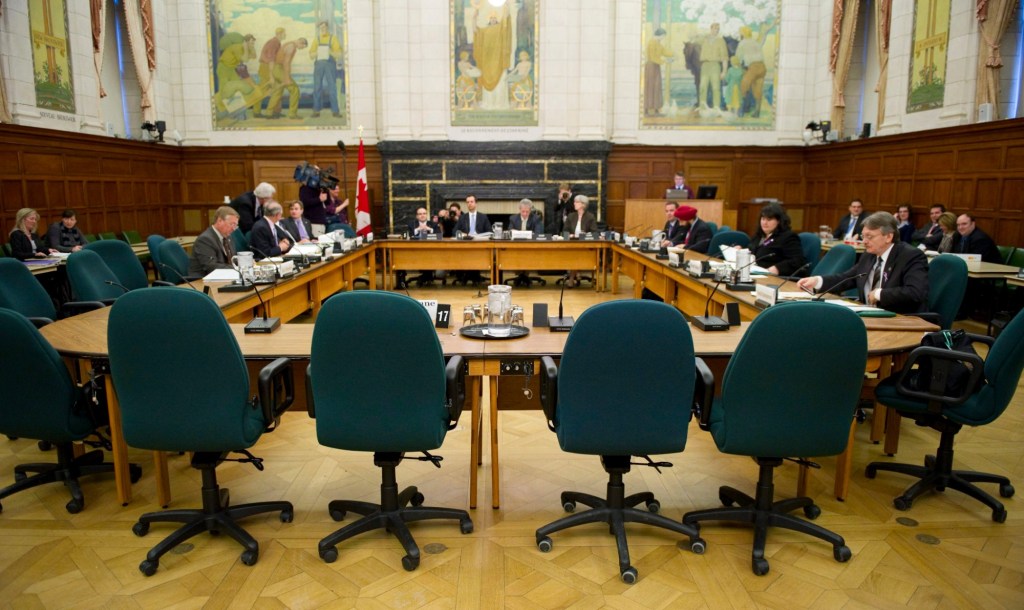
Both concessions came Tuesday as the Clerk of the House, Eric Janse, and two senior administrators appeared before the Standing Committee on Procedure and House Affairs for its study of AI and Canada’s democratic institutions. A second panel of parliamentary interpreters followed with a warning that machine interpretation is not fit for Parliament.
The hearing matters because the House is already running a Copilot pilot for members chosen by party whips, and has been using AI to produce a first draft of Hansard for more than a year.
Conservative MP Michael Cooper opened by pinning down the status of the document the clerk had cited.
“That strategy has not been made public, has it?” Cooper asked.
“At the moment, no, the strategy is available internally only. It’s not been shared with the public,” replied Natalie Foster, Clerk Assistant and co-chair of the House of Commons AI Working Group. Cooper asked whether it could be provided to the committee and was told it could.
The sharper exchange came on where members’ data sits. Conservative MP Kelly DeRidder asked about the Microsoft agreement: “does it protect us from, like, the U.S. Cloud Act?”
Christopher Henry, Director General of Digital Enablement and Innovation, said “we have assurances in our contractual agreements for Microsoft to contact the speaker and the law clerk” if data is sought. But he went further. There could be legal aspects “that could ask for access to the information through court orders south of the border that we may not be able to fully, let’s say, intervene before those orders happen,” he said. “There are risks with the CLOUD Act around that.”
Henry noted “Microsoft is not technically a Canadian headquartered and owned company” and said the House is talking to Canadian AI firms about parallel pilots.
The second panel, from the International Association of Conference Interpreters, Canada Region, argued the one job AI must not be given is the microphone.
“The greatest risk with AI interpretation lies in the fact that artificial intelligence is not in fact intelligent. It is a statistical pattern matching black box that may sound human, but doesn’t actually think,” said conference interpreter Marina Mistral. “We believe that AI should never be given the job of interpreter because nobody deserves AI-grade interpreting.”
Speaking in French, Mistral cited a World Health Organization evaluation in which she said only one speech in 90 received a passing grade, French as a source language scored lowest at 36 per cent, and interpretation lagged by more than 30 seconds. She said the City of Moncton’s switch to an AI provider after its interpreter retired had produced a total disaster with delays of up to a minute.
Bloc Québécois MP Christine Normandin asked, in French, what message the prime minister’s planned 25 per cent cut to the Translation Bureau over five years sends. Association president Alionka Skup, also in French, called it hypocritical to call bilingualism a priority while making those cuts, and said about 90 per cent of parliamentary interpretation and translation goes toward French, so the savings would come at francophones’ expense.
Mistral said training pipelines are already thinning. One of two Canadian programs, at York University’s Glendon campus, “has been paused for a couple of semesters and we’re having issues everywhere with recruitment,” she said.
The House administration has committed to send the committee its internal AI strategy. DeRidder asked Mistral about the internal tests she described as disastrous: “Do you happen to have access to those reports?” Mistral replied, “Absolutely, I will send you all of the links after this committee is done.”
On witness submissions, Janse warned that “you could get 1,000, 10,000 submissions from one person in his basement.” Henry conceded “we don’t have all of the capabilities and sophistication to AI detect all content being submitted to the House,” though Foster said “we have not seen levels of abuse or submissions that are concerning to us.” A proposal on AI disclosure for briefs is going to the Liaison Committee.
Franklin De Vrieze of the Westminster Foundation for Democracy urged caution on using AI in lawmaking. “Experimentation and piloting is not the same as transformation,” he said.
Unanswered is whether the House will move from guidelines to binding rules. Foster, in French, said that depends on what MPs want, and that other parliaments bar any tool not cleared by cybersecurity.
The parliamentary hearing we covered: Procedure and House Affairs (Oct. 20). Quotes are from Hill Monitor‘s transcription services and can be checked against ParlVU.
The Hub’s mission is to create and curate news, analysis, and insights about a dynamic and better future for Canada in a…
The Hub’s mission is to create and curate news, analysis, and insights about a dynamic and better future for Canada in a single online information source.
Already a subscriber? Login
The Hub is a project of Hub Canada Media, a federally incorporated not-for-profit.
PLATINUM Corporate & Industry Council Members:
GOLD Members:
An introduction to Culture Chat
By signing up you’ll also get our email newsletter and special offers. Cancel anytime.
Already a member? Log in
By signing up you’ll get our email newsletter plus special offers and events. Cancel anytime.
Already a member? Login
By signing up you’ll get our email newsletter plus special offers and events. Cancel anytime.
source
This is a newsfeed from leading technology publications. No additional editorial review has been performed before posting.