
Enterprise Data Licensing for AI 3 Gates You Pitch SourceX – PC Tech Magazine
Which entity, which records, which rules: a precise fit check keeps African technology leaders from chasing an AI licensing deal on false assumptions.
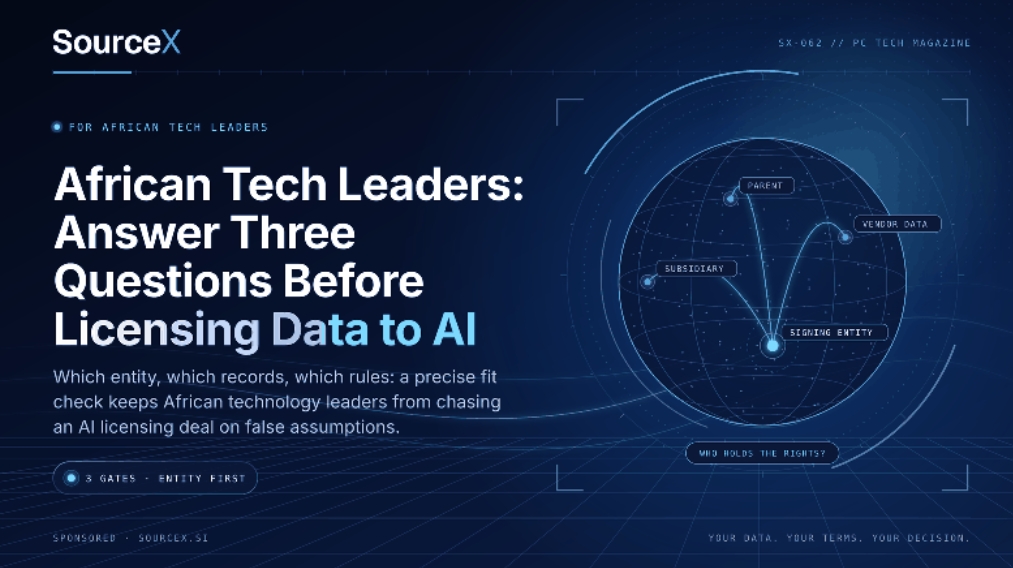
Concept illustration: eligibility follows the signing company, its systems and its data, not the network.
The board meeting ends with one action item for the CTO of a Kampala fintech: find out whether ten years of support history can be licensed for AI training. The company is illustrative, and so is its structure, with a holding entity in Mauritius and engineers in Nairobi.
The tempting next step is a pitch. The useful next step is three questions: which company, which collection, and under which program’s rules?
For anyone exploring enterprise data licensing in Africa, that precision matters more than enthusiasm, because a global AI opportunity does not automatically accept every company location or every archive.
Identify the legal entity that would sign a license and confirm its authority over the selected records. In the Kampala example, the operating company, the Mauritius holding company and an outsourced support vendor could each hold a different piece of the rights picture.
Then trace where the material came from. Customer contracts, vendor content and archives inherited through an acquisition can all carry restrictions that still apply to a new external use.
Your platform lead can describe the records in detail, but an authorized company leader decides whether to pursue a licensing assessment at all and who reviews it.
Three questions before the pitch. A conceptual sequence drawn from this article, not a measured result or a completed transaction.
Describe the task before the terabytes. A useful collection might connect a loan-servicing query to the checks performed and the resolution, or a failed mobile-money transfer to the investigation and the refund decision.
Record the gaps, duplicates and uncertain outcomes. A huge export can be mostly repetition, with no coherent account of finished work.
Your operations owner can name the context an outside reviewer would need and the conclusions the archive cannot support. That honesty makes the history more credible, not less.
SourceX licenses approved business data directly from companies for AI training and evaluation. Its current public guidance works in two tiers: companies in the United States, Canada and the European Union, and a second group of markets (the UK, Australia, New Zealand, India, Singapore, South Africa, Latin America, the UAE and Saudi Arabia) that qualify only when at least 90% of the data is in English.
Uganda is not on either tier today, and neither are Kenya or Mauritius. As things stand, the illustrative Kampala platform does not meet the location condition.
Confirm the actual supplier, its location and its authority over the proposed records. A different group company’s address is not enough by itself. Where several entities genuinely share rights, put that structure to SourceX for review rather than assuming a supported address qualifies the whole group.
Even a listed location is only a starting condition, not acceptance. SourceX’s stated core fit also includes at least 50 full-time employees at peak and several years of operating history, and qualification then looks at systems, rights and how useful the proposed dataset is.
Gates before any pitch: the four checks this article walks through.
For a company that does fit, the counterparty is SourceX itself: the company signs with SourceX, which manages qualification, scope, rights review, preparation and payout under signed terms. The top of SourceX’s advertised range is up to US$4 million, reserved for the largest enterprise datasets: an indicative upper bound, not a typical payout in the region, not a guaranteed offer and not evidence of any completed local deal.
The signed Dataset Deal Confirmation fixes the selected collection, compensation, permitted uses, processing route and deadlines. Read it with the Master before committing; an attractive estimate is not a completed purchase.
The company keeps ownership of its original records. Selected data is exclusive to SourceX for AI training for the term in the Dataset Deal Confirmation. Separately, SourceX’s rights over the deidentified dataset are perpetual, irrevocable, transferable and sublicensable, including model training and evaluation, use in products and onward distribution. Once the fee is paid, those rights survive termination, with no obligation to untrain or delete models already built from the data.
Extraction and delivery require a signed Master Supplier Licensing Agreement, a signed Dataset Deal Confirmation and SourceX’s go-ahead. Signing does not guarantee a purchase: SourceX may decline the delivered data. Written acceptance and every Closing condition lead to a Closing Notice, then an invoice. Under standard terms, payment is due within 60 calendar days after SourceX receives a valid invoice, unless different terms are signed. Data that does not reach Closing earns no payment.
What counts is the entity that actually holds the rights to the records being proposed.
A company with appropriate records may explore a supplier assessment where it meets the current criteria. A professional who knows an eligible company may instead explore the referral program, subject to partner approval, a signed Channel Partner Agreement and its separate terms. For example, a Kampala consultant could ask about introducing a qualifying Johannesburg client; neither location alone guarantees eligibility.
Neither role allows an employee or adviser to forward company files without permission. Company-level information is enough to start a fit conversation.
Run these gates: Entity, location, substance: three yes-or-no gates before anyone drafts a pitch. A single no tells you which conversation to have next.
Run three yes-or-no gates before anyone drafts a pitch:
A single no is not a failure. It tells you which conversation to have next, whether that is a rights review, a referral route or a decision to wait.
Above all, it turns enterprise data licensing in Africa into a question you answer with evidence instead of optimism.
Use SourceX‘s no-upload company fit check to confirm the actual supplier and current criteria. A supported group address is not a substitute for rights review; keep the proposed records and any unresolved entity questions explicit.
Noah Loul is a four-time founder and the founder and CEO of SourceX, which licenses business data directly from companies for AI training and evaluation. He previously founded B2B Rocket, acquired by Blackpearl Group. His work focuses on building permission-based data infrastructure for AI.
source
This is a newsfeed from leading technology publications. No additional editorial review has been performed before posting.


