
Inside the quest to combat Arctic fires and save the planet’s frozen carbon – MIT Technology Review
These scientists hope that fire-spotting satellites, AI tools and ancient land practices could preserve the world’s vulnerable permafrost—and the vast carbon it stores.
In the middle of an especially warm July in 2021, a wildfire ignited in a thick forest of black spruce and peeling paper birch trees on the northern campus of the University of Alaska, Fairbanks.
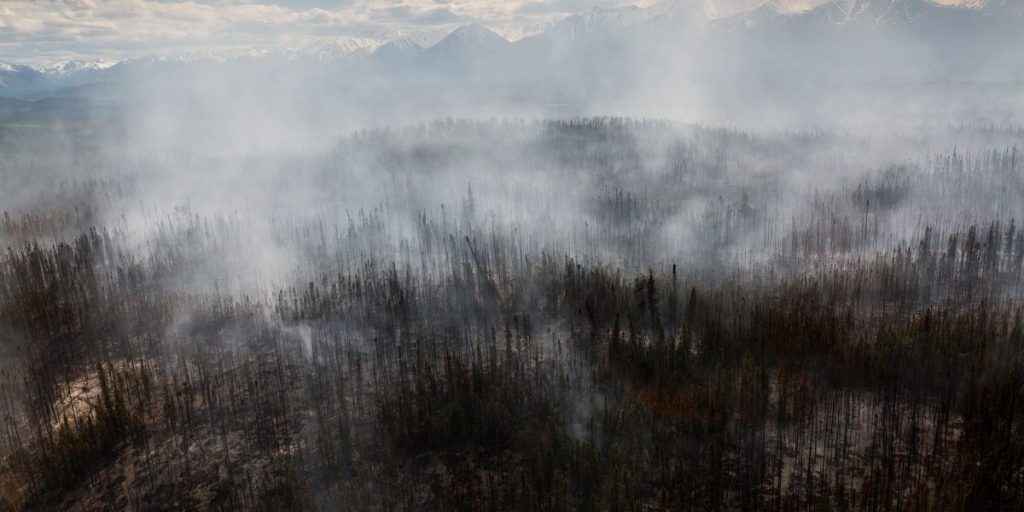
The blaze, possibly sparked by lightning, burned across the dry carpet of feather mosses and lichen before climbing into the crowns. By the time fire agencies responded, flames had reached 12 feet in length and sent up a 500-foot column of smoke.
A few days shy of the five-year anniversary of the Yankovich Road Fire, I followed three members of the Alaska Fire Science Consortium into the boreal forest, walking along cross-country ski trails lined by feathery field horsetail.
In 2024, the organization, which hosts presentations to keep wildfire managers abreast of new developments in fire science, helped turn the area into an educational walking trail, with interpretive signs posted along the route. About a half-mile in, the horizon opened up as we reached a sparse stand of naked, blackened tree trunks, stripped of needles and neighbors.
Hilary Shook, the coordinator of the consortium, stepped off the trail with her thaw probe, a T-shaped pointed metal rod used to detect the upper boundary of the permafrost, the ancient layer of frozen soil that underlies 15% of the land around the Northern Hemisphere and stores roughly twice as much carbon as the atmosphere.
A test of the ground just outside the burn scar hit the concrete-like layer about a foot below the surface. But as Shook applied pressure here, where the fire had burned away the moss and organic-rich topsoil that insulates the permafrost, the probe plunged at least three times deeper into the ground.
“That was an immediate effect of the fire,” said Alison York, the outgoing coordinator of the organization, who was standing nearby. “When we monitored right after, it had already thawed quite a bit.”
This rudimentary tool, offering a measure of depth from a single point in the earth, reveals an escalating problem across the far north. As climate change fuels increasingly frequent and severe fires in the planet’s northern latitudes, they’re accelerating the thawing of more and more permafrost. This allows the organic matter to break down and release powerful greenhouse gases that contribute to a spiraling climate feedback effect, propelling more warming, more fires, and the loss of still more permafrost.
Most dramatically, intensifying wildfires in Canada released more carbon than the nation’s combined fossil fuel emissions in 2023. As in Alaska, many of these megafires occur in vast remote areas where the policy is to let them burn so long as they don’t threaten human habitats. Yet if intensifying fires and warming are left unchecked, the world’s boreal forests and permafrost could increasingly transition from giant carbon sinks into massive sources of atmospheric carbon.
Now, international teams of researchers across the US, Canada, and elsewhere are scrambling to understand what’s at stake, financially as well as ecologically. They’re looking at preventive measures, like controlled burns, and studying the potential to rapidly detect and extinguish wildfires before they grow out of control. They’re even exploring what was once unthinkable: sending in human firefighters not to save lives or structures, but to protect one of our planet’s great stores of carbon.
“We need to figure out a better way to live with wildfire,” says Brendan Rogers, a senior scientist at the Woodwell Climate Research Center, one of the main organizations driving the loosely collaborative research effort. “I do think that it can make a meaningful difference.”
Woodwell, the University of Victoria’s Polis Institute for Ecological Governance, and the nonprofit Alaska Venture Fund are now partnering on a multimillion-dollar initiative known as North Fire to study and raise public awareness about the potential benefits of these interventions, MIT Technology Review can report.
The idea is complicated and controversial for a number of reasons. Wildfire is a natural and necessary component of healthy forest ecosystems. Preventing or suppressing fires across huge stretches of largely unmanaged Arctic-boreal forests and tundra would take vast resources. And it’s not yet clear how much of a difference such interventions would make in emissions.
Ultimately, the mere fact that researchers are considering such extreme interventions into natural systems is a grim reflection of the dangers we’ve placed ourselves in by continuing to generate more and more greenhouse-gas emissions each year. Those threats are forcing us to grapple with increasingly difficult questions that involve ever steeper trade-offs: What’s the best way to spend our finite resources and dwindling time to avoid the worst dangers of climate change? And when, if ever, is it okay to put people in possible danger to reduce broader risks to the world?
Emissions from forest fires have risen 60% around the world since 2001—but they’ve nearly tripled across the boreal forests in the far north.
This stretch of the globe is warming as much as four times faster than the rest of the planet, drying out the landscape. In addition, lightning strikes that set off fires have ticked up sharply as warmer air increases the convective energy in the atmosphere, driving the updrafts that trigger thunderstorms.
In that sense, humans have already interceded in these otherwise natural ecosystems by producing the greenhouse-gas emissions that are increasing temperatures, subjecting forests to fire patterns well outside healthy historic norms.
“To me, that outweighs the existential dread of ‘Should we or should we not intervene?” says Kate Hayes, an assistant professor at Western Washington University, who is working with Woodwell to study the emissions benefits of fire interventions. “We’ve already intervened, arguably. And so from here, it’s a little bit of a Band-Aid on a bullet wound.”
The permafrost that encircles the northern latitudes, underlying large stretches of Canada, Greenland, Siberia, Scandinavia, and other Arctic nations, stores around 1.5 trillion tons of carbon, much of which froze in place millennia ago. The steady global rise in temperature, however, has already shrunk the footprint of Arctic permafrost by about 12 % since 1850, with that loss rapidly accelerating during the last 50 years.
By 2100, fire-driven thawing of permafrost could release about the equivalent of nearly 80 billion tons of carbon dioxide, under high warming scenarios. That’s more than half the emissions that fires will release from the direct combustion of vegetation, according to a January study. And it would be on top of more than 400 billion additional tons that could be released through thawing from general warming over that period.
Despite its growing contributions to climate change, only a minority of the models that have informed the UN’s major climate reports to date include the gradual loss of permafrost through warming temperatures, and none incorporate the abrupt collapse and accelerated thaw that can often occur after fires and heat waves. In light of those phenomena and other powerful and undercounted climate feedback effects, we’re almost certainly underestimating how rapidly the planet will warm up, as scientists warned in a paper earlier this year.
These warming-driven emissions are a “massive blind spot,” says Brian Buma, a senior climate scientist at the Environmental Defense Fund and a coauthor of the paper, who is working to develop tools that could help fire agencies decide which fires to prioritize.
As escalating fire and permafrost emissions become significant additional contributors to climate change, some researchers have begun to explore what it might cost to take on the responsibility of preventing them, in much the way we’ve sought to cut the pollution from power plants, vehicles, and factories.
A 2022 paper in Science Advances, led by researchers at Woodwell and the Union of Concerned Scientists, found that making greater efforts to put out boreal fires could be a cost-effective climate solution—comparable to, or even cheaper than, addressing emissions by building wind turbines, solar farms, or carbon-sucking factories.
Those economic findings were instrumental in getting more researchers to take the idea of tackling fire emissions seriously, says Peter Frumhoff, a coauthor of the 2022 paper and now a senior science policy advisor at Woodwell.
For several years now, Woodwell researchers have been in discussions with forest managers, fire agencies, Indigenous communities, and other groups across Alaska to communicate the potential of this approach.
It hasn’t been an easy sell, given the constrained resources and tightly defined mission of the federal and state agencies responsible for combating fires in Alaska. The general policy there is to allow fires in remote territories to burn unless they present a direct danger to communities.
“Those agencies are tasked with protecting life and property now, and to a lesser extent natural resources,” says Randi Jandt, a fire ecologist at the Alaska Fire Science Consortium. “But they’re not tasked to save the world.”
There was one notable early success, however.
The Yukon Flats National Wildlife Refuge is an 11-million-acre patchwork of wetlands, forests, and bogs. The foothills sit above a particular type of frozen soil known as yedoma. It’s an especially deep, ice-rich, and carbon-dense form of permafrost, composed of massive wedges of silty, wind-blown sediments frozen during the late Pleistocene, which ended about 11,700 years ago. (It also presented ideal conditions for preserving mummified remains of woolly mammoths.)
“It took kind of the last ice age to accumulate,” Hayes says. “So there’s no rapid way to re-accumulate it. We can’t really put it back.”
Members of the Alaska Fire Science Consortium hike into areas affected by fire to measure the layers of ash left in the soil on the forest floor.
In 2019, the region suffered a series of devastating fires that burned some 750,000 acres. After an Alaska Fire Science Consortium meeting at which Woodwell scientists highlighted the possible climate benefits of more aggressive fire suppression, the refuge’s then manager, Jimmy Fox, began exploring the possibility of putting out blazes when they threatened that permafrost, whether or not they threatened human habitations.
The early reaction was not encouraging.
“You’re going to have people jumping out of airplanes with parachutes to save frozen woolly mammoths—and maybe dying from that?” he recalls being asked.
But eventually, he persuaded managers at the US Bureau of Land Management’s Alaska Fire Service to carry out a pilot project on a 1.6-million-acre section of the Yukon Flats. They agreed to try to put out fires there if they had the resources available and believed they could contain a blaze within 72 hours.
Woodwell and its partners agreed to study how that change affected permafrost loss and fire emissions, in the hope of making the case for similar programs elsewhere.
It wasn’t clear the pilot program would survive after Donald Trump was reelected, particularly once the DOGE initiative retroactively cut the public funding for that research collaboration.
But in February, the federal government formally preserved the program and broadened its rationale to include goals like protecting habitat diversity, water quality, and air quality.
One of Woodwell’s main tasks now is determining when and where fire agencies should step in. Crucially, excessive efforts to stamp out fires in the past have allowed the buildup of dry plant material that fuels more severe fires later.
“We’re not going after all fires all the time,” says Rogers over lunch in a sunny courtyard on the Stanford University campus, where Woodwell and EDF hosted a workshop on potential fire interventions in January. “We can’t do that. We don’t want to do that. We shouldn’t do that. So how do we prioritize our resources?”
Woodwell and its collaborators are working to answer that question by developing a map of burn risk and carbon vulnerability across interior Alaska. The plan is to eventually expand it across much of Canada as well.
These maps will highlight the locations of rich reserves of yedoma and other forms of permafrost, forecast where fires are most likely to break out in the next 10 to 15 years, and predict how they’re likely to behave and spread.
“Our ultimate goal is to get a layer that can tell us, if a fire were to occur, what areas are most vulnerable to high carbon emissions, permafrost thaw, permafrost degradation,” Rogers says.
In response to a question about potentially putting firefighters at risk, Rogers stressed in an email that it’s “a very serious issue that needs careful consideration.”
He added that early fire detection technologies, preventative fire stewardship practices, improved fire suppression planning and other measures can all help to reduce dangers to firefighters as well as communities.
Once areas of particular risk are identified, the first option is to take measures to prevent fires there, or at least to reduce the odds that they’ll become major ones. That generally entails using heavy equipment or intentional, controlled fires to clear away vegetation that could fuel new fires, or to create fire breaks that might check their spread.
Indigenous tribes carried out what’s known as cultural burning for thousands of years to reduce fire dangers, clear land for crops, and more. The practice was widely outlawed across North America beginning in the 1800s, though those rules have loosened in recent years.
Both cultural and prescribed fires, however, remain controversial because they can burn out of control. And even if they remain contained, the fires can still produce smoke that wafts into towns.
But rushing around to put out blazes after they’ve started will never get Alaska ahead of its surging wildfire problem, says Edward Alexander, cochair of the Gwich’in Council International, which represents the Indigenous Gwich’in peoples of the Northwest Territories, the Yukon, and Alaska.
“There’s not enough money in the world for this to be a chainsaw-and-ax problem,” he says. “This country is too big up here.”
Alexander, who also serves as senior Arctic lead at Woodwell, argues that Alaska should encourage much greater use of cultural burning to reduce the risk of conflagrations and the emissions that come with them.
“We need mild fire, not wildfire,” he says.
The North Fire initiative will include several additional pilot research projects, including an effort to study the potential for cultural burning to reduce climate and fire dangers near Fort Yukon, Alaska.
The plan is for a wildland firefighting crew operated by the Council of Athabascan Tribal Governments, a consortium in the Yukon Flats region, to carry out cultural burns there next spring, Rogers says.
Researchers at Woodwell and the University of Alaska, Fairbanks, will then collect and analyze data flammability, carbon levels, and permafrost over several years, in the hopes of learning more about what such interventions do.
Similarly, the Polis researchers at the University of Victoria plan to study how adding fuel breaks, by logging or switching to less flammable trees, alters fire risks in British Columbia.
The broad aim of the North Fire initiative is to accelerate research and expand community involvement “in a way that helps us scale this as a meaningful global natural climate solution on a rapid timeline,” says Erin Harrington, a partner at the Alaska Venture Fund, a philanthropy focused on environmental, economic development, and Indigenous issues.
Other observers, including Jandt, believe the bigger opportunity to reduce fire emissions and preserve permafrost may lie in the “initial attack.” That means marshalling planes, tankers, and firefighters to stamp fires out at the first sign of them, before they’ve had the chance to turn into conflagrations.
Once fires reach a certain size, it takes much more time to contain them—and the job becomes far more dangerous.
Accelerating response times is one of the chief promises of the FireSat satellite constellation, which is expected to begin delivering fire data at least twice daily from around the world to Woodwell, a handful of fire agencies, and other early adopters by the end of this year. The system will eventually include more than 50 satellites circling the globe, equipped with high-resolution cameras and thermal sensors that can detect smaller, lower-temperature fires than existing satellite systems, down to as little as five by five meters (16 by 16 feet).
Currently, it can take days to spot fires. But once the full constellation is in place, likely in the early 2030s, FireSat should be capable of detecting and providing updated images of fires anywhere in the world every 20 minutes or less.
The first prototype satellite launched in 2025, and three operational ones went into orbit in July. The Earth Fire Alliance, the nonprofit that manages the constellation, expects to launch four more by the end of next year.
A number of similar systems are also coming online. German-based OroraTech has launched 18 of its fire-detecting satellites in the last year and a half. Similarly, Canadian agencies are planning to launch their own satellite constellation, dubbed WildFireSat, beginning in 2029.
But as these systems produce more and more detections across the globe, it’ll become increasingly essential to build tools that can filter through that information.
EDF is supporting and collaborating on several projects that could potentially help with that, and it ultimately intends to develop an AI-powered triage tool that could help fire agencies prioritize responses as FireSat and other fire-spotting tools come online.
“All of this is kind of like building the data ecosystem around FireSat, so that when they start popping out “fire start here, there, fire start here, fire start there,” we won’t be like, ‘Oh shit, there’s fires everywhere,’” Buma says. “We’ll have a framework. It won’t be perfect, obviously. We’ll have to improve it, but we’ll have the machinery to incorporate those data.”
But faster detections and decisions do only so much. Regions would still need to get firefighting personnel and resources to those fires fast enough to prevent them from burning out of control.
“Say we have the full FireSat constellation up and running, and it spots a fire that just broke out in one of these sort of high-priority, highly vulnerable areas,” I said to Rogers and Frumhoff during our conversation in that Stanford courtyard. “How might we deploy firefighting resources to a remote area fast enough for it to matter in that scenario?”
“I think the answer, unfortunately, is that it depends,” Rogers responded.
Ideally, he said, we would have fire management policies in place that allow for putting out fires with a high risk of producing climate-warming emissions. In addition, regions could install more firefighting personnel and resources across more operational centers, strategically placed in locations that allow them to get to those blazes fast.
Frumhoff stresses that Woodwell isn’t promoting any particular companies but says there are additional technologies “in the mix of conversations” that might help to prevent or rapidly put out fires as well.
Those possible approaches include seeding clouds to suppress lightning strikes and pre-positioning autonomous firefighting helicopters to respond rapidly to high-emissions-risk fires.
Sikorsky, a Lockheed Martin company, is developing and testing autonomous versions of the Black Hawk helicopter, equipped with thermal sensors and water tanks. It is collaborating with Rain Industries, a startup based in Alameda, California, that has developed software to track shifting conditions and steer unpiloted aircraft through the process of putting out wildfires.
The company says it has talked to fire agencies and the “broader Alaska fire community” about the potential use of its technology but declined to name any specific entities it has interacted with.
“The twin climate tipping points of the yedoma permafrost and the boreal forest, and the fact that it’s completely underresourced at the moment, from my perspective does make it an ideal use case for autonomous aircraft,” says Max Brodie, chief executive officer of Rain.
Advancing technologies can only do so much if governments’ fire prevention and suppression policies don’t prioritize preserving carbon.
And that will remain a hard sell given the costs of managing extensive areas of land that nations have historically left largely alone.
The 2022 Science Advances paper estimated that additional fire suppression efforts would cost about $12.63 per metric ton of prevented carbon dioxide emissions—a number that drops when the carbon in permafrost is taken into account, according to upcoming research.
But that would still add up to about $7 billion in additional spending this decade to keep Alaska’s fire emissions at their historical levels, and another $7 billion to $50 billion over the subsequent 30 years as fire severity continues to rise.
Frumoff stresses that those figures just reflect what the researchers found it would cost to preserve the status quo, which is not necessarily what the policy goal would be.
But widening the scope of where we put out fires will inevitably create a big added cost for fire agencies that are already notoriously underfunded in the US. While Alaska produces about half the nation’s wildfire emissions, it receives around 4% of federal firefighting funds.
The US Wildland Fire Service provided a prepared statement in response to an MIT Technology Review inquiry asking whether preserving carbon could or should become a priority in certain fire management decisions. The roundabout reply suggests that this isn’t the agency’s prime concern: “Firefighter and public safety are the top priorities for the U.S. Wildland Fire Service.”
Frumhoff says it’s possible that landowners or government agencies could eventually use carbon markets to defray some of the additional costs. Woodwell has also had multiple conversations with Alaska’s federal legislators about the value of preventing catastrophic wildfires and the need to increase the “total pot” of public funding, he says.
A few days after walking through the fire scar in Fairbanks, I drove slowly along a crumpled stretch of Stampede Road, just north of Denali National Park, where the underlying permafrost had melted without the aid of fire.
I arrived at a cramped wooden cabin to meet with Michelle Mack, a regents professor of ecosystem ecology at Northern Arizona University.
Mack studies how fire is altering ecosystems in the high northern latitudes as the region grows warmer and drier, and she sometimes collaborates with Rogers and other scientists working on the push to protect permafrost in other areas of research. But she’s unsure how much these interventions will accomplish as climate change continues.
“I’m an empiricist, and at this point, it’s not clear to me that the empirical evidence suggests that we can actually have any impact on these fires,” she says.
She expects there will be clear cases where we could and should act fast to put out fires and “keep carbon in the ground.” She points to the example of the 2007 Anaktuvuk River Fire, a massive tundra fire on Alaska’s North Slope that might have been extinguished with relative ease in its early days but was instead allowed to burn until the winter snows put it out nearly three months later. Over that time, it ripped across 400 square miles and, Mack’s research showed, released more than 2 million tons of carbon into the air.
“I feel like that’s the low-hanging fruit, something that doesn’t cost much—and that’s where the technology for detection I think is really important,” she says.
But she adds that fires in boreal forests can rapidly spread in unpredictable ways, frustrating efforts to quickly extinguish them even when they are spotted right away.
In addition, rapidly putting out a fire one season doesn’t necessarily reduce the fire risk for a given forest, so suppression may simply kick the “fire can” down the road—delaying but not preventing an inevitable loss of carbon, Mack says.
Her thinking more recently shifted “a little” after she came across an earlier modeling paper that showed some encouraging findings on the potential of early suppression to reduce the footprint of boreal fires. But she says that prevention through forest thinning, prescribed burns, and the introduction of less flammable deciduous trees to create “living fire breaks” is probably a more promising path than technology-augmented suppression.
“If we could solve this with a techno fix, that’d be great,” she says. “But what if we solved it with nature?”
Rogers, in an emailed response to Mack’s concern, said that the interventions they’re exploring, which do include both prevention and suppression, “can make a real difference.”
“I certainly agree that some fires are much easier to suppress via initial attack than others,” he wrote. “That said, until I see data showing me otherwise, I believe there is strong potential to bend the curve with management.”
EDF’s Buma acknowledges there are a number of unknowns, including how quickly agencies could act on faster detections from satellites—and how big the political obstacles will be to making necessary changes to fire management policies.
“We can’t overpromise what’s possible. We don’t know what’s possible,” he says. “It’s all new. But we’re in a new climate and have to consider trying new things.”
Huge grid-scale batteries are thriving, but smaller residential systems have lagged.
Startup Switch Bioworks hopes to use microbes to reduce demand for chemical fertilizer.
Today’s world is a mess of troubling trends. Some groups are trying to help kids navigate their anxieties about it all.
Discover special offers, top stories, upcoming events, and more.
Thank you for submitting your email!
It looks like something went wrong.
We’re having trouble saving your preferences. Try refreshing this page and updating them one more time. If you continue to get this message, reach out to us at customer-service@technologyreview.com with a list of newsletters you’d like to receive.
© 2026 MIT Technology Review
source
This is a newsfeed from leading technology publications. No additional editorial review has been performed before posting.


