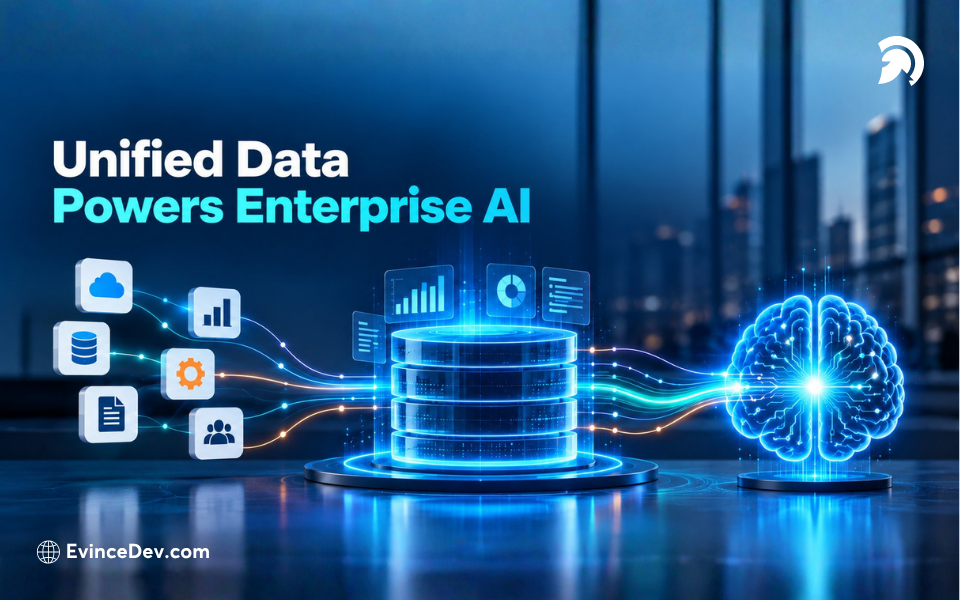
Why Unified Data Architecture Matters for Enterprise AI Adoption – Nasscom
Evince Development Private Limited
The demo goes perfectly. The AI assistant retrieves the right policy, summarizes documents in seconds, and answers every question the leadership team asks. Approval to roll it out across departments comes quickly.
Then it meets real enterprise data. Two systems list different addresses for the same customer. The inventory figure ignores stock already reserved for another order. A sales employee receives an answer built on financial data they were never cleared to see. A policy was updated last month, but the assistant still quotes the old version.
The model hasn’t changed. The data around it has.
Many organizations are now reaching this point. According to McKinsey’s 2026 State of AI survey, 44% of respondents reported that their organizations were scaling AI across the enterprise, compared with 38% a year earlier. As businesses invest in AI development solutions and move them from controlled pilots into everyday workflows, these systems must serve more users, draw on more sources, and meet stricter operational requirements. Weak data foundations become impossible to hide.
Unified Data Architecture closes this gap by establishing consistent ways to connect, understand, protect, and use information across systems. In this blog, we explain what it is, why fragmented data holds back enterprise AI adoption, and the five reasons a unified foundation matters. We also cover how organizations can build one step by step, without overhauling their entire data landscape.
Unified Data Architecture is an approach to organizing data so that applications and teams can use information across different systems under shared standards. It covers how data is collected, connected, described, maintained, and accessed.
Consider a company with customer records in a CRM, invoices in an ERP, contracts in a document repository, and operational reports in spreadsheets. Each system serves a purpose. The challenge appears when a business question requires information from several of them.
A unified approach establishes how those sources work together. Customer identifiers are mapped consistently. Teams agree on what terms such as “active customer” mean. Data owners maintain important records, and access rules follow the information into downstream applications.
Business leaders recognize the importance of this coordination. According to IBM’s 2025 CEO Study, 68% of surveyed CEOs identified an integrated, enterprise-wide data architecture as critical for collaboration across business functions. For AI applications that need information from several departments, this shared foundation helps teams work with consistent business context.
Unification does not require one database or a single vendor. Some information can be consolidated into an analytical platform, while other information stays in its original system and is accessed through approved connections. IBM’s data fabric guidance explicitly considers both data movement and virtual access, depending on workload and latency requirements.
Data silos in enterprises often develop naturally. Departments choose tools for their immediate needs, and acquisitions or legacy applications add further separation. Over time, the same customer, product, or transaction appears in several places with different identifiers and update schedules.
Adding technology does not automatically resolve that fragmentation. According to IBM’s 2025 CEO Study, 50% of surveyed CEOs said the pace of recent technology investments had left their organizations with disconnected, piecemeal systems. Without a coordinated approach to data, new applications can add another layer of separation.
AI applications inherit these gaps unless the business addresses how information is connected, maintained, and interpreted.
A support assistant may see a customer complaint but lack the shipment delay that caused it. A forecasting model may receive sales history without any promotion dates or stockout records. In both cases, the application has information, but the important context is missing. Connecting more relevant sources can help, provided those sources are trustworthy as well as appropriate for the task.
Sales may define revenue using booked orders, while finance uses recognized revenue. An AI assistant asked about growth could return different figures depending on the source it retrieves. The solution requires agreement on business meaning. Connecting systems alone does not resolve conflicting definitions.
Yesterday’s inventory may be suitable for a historical report. It may be unsuitable for promising delivery today. An old policy can remain searchable even after a replacement becomes effective. Freshness requirements must match the workflow, with clear handling when information is too old to use.
When every AI project creates separate connectors, cleaning rules, and permission logic, teams repeat similar work. They also create more components to maintain. Enterprise data integration becomes more valuable when reliable connections and definitions can be reused across several approved use cases.
Enterprise AI succeeds less because of the model a company chooses and more because of the information that model can reach, trust, and use safely. Unified Data Architecture addresses five problems that often keep AI stuck at the pilot stage.
AI can only reason with the information it receives. A customer assistant becomes far more useful when it combines account details, service history, and approved product information. Unified Data Architecture connects these sources under shared definitions, so answers reflect the full business picture rather than one department’s view.
Without a shared foundation, every AI project builds its own connectors, cleaning rules, and permission logic. A unified approach lets teams reuse proven components, such as a maintained customer dataset or document pipeline, across several applications. This reuse allows enterprise AI adoption to spread across departments without costs multiplying with every project.
AI applications often copy and combine information from many systems. If permissions don’t travel with the data, an assistant may reveal information employees could never see in the source application. A unified architecture applies consistent access rules from the original system to the final answer.
When an answer contains a wrong figure, teams need to know which source supplied it, when it was refreshed, and how it was transformed. Shared metadata and lineage make this possible, helping teams separate data problems from retrieval or model problems and fix the real cause.
AI answers lose credibility if they contradict the figures in leadership reports. Established business intelligence solutions help teams agree on reporting definitions and check data quality. When AI draws on the same governed assets, its outputs stay consistent with the metrics the organization already trusts.
An AI-ready data architecture makes information reliable, accessible, and fit for purpose. Yet according to Gartner’s July 2024 survey, 63% of organizations lacked the right data management practices for AI or were unsure whether they had them. Five capabilities make the difference.
A monthly planning model can use scheduled updates; a delivery assistant needs live data. Match freshness to the workflow and define what happens when a connection fails.
Systems must recognize the same customer or product across records. A semantic layer keeps terms like gross sales and recognized revenue from being treated as interchangeable.
Quality checks should fit the task, covering dimensions Microsoft highlights, such as completeness, accuracy, and consistency. Every critical asset needs an owner who resolves issues and approves changes.
Data catalogs help teams find assets and understand their source and restrictions. Lineage shows how data moves and changes, making problems easier to trace.
Data governance for AI must follow information beyond its source system. Access restrictions, permission changes, and deletions need to carry through to search indexes and AI applications, as Microsoft’s guidance on SharePoint-based retrieval illustrates.
Consider an illustrative retail scenario. A customer asks an AI assistant: “Can you deliver twenty units of this product to our office by Friday?” The answer depends on more than a product listing.
Source
Information needed
Customer system
Delivery address and account conditions
Order system
Requested items and existing commitments
Warehouse system
Available and reserved stock
Shipping system
Service coverage and delivery estimates
Without coordinated access, the assistant might retrieve yesterday’s stock report and overlook units reserved for another order. It could also confuse similarly named products or use an outdated address. With a unified approach, the workflow identifies the correct customer and product, checks current availability, and retrieves suitable shipping options. It verifies that the user is authorized to see the information involved.
If a required system is unavailable, the assistant should explain that delivery cannot yet be confirmed and route the request for review. If it can create an order, that action needs separate authorization and validation.
Unified Data Architecture supports the information flow. Business rules determine whether the company can make the commitment. This distinction matters whenever AI moves from answering questions to taking actions.
These concepts address different parts of the data problem and can work together.
A data lakehouse combines flexible data storage with analytics and machine learning management capabilities. It can provide a shared platform for different workloads.
A data fabric connects distributed data environments through capabilities such as integration, metadata, discovery, as well as, governance.
A data mesh emphasizes domain ownership. Business teams maintain data products under shared standards, supported by common platform services.
IBM describes these approaches as having distinct strengths and overlapping capabilities. A lakehouse can participate in a fabric, while a mesh operating model establishes domain responsibility.
Choose an approach based on business needs, existing systems, and team maturity. A smaller organization may need clearer ownership and better integrations before adopting a complex operating model.
Different applications use enterprise information differently. Their data requirements should shape the architecture.
Retrieval-augmented generation, or RAG, retrieves relevant information and supplies it to a language model when generating an answer. It allows an assistant to use company content without retraining the model for every document update.
Documents still need preparation. Text extraction, sensible chunking, metadata, and search relevance influence what the assistant retrieves. Microsoft’s RAG documentation identifies content preparation and query design as key parts of providing useful grounding information.
The workflow also needs a way to refresh changed content, remove withdrawn documents, and show users the supporting sources.
Forecasting requires historical records with consistent definitions and enough context to interpret patterns. Stockouts, promotions, returns, and seasonal changes may affect what sales figures mean.
For predictive analytics solutions, teams should also check whether training data represents the conditions in which predictions will be used. They must avoid including information that would only become available after the predicted event.
An agent may retrieve records, call business APIs, and also request changes. Its architecture must be able to distinguish between reading information from performing a suitable action.
Scalable AI infrastructure therefore needs more than just a model capacity. Reliable integrations, access checks, retries, monitoring, as well as, approval steps help keep the surrounding workflow dependable as usage increases.
Start with just one valuable workflow and then gradually create the touchstone as per the need.
Define a concrete objective, such as reducing the time employees spend finding approved policy answers. Identify users, existing effort, and acceptable error levels before selecting tools.
List the required systems as well as, documents. Determine which sources are authoritative, who maintains them, and also how quickly they are prone to changes.
Record permissions, missing information, conflicting definitions, and also the integration limitations. This assessment often reveals what needs improvement before an AI application can be trusted.
Create the minimum connections, quality rules, and metadata required for the workflow. Use existing capabilities where they meet the need.
Where older systems lack suitable interfaces, custom software development can provide targeted connectors or service layers. The scope should be tied to a business requirement, with maintenance responsibilities established from the start.
Test realistic questions, conflicting records, stale information, denied access, and unavailable systems. Verify that the application responds appropriately when it cannot produce a supported answer.
Include business users in evaluation. Technical success does not necessarily mean the result is understandable or useful in daily work.
Reuse successful components for related workflows. Add sources and capabilities when evidence supports the expansion.
This allows an AI-ready data architecture to grow with business demand while keeping responsibilities clear.
Measure the effect on delivery, reliability, and business work. The number of connected systems alone says little about whether employees benefit.
Measure
What it helps assess
Time to connect a new source
Integration effort for additional use cases
Data freshness and quality
Fitness of information for the intended workflow
Answer accuracy or task success
Reliability under realistic operating conditions
Time to investigate failures
Visibility into sources, pipelines, and application behavior
Usage and workflow completion
Whether employees find the application useful
Cost per completed task
Whether operational benefits justify running costs
Set a baseline and compare results over a defined period. Review different user roles and question types, since averages can hide important failures. Reporting tools and Power BI development can support dashboards for these measures when the underlying telemetry is available.
A strong data foundation solves a lot, but not everything. Think of Unified Data Architecture as the groundwork. The application built on top still needs thoughtful design.
Start with the basics of AI solutions development:
First, pick models and retrieval methods that actually fit the task, not just the most advanced option available.
Second, test the outputs against the real questions/queries your teams might ask almost everyday, instead of some polished demo scenarios.
Third, decide early where a human should review the answer before anyone acts on it, and make sure someone clearly owns monitoring and incident handling when things go wrong.
People matter just as much as technology. Employees need to know what the AI is good at, when an answer deserves a second look, and how to flag a problem. A tool people don’t trust, or don’t know how to use, rarely delivers value, however good the data behind it.
Finally, keep an eye on the costs. Data movement, storage, indexing, model calls, as well as, ongoing maintenance all add up. The good news is that a well-scoped application often doesn’t need an elaborate setup. Starting small and focused can deliver real value with a surprisingly modest architecture.
Enterprise AI becomes more useful when the information is connected, current enough for the task, understandable, and also accessible under appropriate controls. Achieving this requires reliable integration, shared business definitions, as well as, clear accountability for data quality.
Organizations can begin with a priority workflow, identify the information it needs, and strengthen the relevant connections and standards. Results from actual use should guide further investment and expansion.
Unified Data Architecture supports that progression. Infact, its value lies in helping teams use enterprise information consistently, investigate failures, and build AI applications that remain useful beyond the initial demonstration.
Evince Development Private Limited
@Evince Development
EvinceDev is a boutique engineering partner for organizations where delivery certainty matters most. We help founders, CTOs, and enterprises deliver AI-enabled digital transformation and custom software solutions with disciplined execution, clear ownership, and outcomes that hold up in real-world production environments. When systems are business-critical and expectations are high, EvinceDev brings structure, accountability, and calm execution to software delivery.
This content is a community contribution. The views and data expressed are solely those of the author and do not reflect the official position or endorsement of Nasscom.
That the contents of third-party articles/blogs published here on the website, and the interpretation of all information in the article/blogs such as data, maps, numbers, opinions etc. displayed in the article/blogs and views or the opinions expressed within the content are solely of the author's; and do not reflect the opinions and beliefs of Nasscom or its affiliates in any manner. Nasscom does not take any liability w.r.t. content in any manner and will not be liable in any manner whatsoever for any kind of liability arising out of any act, error or omission. The contents of third-party article/blogs published, are provided solely as convenience; and the presence of these articles/blogs should not, under any circumstances, be considered as an endorsement of the contents by Nasscom in any manner; and if you chose to access these articles/blogs , you do so at your own risk.
The 2027 edition will feature over 1,500 exhibitors and is expected to attract nearly a million visitors across two world-class venues in New Delhi: Bharat Mandapam and Yashobhoomi.
Where AI Creates Value in Enterprise Software
How Digital Tools Are Changing Everyday Workforce Coordination
BookMark
Comment
October 15, 2026
October 7, 2026
September 28, 2026
Nasscom Community – A technology knowledge-sharing platform where experts and organizations contribute insights, research and thought leadership to shape emerging trends.
© 2026 Nasscom Community. All rights reserved.
For now on you can edit the blog only once, for more you can contact us at
Only 1 edit allowed, for more you can contact us at
Blog has been submitted for review and it will be live after approval.
Be part of India’s premier tech community
Connect with industry leaders and shape the future of technology
Reset your password to get back into your account and stay part of our growing professional network.
Enter your email to receive a password reset link
Secure, passwordless login for your NASSCOM Community account
No password needed – we’ll email you a one-time code
Enter your email address. We’ll send a one-time password to verify it’s you.
source
This is a newsfeed from leading technology publications. No additional editorial review has been performed before posting.