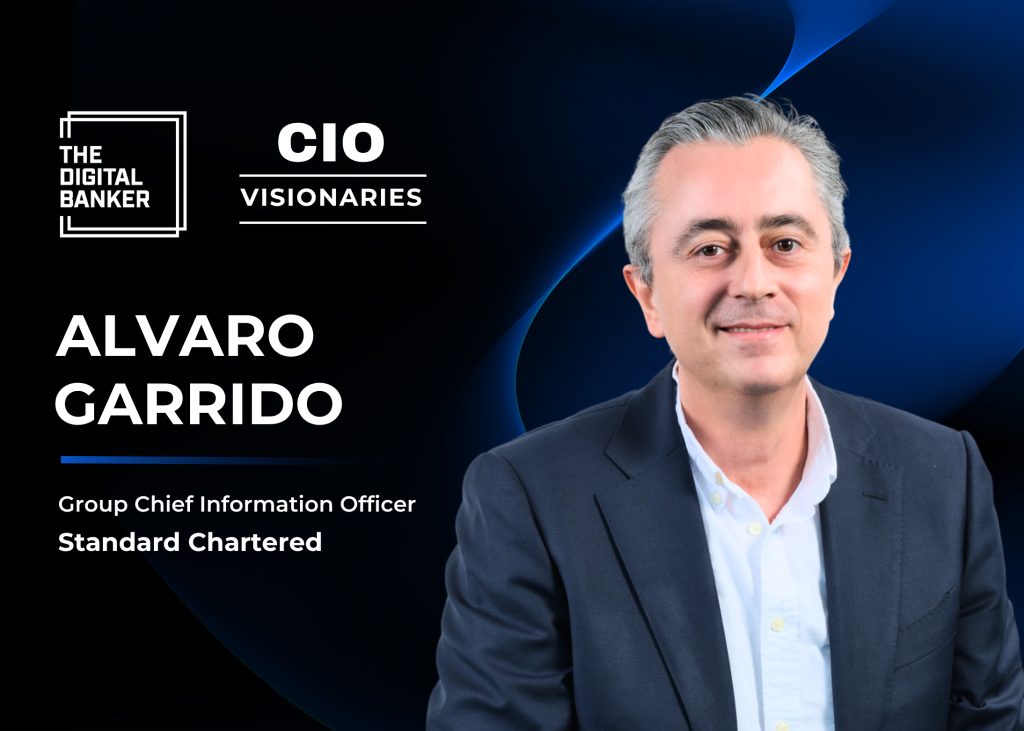
Standard Chartered’s new Group CIO on turning technology transformation into business value – The Digital Banker
For banks, the technology agenda is becoming increasingly inseparable from the business agenda. AI, data and modern engineering are reshaping how financial institutions serve clients and manage risk, while rising cyber threats, regulatory expectations and increasingly complex technology estates are putting greater pressure on banks to move faster without compromising resilience.
Against this backdrop, Standard Chartered is entering the next phase of its technology transformation. Having simplified its organisation and modernised critical platforms, the bank is now focused on turning those foundations into measurable business outcomes – from greater productivity and resilience to better client experiences and faster innovation.
As the Bank’s new Group Chief Information Officer (CIO), Alvaro Garrido will play a central role in that transition. In this interview with The Digital Banker, he discusses his agenda for FY2027, which includes scaling AI beyond experimentation, increasing the use of shared platforms and capabilities, strengthening the technology operating model and ensuring investment is more directly tied to business value. At the same time, the recognises that the Bank will need to develop the skills and culture required to operate effectively in an increasingly AI-enabled environment.
As you take on the Group CIO role at Standard Chartered, what are your immediate priorities for FY2027 and what are the key deliverables to achieve in your initial days?
My priority is to build on the strong foundations already established and accelerate the next phase of our transformation. We have simplified our organisation, modernised critical platforms, and created a more resilient and scalable technology estate. The focus for FY2027 is turning those foundations into greater business outcomes through a technology operating model that is simpler, more connected and faster.
These outcomes are key as Standard Chartered’s latest Future of Trade Report shows that digital tools are increasingly important for managing complexity, with 83% of corporates saying they help them respond faster to supply-chain disruption, while 82% saying improve decision-making through stronger visibility and forecasting across supply-chain and financial flows. The value is increasingly operational as well as technological: digitalisation can improve visibility, connect financial and operational decisions, and help corporates respond faster as external conditions change.
All this points to the need to strengthen technology resilience, improve delivery productivity, and increase the re-use of shared capabilities across markets. A primary focus will also be ensuring that every technology investment is clearly linked to client outcomes, operating leverage and sustainable growth across our global network.
What do you see as the biggest technological opportunities and challenges facing the financial services sector over the next 12 months?
The biggest opportunity is the ability to leverage AI, data and modern engineering platforms to fundamentally change the economics of banking. Institutions that can simplify their technology landscape, connect data and processes, and scale intelligence across the enterprise will deliver better client experiences, faster innovation and stronger productivity.
At the same time, the industry faces significant challenges. Technology estates remain highly complex. Cyber threats continue to evolve – the World Economic Forum’s Cybersecurity Outlook 2026 reveals that AI-powered cybersecurity threats were a grave concern for 94% of respondents. Additionally, expectations around resilience and regulatory compliance are increasing. Therefore, industry leaders will be organisations that can move faster without compromising trust, balancing innovation with resilience and disciplined execution.
AI is rapidly reshaping how banks operate and serve their customers. How do you see Standard Chartered deploying AI at scale across your enterprise in FY2027, particularly around moving from use cases/experimentation to measurable business value?
The industry is moving beyond AI experimentation, and so are we. Our focus in FY2027 is scaling AI as an enterprise capability embedded within our platforms, processes and ways of working. We have already established a common AI platform, data foundation and governance framework that allow us to deploy solutions consistently across markets. The next step is accelerating measurable outcomes through AI-driven productivity, resilience and precision. Success will be defined by tangible business impact: improving client service, accelerating software delivery, increasing straight-through processing, enhancing risk management, and creating capacity for our people to focus on higher-value work.
Beyond these efficiencies, AI can also support both annual revenue growth and reducing annual spend, a sentiment that 89% of respondents to NVIDIA’s State of AI in Financial Services report agree with. AI should improve how the Bank operates and services clients every day, instead of existing as a series of standalone pilots.
How do you see the CIO function evolving in the industry, and what would you like to change or strengthen in the Bank’s technology operating model?
With the advent of technology, our industry is evolving. The World Economic Forum’s Future of Jobs Report reveals that 86% of employers expect AI and information processing technologies to transform their business by 2030.
Similarly, the CIO’s future role is evolving too – from managing technology to shaping how the enterprise creates value. Technology is now central to growth, client experience, risk management, resilience and productivity. As a result, the CIO must be a business leader as much as a technology leader.
At Standard Chartered, my goal is to continue strengthening our technology operating model around simplification, shared platforms and end-to-end accountability. We will standardise wherever scale matters and differentiate where it creates client value. Greater transparency around costs, asset utilisation and value delivery will also help ensure technology investment directly supports our strategic ambition of being a super-connector Bank.
Talent and culture are critical to delivering technology transformation. What capabilities do you think the Bank will need to build or strengthen to execute your FY2027 technology agenda successfully?
The World Economic Forum’s Future of Jobs Report estimates that 39% of workers’ core skills will change by 2030. With that level of change brought about by technology, our own technology transformation ultimately depends on people. As AI becomes more deeply embedded into banking, the most important capability will be the ability to continuously learn, adapt and innovate.
Talent development programmes, such as our dedicated AI Academy and aXess Academy to upskill our technology and engineering workforce, allows us to continue investing in engineering, data, AI, architecture, while strengthening product thinking and business partnership skills. Equally important is creating a culture that embraces continuous improvement and experimentation within clear guardrails.
Our ambition is to evolve towards a skills-based, AI-enabled operating model where people spend less time on routine tasks and more time applying judgement, creativity and expertise. That combination of technology and talent will be a core differentiator for Standard Chartered.
The Digital Banker delivers trusted insights, research, and forecasts for the global financial services sector.
Coeus Intelligence FZE LLC, a company registered in the United Arab Emirates
(License No. 2764), with its registered office at AMC – Boulevard – A Building, Ajman Media City
Personal Data (“Data”) submitted for Media Kit (“Media Kit”), and/or collected in the form of first name, last name, email address and other contact details may be used for the purposes of inviting you to future events and for reaching out to you with content which may be of interest to you. For these purposes, Coeus Intelligence will share the Data with our associate companies (including event and content sponsors) to promote their products and services. If you would like to opt-out, email us at [email protected].
By clicking Submit, you acknowledge that you consent/ have sufficient informed consent to the collection, use and disclosure of Data as set out above.
The information you provide will be held on our database and may be used to keep you informed of our and our associate companies’ products and for selected third party mailings. Please tick the box if you would prefer not to be contacted for these purposes:
The information you provide will be held on our database and may be used to keep you informed of our and our associate companies’ products and for selected third party mailings. Please tick the box if you would prefer not to be contacted for these purposes:
The information you provide will be held on our database and may be used to keep you informed of our and our associate companies’ products and for selected third party mailings. Please tick the box if you would prefer not to be contacted for these purposes:
The information you provide will be held on our database and may be used to keep you informed of our and our associate companies’ products and for selected third party mailings. Please tick the box if you would prefer not to be contacted for these purposes:
The world’s preeminent Private Banks and Wealth Managers are demonstrating a committed drive in innovation, advisory, new products and services to meet the sophisticated needs of their clients.
COVID-19
Amid economic activity revival on the back of the Covid-19 vaccine program, organisations moving from business continuity plans to stable working environments, together with the slightest improvement in unemployment numbers, forced the world to adjust to new realities. Coming to terms with the “new normal”, global investors are now on the look-out for attractive and stable investment opportunities.
Needs of Private Wealth customers and families worldwide have drastically changed due to the pandemic and banks have had to accelerate efforts to deploy a multi-channel service strategy and safeguard clients’ businesses and wealth against negative impacts of economic uncertainly.
The Global Private Banking Innovation Awards will recognise the world’s best private banks, wealth managers and asset managers that are championing innovation across advisory, service, products, customer experience and more.
Lorem ipsum dolor sit amet, consectetur adipiscing elit, sed do eiusmod tempor incididunt ut labore et dolore magna aliqua. Ut enim ad minim veniam, quis nostrud exercitation ullamco laboris nisi ut aliquip ex ea commodo consequat. Duis aute irure dolor in reprehenderit in voluptate velit esse cillum dolore eu fugiat nulla pariatur.
Error: Contact form not found.
source
This is a newsfeed from leading technology publications. No additional editorial review has been performed before posting.