OpenAI Korea Chief: "AI Must Connect to Data and Tools to Work" — Enterprise Adoption Gap Reaches 8.3x – finance.biggo.com
Adopting an artificial intelligence model without connecting it to email or work systems is like hiring a smart employee and giving them no information. Kim Kyung-hoon, OpenAI’s Korea country lead, made this point during his keynote at Samsung SDS’s “REAL Summit 2026” held at COEX Convention Center in Seoul’s Gangnam district on the 8th, identifying the connection of data and work systems as the core condition for enterprise AI adoption.
His argument: providing AI models to employees is not enough — companies must help AI understand their business context and then assign real work before results can materialize. Kim compared the current AI adoption wave to the introduction of electricity in factories roughly a century ago. Early factories swapped steam engines for electric power but kept machine layouts and work sequences unchanged. Only later, when factories installed motors on individual machines and redesigned production flows, did electricity’s productivity benefits truly emerge.
“If you simply bolt AI onto existing workflows, you can achieve small efficiency gains across various tasks, but it’s hard to translate that into enterprise-wide productivity change,” he said. “Companies need to pick their most important work and redesign it from scratch with AI.”
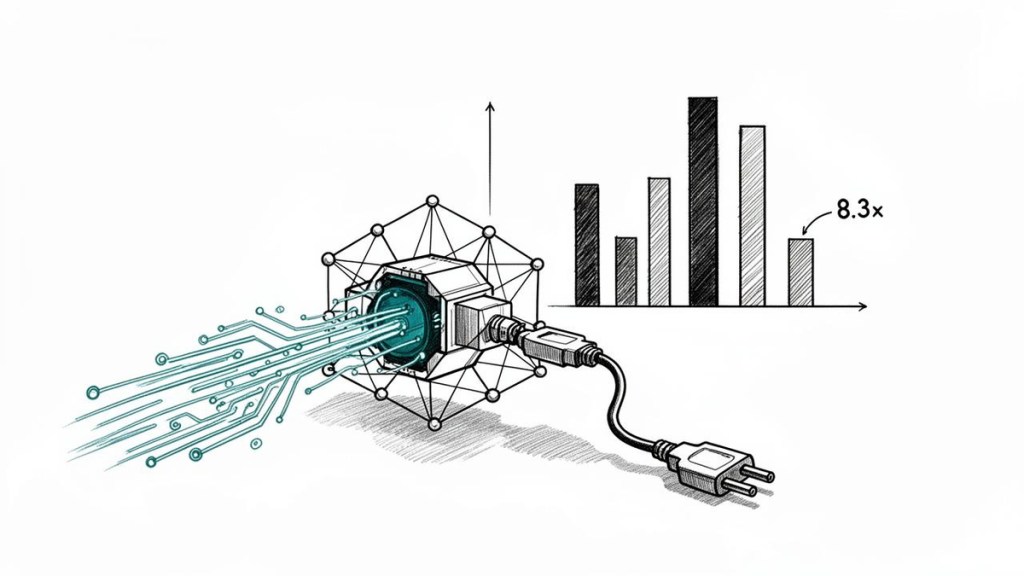
The gap between companies that use AI proficiently and those that don’t is widening. According to an enterprise AI usage analysis OpenAI released in August, as of June this year, the top 10% of companies by AI usage generated 8.3 times more output tokens per active user than median companies. The gap between the two groups widened from 2.6x in January to more than triple in just five months. In manufacturing, the gap was 5.3x.
The disparity also showed up in adoption of features that connect AI to work systems. At top-tier companies, 21% of weekly AI users utilized plugins, compared to just 9% at median companies. Plugins are features that let AI pull in internal documents, customer information, and work tools to complete tasks. Within OpenAI itself, 95% of employees use plugins weekly.
“One of the most important differences is connection,” Kim said. “You need to connect the records your organization shares — internal documents, customer information, work guidelines — so AI can do more work inside the company.”
Enterprise AI usage is shifting from a question-and-answer model to delegating multi-step tasks. As of June this year, Codex — OpenAI’s coding agent — accounted for 64% of all output tokens generated by enterprise customers across ChatGPT and Codex.
Codex usage has also expanded beyond development work. Since February this year, weekly Codex users among enterprise customers grew 108x in legal, 41x in sales, 41x in recruiting, and 26x in marketing. The explanation: AI has begun performing multi-step work spanning research, analysis, document creation, and system verification.
Kim highlighted Cisco as a real-world example. Cisco applied Codex to its large-scale software development environment and raised defect-fix throughput by 10–15x. By analyzing build processes across multiple code repositories, the company also cut build times by about 20% and saved more than 1,500 hours of engineering time per month.
However, even when delegating work to AI, human oversight remains necessary. Kim explained that important tasks should require human approval and that the basis for results must be verifiable. “Just as electricity needs circuit breakers, AI needs safety mechanisms,” he said. “Don’t just look at model fees — measure actual performance including employee time invested and the cost of re-processing incorrect results.”
Cisco, the world’s largest networking equipment maker, recently deployed personalized AI agents to roughly 90,000 employees worldwide. The agent, named “MyAgent,” finished rollout in late August and goes beyond simple chatbot Q&A — it leverages internal information and work tools accessible to each employee to handle everything from research and data analysis to report writing and email management, essentially covering most of a desk worker’s responsibilities.
Mark Patterson, Cisco’s chief financial officer, said “AI agents are already drafting 80–90% of financial disclosure documents.” However, as the scope of AI-assigned work expands too rapidly, side effects are mounting, and some analysts suggest it will take considerable time before AI can replace human employees.
AI agents with access to information, tools, and permissions comparable to human employees produce results on a completely different level from chatbot-era AI. If a company merely issues AI service accounts to employees, a salesperson instructing the AI to “draft a proposal for our partner” must first find and provide materials to help the AI make judgments — customer information, existing proposals, price lists. Once the AI produces a draft, the employee must convert it into a document file, upload it to the internal network, and send the email themselves.
At a company that has adopted AI agents, the human’s only job is issuing the instruction. In that scenario, the agent automatically searches the internal network for transaction history with that partner, recent consultation records, similar proposals, and current pricing, then drafts the proposal.
Attempts to delegate work to AI agents don’t always guarantee good outcomes. Meta is the prime example: earlier this year, the company pursued “Project OT,” a secret plan to reorganize around AI, and reviewed scenarios cutting some teams by up to 60%.
In line with this, Meta cut 10% of its workforce in May and planned to lay off remaining staff in November, but recently scrapped the plan. According to internal Meta documents obtained by Reuters, code changes resulting from AI agent adoption surged 220% year-over-year as of June, but new services or improved features actually delivered to users rose only 36%.
During the same period, major technical and security incidents — including service outages and data leaks — increased 40%, and the time employees spent on incident remediation jumped 70%.
The following table compares key metrics between AI-leading companies and median companies.
Note: As of June 2026, OpenAI enterprise customer analysis report. Token output is interpreted as a metric directly tied to AI productivity.
Security concerns are also emerging. In the chatbot era, if AI produced a wrong answer, there was no problem as long as the employee didn’t use it. In the agent era, AI can make mistakes like unauthorized access to customer information or leaking security files externally. This is why the argument for assigning separate identities to AI agents is gaining traction. The approach: create unique accounts for each agent, designate a human manager responsible for its work, and grant the agent access to only the minimum data needed for its tasks.
Experts particularly advise requiring human approval for high-risk actions such as fund transfers, purchases, file deletion, and external transmission, while logging the AI’s entire work process to enable clear cause identification and accountability in the event of an incident.
An AI industry insider said: “Meta’s case paradoxically demonstrated that the more you increase AI agent utilization, the more skilled humans you need to evaluate the results. It’s not just about deploying agents — you need to calculate per-task processing costs including model fees, track error and security incident counts, and combine that with human employee capabilities to deliver genuinely meaningful outcomes.”
Kim Kyung-hoon concluded: “Connect AI more deeply to your organization’s data and systems, confidently delegate real work, and turn the results into business performance. Just as factory owners a century ago decided what kind of factory to build, now it’s time for companies to decide how they will use AI.”
Once added, BigGo Finance appears first in Google Search Top Stories, so you get the broadest, most up-to-the-minute, and most comprehensive global financial news first.
The news and data on this website are for reference only and do not constitute investment advice or an offer to buy or sell. Information is sourced from exchanges and public sources, and may be delayed, interrupted, or updated. While we strive for accuracy, we do not guarantee timeliness, correctness, or completeness. Content may include external links for which we are not responsible. By using this site, you agree that we and our partners are not liable for any losses. Investment carries full responsibility; please carefully assess risks and consult professionals. If there are errors in the content, please contact us for correction.
source
This is a newsfeed from leading technology publications. No additional editorial review has been performed before posting.