Researchers harness sunlight to generate quantum entanglement – Physics World
Sign into your Physics World account to get access to all available digital issues of the monthly magazine. Your Physics World account is separate to any IOP accounts you may have
Create a Physics World account to get access to all available digital issues of the monthly magazine. Your Physics World account is separate to any IOP accounts you may have.
Note: The verification e-mail to complete your account registration should arrive immediately. However, in some cases it takes longer. Don’t forget to check your spam folder.
If you haven’t received the e-mail in 24 hours, please contact customerservices@ioppublishing.org.
Please enter the e-mail address you used to register to reset your password
Note: The verification e-mail to change your password should arrive immediately. However, in some cases it takes longer. Don’t forget to check your spam folder.
If you haven’t received the e-mail in 24 hours, please contact customerservices@ioppublishing.org
Thank you for registering with Physics World
If you’d like to change your details at any time, please visit My account
As the world of quantum computing grows and researchers work towards scaling up quantum systems, energy consumption is becoming a major concern. Beyond the small scale and high level of control in a laboratory environment, the lasers that power quantum systems result in a large energy cost that may act as a bottleneck for the integration of quantum technology.
Publishing their findings in Optica, researchers have demonstrated that sunlight can be used to generate pairs of entangled photons, providing a more energy efficient alternative to laser-pumped systems. This collaborative project combined theoretical research led by Robert Boyd at the University of Ottawa with technology developed by Hanieh Fattahi’s research group at the Max Plank Institute for the Science of Light in Erlangen, Germany.
Optical quantum computers use pairs of entangled photons as qubits, with the nonlinear optical processes used to produce them typically relying on lasers. This is largely due to two assumptions: firstly, that high optical coherence is required, meaning that the light waves maintain a steady phase relationship; and secondly, that lasers are the only way to achieve the necessary optical power density for these methods.
Sunlight, while naturally abundant, is largely incoherent and is difficult to collect in concentrations comparable to that of lasers. As such, this natural reservoir of optical input has been largely overlooked as a direct resource for nonlinear optical processes.
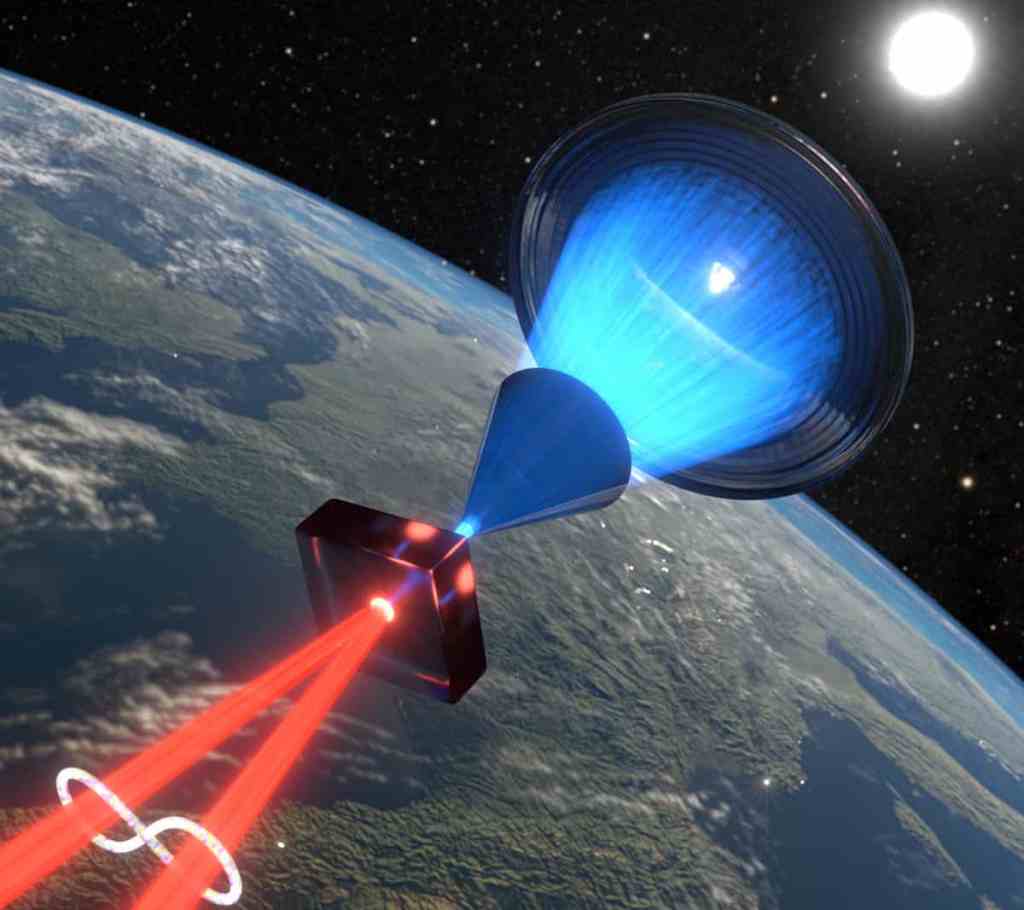
The researchers behind this latest study are challenging these assumptions with a new system that uses sunlight to fuel a process called spontaneous parametric down-conversion (SPDC). In this process, a pump beam – usually a laser but replaced here with solar light – interacts with a nonlinear crystal, splitting individual photons into entangled pairs.
Previous work from Boyd’s team demonstrated that incoherent light from an LED can produce photons with entangled polarization states. By achieving entanglement powered by sunlight, this new research further overturns both assumptions about the necessary properties of the optical input.
To harness the plentiful yet highly dispersed sunlight, Fattahi’s team had to develop a device that focuses sunlight down to a point approximately 2 mm wide, to be coupled to a fibre as thin as a human hair. To achieve this, they used a Fresnel lens and spectral filter to collect sunlight, and a glass cone-shaped concentrator to funnel the light to a point, where it is coupled to the fibre. The fibre then directs the sunlight into the nonlinear crystal to induce SPDC.
Fattahi described the “significant practical challenges” involved with implementing such a system. Along with having to continuously track the Sun, the outdoor nature of the experiment left it vulnerable to both environmental effects and background light. Eventually compensated for by enclosing the system in a tent, the background light was initially offset by students beginning measurements at around 3 a.m. to make the most of the natural darkness.
Overcoming both theoretical and practical concerns, the system was able to successfully produce entangled photons. The states produced violate Bell’s inequality (as the photon correlations cannot be modelled classically) with an S value of 2.54, where S = 2 is the threshold for indication of quantum behaviour, and a 94% fidelity to the target entangled Bell state.
Significantly, when normalized in terms of the spectral bandwidth of the pump, sunlight-powered SPDC demonstrates a photon pair generation rate comparable to that of the laser-pumped process. This method eliminates the need for electrical-to-optical energy conversion, providing a viable path towards increasing energy efficiency.
The development of quantum technology is vital for the future of secure communication, ultraprecise sensing and high-performance computation. Taking steps to develop a sunlight-driven method of photon pair production will potentially allow scaling of this technology without the major energy cost.
Minimizing energy consumption and system complexity would be a huge benefit for systems operating in demanding conditions, such as polar deserts. This research is particularly striking when considering space-based quantum technology. Sun-synchronous orbits could allow near constant access to a naturally occurring, reliable pump-source.
Sunlight can produce correlated pairs of photons
Fattahi and her team intend to develop a field-deployable version of this system, with a focus on greater integration which should “significantly improve mechanical stability, efficiency and overall practicality”. There is also potential to expand the portion of the solar spectrum used in this experiment. Fattahi described the “exciting possibility” of using different spectral regions to drive multichannel entangled-photon generation, increasing efficiency and capacity.
Research into new, energy-efficient photon production has the potential to remove a major barrier for the integration of quantum technologies and contribute to a brighter future for quantum computing.
Note: The verification e-mail to complete your account registration should arrive immediately. However, in some cases it takes longer. Don’t forget to check your spam folder.
If you haven’t received the e-mail in 24 hours, please contact customerservices@ioppublishing.org.
Lauren Matthews is a Production Intern at IOP Publishing
Receive our highlights in optics research, industry news and long reads straight to your inbox, twice a year.
Physics World represents a key part of IOP Publishing’s mission to communicate world-class research and innovation to the widest possible audience. The website forms part of the Physics World portfolio, a collection of online, digital and print information services for the global scientific community.
source
This is a newsfeed from leading technology publications. No additional editorial review has been performed before posting.