DeepSeek Data Center Plan Reveals Its 2026 AI Strategy – Memeburn
DeepSeek data center plans now point to at least 1 GW of capacity in Ulanqab, Inner Mongolia. You can trace the company’s shift from R1’s efficiency narrative to a capital-heavy infrastructure strategy backed by a $7.4 billion funding round and a possible 2028 launch.
Table of Content
Most Read
Sponsored
TL;DR
DeepSeek is planning a gigawatt-scale artificial intelligence data center in Inner Mongolia as the Chinese startup expands beyond efficient model development and commits more capital to physical computing infrastructure.
The company wants to add at least 1 GW of computing capacity in Ulanqab, approximately 350 kilometres northwest of Beijing, according to a Bloomberg report republished by Investing.com.
DeepSeek reportedly plans to build part of the facility itself while leasing additional capacity from existing data center operators. At least part of the new capacity could become operational by the end of 2027 or early 2028.
The processors that will power the project have not been confirmed. DeepSeek could use Nvidia hardware, Huawei processors, its own future chips or a combination of different systems.
The scale of the plan represents a major shift for a company that became famous for reducing the computing costs associated with frontier AI. DeepSeek is now preparing the infrastructure needed to train larger models, serve more users and reduce its dependence on external computing providers.
The move reflects a broader industry trend. As Memeburn previously reported, Big Tech’s AI infrastructure spending is accelerating even as investors question the financial returns.
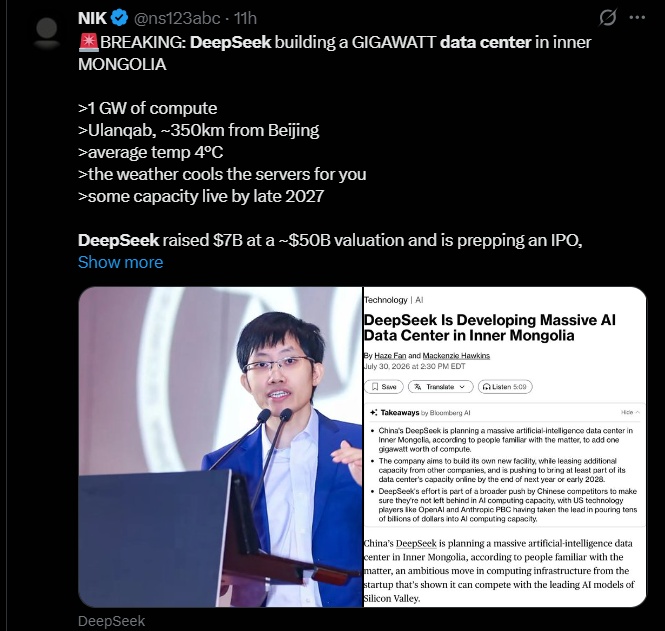

One gigawatt refers to the maximum electrical capacity available to power computing equipment, cooling systems, networking hardware and supporting infrastructure.
A fully developed 1 GW AI campus would belong to a new generation of facilities designed around increasingly dense clusters of advanced processors. The final number of chips will depend on the hardware used, the cooling architecture, power distribution and the proportion of electricity reserved for non-computing operations.
The project should therefore not be interpreted as 1 GW flowing directly into AI chips. Cooling, networking, power conversion and backup systems will consume part of the available electricity.
DeepSeek’s reported strategy also uses a hybrid development model. Building its own facility would give the company greater control over hardware, networking, security and model development. Leasing capacity from existing operators could allow it to access computing resources before the entire campus is complete.
More than a dozen companies have reportedly received approvals for projects in Ulanqab. DeepSeek would therefore enter an established computing cluster rather than develop an isolated data center in a new market.
This matters because the availability of chips is no longer the only constraint on AI expansion. Memeburn’s analysis of Oracle’s data center expansion problems showed how grid connections, transmission lines, permits and construction schedules can delay projects even when companies have enough financing.
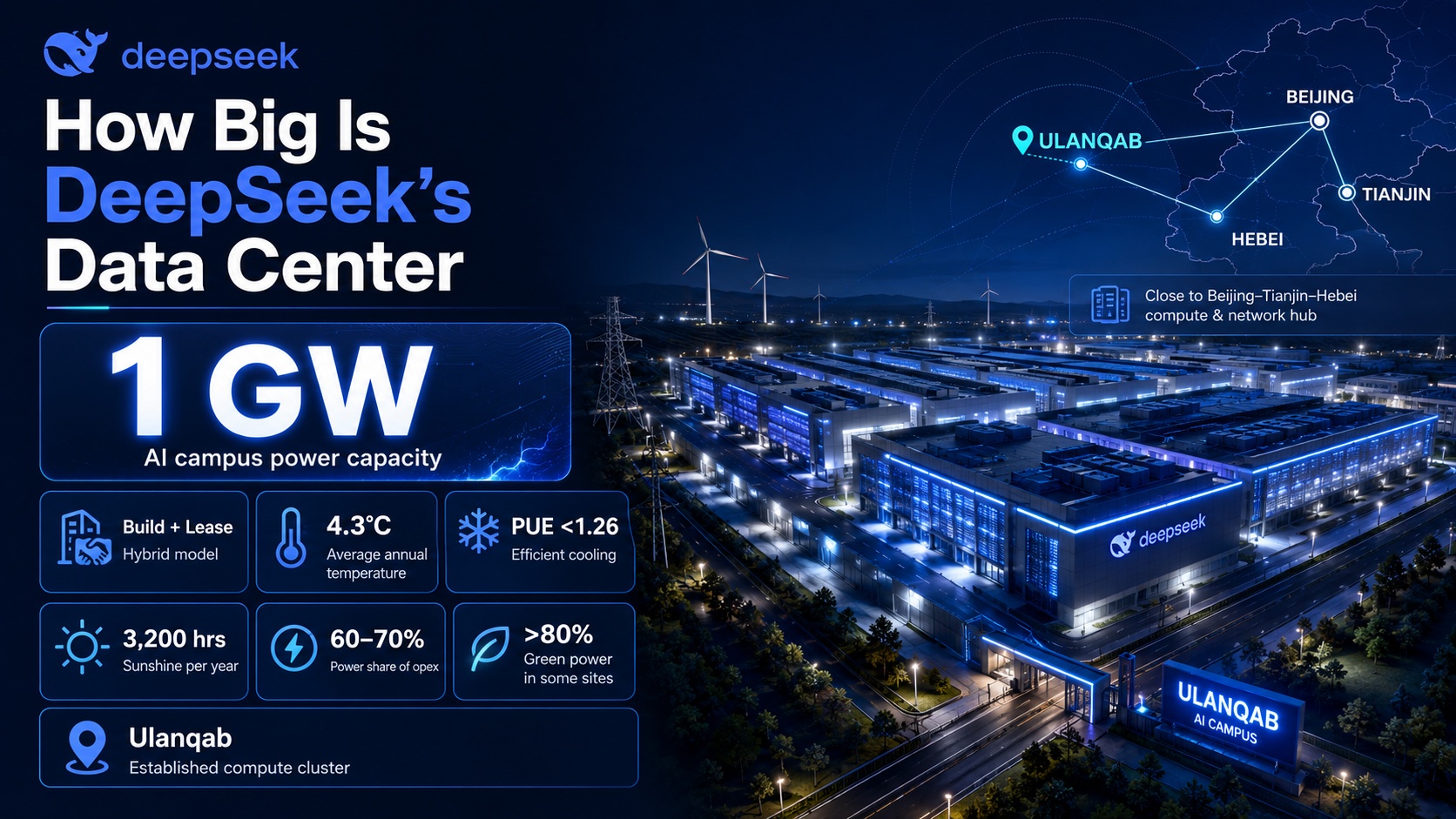

Ulanqab has spent years developing into one of China’s most important computing and data center locations.
The city’s cold climate allows operators to use outside air for cooling during much of the year. This can reduce the amount of electricity consumed by conventional cooling equipment.
China’s Ministry of Industry and Information Technology previously highlighted Huawei’s Ulanqab data center, which can use natural cooling for approximately ten months of the year. The facility reported annual power usage effectiveness of 1.32, with monthly efficiency reaching approximately 1.22 under full natural cooling conditions.
The region also has substantial wind and solar resources. In July 2025, China connected a green-powered computing base in Ulanqab to the grid. The project combines 200 MW of wind power, 100 MW of solar capacity and 45 MW of energy storage.
The facility was designed to generate approximately 848 million kilowatt-hours of green electricity annually and serve a computing base containing 25,000 server cabinets. These projects form part of China’s broader East Data, West Computing policy. The strategy moves computing workloads from densely populated eastern regions toward western and northern areas where land, electricity and renewable energy are more abundant.
Ulanqab remains close enough to Beijing to serve companies operating in the Beijing, Tianjin and Hebei economic region. Apple, Alibaba and Huawei have already developed data center infrastructure in the area.
DeepSeek can therefore access lower cooling costs, large energy resources and established network infrastructure without locating its entire computing operation in a more expensive coastal technology hub.
Power availability may become an increasingly important competitive advantage. Memeburn has also examined how AI data center growth is creating disputes over electricity prices in markets where grid capacity is more limited.
The type of processors used inside the new data center could become the most politically sensitive part of the project.
A senior US official told Reuters in February 2026 that DeepSeek had trained an advanced model using Nvidia Blackwell processors despite US export restrictions.
The official claimed that the Blackwell chips were likely clustered at a data center in Inner Mongolia. DeepSeek has not publicly confirmed how the chips were obtained or whether the allegation is accurate. The claim should therefore be treated as a statement from a US government official rather than an independently verified description of DeepSeek’s infrastructure.
The case intensified concerns that advanced Nvidia chips could reach Chinese AI companies through intermediaries, third countries or data center arrangements outside established export channels.
Memeburn previously covered the political pressure surrounding Nvidia’s China business and US chip export controls. Lawmakers are increasingly asking chipmakers to prove that restricted hardware is not being diverted through distributors or overseas subsidiaries.
The final processor mix for DeepSeek’s Ulanqab facility remains unclear. Nvidia chips continue to set the standard for many frontier AI workloads, while Huawei has become China’s leading domestic alternative. Other Chinese technology companies are also diversifying their supply chains.
ByteDance, for example, has reportedly been buying chips from Chinese Nvidia competitors while developing custom hardware. DeepSeek is taking a similar step. Reuters reported in July 2026 that the company is developing its own inference chip.
An inference chip is designed to run trained models and generate responses for users. It is generally different from the more powerful processors required to train a frontier model from the beginning. DeepSeek could eventually combine its own inference chips with Huawei systems and any legally available Nvidia hardware.
This flexibility matters because a data center may operate for decades, while the processors installed inside it can be replaced every few years. DeepSeek needs an electrical, cooling and networking architecture that remains useful as chip availability, hardware performance and export rules change.
DeepSeek’s infrastructure push follows a major increase in available capital.
Reuters reported in June 2026 that the company was preparing to raise approximately 50 billion yuan, equivalent to around $7.4 billion, from investors including Tencent and battery manufacturer CATL.
The transaction was expected to value DeepSeek at between $52 billion and $59 billion after the investment.
A later Chinese stock exchange filing implied a valuation of approximately $52 billion, providing one of the first public indications of the price used in DeepSeek’s external funding round. The Wall Street Journal subsequently reported that DeepSeek had raised more than $7.4 billion.
The battery manufacturer is expanding beyond electric vehicles into large-scale energy storage systems. These systems can help data centers manage power fluctuations, integrate renewable electricity and provide backup capacity during grid disruptions.
CATL’s investment does not confirm that it will supply batteries or energy infrastructure to DeepSeek’s Ulanqab project.
However, the relationship gives CATL financial exposure to an AI company that could become a major consumer of power storage equipment. It also connects the battery company more directly to China’s expansion of energy-intensive computing infrastructure.
DeepSeek may not immediately need another large capital injection. Reuters reported on July 25 that the company had paused discussions for a second funding round.
The reason for the pause was not disclosed. DeepSeek’s recently completed funding and the size of its infrastructure plans suggest that management may be reassessing its capital requirements before returning to investors.
DeepSeek’s planned facility is large, although it remains smaller than the complete infrastructure programme being developed around OpenAI.
OpenAI, SoftBank, Oracle and MGX announced Stargate in January 2025. The project intends to invest up to $500 billion in US AI infrastructure over four years.
OpenAI later said its partnership with Oracle had brought Stargate to more than 5 GW of capacity under development, representing progress toward a target of 10 GW across several US locations.
The comparison is imperfect because DeepSeek’s 1 GW figure relates to one regional expansion, while Stargate covers a portfolio of facilities.
The broader implication is clearer. Competition between Chinese and American AI companies is moving beyond model benchmarks.
Electricity, land, cooling systems, transmission networks, chip access and financing increasingly determine how quickly an AI company can expand its computing capacity.
Stargate has also shown that announcements do not automatically translate into completed infrastructure. Memeburn’s coverage of Stargate UK’s site and grid questions showed how energy access and due diligence can affect even the largest AI investment plans.
DeepSeek’s infrastructure expansion appears to contradict the narrative that made the company famous.
When R1 gained global attention in January 2025, investors interpreted its efficiency as evidence that AI companies might require fewer chips, data centers and power plants.
Nvidia shares fell nearly 17 percent in one session. Vistra lost 28.3 percent, while Constellation Energy declined 20.8 percent as markets reconsidered forecasts for data center electricity consumption.
Reuters described the event as a global market rout triggered by DeepSeek’s lower-cost AI model.
DeepSeek is now planning infrastructure capable of drawing up to 1 GW of electricity.
The apparent contradiction can be explained through the Jevons paradox. When a technology becomes more efficient and less expensive, total consumption can rise because more people and businesses begin using it.
Cheaper AI inference can support more users, longer context windows, automated agents, software development tools and enterprise applications.
Each individual request may require less computing power, while the combined volume of requests continues to expand.
Efficiency can also allow AI laboratories to reinvest savings into larger experiments. A company that reduces the cost of one training run may conduct more training runs, test more model variations or launch more products.
DeepSeek’s technical reports describe architecture choices such as Mixture-of-Experts and Multi-head Latent Attention, which were designed to improve training and inference efficiency.
According to DeepSeek’s V3 technical report, the model activated only part of its total parameter count for each token and used approximately 2.8 million H800 GPU hours during pre-training.
DeepSeek plans to develop computing capacity in Ulanqab, a city in Inner Mongolia approximately 350 kilometres northwest of Beijing.
The company is targeting at least 1 GW of computing capacity. DeepSeek reportedly plans to combine a company-owned facility with capacity leased from other operators.
Inner Mongolia offers abundant electricity, renewable energy resources, a cold climate that can reduce cooling costs and established data center infrastructure connected to major Chinese technology markets.
DeepSeek raised more than $7.4 billion from investors reportedly including founder Liang Wenfeng, Tencent, CATL, JD.com, NetEase, IDG Capital and China’s state-backed AI investment fund.
DeepSeek is targeting at least 1 GW at its Ulanqab project. Stargate targets 10 GW across multiple US locations, making it a larger programme distributed across several data center campuses.
Marko Nguyen
Marko is a tech journalist covering AI, consumer technology, crypto, and digital innovation. His work focuses on clear, accessible reporting that helps readers understand how new technologies are shaping business, finance, and everyday life.
Read more
© 2026 MemeBurn. All rights reserved.
source
This article was autogenerated from a news feed from CDO TIMES selected high quality news and research sources. There was no editorial review conducted beyond that by CDO TIMES staff. Need help with any of the topics in our articles? Schedule your free CDO TIMES Tech Navigator call today to stay ahead of the curve and gain insider advantages to propel your business!
Table of Content
Most Read
Sponsored
TL;DR
DeepSeek is planning a gigawatt-scale artificial intelligence data center in Inner Mongolia as the Chinese startup expands beyond efficient model development and commits more capital to physical computing infrastructure.
The company wants to add at least 1 GW of computing capacity in Ulanqab, approximately 350 kilometres northwest of Beijing, according to a Bloomberg report republished by Investing.com.
DeepSeek reportedly plans to build part of the facility itself while leasing additional capacity from existing data center operators. At least part of the new capacity could become operational by the end of 2027 or early 2028.
The processors that will power the project have not been confirmed. DeepSeek could use Nvidia hardware, Huawei processors, its own future chips or a combination of different systems.
The scale of the plan represents a major shift for a company that became famous for reducing the computing costs associated with frontier AI. DeepSeek is now preparing the infrastructure needed to train larger models, serve more users and reduce its dependence on external computing providers.
The move reflects a broader industry trend. As Memeburn previously reported, Big Tech’s AI infrastructure spending is accelerating even as investors question the financial returns.
One gigawatt refers to the maximum electrical capacity available to power computing equipment, cooling systems, networking hardware and supporting infrastructure.
A fully developed 1 GW AI campus would belong to a new generation of facilities designed around increasingly dense clusters of advanced processors. The final number of chips will depend on the hardware used, the cooling architecture, power distribution and the proportion of electricity reserved for non-computing operations.
The project should therefore not be interpreted as 1 GW flowing directly into AI chips. Cooling, networking, power conversion and backup systems will consume part of the available electricity.
DeepSeek’s reported strategy also uses a hybrid development model. Building its own facility would give the company greater control over hardware, networking, security and model development. Leasing capacity from existing operators could allow it to access computing resources before the entire campus is complete.
More than a dozen companies have reportedly received approvals for projects in Ulanqab. DeepSeek would therefore enter an established computing cluster rather than develop an isolated data center in a new market.
This matters because the availability of chips is no longer the only constraint on AI expansion. Memeburn’s analysis of Oracle’s data center expansion problems showed how grid connections, transmission lines, permits and construction schedules can delay projects even when companies have enough financing.
Ulanqab has spent years developing into one of China’s most important computing and data center locations.
The city’s cold climate allows operators to use outside air for cooling during much of the year. This can reduce the amount of electricity consumed by conventional cooling equipment.
China’s Ministry of Industry and Information Technology previously highlighted Huawei’s Ulanqab data center, which can use natural cooling for approximately ten months of the year. The facility reported annual power usage effectiveness of 1.32, with monthly efficiency reaching approximately 1.22 under full natural cooling conditions.
The region also has substantial wind and solar resources. In July 2025, China connected a green-powered computing base in Ulanqab to the grid. The project combines 200 MW of wind power, 100 MW of solar capacity and 45 MW of energy storage.
The facility was designed to generate approximately 848 million kilowatt-hours of green electricity annually and serve a computing base containing 25,000 server cabinets. These projects form part of China’s broader East Data, West Computing policy. The strategy moves computing workloads from densely populated eastern regions toward western and northern areas where land, electricity and renewable energy are more abundant.
Ulanqab remains close enough to Beijing to serve companies operating in the Beijing, Tianjin and Hebei economic region. Apple, Alibaba and Huawei have already developed data center infrastructure in the area.
DeepSeek can therefore access lower cooling costs, large energy resources and established network infrastructure without locating its entire computing operation in a more expensive coastal technology hub.
Power availability may become an increasingly important competitive advantage. Memeburn has also examined how AI data center growth is creating disputes over electricity prices in markets where grid capacity is more limited.
The type of processors used inside the new data center could become the most politically sensitive part of the project.
A senior US official told Reuters in February 2026 that DeepSeek had trained an advanced model using Nvidia Blackwell processors despite US export restrictions.
The official claimed that the Blackwell chips were likely clustered at a data center in Inner Mongolia. DeepSeek has not publicly confirmed how the chips were obtained or whether the allegation is accurate. The claim should therefore be treated as a statement from a US government official rather than an independently verified description of DeepSeek’s infrastructure.
The case intensified concerns that advanced Nvidia chips could reach Chinese AI companies through intermediaries, third countries or data center arrangements outside established export channels.
Memeburn previously covered the political pressure surrounding Nvidia’s China business and US chip export controls. Lawmakers are increasingly asking chipmakers to prove that restricted hardware is not being diverted through distributors or overseas subsidiaries.
The final processor mix for DeepSeek’s Ulanqab facility remains unclear. Nvidia chips continue to set the standard for many frontier AI workloads, while Huawei has become China’s leading domestic alternative. Other Chinese technology companies are also diversifying their supply chains.
ByteDance, for example, has reportedly been buying chips from Chinese Nvidia competitors while developing custom hardware. DeepSeek is taking a similar step. Reuters reported in July 2026 that the company is developing its own inference chip.
An inference chip is designed to run trained models and generate responses for users. It is generally different from the more powerful processors required to train a frontier model from the beginning. DeepSeek could eventually combine its own inference chips with Huawei systems and any legally available Nvidia hardware.
This flexibility matters because a data center may operate for decades, while the processors installed inside it can be replaced every few years. DeepSeek needs an electrical, cooling and networking architecture that remains useful as chip availability, hardware performance and export rules change.
DeepSeek’s infrastructure push follows a major increase in available capital.
Reuters reported in June 2026 that the company was preparing to raise approximately 50 billion yuan, equivalent to around $7.4 billion, from investors including Tencent and battery manufacturer CATL.
The transaction was expected to value DeepSeek at between $52 billion and $59 billion after the investment.
A later Chinese stock exchange filing implied a valuation of approximately $52 billion, providing one of the first public indications of the price used in DeepSeek’s external funding round. The Wall Street Journal subsequently reported that DeepSeek had raised more than $7.4 billion.
The battery manufacturer is expanding beyond electric vehicles into large-scale energy storage systems. These systems can help data centers manage power fluctuations, integrate renewable electricity and provide backup capacity during grid disruptions.
CATL’s investment does not confirm that it will supply batteries or energy infrastructure to DeepSeek’s Ulanqab project.
However, the relationship gives CATL financial exposure to an AI company that could become a major consumer of power storage equipment. It also connects the battery company more directly to China’s expansion of energy-intensive computing infrastructure.
DeepSeek may not immediately need another large capital injection. Reuters reported on July 25 that the company had paused discussions for a second funding round.
The reason for the pause was not disclosed. DeepSeek’s recently completed funding and the size of its infrastructure plans suggest that management may be reassessing its capital requirements before returning to investors.
DeepSeek’s planned facility is large, although it remains smaller than the complete infrastructure programme being developed around OpenAI.
OpenAI, SoftBank, Oracle and MGX announced Stargate in January 2025. The project intends to invest up to $500 billion in US AI infrastructure over four years.
OpenAI later said its partnership with Oracle had brought Stargate to more than 5 GW of capacity under development, representing progress toward a target of 10 GW across several US locations.
The comparison is imperfect because DeepSeek’s 1 GW figure relates to one regional expansion, while Stargate covers a portfolio of facilities.
The broader implication is clearer. Competition between Chinese and American AI companies is moving beyond model benchmarks.
Electricity, land, cooling systems, transmission networks, chip access and financing increasingly determine how quickly an AI company can expand its computing capacity.
Stargate has also shown that announcements do not automatically translate into completed infrastructure. Memeburn’s coverage of Stargate UK’s site and grid questions showed how energy access and due diligence can affect even the largest AI investment plans.
DeepSeek’s infrastructure expansion appears to contradict the narrative that made the company famous.
When R1 gained global attention in January 2025, investors interpreted its efficiency as evidence that AI companies might require fewer chips, data centers and power plants.
Nvidia shares fell nearly 17 percent in one session. Vistra lost 28.3 percent, while Constellation Energy declined 20.8 percent as markets reconsidered forecasts for data center electricity consumption.
Reuters described the event as a global market rout triggered by DeepSeek’s lower-cost AI model.
DeepSeek is now planning infrastructure capable of drawing up to 1 GW of electricity.
The apparent contradiction can be explained through the Jevons paradox. When a technology becomes more efficient and less expensive, total consumption can rise because more people and businesses begin using it.
Cheaper AI inference can support more users, longer context windows, automated agents, software development tools and enterprise applications.
Each individual request may require less computing power, while the combined volume of requests continues to expand.
Efficiency can also allow AI laboratories to reinvest savings into larger experiments. A company that reduces the cost of one training run may conduct more training runs, test more model variations or launch more products.
DeepSeek’s technical reports describe architecture choices such as Mixture-of-Experts and Multi-head Latent Attention, which were designed to improve training and inference efficiency.
According to DeepSeek’s V3 technical report, the model activated only part of its total parameter count for each token and used approximately 2.8 million H800 GPU hours during pre-training.
DeepSeek plans to develop computing capacity in Ulanqab, a city in Inner Mongolia approximately 350 kilometres northwest of Beijing.
The company is targeting at least 1 GW of computing capacity. DeepSeek reportedly plans to combine a company-owned facility with capacity leased from other operators.
Inner Mongolia offers abundant electricity, renewable energy resources, a cold climate that can reduce cooling costs and established data center infrastructure connected to major Chinese technology markets.
DeepSeek raised more than $7.4 billion from investors reportedly including founder Liang Wenfeng, Tencent, CATL, JD.com, NetEase, IDG Capital and China’s state-backed AI investment fund.
DeepSeek is targeting at least 1 GW at its Ulanqab project. Stargate targets 10 GW across multiple US locations, making it a larger programme distributed across several data center campuses.
Marko Nguyen
Marko is a tech journalist covering AI, consumer technology, crypto, and digital innovation. His work focuses on clear, accessible reporting that helps readers understand how new technologies are shaping business, finance, and everyday life.
Read more
© 2026 MemeBurn. All rights reserved.
source
This article was autogenerated from a news feed from CDO TIMES selected high quality news and research sources. There was no editorial review conducted beyond that by CDO TIMES staff. Need help with any of the topics in our articles? Schedule your free CDO TIMES Tech Navigator call today to stay ahead of the curve and gain insider advantages to propel your business!