Scientists Are Using Quantum Computing to Find Fusion Fuel – Tomorrow's World Today
Categories
Original Shows
About
Inspiration
Creation
Innovation
Production
Nature Inspires Ideas
Hands Craft Beauty
Inventions, Breakthroughs, and Progress
Scaling Innovations to Serve Many
Categories
Original Shows
About
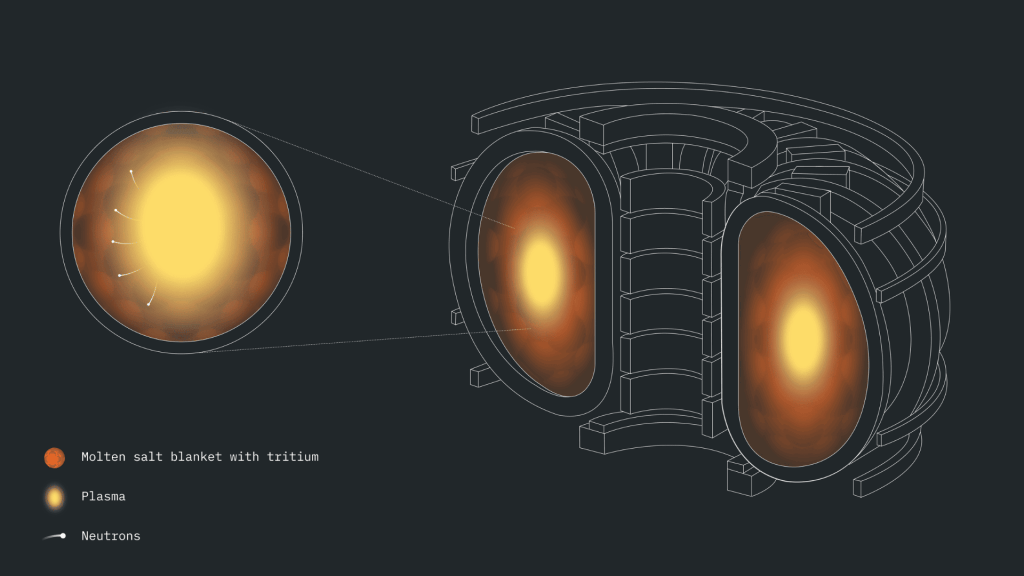
Tritium is key to fueling fusion energy, and quantum computing is helping to secure the material.
Scientists from Oak Ridge National Laboratory, Cleveland Clinic, and IBM used quantum computers to calculate nine molecular setups for a fusion energy fuel material.
Fusion energy needs tritium to work, but tritium is extremely rare. Finding enough is a major barrier for clean fusion plants, making it a key focus of the Department of Energy’s Genesis Mission.
The team studied a liquid salt called FLiBe, which they believe is a top candidate for extracting tritium fuel. FLiBe changes constantly under extreme heat and radiation, making it hard for standard computers to study. The team combined quantum and classical computers to see exactly how the material binds to tritium at a molecular level.
Advertisement
“In order to demonstrate the capabilities catalyzed by the Genesis Mission, we have built a team of leading experts across seven DOE national labs, four universities, three industry partners, and Cleveland Clinic to pursue a multi-pronged discovery cycle aimed at optimizing tritium production in molten salt fusion blanket materials,” Tom Beck, Section Head for Science Engagement at ORNL, explained. “Quantum computers, such as those built by IBM and enhanced by AI and exascale computing, are key tools that accelerate the discovery and design cycles needed to produce sufficient tritium to fuel fusion reactors.”
Kenneth Merz, PhD, staff scientist at Cleveland Clinic, shared why these computing methods matter.
“This work builds on our advances in simulating complex biological systems at scale, including proteins spanning 12,635 atoms and extends those techniques into materials science to explore fusion-relevant systems with greater accuracy and efficiency,” Merz said.
“Bringing quantum, AI, and classical computing together is essential to tackling our society’s most fundamental scientific challenges – unlocking capabilities which none of these paradigms can access alone,” Jerry Chow, CTO of Quantum-Centric Supercomputing at IBM, added. “These results add to mounting evidence that quantum-centric supercomputing is now a practical scientific tool for problems that have long challenged chemists, engineers, and materials scientists. As quantum computers scale, the path ahead is promising.”
Create a free account and get the most out of Tomorrow’s World Today Read Exclusive Stories
 Bookmark & Save Articles For Later
Drop your email below and we’ll send our best stories straight to your inbox every day.
MMXXIII Tomorrows World Today ® | Terms | Privacy |
source
This is a newsfeed from leading technology publications. No additional editorial review has been performed before posting.